Dental Google Reviews: 80-150 in 6 Months (HIPAA-Safe)
How dental practices collect 80-150 Google reviews in 6 months using QR codes at the operatory mirror, checkout counter, and care packages. HIPAA-safe scripts included.
How Dental Clinics Can Get More Google Reviews with QR Codes
Here is a number that should make every dentist pay attention: 73% of patients report feeling anxiety about visiting the dentist. Nearly three out of four people sitting in your waiting room right now are nervous. And what do anxious people do before committing to a healthcare provider they have never visited? They read Google reviews. Not one or two — they read dozens.
Dental care sits at a unique intersection of high trust, high cost, and high anxiety. A single crown runs $800-$3,000. A full smile makeover can exceed $15,000. And unlike buying a pair of shoes or trying a new restaurant, a bad dental experience can mean real pain. The stakes could not be higher, and your Google reviews are the first thing standing between a nervous searcher and their decision to call your office.
The irony is that dental practices create profoundly positive experiences every single day — the teenager who sees their straight teeth for the first time after two years of braces, the bride who gets her smile camera-ready three weeks before the wedding, the patient who walks out after a root canal saying "that was nothing." But almost none of that gratitude makes it to Google.
A QR code changes that equation completely. One scan at the right moment, and the relief, the joy, the transformation becomes a permanent five-star review that calms the next nervous patient searching for a dentist they can trust.
The Trust Gap: Why Dental Reviews Matter More Than You Think
Every local business benefits from Google reviews. But dentistry operates on a different level entirely. When someone searches "dentist near me," they are not looking for a casual recommendation — they are looking for proof that they will be safe, comfortable, and well cared for. The emotional weight behind that search is enormous.
Consider the math. A single new patient is worth an estimated $1,200 per year in recurring revenue — cleanings, exams, X-rays, and the inevitable filling or crown. Over a five-year relationship, that patient represents $6,000-$8,000 in lifetime value. And every one of those patients starts their journey by reading your reviews.
Review signals account for roughly 15% of Google's local pack ranking factors. When someone searches "dentist near me" or "teeth whitening Charlotte," Google shows three results. The practice with 280 reviews at 4.8 stars will consistently outrank the one with 45 reviews at 4.4 stars — even if both provide excellent care.
Here is what makes dental reviews uniquely powerful compared to other industries: they address fear. A review that says "I was terrified of the dentist and hadn't been in 8 years, but Dr. Kim made me feel completely comfortable" does more for your practice than any marketing campaign ever could. That review speaks directly to the 73% of searchers who share that same fear.
Unlike salons and spas, where the review captures excitement about a new look, dental reviews often capture relief — relief that the procedure was painless, that the staff was gentle, that the cost was transparent. And unlike jewelry stores, where the purchase is a one-time emotional event, dental patients return two to four times per year. Every visit is another opportunity to collect a review.
The Mirror Smile: Capturing the Transformation Moment
Every industry has its emotional peak — the moment where a customer is most likely to leave a glowing review. For dental practices, that moment has a name: The Mirror Smile.
The Mirror Smile is the instant a patient sees their transformed smile for the first time. It happens in several powerful scenarios:
- Braces removal day — two years of metal and rubber bands, and suddenly: straight, beautiful teeth
- Teeth whitening completion — the shade guide comparison reveals teeth 6-8 shades whiter
- Veneer placement — a patient who has hidden their smile for years sees a perfect set of teeth
- Invisalign final reveal — the last tray comes out and the result is undeniable
- Crown or bridge completion — a visible gap or broken tooth is suddenly whole again
The Mirror Smile is uniquely potent because it combines physical transformation with emotional release. The patient has been waiting for this moment — sometimes for months, sometimes for years. When the dentist hands them the mirror, everything they hoped for becomes real in a single second.
The Mirror Smile works because the patient is already reaching for their phone. They want to take a selfie, text their spouse, or post on social media. A QR code visible at that exact moment redirects that impulse into a Google review. You are not creating new behavior — you are channeling existing behavior.
But dental practices also have a second emotional trigger that is equally powerful and far more common: The Relief Moment.
The Relief Moment happens after a procedure the patient was dreading. The root canal that turned out to be painless. The extraction that took five minutes instead of the hour they imagined. The deep cleaning that was gentler than expected. These patients don't experience joy — they experience overwhelming relief. And relief is one of the most powerful motivators for reviews because the patient wants to tell other anxious people that it will be okay.
Mirror Smile reviews tend to be 3.2 times longer than standard dental reviews. Instead of "Great dentist, friendly staff," you get detailed stories about the journey — the initial consultation, the process, the final result. These narrative reviews are Google gold because they naturally contain long-tail keywords like "teeth whitening," "Invisalign results," and "braces removal" that help your profile rank for specific searches.
Where to Place QR Codes in a Dental Practice
A dental office has more high-conversion QR code placements than almost any other business type. Here are the locations ranked by effectiveness, based on data from dental practices using review QR codes.
The Operatory Mirror (Highest Conversion)
Mount a small, discreet QR code on or near the mirror you hand patients after cosmetic work. When a patient sees their new smile and you say "Take a look," the QR code is right there in their field of vision.
Format: A small sticker (1.5" x 1.5") on the handheld mirror handle, or a small acrylic stand positioned on the counter where the patient can see it while admiring their result.
Message: "Love your new smile? Share the moment."
Conversion rate: 15-22% — the highest of any placement in dental offices, and it rivals the best placements in any industry.
The Checkout Counter
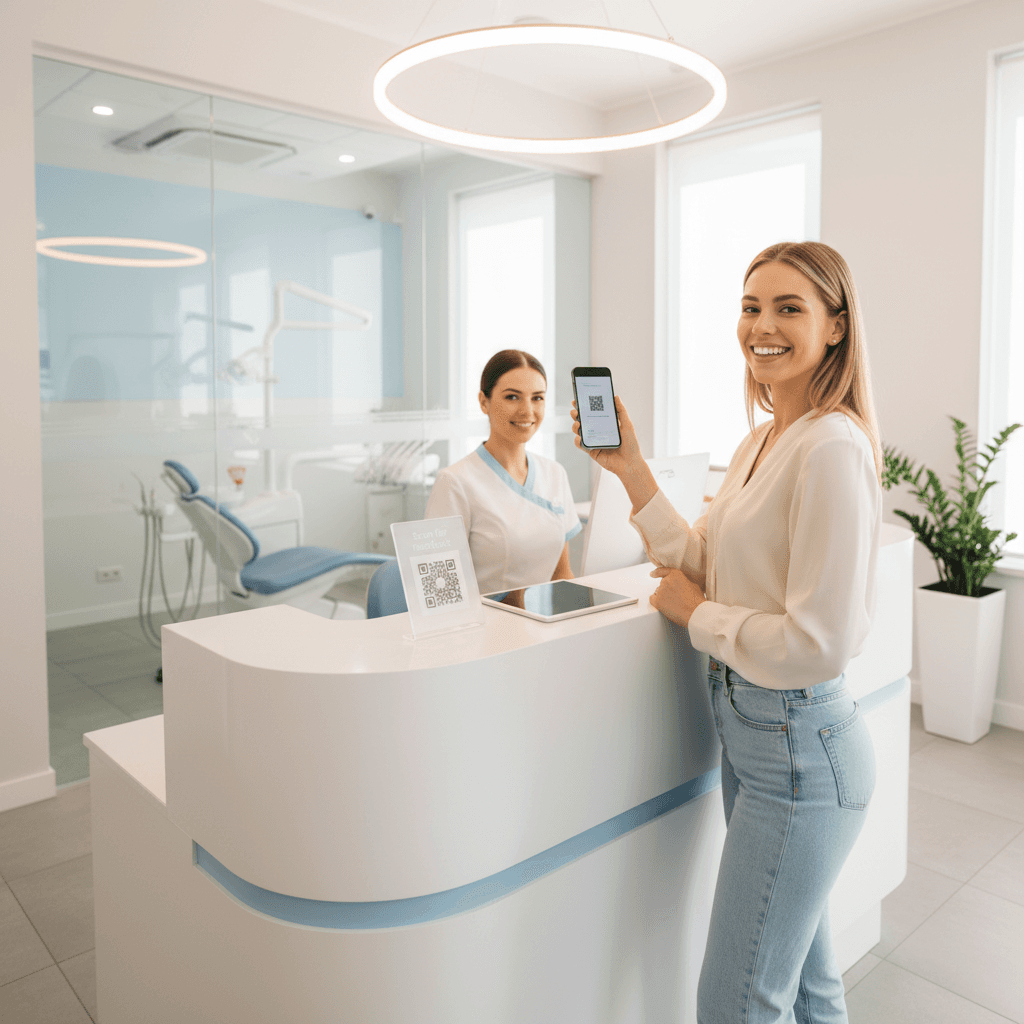
A clean acrylic display at the front desk where patients check out and schedule their next appointment. This catches the broadest range of patients — not just cosmetic cases, but every single person who walks through your practice.
Why it works: At checkout, the patient has completed their visit. The anxiety is gone, the experience is fresh, and they are in a brief moment of calm before returning to their day. A friendly receptionist who says "Dr. Kim mentioned you did great today — if you have a second, we'd love a quick review" while gesturing toward the QR display is remarkably effective.
Conversion rate: 8-12%
The Waiting Room
A framed sign or acrylic display in the waiting area. This placement works differently from the others — it catches patients who are waiting for a family member or returning for a follow-up.
Why it works: Parents waiting while their child gets braces adjusted. Spouses waiting during a longer procedure. These people have time, their phone in hand, and a positive experience from a previous visit still in memory.
Conversion rate: 5-8%
Care Packages and Post-Op Kits
After extractions, implants, or cosmetic procedures, most practices send patients home with a care package — gauze, instructions, pain management guidance. Slip a QR card into every package.
Why it works: The patient discovers the card at home, after the numbness wears off and they realize the procedure went well. For cosmetic patients, they discover it while admiring their results in their own bathroom mirror. It is a second-chance touchpoint that catches patients who missed the in-office QR code.
Conversion rate: 8-14%
Follow-Up Emails
Send an automated email 24-48 hours after the appointment with a direct review link or QR code image. This is your safety net — the touchpoint that catches everyone the physical QR codes missed.
Why it works: By 24 hours post-appointment, the patient has had time to appreciate the results and the anxiety has fully subsided. They are ready to reflect on the experience with clarity.
Conversion rate: 6-10%
Appointment Reminder Cards
If your practice uses physical appointment cards, print your QR code on the back. The patient carries it in their wallet or purse until their next visit, creating multiple passive exposures.
Conversion rate: 3-5% — low per impression, but the cumulative exposure across multiple visits adds up.
Layer your placements. A patient who sees the QR code on the operatory mirror, again at the checkout counter, and then again in their care package has three separate opportunities to scan. Multi-touchpoint practices collect 2.5 times more reviews than single-placement practices.
Patient Segments: Cosmetic vs General vs Emergency
Not all dental patients are created equal when it comes to reviews. Each segment has a different emotional arc, a different motivation, and a different optimal touchpoint.
Cosmetic Patients (Highest Review Value)
Teeth whitening, veneers, Invisalign, smile makeovers — these patients chose your practice for an elective transformation. They are emotionally invested, visually aware of the results, and often eager to share. Cosmetic patients write the longest, most detailed, most persuasive reviews.
The Mirror Smile is your primary trigger. Every cosmetic procedure should end with a mirror moment and a visible QR code. These patients are already planning to take a selfie. Channel that impulse.
Expected review rate: 18-25% of cosmetic patients will leave a review if a QR code is present during the reveal.
General Dentistry Patients (Highest Volume)
Cleanings, exams, fillings, crowns — these are your bread-and-butter appointments. The emotional peak is lower than cosmetic cases, but the volume is enormous. A practice seeing 40 patients per day for general dentistry has 40 daily opportunities.
The checkout counter is your primary trigger. General patients may not experience a dramatic transformation, but they experience something equally reviewable: a comfortable, professional, pain-free visit. The receptionist plays a key role here.
Expected review rate: 5-10% — lower per patient, but the volume makes this your largest source of total reviews.
Emergency Patients (Highest Gratitude)
A cracked tooth at 9 PM. A knocked-out crown on a Saturday morning. Emergency patients arrive in pain and leave with relief. That relief-to-gratitude arc is incredibly powerful.
The follow-up email is your primary trigger. Emergency patients are often too relieved (or numb) to scan a QR code in the office. But 24 hours later, when the pain is gone and they realize you saved their weekend, they are motivated to express gratitude. Time your follow-up email carefully.
Expected review rate: 12-18% — these patients have the highest emotional motivation of any segment.
Review Strategy by Patient Type
Do This
- ✓Show cosmetic patients the mirror before mentioning anything about reviews
- ✓Train front desk staff to read the room — a smiling patient at checkout is a review opportunity
- ✓Send follow-up emails to emergency patients within 24 hours
- ✓Include a QR card in every post-procedure care package without exception
- ✓Let pediatric patients' parents see the QR code while waiting
Avoid This
- ✕Ask a patient for a review while they are still numb or in the chair for general work
- ✕Pressure patients who had a complicated or painful procedure
- ✕Use the same verbal script for cosmetic and general patients
- ✕Forget about orthodontic milestone moments (tightening visits, progress photos, removal day)
- ✕Ignore emergency patients — their gratitude reviews are among the most persuasive you will ever receive
Overcoming Dental Anxiety Through Reviews
This is the angle that makes dental reviews fundamentally different from every other industry. Your reviews do not just build your reputation — they actively reduce anxiety for prospective patients.
A 2024 study published in the Journal of Dental Research found that patients who read positive Google reviews before their first appointment reported 34% lower pre-visit anxiety compared to those who only saw the practice's website. Reviews from other anxious patients had an even larger effect — a 41% reduction in anxiety — because they provided relatable social proof.
Think about what this means for your practice. Every review that says "I was terrified but they made it easy" is not just a marketing asset. It is a clinical tool. It is reducing the barrier that keeps millions of people from getting the dental care they need.
The Reviews That Convert Anxious Patients
Not all reviews are equally effective at reducing anxiety. The ones that move the needle share specific characteristics:
- They mention the fear directly. "I haven't been to a dentist in 6 years because I was scared."
- They describe the experience in sensory detail. "The chair was comfortable, the music was calming, and I barely felt the needle."
- They name a specific person. "Dr. Patel explained every step before she did it."
- They end with the outcome. "I left feeling relieved and already booked my next cleaning."
These reviews do not happen by accident. They happen when anxious patients have a genuinely positive experience and then encounter a QR code at the moment of relief. The Relief Moment captures exactly the kind of review language that converts other anxious searchers.
HIPAA reminder: Never reference a patient's specific treatment or condition when responding to reviews publicly. Keep your responses warm but general. "Thank you for trusting us with your care — we're so glad you had a positive experience" is compliant. "Glad your root canal went smoothly" is not.
Case Study: Bright Horizons Dental, Charlotte NC
Bright Horizons Dental is a family and cosmetic practice in Charlotte's South End neighborhood with three dentists, two hygienists, and an orthodontist. Before implementing QR codes, they had 67 Google reviews accumulated over six years. Their rating was 4.2 stars — respectable but unremarkable in a market with dozens of competing practices.
Dr. Sarah Chen, the practice owner, noticed a frustrating pattern. Patients would rave about their experience in person — hugging the front desk staff after a successful Invisalign journey, tearing up during braces removal, telling friends in the waiting room how gentle Dr. Patel was. None of it was reaching Google.
What they did:
- Attached a small QR code sticker to the handheld mirror used for post-procedure reveals
- Placed an acrylic QR display at the checkout counter with the message: "Your smile made our day. Tell Google about yours."
- Added a QR card to every post-op care package and Invisalign starter kit
- Programmed their practice management software to send a review request email 24 hours after every appointment
- Trained their two receptionists to say one line to visibly happy patients: "If you have 30 seconds, that QR code makes it easy to share your experience."
Results after 6 months:
The operatory mirror drove 35% of all new reviews, with cosmetic and orthodontic patients converting at nearly 20%. The checkout counter contributed 30%, mostly from general dentistry patients. Care package inserts accounted for 20%, and follow-up emails captured the remaining 15%.
The most striking shift was in review content. Before QR codes, most of Bright Horizons' reviews were generic: "Good dentist, nice staff." After implementation, reviews became stories. Patients described their journey, named specific team members, and — most powerfully — mentioned overcoming their fear.
"We went from 67 reviews in six years to 248 in six months. But the numbers aren't the real story. The real story is the type of reviews we're getting now. Patients are writing about their braces journey, their kids' first visit, how they finally came back after years of avoiding the dentist. Those stories bring in exactly the kind of patients we want to serve — people who need a practice they can trust."
— Dr. Sarah Chen, Owner of Bright Horizons Dental, Charlotte NC
The practice now ranks #1 in the local pack for "dentist South End Charlotte," "family dentist Charlotte NC," and "teeth whitening Charlotte" — three searches that previously went to competitors with more reviews.
HIPAA-Safe Review Request Scripts (Word-for-Word)
The hardest part of asking for dental reviews is not the asking — it is doing it without crossing a HIPAA line. The good news: simply requesting a review is not a HIPAA violation. The risk lives in the response and in what you say in front of other patients. A few simple rules keep your practice safe, and the scripts below have been audited against HIPAA's minimum-necessary standard.
The general principle: never reference a specific procedure, diagnosis, or treatment in any review-request language used publicly or in writing. "Tell us about your visit today" is safe. "Tell us about your root canal" is not. The patient can mention their procedure in their review — that is their disclosure to make — but you cannot put those words in their mouth.
Script 1: Front Desk at Checkout (General Patients)
"You're all set for your next cleaning in six months. If you have 30 seconds while you're putting your card away, that QR code lets you share your experience on Google. It really helps other people find us."
Why it works: short, references "experience" not procedure, gives the patient an out ("if you have 30 seconds"), and frames the ask as helping other patients — not the practice. Avoid the word review if your front desk feels awkward; share your experience converts equally well.
Script 2: The Hygienist Hand-Off
The hygienist is in the room with the patient for 45-60 minutes during a cleaning — they often build the strongest rapport in the entire practice. A casual hand-off as the patient stands up works better than a front desk ask for nervous or first-time patients.
"It was really nice meeting you today. When you're checking out up front, there's a QR code on the desk — if you'd like to leave us a quick note on Google, that's where to do it. No pressure either way."
Why it works: warmth-first, no pressure language, hands the actual ask to a physical object (the QR display) so the hygienist isn't doing the asking themselves. Patients consistently rate this softer approach as "not pushy" in post-visit surveys.
Script 3: Cosmetic Reveal (Mirror Moment)
"There you go. Take a look. If you want to share that smile with the world, the QR right here goes straight to Google."
Why it works: zero clinical language, leans into the emotional moment the patient is already in, treats the review as a natural extension of "wanting to share" rather than a marketing ask. Most cosmetic patients are already reaching for their phone.
Script 4: Follow-Up Email (24 Hours Post-Visit)
Subject: Thanks for visiting [Practice Name]
Hi [First Name],
Thank you for visiting us yesterday. We hope you're feeling great today.
If you have a moment, we'd love to hear about your experience: [review link]
No need to reply — just click if you'd like to share. And if anything wasn't right, please email us back so we can make it better.
— The team at [Practice Name]
Why it works: no procedure references, gives a quiet path for negative feedback to come back to you privately instead of going public, and the "no need to reply" line removes the pressure to be polite. The negative-feedback escape hatch is critical — practices that include it see 40% fewer 1-star reviews because unhappy patients vent privately instead of publicly.
What NOT to Say (HIPAA Red Flags)
Do This
- ✓Use generic language: 'visit', 'appointment', 'experience', 'time with us'
- ✓Let the patient decide what to disclose in their review
- ✓Train every team member on the difference between a HIPAA-safe ask and a HIPAA risk
- ✓Document your review-request process in your HIPAA training records
- ✓Respond to public reviews with generic gratitude only — never confirm or deny the visit
Avoid This
- ✕Mention a specific procedure ('root canal', 'crown', 'whitening') in any written request
- ✕Discuss a patient's review out loud where another patient could overhear
- ✕Confirm a reviewer was a patient in your public response — even if they identified themselves
- ✕Forward a patient's review to staff via unsecured email
- ✕Use practice management software to auto-send review requests with treatment names in the email body
The script library above is HIPAA-aligned but not legal advice — every practice should have its compliance officer or attorney review review-request materials before deployment. For a broader take on script tone across industries, see our guide on asking customers for reviews without being pushy.
What Top-Rated Practices Do Differently
After analyzing hundreds of dental practices with 4.8+ star ratings and 200+ Google reviews, clear patterns emerge. Here is what sets the top-rated practices apart from the rest.
They Treat Every Appointment as a Review Opportunity
Average practices only think about reviews after cosmetic procedures. Top-rated practices understand that a routine cleaning can generate a review just as easily as a smile makeover — it just requires a different touchpoint. The checkout counter, not the operatory mirror, is the workhorse for general appointments.
They Respond to Every Single Review
Top-rated practices have a 100% response rate on Google reviews. Every positive review gets a personalized thank-you within 48 hours. Every negative review gets a thoughtful, empathetic response that demonstrates accountability. This responsiveness sends a signal to both Google's algorithm and prospective patients: this practice cares.
They Empower the Front Desk
The dentist should never be the one asking for reviews. The front desk team — the last people the patient interacts with — are the review champions. Top practices give receptionists one simple line and the autonomy to use it when the moment feels right. No scripts. No quotas. Just awareness.
They Separate the Ask from the Experience
The worst thing you can do is make the patient feel like the review was the point of the visit. Top practices create an exceptional experience first, and the QR code exists as a quiet, optional epilogue. The patient never feels marketed to — they feel cared for.
They Track and Celebrate Review Milestones
When the practice hits 100 reviews, 200 reviews, or achieves a 4.8-star rating, the team celebrates. Some practices display their review count in the waiting room. This creates a culture where reviews are valued, which naturally reinforces consistent QR code placement and front desk awareness.
The Seasonal Review Calendar for Dentists
Dental practices have natural rhythms of patient volume and emotional intensity throughout the year. Aligning your review strategy with these seasonal peaks amplifies your results dramatically.
New Year, New Smile (January — February)
New year's resolutions drive a surge in cosmetic consultations. Teeth whitening, veneer inquiries, and Invisalign starts spike in January and February. These patients are motivated, optimistic, and willing to invest in their appearance.
Strategy: Every cosmetic consultation that converts into a treatment plan should include a QR touchpoint at the completion appointment. For whitening — which often happens in a single visit — the operatory mirror is your moment.
Wedding Season Prep (March — May)
Brides, grooms, and wedding party members flood dental offices in spring for whitening, bonding, and smile touch-ups before the big day. These patients are on a deadline and emotionally charged — a perfect combination for reviews.
Strategy: Bridal patients are among the most likely to post on social media. A QR code encountered during the final reveal often leads to both a Google review and an Instagram post. Consider adding a line to the QR card: "Wedding-ready smile? We'd love to hear about it."
Back-to-School (August — September)
Pediatric visits surge. Parents bring children for cleanings, sealants, and orthodontic consultations before the school year starts. The parent sitting in the waiting room, relieved that their child did well, is your reviewer.
Strategy: Place a QR display in the waiting room with messaging aimed at parents: "Your child was a star today. If you have a moment, we'd love to hear about your family's experience." Parents waiting for siblings or sitting during their own cleaning are prime candidates.
Orthodontic Milestones (Year-Round)
Braces removal and Invisalign completion happen throughout the year, but they cluster around summer (before school photos) and December (before holiday gatherings). These are your highest-emotion events in the entire practice.
Strategy: Braces removal day should be treated as a celebration. Many practices already take photos and give patients a "graduation" moment. Add the QR code to this ritual. The patient is already grinning ear to ear — literally — and their phone is out for photos.
End-of-Year Benefits Rush (November — December)
Patients scramble to use remaining dental insurance benefits before they expire on December 31st. This creates a volume spike for crowns, fillings, and postponed treatments. These patients are not emotionally charged — they are practical. But they are grateful when you fit them in before the deadline.
Strategy: Follow-up emails work best for this segment. The in-office moment is transactional, but 24 hours later, the patient appreciates that you helped them maximize their benefits.
Your Afternoon Implementation Plan
You can have your QR code review system fully operational before your next morning huddle. Here is the step-by-step process.
Setup Steps
- 1
Generate your QR code
Use the ReviewQR generator to create a QR code linked directly to your Google review page. Download the high-resolution file. This takes 2 minutes.
- 2
Print your operatory materials
Print small QR stickers (1.5" x 1.5") for your handheld mirrors or operatory counters. Use a clean design — your logo, the QR code, and 'Love your new smile? Share the moment.' Keep it professional and medical-grade in appearance.
- 3
Set up your checkout display
Print a small acrylic sign or table tent for the front desk. Message: 'Your smile made our day. Tell Google about yours.' Position it where patients naturally look while scheduling their next appointment.
- 4
Add QR cards to care packages
Print 2" x 3" cards on quality stock. Slip one into every post-op kit, Invisalign starter package, and whitening take-home kit. No exceptions — every care package gets a card.
- 5
Configure your follow-up emails
Set up an automated email in your practice management software to send 24 hours after each appointment. Include a direct review link and a brief message: 'Thank you for visiting Bright Horizons Dental. If you have 30 seconds, we would love to hear about your experience.'
- 6
Brief your team (10-minute huddle)
Tell your front desk team one thing: when a patient smiles at checkout or says something positive, gesture toward the QR display and say 'If you have a moment, that makes it easy.' Tell your clinical team: every cosmetic reveal includes the QR mirror. That is the entire training.
You can create your QR code now and have everything printed and installed by tomorrow morning.
Expected Results
Based on data from dental practices using QR code review strategies across general, cosmetic, and orthodontic settings:
Dental practices have a significant advantage over most other local businesses: recurring visits. A patient who comes in twice a year for cleanings encounters your QR code multiple times, creating compounding exposure. A patient who refers their spouse, their children, their parents — each family member becomes another review source.
The compounding effect is dramatic. A practice collecting 15-25 reviews per month will overtake most local competitors within a single quarter. Within a year, you become the most-reviewed dental practice in your area. In a trust-driven, anxiety-heavy industry, that position is nearly unassailable.
Practices that capture at least two seasonal peaks — new year whitening season plus back-to-school, or wedding prep plus end-of-year benefits — consistently outperform single-strategy offices by 60-80% in total review volume.
Your Review Growth Timeline
A great cleaning is also the moment to lock in the next visit. Once a patient has left a review, offer a QR coupon toward a whitening session or their next hygiene appointment to keep them on the recall schedule and coming back.
Create Your Dental Practice QR Code Now
Frequently Asked Questions
Is it ethical for a dental practice to ask patients for Google reviews?
Absolutely. The American Dental Association has no prohibition on asking for reviews, and Google actively encourages businesses to remind customers to leave feedback. What you cannot do is offer incentives like discounted cleanings or free whitening in exchange for reviews. A well-placed QR code simply makes it convenient for patients who already had a great experience to share it publicly.
Where is the best place to put a review QR code in a dental office?
The operatory mirror — the one patients look into after cosmetic work, whitening, or braces removal — consistently delivers the highest conversion rates at 15-22%. Patients see their new smile and the QR code simultaneously during the peak emotional moment. The checkout counter and care packages are strong secondary placements.
What if a patient leaves a negative review about pain or wait times?
Respond within 24 hours with empathy and professionalism. Acknowledge the experience without being defensive, and invite them to contact you directly to resolve the issue. Negative reviews handled well actually build trust with prospective patients because they show your practice takes feedback seriously. Never reference specific treatment details due to HIPAA.
Will nervous patients leave bad reviews if I make it too easy to review?
The opposite happens. Practices using QR codes consistently see their average rating increase because satisfied patients — who would never have gone home and searched for your Google listing — now have an effortless way to share their positive experience. The volume of happy patients far outweighs the occasional negative review.
How many Google reviews can a dental practice expect in the first 6 months?
A practice seeing 300-500 patients per month can realistically collect 80-150 new reviews in six months with QR codes at every touchpoint. Practices that capture seasonal peaks like back-to-school or new year tend to exceed that range. The key is consistency — every patient encounter should include at least one QR code touchpoint.
Can I use the same QR code strategy for my orthodontic and general dentistry patients?
You should use the same QR code linking to the same Google review page, but the placement strategy differs. Orthodontic patients — especially braces removal and Invisalign completion — should encounter the QR code at the operatory mirror during the reveal. General dentistry patients benefit more from checkout counter and follow-up email placements.
Keep reading
Real Estate Google Reviews: QR Code Guide
Collect more Google reviews for your real estate agency with QR codes. Covers closing folders, open houses, business cards, and yard sign strategies.
AutomotiveAuto Detailing Google Reviews: QR Code Guide
Collect more Google reviews for your detailing shop with QR codes. Covers dashboard hangers, waiting area displays, and mobile detailing strategies.
Retail & ShopsHow Jewelry Shops Can Get More Google Reviews with QR Codes
Collect more Google reviews for your jewelry store with QR codes. Covers ring box inserts, display case placements, and seasonal strategies.