QR Code Coupons for Coffee Shops: Turn Visits Into Regulars
How small coffee shops use a single-use 10% off next visit QR coupon to bring first-time customers back for the second cup and build a regular base.
QR Code Coupons for Coffee Shops: Turn Visits Into Regulars
Turn one visit into many
Hand out single-use QR coupons that pull customers back through your door. Part of your Customer Comeback System. 14-day free trial, cancel anytime.
Create a couponIt's a Tuesday morning at 8:14 a.m. A first-time customer walks into your café, orders a flat white to go, pays, smiles, leaves. You'll probably never see them again. Not because they didn't like the coffee — they did. Not because the price was wrong — it wasn't. They'll never come back because tomorrow morning at 8:14, they'll be standing somewhere else in front of a chrome espresso machine, ordering exactly the same drink from someone whose face they also won't remember.
Coffee, more than almost any other small-business product, lives or dies on the second visit. The first cup tells the customer the espresso isn't bitter. The second cup tells them you're their café. There is a tiny, fragile window between those two visits — usually 24 to 72 hours — and most independent coffee shops do nothing inside it.
This is a playbook for closing that window with a single tool: a single-use QR code coupon offering 10% off the next visit, handed to the customer in the small moment between drink and door. It's the cheapest, smallest, most embarrassingly low-effort marketing intervention a café can make — and for the kind of repeat-frequency economics a coffee shop runs on, it's also one of the highest-ROI ones.
The Second Cup Moment: why visit two decides the regular
Talk to any café owner who's been doing it for five years, and they'll tell you the same thing: the customer who comes back a second time inside a week is the one who becomes a regular. The customer who doesn't come back inside a week is almost never going to come back at all. The Second Cup Moment is real, and it's narrower than most owners think.
Coffee is a habit product. Your customer already has a morning routine that exists in muscle memory: walk to that corner, push that door, see that face. If you weren't part of the routine yesterday, you're competing with a routine they've already had for years. The 10% off coupon doesn't compete with the chain on price — it gives the customer a tiny social nudge to break the routine one more time and let your café become the new default.
After visit two, the math flips. Most independents who track this report that customers who come three times are roughly six to eight times more likely to still be visiting them a year later than customers who come once. The coupon, in other words, isn't paying for a discount. It's paying for the chance at a year-long relationship.
The Second Cup Moment is the 24-to-72-hour window between a first-time visit and the visit that decides whether a customer becomes a regular. Most cafés do nothing inside this window. A single-use QR coupon is the cheapest thing you can put in it.
The math: what one returning customer is worth
Café owners chronically under-value a returning customer because the per-visit ticket is so small. A $5 flat white feels like a $5 transaction. But the unit of analysis that matters isn't the ticket — it's the year.
A customer who buys coffee from you twice a week for one year, at an average ticket of $6 (drink + occasional pastry), is worth around $625 in revenue. A customer who comes three times a week — which is what a genuine regular looks like — is worth closer to $940. Your gross margin on espresso drinks is high, often 80%+ on the drink itself, so the contribution margin on that yearly customer is substantial.
Now hold those numbers next to the cost of the coupon. A 10% discount on a $5 drink is 50 cents. If one in twenty coupon recipients becomes a 2x/week regular for a year, the coupon program pays for itself dozens of times over. Even if only one in fifty converts to a long-term regular, you're still ahead — because the only customers you discount are the ones who actually come back. Customers who never return cost you exactly zero, because the coupon was never redeemed.
This is the part café owners miss when they say "I don't want to discount." You're not discounting your existing customers. You're not even discounting the people who don't return. You're spending 50 cents on the people who decide to come back — the only people you actually want to spend money on.
Why 10% off the next visit beats every other café loyalty mechanic
Cafés have tried every loyalty mechanic in the book. Punch cards. Stamp apps. "Buy 9 get the 10th free." House accounts. None of them are bad, but they all share a single fundamental problem: they reward the tenth visit, not the second. By the time the customer has earned the punch card prize, they've already become a regular through some other means — usually nothing to do with the card.
A single-use 10% off coupon, handed at the end of visit one, attacks the exact transition that loyalty cards ignore: the gap between casual customer who tried you once and customer who chose you over the chain twice in a row.
Do This
- ✓Hand the coupon at the moment of peak generosity (with the drink, not with the receipt)
- ✓Use single-use codes — one scan, one redemption, then dead
- ✓Keep the offer simple: 10% off the next visit, no minimum, expires in 14 days
- ✓Track redemption — knowing what percent of coupons come back is the entire point
- ✓Print on cup sleeves, kraft cards, or stickers; pick whichever fits your packaging
Avoid This
- ✕Don't advertise the coupon publicly — it's a thank-you, not a promotion
- ✕Don't pair it with a minimum spend (kills the low-ticket coffee math)
- ✕Don't make it forever-valid — urgency is half the mechanic
- ✕Don't give it to every customer every visit — it's specifically for first-timers and lapsed customers
- ✕Don't run it alongside a punch card on the same purchase — pick one
The single-use part matters more than people think. Paper coupons get photocopied, screenshotted, and posted in local "cheap eats" Facebook groups. By Friday you're effectively running a 10%-off promotion you never agreed to. A QR coupon scanned once is dead — the second person to try the same code sees a polite "already redeemed" screen, which means your offer stays exactly as targeted as you intended.
A 10% discount sounds tiny — and in absolute terms, on a $5 drink, it is. But the size of the discount isn't doing the work. The work is being done by the gesture: a small, deliberate, personal act of recognition from your café to the customer who just tried you for the first time. The 10% is the wrapping paper, not the gift.
Where to hand them out (not at the till)
The most common mistake café owners make in their first coupon campaign is handing the coupon at the till, with the receipt, at the moment of payment. The till is the least generous-feeling moment in the entire transaction. The customer is parting with money, calculating change, looking for the door. Anything you give them there feels like part of the bill, not a gift.
The moment of peak generosity in a coffee shop is when the barista slides the drink across the bar and says enjoy your morning. The customer has paid. They're holding a warm cup. They're about to walk out into the day. Drop a coupon into that moment and it lands as a small kindness — exactly the framing the mechanic depends on.
Five café-specific placements that consistently outperform handing the coupon at the till:
On the cup sleeve
A small QR sticker pressed onto the kraft cup sleeve. Half the customer base sees it within sixty seconds of leaving the shop, because they fiddle with the sleeve as they walk. Free placement, zero friction.
Tucked into the to-go bag with the pastry
If you sell pastries, drop a small business-card-sized coupon into the paper bag at packing. The customer finds it when they open the bag, which usually happens at their desk — the exact moment they're already thinking about the café.
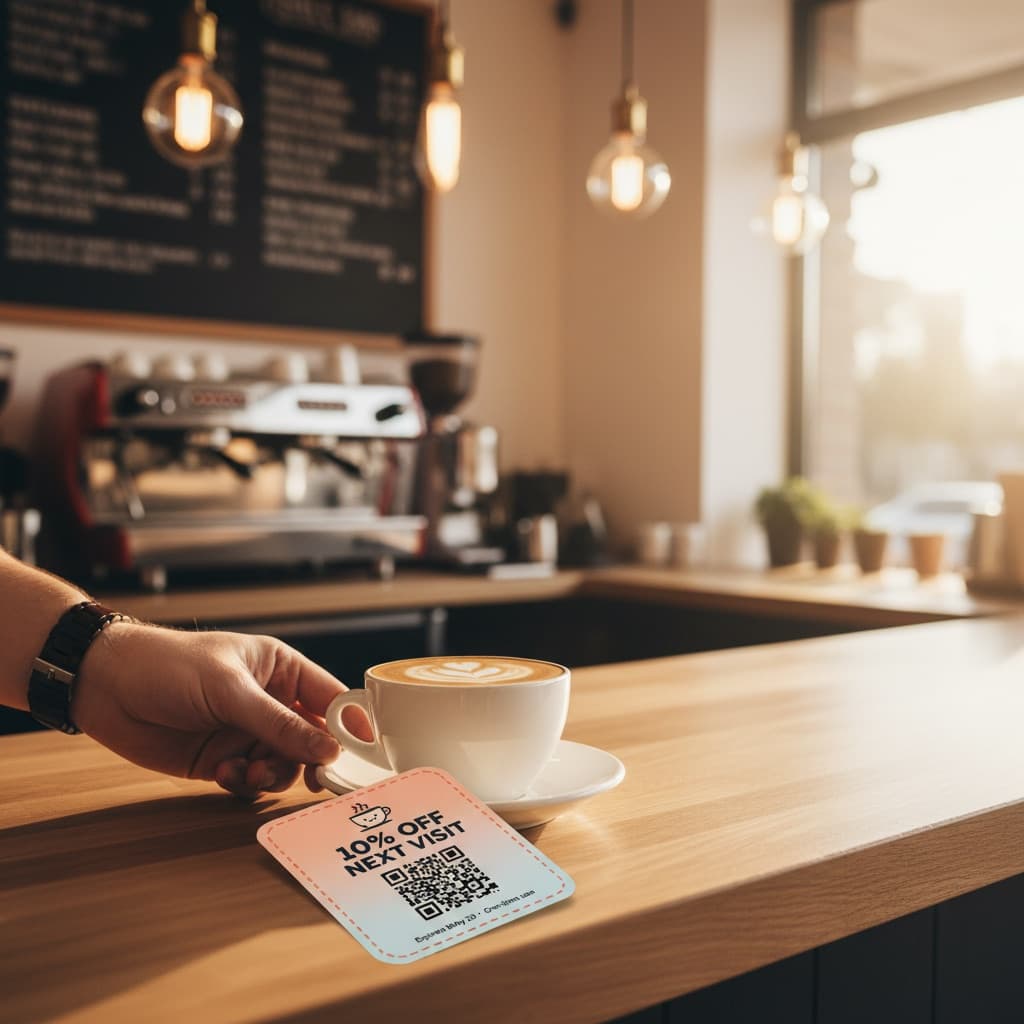
Slipped under the saucer for dine-in
For sit-down customers, the barista tucks a small card under the espresso saucer when the drink is delivered. Customer flips the cup, finds the coupon — feels like a small treasure-hunt moment, which makes the offer memorable.
On the back of the loyalty card or business card
If you already hand out business cards or punch cards, print the coupon QR on the reverse. Customer keeps both in their wallet; the coupon becomes a free upgrade to a card they were going to keep anyway.
Handed personally after a clearly first-time order
When a customer asks you what your espresso blend is, or seems unfamiliar with the menu — that's the highest-conversion moment. A barista who hands them a coupon at the door with a 'come back and try the pour-over this weekend' is doing the entire job of marketing in one sentence.
The placement choice depends on your packaging and your shift culture, but the principle is constant: hand it during the warm moment, not the cold one.
Turn one visit into many
Hand out single-use QR coupons that pull customers back through your door. Part of your Customer Comeback System. 14-day free trial, cancel anytime.
Create a couponDesigning the offer for café economics
The 10% number isn't arbitrary, but it's also not the only option. The offer needs to satisfy three constraints simultaneously:
- Big enough to feel like a real thank-you. Under 10% on a sub-$10 ticket reads as cheap. A 5%-off coupon on a $5 latte saves the customer a quarter — they'll throw the sticker in the bin.
- Small enough to protect margin. Anything more than 15% on the full ticket starts eating into your contribution margin in a way that doesn't scale.
- Simple enough to redeem in five seconds. Anything that requires a minimum spend, a specific drink, or a particular day of the week adds friction at the till. The barista has thirty seconds during the morning rush; the offer has to fit in five of them.
Variants that work well for cafés specifically:
- 10% off the next visit — the default. Simple, universal, hard to game.
- Free pastry with any drink, next visit — works if you have a pastry program with healthy margin. The fixed-cost gift feels more generous than a percentage; pair-purchase rate goes up.
- Free upgrade to a larger size, next visit — almost zero marginal cost (your milk cost difference between small and medium is a few cents), feels disproportionately generous to the customer.
- Buy a coffee, get a second one half-price (to share) — encourages the customer to bring a friend, which is how cafés actually grow.
The wrong direction is to layer complexity. "10% off Tuesdays and Wednesdays between 2 and 5 p.m. on drinks over $4 excluding cold brew" is not a coupon — it's a legal document. Pick the simplest version that protects your worst-case margin and move on.
If you're tempted to make the coupon valid only on slow days or off-peak hours, resist that for the first campaign. The whole point of the second-visit coupon is to attack the visit-one-to-visit-two transition. The customer is going to come back on the day that fits their routine — usually the same day of week as their first visit. Forcing them onto a different day defeats the mechanic.
The morning rush mistake (and how to avoid it)
The single biggest operational risk of a café coupon program is morning rush slowdown. Your peak hour is 7:30-9:00 a.m., when the queue is out the door, every second counts, and your barista is making a flat white every forty-five seconds. If redeeming a coupon adds even ten seconds to each transaction, you've added two minutes per ten customers — which on a busy rush translates to lost orders, frustrated regulars, and a barista whose morning is suddenly worse.
The fix is structural, not behavioral. A modern QR coupon system should let the barista scan the customer's coupon with the same phone they already have at the till — one tap, one beep, redemption marked. No paper to find, no codes to type, no bill to recalculate. The discount is applied at the POS in the same flow they were already running.
This is the operational reason single-use QR coupons fit coffee shops where, say, restaurants have more slack. Restaurants can afford a 60-second redemption flow because the table is sitting there for forty-five minutes. A café cannot — the queue behind the redeemer is what generates 60% of the shift's revenue. If the coupon flow takes more than five seconds, the campaign will quietly die because the baristas will stop honoring it.
ReviewQR's coupon system is built around this constraint specifically — single-tap scan from the staff phone, no extra hardware, no till integration required. The campaign you create takes about three minutes to set up; the redemption itself is one barista action.
Live in 10 minutes: setting up your first café coupon
The fastest version of this for a small independent café, from zero to first sticker on a cup, is roughly:
Create the campaign in the coupon tool
Name it something internal-only — 'Second Cup' or 'May First-Timers' works. The customer never sees this name; only your team does. It's how you'll track which campaign converted best when you run your second one.
Write the offer in five words or fewer
'10% off your next visit.' Don't elaborate. Don't add conditions. The customer will read this for half a second while holding a hot drink — make the words do all the work in that half-second.
Pick the coffee mascot and set 14-day expiry
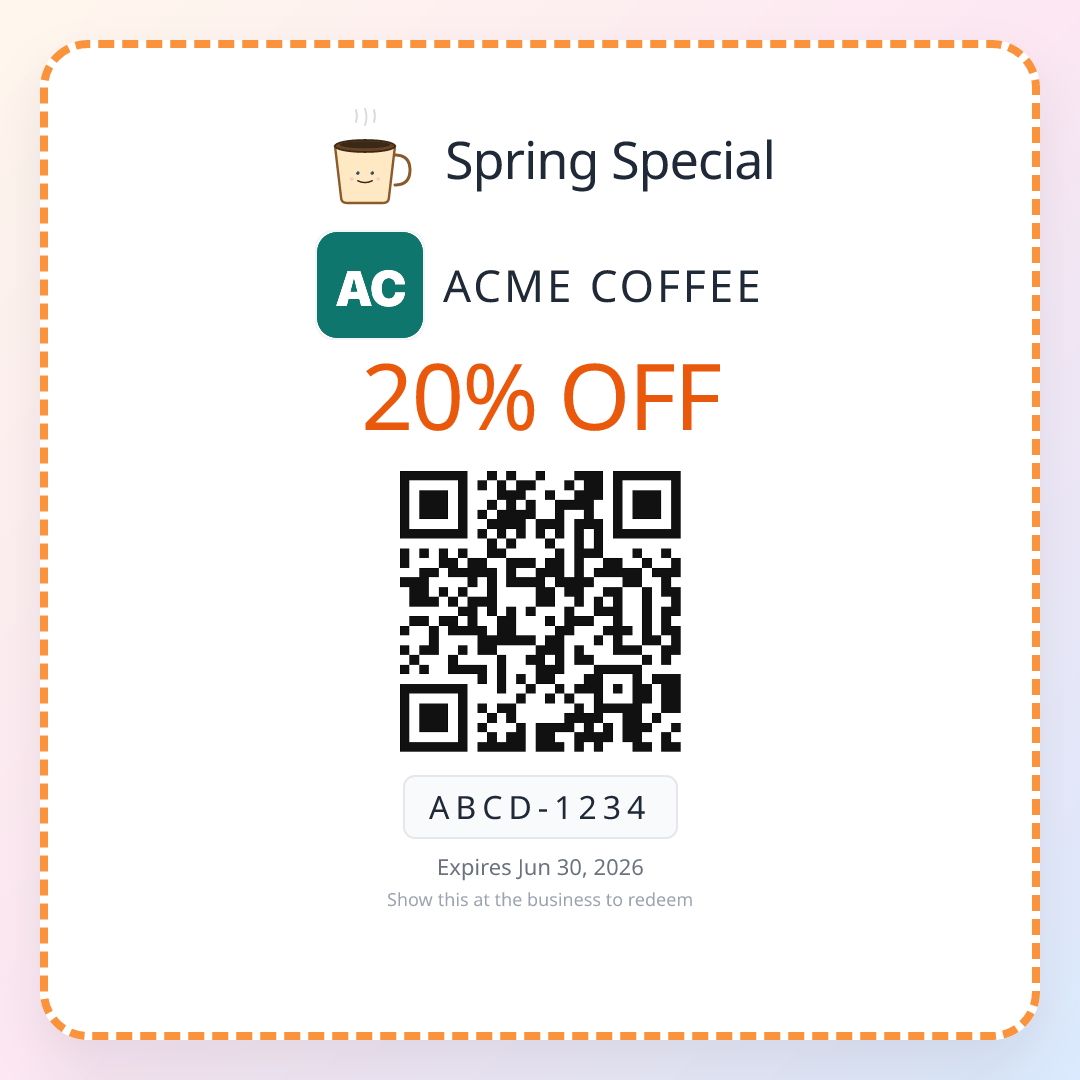
ReviewQR ships with a coffee-cup mascot specifically for this use case. The 14-day expiry creates the urgency that makes the customer come back inside the Second Cup window instead of saving the coupon for someday.
Print 50 stickers (not 500)
Fifty is enough to learn whether this works in your specific shop. You'll know in two weeks. If the redemption rate is decent, print 500. If it isn't, change the offer, not the print run.
Brief the team in 90 seconds
Two rules: hand it with the drink, not the bill; only hand it to customers you don't recognize. That's the entire training. Anything more elaborate will get forgotten by Thursday.
Track the first 10 redemptions
When the first ten codes get scanned, look at who came back and how long after. That's your real data — not the redemption rate alone, but the second-visit interval. Sub-7-day intervals are excellent; 7-14 days is normal; over 14 days is a sign the urgency wasn't strong enough.
Common café coupon mistakes
A short list of the avoidable ones, gathered from owners running this play in the wild:
- Handing the coupon to every customer, every visit. That's not a coupon program — that's a 10% price cut, and you'll feel it in the margin within a month. The coupon is specifically for first-timers, lapsed customers, and people who showed unusual signal interest (asked about beans, lingered, took a photo).
- Coupons valid for 90 days. Defeats the urgency mechanic. The customer thinks "I'll save it for a special occasion" and never uses it. Fourteen days is the sweet spot — long enough to fit a normal week, short enough to nudge the next visit forward.
- Pairing the coupon with a public Instagram post. The whole reason single-use QR works is that the offer is invisible to your regulars. The moment you post it, you turn it into a public promotion, and every Saturday-morning regular is going to ask why they didn't get one.
- Discounting on top of an already-discounted item. If you run a daily special, exclude it from the coupon offer up-front. Otherwise the stacking math will blow up your margin on exactly the items that were already the thinnest.
- Not tracking conversion to the third visit. A coupon that gets redeemed once and never produces visit three is a 50-cent loss. The real win is the customer who redeems on visit two and then comes back on visit three with no coupon at all. That's the metric to watch.
Adjacent plays worth knowing about
If you've never run a structured promotion in your café, the single-use second-visit coupon is the right place to start — it's the simplest mechanic with the cleanest ROI math. Once it's working, three adjacent plays are worth knowing about for later:
- The Google review thank-you coupon. When a customer leaves a review, the next time they're in, hand them a coupon. The coupon thanks them for the relationship, not the review — which keeps you fully compliant with Google's policy on review incentives. See the full mechanic in the restaurant coupon playbook, which works identically for cafés.
- The slow-Tuesday-afternoon coupon. Same single-use mechanic, different goal: fill a specific shift. Hand it out the Friday before the slow Tuesday, valid only for that window.
- The lapsed-regular win-back. Customers you used to see twice a week who haven't been in for a month get a coupon mailed or DM'd. Hard to do at scale without a list, but devastatingly effective when it works.
If you want to compare coupon platforms before committing, the best QR coupon app comparison covers the trade-offs between the major options, including which fit cafés specifically. And if your operational stack still leaks reviews and shift consistency, the companion piece on training new baristas without burning out covers the SOP side of running a small café.
A note on what the coupon is actually doing
The temptation in writing about QR coupons is to make them sound like a clever growth hack — a tactic, a mechanic, a discount-engineering trick. They're not. The reason this works for a coffee shop has very little to do with the 50 cents the customer saves and almost everything to do with what the coupon signals: this place cared enough to give me something on the way out. In an industry where the experience differs by tiny margins from one shop to the next, that signal is the difference between the customer choosing you on Wednesday morning and the customer choosing the chain.
The 10% off coupon, in the end, is the smallest possible artifact of the thing that actually grows a café: a deliberate, human moment between a barista and a customer, made repeatable.
Frequently asked questions
Is 10% off the next visit enough to bring a coffee shop customer back?
Yes, more than people expect — because in a coffee shop the discount isn't the real reason they come back. The reason is that the coupon gives them a small social permission to choose you over the chain on the corner. On a $5 cappuccino, 10% is 50 cents. Nobody walks two extra blocks for 50 cents. They walk for the feeling that this place remembered them. The coupon is the artifact that proves it.
Won't a 10% off coupon train my regulars to wait for a discount?
Not if it's single-use and handed out selectively. A QR coupon stuck inside the bag of a first-time customer is invisible to your Monday-morning regulars — they never see it, they never expect it, they never start gaming it. The whole point of a single-use mechanic instead of a public "happy hour" sign is that you target the visit-two transition without leaking margin on visit fifty.
When is the best time to hand a customer the coupon?
With the cup, not with the bill. The moment of peak generosity in a coffee shop is when the barista slides the drink across the bar and says "enjoy." That's when you tuck a coupon sticker on the cup sleeve or include a small card with the to-go bag. Handing it at payment makes it feel transactional; handing it with the product makes it feel like a gift.
What if my coffee shop already has a punch card or app loyalty program?
Single-use QR coupons solve a different problem than punch cards. Punch cards reward your tenth visit; QR coupons rescue your second. Most first-time café customers never punch a single hole because they never come back at all — the gap between visit one and visit two is where the customer is lost, and that's exactly the gap a "thanks for coming in, here's 10% off your next visit" coupon is designed to close.
How many coupons should a small coffee shop print to start?
Fifty stickers is enough for the first two weeks. That covers roughly the new-customer count of a small independent café and gives you a clean read on what percentage actually redeem. Don't print a thousand on day one — you'll learn more from fifty stickers in two weeks than from a print run that takes you four months to hand out.
Try it on your own customers
Design a single-use QR coupon in 2 minutes, no account needed. Then a 14-day free trial, or buy only the coupons you need, from $3, no subscription.
Design your first coupon →Keep reading
How Busy Cafés Train New Baristas Without Burning Out the Owner
Why your espresso calibration speech happens 9 times a month, the 7 procedures every café actually needs, and how review collection becomes a closing-shift ritual instead of an afterthought.
hospitalityHotel Google Reviews: 25+/Month with QR Cards (2026)
How boutique hotels and Airbnb hosts collect 25+ Google reviews per month with nightstand QR cards. Real scan rates, placement data, and what guests actually respond to.
Retail & ShopsQR Code Coupons for Eyewear Stores: The Annual Frame Refresh
An optical shop sees each patient once a year and loses the sale to a website in the parking lot. How independent eyewear stores use single-use QR coupons to raise capture rate, attach a second pair, and harvest expiring vision benefits. Math, three plays, placements, and a 6-minute setup.