QR Code Coupons for Restaurants: Fill Slow Shifts and Bring Diners Back
How restaurants use single-use QR code coupons to fill Tuesday lunches, launch new menus, win back lapsed regulars, and protect peak-hour margin.
QR Code Coupons for Restaurants: Fill Slow Shifts and Bring Diners Back
Turn one visit into many
Hand out single-use QR coupons that pull customers back through your door. Part of your Customer Comeback System. 14-day free trial, cancel anytime.
Create a couponIt's Tuesday at 2:47 PM. Your dining room has six covers in it. The host is folding napkins. Two line cooks are scrolling their phones. Saturday night, this same room turned away a four-top at 8:15. The math of running a restaurant is brutal in exactly this way: you can't move Saturday's revenue into Tuesday, but Tuesday's empty chairs eat your rent all the same.
Most owners try to fix it with a happy hour sign on the sidewalk. That works, kind of, but it leaks margin every week — including on the busy days the discount was never meant to subsidize. The cleaner fix is QR code coupons: single-use, time-bound, handed out only to the customers and on the days that need them.
This is a playbook for restaurant operators specifically. It assumes you already have foot traffic and a Google Business Profile working for you, and you want to put the next layer on top — the layer that fills empty seats, launches new menu items without lighting cash on fire, and gets your three-month-no-show regulars to walk back through the door.
The economics of an empty table
A restaurant's cost structure is mostly fixed. Rent, salaried back-of-house, equipment leases, insurance — those numbers don't care whether you do 40 covers or 140 on a given shift. What changes between a great Tuesday lunch and a dead one is almost entirely the variable side: food cost on the plates that actually leave the kitchen, and the hourly wages of staff you can't reasonably send home.
That's why filling the empty seat is so much more profitable than it looks on paper. A diner who only walks in because they're holding a "free side with any entrée" coupon still pays for an entrée, a drink, and probably a coffee. The marginal cost of feeding them is a fraction of the check. The fixed costs were already burning whether they showed up or not.
This is the whole reason QR code coupons work for restaurants in a way they don't for, say, a software product. Your unit economics quietly want you to fill the slow shifts even at a discount — what you can't afford is to give that discount to the customers who would have come anyway.
Why single-use beats every other coupon format
Restaurants have tried every coupon format ever invented. Newspaper inserts. Groupon. Punch cards. "Show this email" deals. Each one has the same fundamental problem: there's no reliable way to stop one customer's offer from becoming everyone's offer.
A printed coupon gets photocopied, screenshotted, posted in the local "cheap eats" Facebook group, and suddenly you're running a 50%-off promotion you never intended. A Groupon goes out to fifteen thousand people who wanted half-off Italian once, will never come back, and tank your margin on the way out. An email blast trains your list to only visit when they have a code in their inbox.
A single-use QR code coupon doesn't have any of these problems:
- One redemption per code. Once a server scans the QR and taps Redeem, that code is dead. Screenshots and photocopies don't matter — the system already knows.
- You control the distribution. You hand out 200 stickers to the customers and on the days you choose. The offer never leaks beyond that.
- Every redemption is tracked. You see which campaign, which day, which shift. After three campaigns you know exactly which offers move people and which don't.
The single-use guarantee is what unlocks the offers most owners are too scared to run. "Free entrée" stops being terrifying the moment you know it can only be claimed once per code, by the person physically standing in front of your host stand.
The 3 PM Dead Zone playbook
Every restaurant has its dead zone. For most lunch-and-dinner spots it's the 2:30–5:00 PM gap. For dinner-focused places it's Monday or Tuesday entirely. For brunch-heavy concepts it's any weekday morning. The dead zone has three things in common across every restaurant we've talked to:
- Fixed costs are still running. You're paying rent, paying line cooks, paying the AC.
- Marginal capacity is sitting there. Tables, kitchen bandwidth, prep that's already been done.
- A small nudge converts. The dead zone isn't dead because customers refuse to come — it's dead because there's no specific reason to come right now.
The Dead Zone playbook flips that last point on its head. You hand a single-use coupon — "Free appetizer with any entrée, Mon–Wed before 6 PM" — to the customers who are already eating with you on a Friday night. They're holding a physical reason to come back during a window they wouldn't have considered, and the offer is invisible to anyone else.
The result is a restaurant that runs hotter on the weak shifts and identically on the strong ones. Your peak revenue stays protected. Your trough fills in with diners who self-selected into showing up exactly when you needed them.
Five restaurant coupon plays that actually fill seats
Five campaigns to run in your first ninety days. Pick the two that fit your restaurant best and start there.
1. The Slow-Shift Filler
The play described above. Print 100 stickers, design the offer to require an entrée (so you protect ticket size), and hand them out on busy nights only. Every redemption is a customer who would not have walked in otherwise.
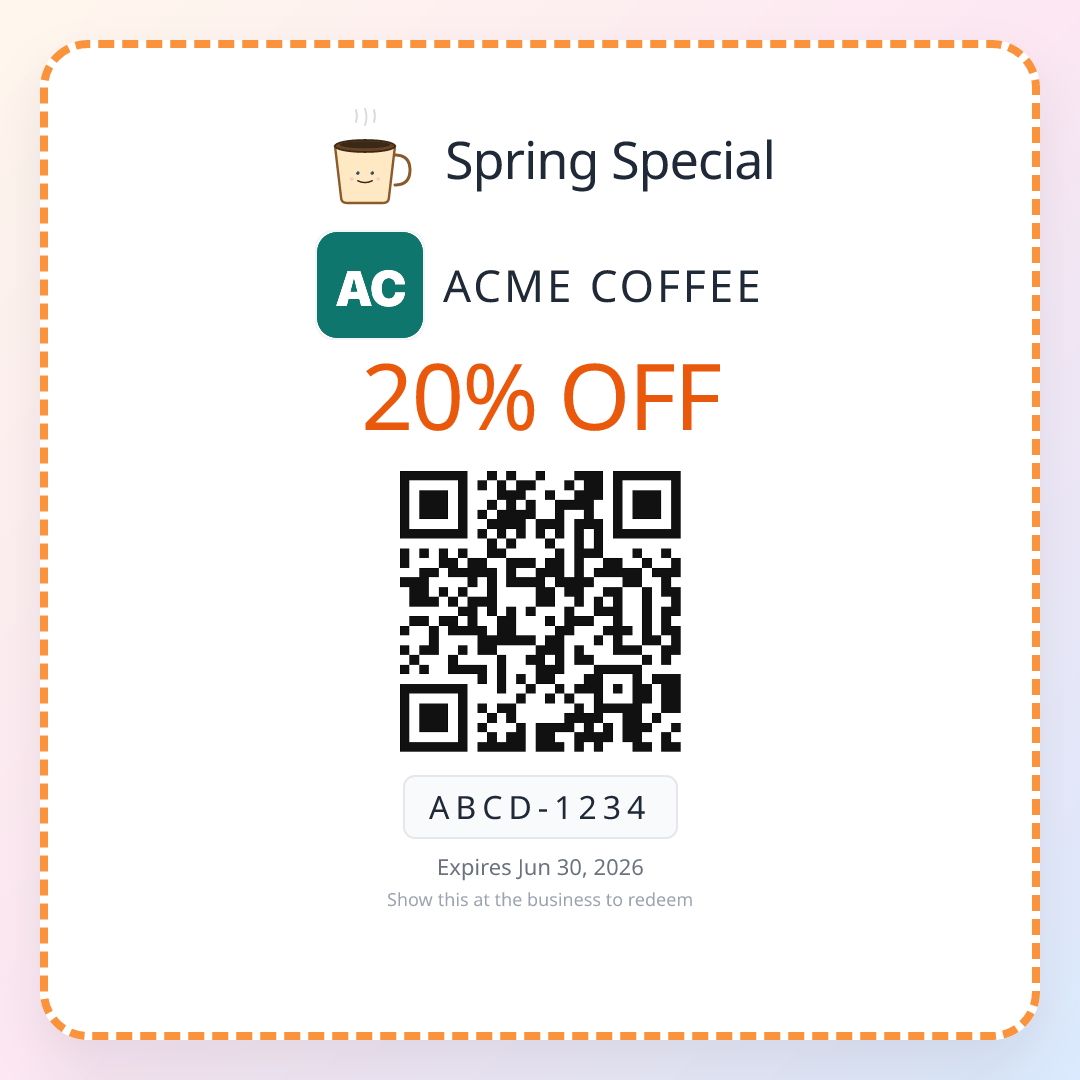
- "Free side or appetizer with any entrée — Tuesday or Wednesday only, expires June 30."
- "$10 off any check of $35+, Mon–Thu lunch — through May 31."
- "Free dessert with any two-entrée table, dinner Mon–Wed."
The key constraint: the qualifying purchase has to guarantee a real check. "Free coffee, no purchase required" fills seats but starves your margin. "Free coffee with any entrée" fills seats and moves entrées.
2. The New Menu Launch
Every restaurant knows the awkward middle phase of a menu drop: the new dish is on the page, your team can describe it, but nobody's ordering it because nobody's tried it yet. The standard fix — a "Server Pick!" star next to it on the menu — is weak.
A QR coupon underwrites the first taste. Print 200 stickers offering 50% off any new menu item, redeemable through the next two weeks. Hand one out with every check. You're not running a perpetual discount — you're paying for the first 200 trials of a specific dish, after which it lives or dies on its own merits.
The bonus: customers who try the new dish on a coupon and love it are unusually likely to mention it in their Google review by name. That mention then becomes its own marketing for every subsequent diner reading reviews.
3. The Comeback Coupon
You already have a list of customers who haven't been back in 90 days. They're in your reservation system, your loyalty program, your email list, your phone book. The reason most "we miss you" emails fail is that "come back soon!" is not a campaign — it's a polite hint nobody acts on.
A QR coupon sent over WhatsApp or email lands differently. "Coffee and dessert on us, anytime in the next 30 days — single use, just show this on your phone." It's specific. It has a deadline. Each link is unique to that customer, redeemable once. The friction is just barely low enough that a meaningful percentage of lapsed regulars actually walk back through your door.
The math on a Comeback campaign
Send 200 single-use coupons to customers who haven't been back in 90 days. Even a 10% redemption rate (which is conservative) brings 20 lapsed diners back into your restaurant. If half of them spend $40 above the coupon's value, you've recovered $400 of dormant revenue from a list you already had. Most owners run this campaign once and immediately put it on a quarterly cadence.
4. The Review Thank-You
You're already collecting Google reviews — or you should be, with a QR code on every check. The diners who actually leave one are your most engaged customers. Until now, the relationship ended with a five-star review and a quiet thank-you.
A single-use coupon turns it into a loop. "Thanks for taking the time to review us. This dessert's on us next visit." The coupon is for the relationship, not for the review — Google's policy forbids offering anything in exchange for a review or conditioning rewards on a positive rating. But thanking customers who reviewed you (regardless of what they said) is fully compliant and converts beautifully into repeat visits.
5. The Surplus Move
Restaurants run on perishable inventory. The fish that needs to move tonight. The tray of cannoli at 4 PM. The case of a wine that didn't sell as expected.
A public discount on perishables trains every customer to wait for the markdown. A single-use QR coupon doesn't. Send a "Half-price on tonight's special — first 20 only" coupon to your WhatsApp regulars. Tape a "Free pastry with any drink, until close today" sticker on the counter. The discount is invisible to full-price customers and gone the moment your surplus moves. The alternative — throwing food away at midnight — is a 100% loss on inventory you've already paid for.
Turn one visit into many
Hand out single-use QR coupons that pull customers back through your door. Part of your Customer Comeback System. 14-day free trial, cancel anytime.
Create a couponDesigning the offer: what works in restaurants specifically
Three rules, learned the hard way watching the first wave of restaurant coupon campaigns:
Do This
- ✓Anchor every offer to an entrée or check minimum — 'free X with any entrée' or '$10 off $40+' protects ticket size
- ✓Pick a real expiry — 'this week only' or 'through May 31' converts; 'sometime soon' doesn't
- ✓Use a mascot that matches your concept — pizza for a pizzeria, coffee for the brunch spot, the icon shows up on every printed sticker
- ✓Print a small batch first — 50 to 100 stickers — and learn what redeems before committing to a thousand-piece run
- ✓Brief your front-of-house team on day one — every host and server needs to know how to scan and redeem in under five seconds before you hand out a single sticker
Avoid This
- ✕Don't run percentage-off offers without a check minimum — '20% off your meal' on a $14 lunch is a 30% margin hit you didn't budget for
- ✕Don't make coupons conditional on a positive Google review — that violates Google's policy and can get your profile penalized
- ✕Don't hand the same offer to everyone every shift — the slow-day filler only works if it's invisible on busy days
- ✕Don't extend the expiry past 30 days for a slow-shift campaign — short windows drive faster redemption and a cleaner read on whether the offer worked
Where to hand them out (placements unique to a restaurant)
A restaurant is unusually rich in customer touchpoints, which means there are at least eight reasonable places to put a coupon. Here are the ones that actually work:
| Placement | Use for | Why it works |
|---|---|---|
| In the check presenter | Slow-shift filler, comeback offers | Highest engagement moment of the meal — the table is paying, attention is on the folio, and a coupon slip sits naturally next to the receipt |
| Bag tag on takeout orders | Comeback, slow-shift filler | Customer takes it home, often pinned to a fridge until the expiry date |
| Insert with delivery orders | Win-back, new menu launch | The only direct-to-consumer touchpoint you control on a delivery — every other surface belongs to the platform |
| Hand-off at host stand | New menu launch, surplus | Hand a sticker as the customer leaves: "We just dropped a new menu — first 100 get half off any new dish through next Sunday" |
| WhatsApp / SMS for regulars | Comeback, surplus | A unique-link coupon to lapsed customers or to your VIP list, redeemable once on next visit |
| Counter or table tent | Slow-shift filler (when discreet) | Only place a slow-day coupon visibly during off-peak hours so peak diners don't see it — pull it back at 5 PM |
| Loyalty milestone hand-off | Loyalty (fifth-visit free, birthday) | "Your fifth coffee's on us" — much higher conversion than a punch card because the offer is concrete and the redemption is one scan |
| Review thank-you card | Review thank-you | Hand it to the diner who just scanned your review QR — the cleanest closing of the review loop a local restaurant can run |
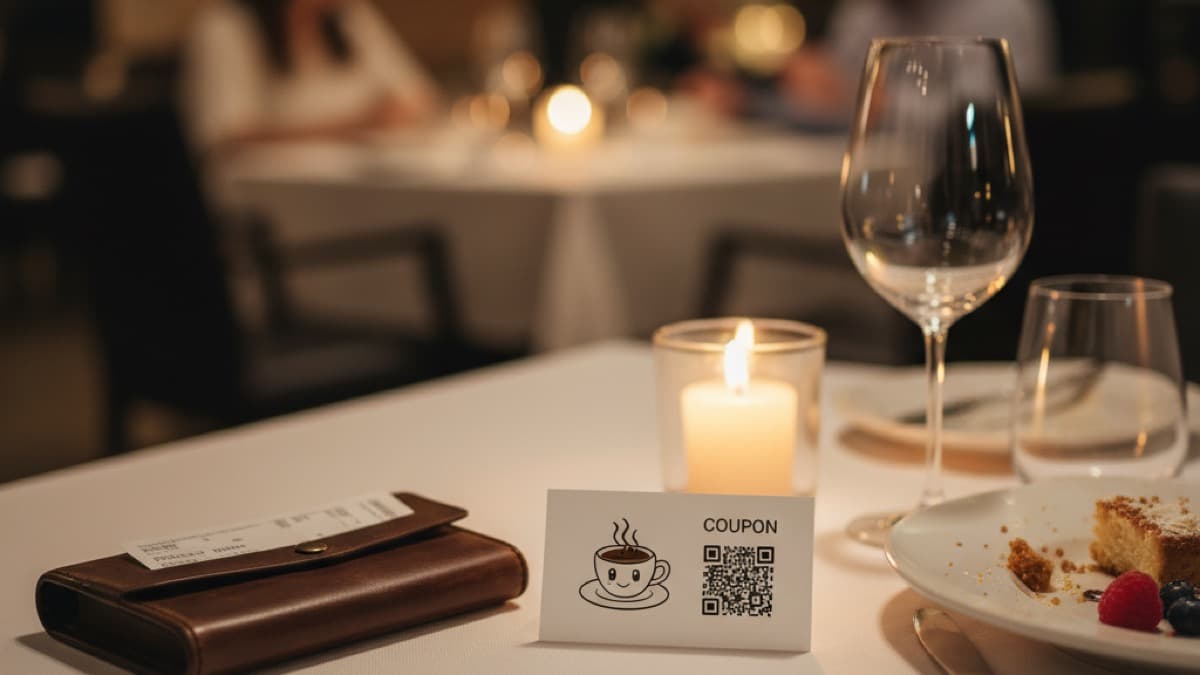
The single highest-converting placement we see, by a wide margin, is the check presenter. The diner has just decided whether their meal was worth the price. A coupon for next visit, slipped in next to the bill, lands at the moment of peak goodwill — and almost every guest who's been pleasantly surprised by a meal will pocket it.
Case study: Trattoria Bardi, Cleveland OH
Bardi is a 60-seat Italian neighborhood trattoria, dinner-only, six nights a week. Friday and Saturday it does 110 covers. Tuesday and Wednesday it averaged 28. The Tuesday/Wednesday number had been creeping down for three quarters.
Owner Anna Bardi ran two QR coupon campaigns for ninety days:
- Slow-shift filler — 150 stickers, "Free antipasto with any entrée, Tuesday or Wednesday only, expires in 30 days." Stickers handed out only on Friday and Saturday nights with the check.
- Comeback campaign — 220 single-link coupons sent over WhatsApp to diners who hadn't been in for 90+ days, "A glass of Chianti on us, anytime in the next 21 days."
The numbers after three months:
"I'd run paper coupons before. Two thousand printed, maybe forty came back, no idea who or when. With this we know exactly: 47 antipasto stickers, all on Tuesdays and Wednesdays, mostly redeemed in the first ten days. The campaign cost me sixty dollars in printing and got me a thirty-eight percent lift on my worst nights." — Anna Bardi, Trattoria Bardi
What's quietly important in Anna's story isn't the lift — it's that her Friday and Saturday numbers didn't move. Peak revenue stayed peak. The campaign only hit the shifts that needed hitting.
Quick start: live in ten minutes
Pick the one campaign that fits your restaurant first
If your slow-shift problem is acute, start with the Slow-Shift Filler. If you've just dropped a new menu, start with the Launch. If you have a long list of lapsed regulars, start with the Comeback. Don't run all five at once — pick one and learn.
Write the offer in plain English
Specific item, specific qualifier, specific expiry. 'Free antipasto with any entrée, Tuesday or Wednesday only, through May 31.' Avoid % off without a check minimum.
Create the campaign and download the PDF
From your dashboard, open the QR Coupons page, click New Campaign, fill in the offer, set the expiry, pick a mascot, choose 50–100 coupons. The PDF generates a 2×5 sticker grid per A4 page.
Print and brief the team
Any local printer turns it around in a day, or print at home on sticker paper. Before you hand out a single sticker, spend three minutes with the host and servers practicing the scan-and-redeem flow on one test code.
Hand them out only where you decided
Slow-shift fillers go in check presenters on busy nights. Launch coupons go to every table. Comeback coupons go on WhatsApp to your lapsed list. Don't blanket distribute.
If you don't yet have a Google review QR code on every check, set that up first — the review loop is what feeds half the campaigns above (Comeback uses your reviewer list; Review Thank-You closes the loop directly). Then layer coupons on top — see the full QR Coupons feature. For the broader strategy across local businesses, see our QR code for business reviews playbook or the original QR Coupons launch post.
Common mistakes restaurants make with coupons
The first ninety days of running QR coupons reveal a small set of repeated mistakes. None of them are fatal — all of them are avoidable.
Discounting peak shifts you didn't mean to discount
The classic version: a "20% off any meal" coupon goes home with every customer for a month, including the Saturday-night anniversary couple who would have ordered the tasting menu at full price. By the end of the month you've quietly trained your highest-margin shift to expect a discount. The fix is mechanical — single-use coupons with a "Mon–Wed only" expiry condition baked into the offer text, plus discipline about not handing them out on weekends.
Running the offer for too long
Owners default to 90-day expiries because longer feels safer. The opposite is true. A two-week expiry creates urgency, drives 60–70% of redemption inside the first ten days, and gives you a clean read on whether the offer worked. A 90-day expiry leaves you waiting eight weeks to find out you ran a dud.
Skipping the staff briefing
The first time a server has to figure out the redemption flow at the host stand with a guest watching, the experience is bad for everyone. Three minutes of practice on day one — open camera, scan, log in, tap Redeem — fixes it permanently. Build it into your daily preshift for the first week of any new campaign.
Treating the coupon as the campaign
The coupon is the artifact. The campaign is the placement plus expiry plus offer plus distribution channel. Owners who think "I made a coupon, why isn't it working?" are usually missing one of those four elements — most often the distribution channel, where they printed 200 stickers and then... left them in a drawer.
Frequently asked questions
Are QR code coupons better than printed paper coupons for restaurants?
Yes, for two reasons. First, every QR coupon is single-use — once you scan and redeem it, it can't be cloned, screenshotted, or photocopied. Second, you get redemption data: which day, which shift, which campaign. Paper coupons give you neither, and most owners massively overestimate how many they're actually getting back.
Won't a coupon just train my regulars to wait for the next deal?
Only if the offer is public and recurring. A single-use QR coupon, handed out selectively (slow days, launches, win-back), is invisible to your full-price customers. Your Saturday-night regulars never see it. Your Tuesday-lunch traffic does. That's the whole point of a single-use mechanic over a printed "happy hour" sign.
What's the best slow-day coupon offer for a restaurant?
Pair an entrée requirement with a free or steeply-discounted side or drink: "Free side with any entrée, Tuesday or Wednesday lunch only." It guarantees a real check size, feels generous, and costs you a few dollars of food — not a 50% margin hit on the entire ticket.
How many QR coupons should I print for my first restaurant campaign?
Start with 50 to 100 stickers. That's enough to learn what redeems and what doesn't without committing to a thousand-piece print run on an offer you haven't tested. Once you see which campaigns hit double-digit redemption rates, scale those — kill the rest.
Can I use a QR coupon to thank diners who leave a Google review?
Yes, with one important rule. The coupon thanks the customer for the relationship, not for the specific review or its rating. Google's policy forbids offering rewards in exchange for reviews or making rewards conditional on a positive star count — but a single-use "thanks for taking the time" coupon, given regardless of what they wrote, is fully compliant and one of the highest-converting plays in this article.
Do QR coupons work for takeout and delivery, or only dine-in?
They work for all three, but the placement changes. Dine-in: hand it with the check. Takeout: drop it in the bag. Delivery: tuck it under the receipt or include it as a printed insert. Each one is single-use and tied to your restaurant — the redemption happens in person on the next visit, which is the whole point.
Ready to Implement This Strategy?
Create your custom QR code in 2 minutes and start collecting Google reviews today.
Create Your QR Code NowMore Google Review Guides
How to Get Repeat Restaurant Customers with QR Coupons
Bringing a diner back costs a fraction of finding a new one. Here's how restaurants use single-use QR coupons to drive repeat visits and grow sales.
Restaurants & FoodRestaurant Google Reviews: 40-60 New in 90 Days (QR)
How restaurants collect 40-60 Google reviews in 90 days with table-tent QR codes. Real placement data, server scripts, conversion rates by placement, and what to avoid.
Restaurants & FoodQR Code Coupons for Food Trucks: The Tomorrow's-Spot Tease
Food trucks lose customers to geography, not food. How single-use QR coupons that double as a location reveal turn one-off encounters into route regulars. Unit economics, three plays, truck-surface placement, scripts, and a 6-minute setup.