How Busy Cafés Train New Baristas Without Burning Out the Owner
Why your espresso calibration speech happens 9 times a month, the 7 procedures every café actually needs, and how review collection becomes a closing-shift ritual instead of an afterthought.
How Busy Cafés Train New Baristas Without Burning Out the Owner
Turn happy customers into reviews
A Google review QR code that gets you more reviews in one scan. Included in every plan.
Get my review QR codeIt's 9:47 a.m. on a Tuesday and you are standing behind the bar explaining grind size to a new hire for the ninth time this month.
You have done this speech before. You did it for Maria three weeks ago. Before that, for Andrei, who stayed two months and then quit to study abroad. Before him, for the part-timer whose name you have already forgotten because she lasted exactly one weekend.
The line at the till is six deep. The milk pitcher needs rinsing. Someone is asking if you have oat. And the new hire is staring at the grinder like it is a piece of NASA equipment.
This is the Espresso Reset Moment — the second your café turns from a business into a teaching gig, and the second every café owner has felt at least once. It costs you the same hour, every time. And the worst part is you know you will be standing right here again in seven weeks.
A written set of procedures — the kind a new hire can read on day one and refer to on day twenty — is the difference between a café that runs on the owner being on shift and one that runs on the system the owner built. Most small cafés never make that transition because the procedures live entirely inside one person's head.
This is the playbook for getting them out.
The 3-Month Barista Cycle Trap
Specialty coffee has one of the worst employee retention curves in food service. Most independent cafés turn over their bar staff every 8 to 14 months, and the part-time / student labor pool churns even faster.
Notice the third number — that is the one that actually breaks small café owners. It is not the wages, it is not the broken cups during week one, it is the forty-seven hours of your own time you spend explaining the same things you explained three months ago to a different person who has already left.
Multiply that across a 12-month cycle of two or three new hires and you have spent more than 140 hours — almost a full month of work — re-teaching procedures you have already taught at least four times this year.
That hour count is invisible on your P&L. It hides as exhaustion, as missed orders during the training shift, as the menu change you keep postponing, as the marketing initiative you never get around to. It is the most expensive line item in your café and it is not in QuickBooks.
Why "I'll Show You" Doesn't Scale
Most café training looks like this. A new hire shadows the owner for two days, watches them pull shots, listens to a few stories about why the milk steaming has to sound like that, and then is dropped onto the bar during the morning rush.
The problem is not that this method is bad. It is that it is non-recoverable. When the trainer is on shift, the new hire learns. When the trainer is not on shift, the new hire either invents something or asks the next-most-senior barista, who learned three months ago from a different trainer, who interpreted the original method slightly differently.
Within four weeks, three baristas in a four-person team are pulling shots three different ways. The drinks taste subtly different depending on who made them. Customers notice but cannot articulate it — they just say things like "it was better last week" and stop coming.
This is the drift problem, and it is the single most common reason small café reviews slowly slide from 4.7 stars to 4.3 over the course of a year. Not because the owner got worse, but because the procedures got distributed across more heads and each head rounded a few corners.
The 4.7-to-4.3 slide is reversible, and faster than most owners think. Cafés that put one written procedure in place — usually espresso calibration — see the first review uptick within 30 days because the drink quality stops fluctuating between baristas.
A café running QR code review collection without an underlying consistency system is collecting reviews on whatever the drink quality happens to be that week. The reviews are honest. They just become inconsistent in the same way the espresso does. Fix the drink first, then scale the reviews.
The 7 Procedures Every Café Actually Needs
You do not need a 50-page operations manual. Cafés that successfully transition from "the owner explains everything" to "the system explains everything" usually start with seven core procedures. Together they cover roughly 90% of what a new barista needs to know to run a shift competently.
Do This
- ✓Opening checklist — what gets done in the first 30 minutes before doors open
- ✓Espresso calibration — dose, yield, shot time, what to adjust when
- ✓Milk steaming — texturing temperatures and pitcher positions per drink size
- ✓Daily hygiene & equipment cleaning — group head backflush, steam wand, grinder
- ✓Customer scripts — handling allergies, refunds, the difference between flat white and latte
- ✓Closing checklist — clean-down, restock, deposit, review collection check
- ✓Emergency procedures — espresso machine error codes, milk shortage, card reader down
Avoid This
- ✕Don't write a procedure for every conceivable drink — keep the SOPs to recurring tasks
- ✕Don't make the document so long no one reads it — each procedure should fit on one page
- ✕Don't forget the "why" — a barista who knows why purges the steamer purges it; one who doesn't, won't
- ✕Don't store SOPs only on a laptop — they need to be visible at the bar
Notice that review collection is in the closing checklist, not in a separate marketing document. That single placement is the difference between a café that gets two reviews a month and one that gets twenty. Reviews are an operational outcome, not a marketing campaign — and they only happen consistently when collecting them is part of someone's job description.
From Tribal Knowledge to Written SOPs
There are three honest ways to get café procedures out of your head and into a place a new hire can use them.
Option 1 — The Whiteboard
Cheapest, fastest, and surprisingly effective for the first 90 days. Write each procedure on a laminated sheet, tape it inside the cabinet next to the relevant station. Espresso calibration goes inside the door above the grinder. Steaming temperatures go on the side of the espresso machine. The closing checklist goes on the back office door.
Strength: Zero cost, zero adoption friction, the SOP is visible at the moment of decision.
Weakness: Updating gets messy. Coffee gets spilled on it. Senior baristas write notes that contradict the original. After six months you have three layers of edits and no source of truth.
Option 2 — A Shared Doc
A Google Doc or Notion page per procedure, with photos and a short video clip per step. The team can read it on a phone before opening, the owner can update it from home.
Strength: Easy to update, searchable, accessible from anywhere.
Weakness: Adoption is fragile. New hires open it once during training and never again. There is no signal that they actually followed the procedure on a given shift, and nothing flags when they got stuck.
Option 3 — AI-Guided Procedures
A new category of tools turns each procedure into an interactive walkthrough the barista follows step by step on a tablet or phone. Instead of reading a doc, they tap through the actual steps with photos, timing, and decision branches ("if the shot is under 22 seconds, do X").
The AI also captures where new hires get stuck, which steps they skip, and which procedures need clearer wording. After two weeks of use, you do not just have a training tool — you have data on which parts of your operation are leaking time.
Strength: New hires learn faster, mistakes drop, and the senior barista's expertise is preserved even when they leave.
Weakness: Costs more than a whiteboard. Worth it past the 4-person team threshold; overkill for a one-person owner-operated kiosk.
The right answer is rarely just one of these. Most cafés that get this transition right run whiteboard SOPs at each station for the moment-of-decision reference, plus a digital source of truth for training and updates.
Where Review Collection Fits: Your Closing-Shift SOP
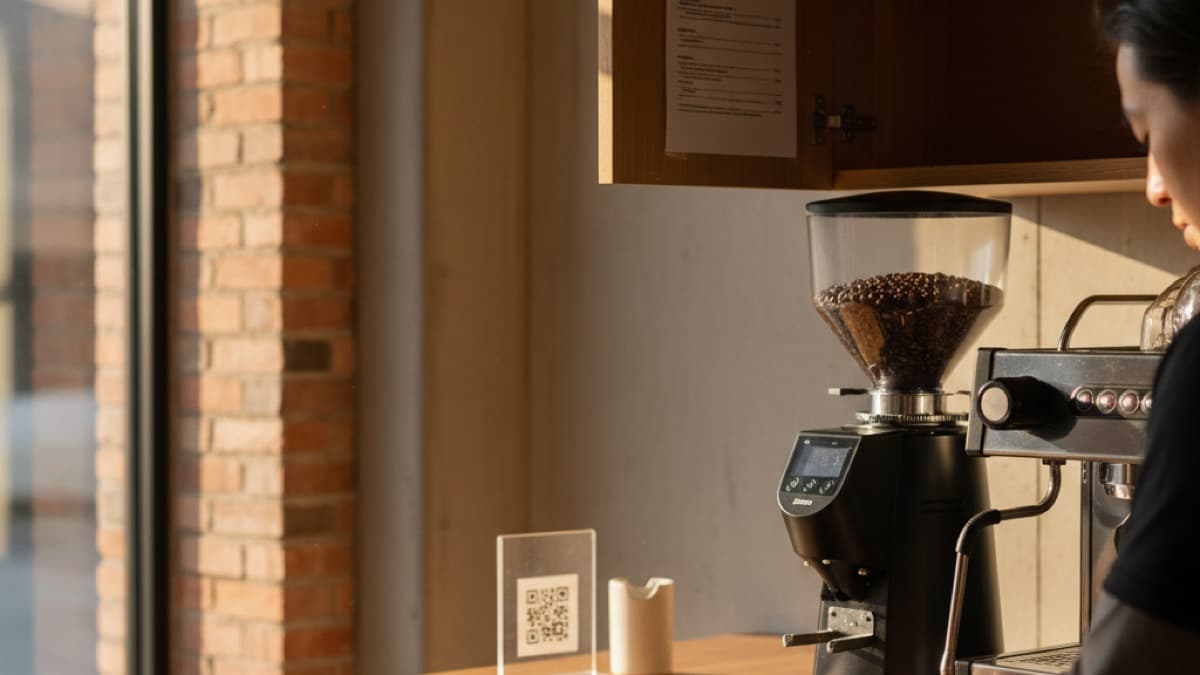
Most small cafés treat review collection as a marketing project. They print a QR code, put it in a Perspex stand at the till, and then forget about it for six months. When reviews trickle in, great. When they don't, the QR stand gets blamed.
The problem isn't the QR code. It's that nobody owns the procedure that keeps it visible, clean, and pointed at customers.
The Closing-Shift Review Check (a 60-second SOP)
At the end of every closing shift, before the deposit:
- Wipe down the QR code stand at the till with a cloth (coffee splatter and pastry crumbs accumulate fast).
- Check that the QR stand is upright, facing customers, and the QR code itself is undamaged.
- Confirm there's a small "Loved your coffee? 30-second review →" message on the stand. If a customer removed the message card, replace it from the stack in the back office.
- Take five seconds to glance at today's review count in the ReviewQR dashboard on the till tablet. If a new review came in, share it with the team in the next morning briefing.
- If you handed out QR coupon stickers for first-time customers today, restock the dispenser at the counter to 12.
That's it. Sixty seconds, every night. And it converts review collection from a thing-the-owner-does-when-they-remember into a thing-the-closing-barista-does-because-it-is-on-the-list.
A café running this single SOP for 30 days collects 3-4x more reviews than the same café running the same QR code without an owner. Same equipment, same customers — different procedure layer.
You can generate your café's review QR code in under two minutes and have a printable QR stand on the bar by tomorrow. The procedure layer is what makes it work consistently.
Turn happy customers into reviews
A Google review QR code that gets you more reviews in one scan. Included in every plan.
Get my review QR codeBuilding Your First SOP: Espresso Calibration
If you write only one SOP this quarter, make it espresso calibration. It is the highest-variance task in the café, the one customers notice first when it goes wrong, and the one that gets explained verbally more than any other.
Here is what a one-page espresso calibration SOP looks like for a typical café running an 18-gram VST basket on a medium-roast house blend.
Dose
18.0g (+/- 0.2g) into the portafilter. Distribute with a finger or distribution tool. Tamp level with 15-20 lb of pressure. If the basket overflows during tamping, the dose is too high.
Pull
Lock the portafilter. Start the shot. Watch the timer.
Yield & Time
Target: 36g out (+/- 1g) in 25-30 seconds. Use a scale on the drip tray or eyeball the marker line on the cup.
Adjust if Off-Target
If the shot pulls under 22 seconds: grind one click finer, re-dose, pull again. If it pulls over 33 seconds: grind one click coarser, re-dose, pull again. Recalibrate every 2 hours during a busy shift, every shift change, and after a beans bag change.
Taste Check
Every recalibration ends with the barista tasting the shot. If it is sour: the grind is too coarse. If it is bitter: the grind is too fine. Taste before serving the first customer of the new calibration.
That fits on one laminated sheet. A new hire can follow it on day three. A senior barista can use it as a reference when the morning's first shot tastes off. And — critically — when one barista hands off to another mid-shift, the calibration data is on paper, not lost in handover chatter.
What Changes After 30 Days on SOPs
Cafés that put even three of the seven procedures in writing typically see a similar set of changes inside the first month.
The 30-Day Compounding Effect
Week 1: New hires stop interrupting the owner with the same five questions per shift.
Week 2: Drink consistency between baristas tightens. The 4-7 p.m. flat white tastes the same as the 7-10 a.m. one. Repeat customers stop noticing variance.
Week 3: The closing-shift review SOP starts compounding. Reviews go from 2-3 a month to 6-8.
Week 4: The owner takes a Wednesday off. The shop runs without them. Nothing breaks.
That last one — the owner-off-shift test — is the only metric that matters in the long run. If your café cannot run a normal Wednesday without you on the floor, the procedures are still in your head. If it can, you have built a business instead of a job.
Case Study: Roastery 14, Cluj
Roastery 14 is an independent specialty café in Cluj-Napoca, four-person team, ~280 drinks a day, 4.4 stars on Google with 62 reviews when they started. They had the textbook problem: every barista pulled espresso slightly differently, the owner spent every Tuesday morning re-teaching the closing routine, and review collection was a QR stand on the till that nobody touched.
Over six weeks they put four written procedures in place: espresso calibration, milk steaming, opening checklist, and a closing checklist that included the QR stand check. The senior barista co-authored the calibration SOP. They added a 60-second daily review check to the closing routine.
"The biggest change wasn't even the reviews. It was that I could take a Wednesday off and the place ran fine. The closing barista runs through the list, the QR stand stays clean, and the next morning's opening barista doesn't text me at 7 a.m. asking how the grinder works. That alone paid for the whole thing."
— Andrei P., owner, Roastery 14
The review uplift came not from changing how they ask for reviews — they kept the same QR stand — but from making the daily 60-second check a procedure instead of a hope.
Common Failure Modes (and Fixes)
Three patterns kill SOP rollouts at small cafés. All three are recoverable if you spot them early.
Failure Mode 1: The Document That Nobody Reads
You spent a Sunday writing a 14-page Google Doc. You sent it to the team in WhatsApp. Two people opened it. Nobody followed it on shift.
Fix: Cut the document down by 70%. Print one page per procedure. Tape it where the procedure happens. Visibility beats completeness.
Failure Mode 2: The Senior Barista Who Refuses
Long-tenured baristas often resist written SOPs because their identity is partly built on being the source of truth. If the procedure is on the wall, what makes them special?
Fix: Make them the author. Have the senior barista co-write the SOP. Their name on the document, their phrasing where it works, their photos in the steps. They become the keeper of the standard rather than its replacement.
Failure Mode 3: SOPs That Drift Out of Date
You wrote the procedure in March. In April, you switched bean roasters. The grind setting in the SOP is now wrong. By June, baristas are ignoring the SOP because half of it is outdated.
Fix: A 5-minute SOP review at the end of each month. The opening barista on the first of the month checks each SOP against current reality and flags drift. A whiteboard with three columns — Still True / Outdated / Needs Discussion — is enough.
The cafés that maintain SOPs successfully are not the ones with the best documents. They are the ones with a recurring monthly review built in. Treat SOPs like sourdough — they need regular feeding or they go stale.
Setup Guide: Live by Friday
Here is the lightest possible version of the system. You can have it running by the end of the week.
The 5-Day Café SOP Rollout
Monday — List your top 7 procedures
Write down the seven things a new hire needs to do without you watching. Don't draft them yet — just list the titles. Opening, espresso calibration, milk steaming, hygiene, customer scripts, closing, emergencies.
Tuesday — Draft the espresso calibration SOP
The highest-leverage one. One page. Dose, yield, time, adjustment rules, taste check. Print and laminate. Tape inside the bar cabinet.
Wednesday — Draft the closing checklist
Include the review-collection check. Print and tape on the back office door. The closing barista signs the bottom of each day's checklist.
Thursday — Set up review collection
Generate your café's QR code, print a clean A6 stand, place it at the till facing customers. Add the daily check to the closing checklist you just drafted.
Friday — Run a dry shift
Have your most junior barista open and close the café using only the two SOPs and the closing checklist. Note where they get stuck. Those gaps are next week's procedures.
By the end of the week, your café has two written procedures, a closing checklist, a review collection system, and one validation shift run by a junior barista. That is more than 90% of small cafés ever achieve, and the entire setup costs less than a single replacement hire.
For the deeper psychology of asking customers for reviews without making them feel pressured, see our guide on asking for reviews without being pushy. For the broader QR code playbook for hospitality, the restaurant guide covers placement and timing in detail.
And once the procedures are in place, the next lever is bringing those customers back. A single-use QR coupon handed out at the till — "10% off your next visit" — turns a one-time visitor into a regular, and gives you a natural moment to ask for the Google review right after they redeem.
Frequently Asked Questions
How long does it actually take to train a new barista?
Two weeks to be productive on bar, six to eight weeks to run a shift solo. Most owners underestimate this and put unsupervised hires on rush hour after ten days, which is where consistency breaks. A written procedure set lets a new hire reach productive speed in 10-12 days because they stop relying on the owner being on shift to ask questions.
Why do my baristas keep making espresso differently from each other?
Because they were each trained verbally by whichever barista was on shift the day they started. Without a written calibration procedure (dose weight, yield weight, shot time, cleaning interval), every barista drifts toward their own preference within two weeks. A one-page Espresso Calibration SOP, taped inside the bar cabinet, cuts taste variance dramatically inside a month.
Is a written SOP overkill for a 4-person café?
No. The smaller the team, the higher the per-person cost when one person leaves and takes the know-how with them. A 4-person café losing one barista loses 25% of operational knowledge. Written SOPs are insurance against that — and they reduce the daily question load on whoever opens the shop.
Where does review collection fit into a café's daily procedures?
It belongs in the closing-shift SOP, not as an ad-hoc afterthought. The barista wipes the bar, restocks cups, runs the cleaning shot, then checks the QR code stand at the till is upright, clean, and visible. Treating review collection as a procedure rather than a marketing task is what turns 2 reviews per month into 20.
What's the difference between a checklist and an SOP?
A checklist tells you what to do; an SOP tells you how to do it correctly when something goes wrong. "Calibrate espresso" is a checklist item. "If the shot pulls under 22 seconds, grind 1 click finer and re-dose" is an SOP. New hires need both, but they fail without the second one.
How do I capture procedures from a senior barista who's leaving?
Record them doing the procedure once, then have them describe what they're doing and why. Capture the exceptions: "if the milk steamer screams, the steam wand is clogged — purge first." A simple procedure tool — even a shared doc or a checklist app — turns that recording into a written SOP your next hire can follow step by step. Otherwise, the knowledge walks out the door with the apron.
Ready to Implement This Strategy?
Create your custom QR code in 2 minutes and start collecting Google reviews today.
Create Your QR Code NowMore Google Review Guides
QR Code Coupons for Coffee Shops: Turn Visits Into Regulars
How small coffee shops use a single-use 10% off next visit QR coupon to bring first-time customers back for the second cup and build a regular base.
hospitalityHotel Google Reviews: 25+/Month with QR Cards (2026)
How boutique hotels and Airbnb hosts collect 25+ Google reviews per month with nightstand QR cards. Real scan rates, placement data, and what guests actually respond to.
Restaurants & FoodRestaurant Google Reviews: 40-60 New in 90 Days (QR)
How restaurants collect 40-60 Google reviews in 90 days with table-tent QR codes. Real placement data, server scripts, conversion rates by placement, and what to avoid.