QR Code Coupons for Dry Cleaners: The Hanger-Tag Bounce-Back
How dry cleaners use single-use QR coupons stapled to the poly bag to pull drifting customers back before their garments pile up. With the closet-visibility mechanic, math, counter scripts, and a 6-minute setup.
QR Code Coupons for Dry Cleaners: The Hanger-Tag Bounce-Back
Turn one visit into many
Hand out single-use QR coupons that pull customers back through your door. Part of your Customer Comeback System. 14-day free trial, cancel anytime.
Create a couponIt is Monday morning. The weekend pile is back: shirts the regulars wore Thursday and Friday, a blazer somebody spilled coffee on, two dresses for an event next week. Your counter is three deep before nine. By Wednesday the rush has gone, the conveyor is half empty, and you are watching staff fold the same towels twice to look busy.
Somewhere across town, one of your regulars just signed up at the gym near the new cleaner that opened by the highway exit. He has not decided to leave you. He has not thought about you at all. He just has four shirts in a hamper and a cleaner that is now two minutes from his treadmill instead of ten minutes from his house. The next time those shirts pile up, the path of least resistance points away from your counter, and you will never know it happened until his name stops showing up on the conveyor.
That is the whole problem with dry cleaning as a business. You do not lose customers in a dramatic exit. You lose them to a closer parking spot and a hamper that filled up on a week you were not in front of them. The fix is not a louder sign or a lower price. It is a small artifact that rides home on the garment bag and hangs in the customer's closet, in view, every morning, until the next pile is ready to come in.
The Hanger-Tag Coupon: let the closet do your follow-up
Every other small business has a placement problem. A coffee shop's coupon dies on a cup sleeve in the trash by lunch. A car wash coupon gets shoved in a cupholder. A barber's card goes in a back pocket and through the wash. The artifact has minutes, maybe an hour, in front of the customer before it disappears.
A dry cleaner is the rare business whose product goes home and hangs in the most-looked-at spot in the customer's house. The poly bag rides home on a hook in the back seat, then onto the closet rod, where it stays until the shirt or the suit gets worn. That is days. Often a week or two. The customer opens that closet every single morning, half-awake, deciding what to put on, and your coupon is hanging right there on the bag.
No other small business gets that. A coupon stapled to the poly bag at pickup is not a coupon handed at a register. It is a coupon installed in the customer's daily routine, in the exact room where the decision to bring in the next load gets made.
What a steady dry-cleaning customer is actually worth
Dry cleaning runs on cadence, not on ticket size. A single order is modest, around $28 at a typical neighborhood cleaner once you blend shirts, pressing, and the occasional suit or dress. The money is in how often that order repeats. A working professional who drops a load every three to four weeks is worth far more over a year than the number on any one receipt suggests, and the gap between a steady customer and a drifter is enormous.
Picture two customers. The first brings in a load like clockwork every three weeks: roughly 17 orders a year at $28, about $476 in annual revenue. The second used to be a regular but drifted to once a season: 4 orders a year, about $112. Same person, different cadence, and the difference is $364 a year. The drifter did not decide to spend less on dry cleaning. He just started taking some of it elsewhere, or letting it pile up, or wearing the wrinkled shirt one more time.
The asymmetry that makes the math wildly positive
A drifter at 4 orders a year is worth about $112. Pull that same customer up to a load every five or six weeks (the realistic effect of a closet-hung bounce-back coupon working over 12 months) and you reach roughly 9 orders a year, about $252. That is $140 of recovered annual revenue per drifter at a cost of maybe three $5 discounts, about $15. The ratio runs close to 9 to 1 on coupon cost to revenue recovered, and that is before any alterations, leather, or household-item work the returning customer brings with them.
The point is not to discount your way to volume. The point is that a dry-cleaning coupon is not a price cut, it is a cadence lever. Any coupon that nudges a drifter from four loads a year to nine pays for itself many times over, because the business compounds on visit count, not on per-order margin.
Three coupon plays for a dry cleaner
The three plays below each do a different job: pull the drifter back, capture the high-ticket seasonal item, and fill the dead midweek. Each is a single-use QR code with a tight expiry. Run one for two weeks, read the redemption rate, then layer the next.
Play 1: The Pickup-Bag Bounce-Back
Job: Pull the next load forward before the customer drifts to a closer cleaner.
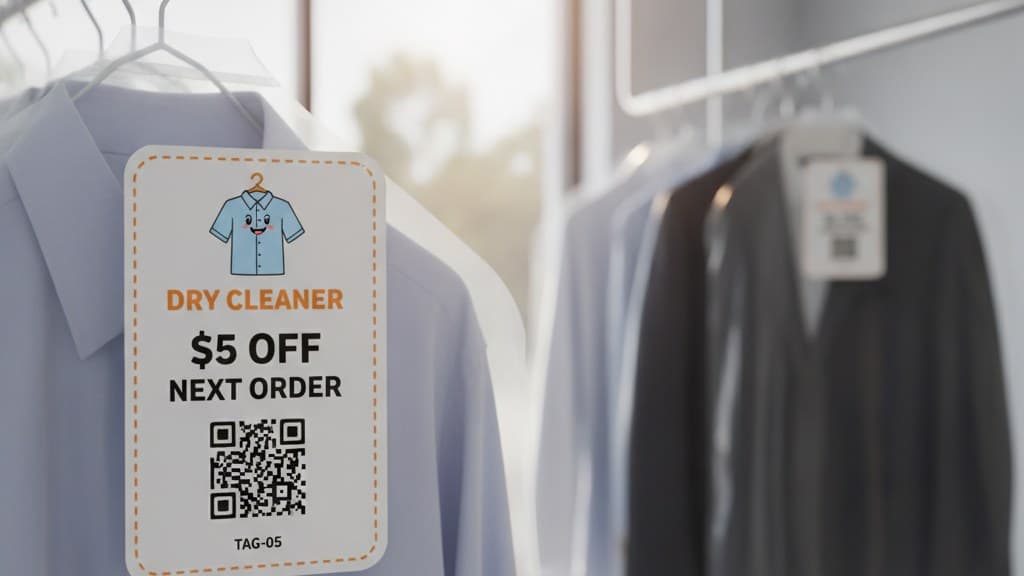
This is the universal play, and the one the whole article is built around. Every customer who picks up an order gets a single-use QR coupon stapled to the top of the poly bag near the hook. $5 off your next order of $25 or more, valid 30 days from pickup, one redemption.
The 30-day expiry is deliberate. It sits just inside the natural three-to-four-week reorder cadence, so the deadline lands right as the next pile is forming. The closet placement does the reminding for free: the coupon hangs where the customer dresses every morning, so the deadline never gets forgotten in a drawer.
Offer shape: $5 off your next order of $25+, valid 30 days, one redemption. Best handed to: Every pickup. Universal. Why it works: The closet is the highest-frequency reminder surface a small business will ever get, and the 30-day window matches the natural reorder cycle exactly.
Play 2: The Seasonal Bulky-Item Upgrade
Job: Capture the once-a-year high-ticket clean (winter coats, comforters, drapes) the customer keeps putting off.
Twice a year there is a wave of bulky items every household owns and no household enjoys dealing with: winter coats going into storage in spring, comforters and drapes at the seasonal turn, formalwear after the holidays. These are high-ticket cleans, and most customers procrastinate them for weeks because the job feels like a chore. Hand a single-use coupon, timed to the season, that takes the friction off: $10 off a comforter or coat clean, valid 45 days, one redemption.
The wider 45-day expiry fits the slower decision cycle on a bulky item, and the flat-dollar framing matters because the customer cannot guess what a comforter clean normally costs, so a percentage off means nothing to them while $10 off reads as concrete.
Offer shape: $10 off a bulky-item clean (coat, comforter, drapes), valid 45 days, one redemption. Best handed to: Every pickup during the spring and fall seasonal turns, plus post-holiday formalwear. Why it works: It removes the procrastination tax on a job the customer already knows they need done, and the high ticket means even a deep discount stays profitable.
Play 3: The Midweek Drop-Off Filler
Job: Shift a few weekend-and-Monday droppers into the dead Tuesday and Wednesday window.
Most neighborhood cleaners are slammed Monday morning and quiet by midweek. That imbalance costs you, because the Monday rush strains staff and the Wednesday lull wastes paid hours. Hand a single-use coupon that rewards a midweek drop-off: $4 off any order dropped Tuesday or Wednesday, valid 30 days, one redemption. The customer who has flexible timing takes the nudge, your midweek conveyor fills, and the Monday crush eases.
Offer shape: $4 off any order dropped Tuesday or Wednesday, valid 30 days, one redemption. Best handed to: Customers who drop on Monday or over the weekend and seem time-flexible. Why it works: It smooths demand into the dead part of your week without cutting price for the customers who were always going to come Monday anyway.
Do This
- ✓Run only one play at a time for the first two weeks until you have data
- ✓Use single-use codes so each discount stops at one redemption
- ✓Match the expiry to the play (30 days for bounce-back and midweek, 45 for bulky)
- ✓Staple or clip the coupon near the hook so it stays visible on the closet rod
- ✓Set a minimum order ($25+) on the bounce-back to protect margin on small tickets
Avoid This
- ✕Don't post the coupon on the storefront window (it stops being targeted)
- ✕Don't hand it at drop-off (the customer is rushed and the bag is dirty)
- ✕Don't run a percentage off (gets photographed and shared in local Facebook groups)
- ✕Don't make the expiry longer than 45 days (urgency is half the mechanic)
- ✕Don't reward the punch-card behavior your loyal regulars already do for free
Where the QR rides home
A dry cleaner has a placement advantage no other small business shares: the product itself goes home and hangs in view for days. The job is to put the QR on the part of the order that survives the trip and stays visible in the closet. Five placements that consistently beat handing a paper coupon at the register:
Clipped to the poly bag near the hook
The single best spot. A small QR card clipped or stapled to the top of the poly bag, just below the wire hook, rides onto the closet rod and hangs at eye level. The customer sees it every morning while choosing an outfit, in the exact room where the decision to bring in the next load gets made. Nothing else a dry cleaner hands out gets that kind of daily attention.
Printed on the claim ticket stub
The customer keeps the claim ticket to retrieve the order. Print the QR on the stub they hold onto, so the coupon is in their hand at the moment they are already thinking about this cleaner. It is a backup to the bag placement for customers who lose the bag tag.
Tucked in the button bag
If you return spare buttons, collar stays, or a care card in a small bag clipped to the order, drop a QR coupon card in with them. The customer finds it the next time they reach for the garment, which is usually inside the reorder window.
On the back of the loyalty or care card
If you already hand out a fabric-care card or a 'how to store your suit' card, print the coupon on the back. Existing objects already make it home; piggybacking on them costs you nothing extra.
On a wallet-size card with the receipt
For walk-out customers who decline a bag or pick up a single shirt, a small wallet card slipped into the receipt fold is the fallback. It is the weakest of the five because it skips the closet, but it beats no coupon at all.
Pickup beats drop-off every time. Drop-off is the rushed, dirty-pile, thinking-about-errands moment. Pickup is the clean, pressed, satisfied moment, and it is the only one where the coupon gets to ride home on the bag. Move the handoff to pickup and the closet does the rest of the work for free.
Turn one visit into many
Hand out single-use QR coupons that pull customers back through your door. Part of your Customer Comeback System. 14-day free trial, cancel anytime.
Create a couponThe pickup-bag math (with real numbers)
Let's stress-test the Pickup-Bag Bounce-Back across a single-counter neighborhood cleaner that processes about 100 pickups in a week.
Hand every one of those 100 pickups a single-use $5-off coupon clipped to the poly bag, minimum order $25, valid 30 days. Because the coupon hangs in the closet rather than dying in a pocket, hanger-tag coupons redeem at roughly 22 percent. That is 22 returning orders inside 30 days, each at the $28 average ticket, each costing you a $5 discount.
You spent $110 on discounts and billed $616 in orders, many of which would otherwise have slipped to week eight or to the cleaner near the customer's gym. The ratio is roughly five-to-one on discount cost to recovered revenue, before counting any alterations, leather, or household items those returning customers bring along.
Be honest about the number. Not all 22 returns are purely "extra," because some of those customers would have come back to you anyway over the following weeks. What the coupon actually buys is the shift: it pulls the next order forward from week eight to week three, and it makes sure the order happens at your counter instead of the competitor's. That shift is real revenue. Calling all 22 returns "new" overstates it.
The counter script at pickup (or the coupon dies)
A QR card clipped to the bag without a word is wallpaper. A QR card clipped to the bag with one sentence from the counter staff is a small gift. The sentence is doing more work than the discount.
Bad version (sounds like a chore): "There's a coupon on the bag, scan it next time."
Good version (sounds like a tip from someone who knows): "Five off your next load. Thirty days. It's on the bag."
The good version names the value, names the deadline, and tells the customer exactly where to find it later, so when they spot the card in the closet next week it already has meaning. Same $5 discount, completely different framing.
Train every counter person on one sentence per play. Consistency is the single biggest predictor of whether a coupon program that should work shows up in your redemption data. One counter person who says the line and one who silently staples the card will quietly cut your numbers in half.
Setting up your first campaign in 6 minutes
Sign in to ReviewQR (14-day free trial)
Create an account with any email at reviewqr.app. The 14-day free trial (card on file, cancel anytime) is enough to test the hanger-tag handoff across a few days of pickups before the trial ends. After that, Essentials is $10/month for 100 single-use coupons.
Pick the play that matches your week
Start with Play 1 (Pickup-Bag Bounce-Back) as your universal handoff. If you are heading into a seasonal turn (spring coat storage, fall comforters), run Play 2 alongside it. Save Play 3 (Midweek Filler) for once you have two weeks of bounce-back data.
Set the offer and expiry
$5 off your next order of $25 or more, valid 30 days from issue, one redemption per code. The single-use mechanic is automatic: once a code is scanned and marked redeemed at your counter, a second scan shows 'already redeemed.'
Print 50 hanger-tag cards
Plain cardstock with a punch hole or a clip works for round one. Skip the design polish. The QR plus 'Next load. 30 days.' is enough text. Size it to clip near the wire hook so it hangs at eye level in the closet.
Brief the pickup counter
One sentence: 'Five off your next load. Thirty days. It's on the bag.' Practice it once before the shift. Make sure every counter person says it, not just the talkative one.
Clip at pickup, never at drop-off
Attach the card near the hook at the moment you hand over the finished order. Pickup is clean, satisfied, and headed home to a closet. Drop-off is rushed and dirty. Always pickup.
If you run more than one location or want to tag campaigns by season and read which one converts, the Essentials plan at $10/month gives 100 codes per month and per-campaign tracking. That tracking is what tells you whether the spring coat push out-pulls the everyday bounce-back, which is the data point worth $10 a month once you are running more than one play.
Common dry-cleaner coupon mistakes
Mistake 1: Handing the coupon at drop-off. Drop-off is the rushed, dirty-pile moment, and the coupon never rides home on a bag. You lose the one placement advantage your business has over every other small business. Always hand at pickup, clipped to the finished order.
Mistake 2: Posting it on the storefront window. A "$5 off your next order" sign in the window kills the targeting. Every loyal three-week regular uses it, and the discount lands on orders you were going to bill at full price. The single-use QR mechanic only works when regulars never see it and drifters always do.
Mistake 3: No minimum order. Without a $25 minimum, a customer redeems $5 off a single $7 shirt and you have torched the margin. The minimum keeps the discount tied to a real load, which is the behavior you actually want to reward.
Mistake 4: Vague or long expiries. "Valid 90 days" reads as "I have forever," and the card hangs in the closet until it is laundry-day wallpaper. Thirty days for the bounce-back and midweek plays, 45 for bulky items. The deadline is half the mechanic.
Mistake 5: Rewarding the wrong customer. A punch card rewards the tenth visit, by which point the customer is already a loyal regular. Point the coupon at the drifter and the first-timer, the customers at risk of slipping away, not the ones who already come like clockwork.
Mistake 6: No script at the counter. A silently stapled card converts far below a card handed with one sentence. The discount is small. The sentence at pickup is the lever, and untrained handoffs underperform trained ones by more than most owners believe until they watch two counter staff in the same week.
Related reading
This piece is about the coupon mechanic for dry cleaners. For the broader single-use QR coupon playbook across small-business categories, the QR coupons for small business overview covers the mechanic at a higher level, and the coupon ideas listicle groups 23 plays by goal (attract new, boost average sale, build loyalty). If you are comparing tools before you commit, best QR coupon app for small business lays the options side by side.
Frequently asked questions
Do QR coupons actually work for dry cleaners, or do customers ignore them?
They work better at a dry cleaner than at almost any other small business, for one structural reason: the coupon goes home and lives in the customer's closet. Every other small business hands a coupon that gets shoved into a pocket or a cupholder and tossed within the hour. A dry cleaner hands the coupon on the poly bag, and that bag hangs in the closet for days or weeks until the garment is worn. The customer sees the coupon every single morning while getting dressed. That closet visibility is why hanger-tag QR coupons at dry cleaners redeem at 20 to 25 percent, well above the 8 to 12 percent typical of a paper coupon handed at a register.
What discount should I put on a dry cleaning coupon?
Match the discount to the job. For a universal next-order bounce-back, $5 off an order of $25 or more is the right size: small enough to protect margin, large enough to register as worth saving. For a bulky seasonal item (winter coat, comforter, drapes), frame it as a flat price or a dollars-off the bulky-item clean rather than a percentage, because the customer cannot guess what the bulky clean normally costs. For a slow-midweek drop-off nudge, $4 off a Tuesday or Wednesday drop-off is enough to shift a few weekend droppers into the dead part of your week.
When should the counter staff hand the coupon to the customer?
At pickup, attached to the poly bag, not at drop-off. Drop-off is the wrong moment: the customer is in a hurry, handing you a pile, and thinking about the rest of their errands. Pickup is the right moment: the order is clean and pressed, the customer is satisfied, and the bag is about to ride home to a closet where the coupon will hang in view for days. Staple or clip the QR card to the top of the bag near the hook so it travels with the garment and stays visible.
Will running coupons train my regulars to wait for a discount?
Not if the codes are single-use and selectively handed. The coupon is never posted on the storefront window or your social media, so a regular who already comes in every three weeks never sees one. You hand it to the drifter, the once-a-season customer, and the first-timer, and the single-use code stops at one redemption. The discount lands on the visit you were at risk of losing, not on the visits you were going to bill at full price anyway.
How is a QR coupon better than the old paper punch card?
A punch card lives in the customer's wallet, gets lost, and rewards a behavior the customer was already going to do (the tenth visit, when they were already a loyal regular by visit four). A single-use QR coupon does the opposite job: it targets the customer who is about to drift away, gives them a reason to come back inside a tight window, and you can see exactly how many redeemed. No card to reprint, no punches to track, no fraud from borrowed cards, and real redemption data instead of a guess.
How many QR coupons should a dry cleaner print to start?
Start with 50, which covers roughly a week of pickups at a single-counter shop and gives you a clean read on the redemption rate. Every ReviewQR plan starts with a 14-day free trial, enough to test the hanger-tag handoff on a few days of pickups before the trial ends. Once the redemption data looks good, the Essentials plan at $10 per month gives 100 codes monthly, which comfortably covers a normal one-location dry cleaner.
Ready to Implement This Strategy?
Create your custom QR code in 2 minutes and start collecting Google reviews today.
Create Your QR Code NowMore Google Review Guides
Florist Google Reviews: 25-40 per Valentine's Weekend
How flower shops collect 25-40 Google reviews per Valentine's or Mother's Day weekend using QR codes on bouquet tags and delivery cards. QR generator + playbook.
Retail & ShopsQR Code Coupons for Eyewear Stores: The Annual Frame Refresh
An optical shop sees each patient once a year and loses the sale to a website in the parking lot. How independent eyewear stores use single-use QR coupons to raise capture rate, attach a second pair, and harvest expiring vision benefits. Math, three plays, placements, and a 6-minute setup.
Retail & ShopsSpring Clean Your Online Reputation with a QR Code
Boost your Google reviews this spring. Learn how to create a review QR code in 60 seconds, where to place it, and seasonal strategies that drive 3-5x more reviews.