QR Code Coupons for Nail Salons: Win the Chip-Day Window
Single-use QR coupons built for the gel cycle. 14-day fill discount, tech-specific referral, pedi add-on bounce-back. With station-side scripts, the economics, and a 6-minute setup.
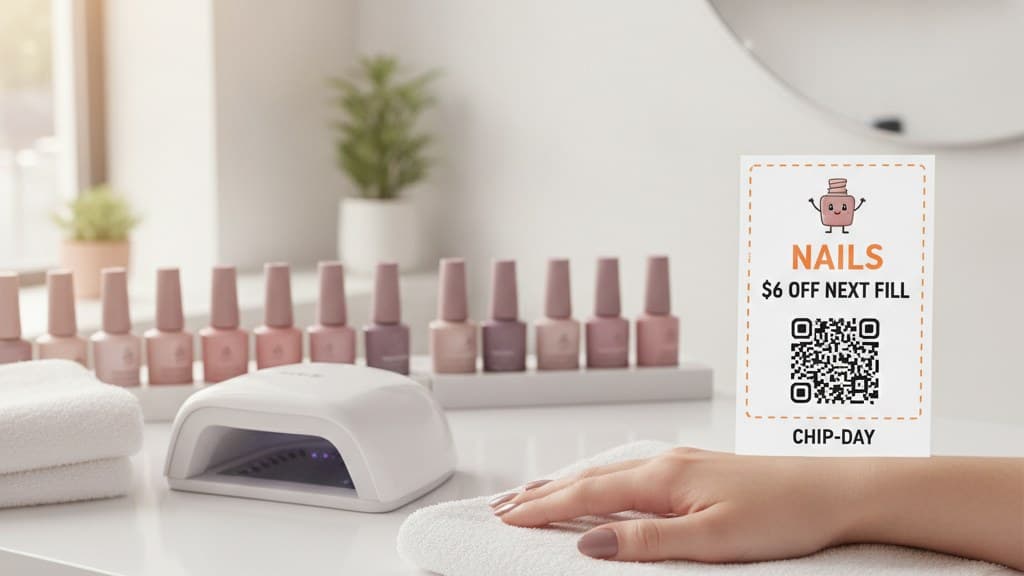
QR Code Coupons for Nail Salons: Win the Chip-Day Window
Turn one visit into many
Hand out single-use QR coupons that pull customers back through your door. Part of your Customer Comeback System. 14-day free trial, cancel anytime.
Create a couponA regular settles into your station on a Saturday. Gel removal, fresh cuticle work, a soft almond shape, two coats of a mauve she picked off the wall. Forty minutes later she pays, tells you "I'll see you in three weeks," and floats out with her hands held flat in front of her like she is carrying something fragile. You both believe the three weeks.
Day twelve, a corner lifts on her index finger. Day fourteen, a thumb chips against a car door. By day seventeen the mauve looks tired and she is hiding her hands in meeting photos. She means to call you. She really does. But the week gets away from her, and on day twenty she peels the gel off at her kitchen table while watching TV, promising herself she will book "next week."
Next week she sees a new salon's grand-opening post with 20 percent off a first set. She is between you and nobody right now, her nails are bare, and the offer is sitting in her feed. She did not leave you because of your work. She left because at the moment her polish failed, you were not on her calendar and someone else was in her feed.
Nail salons live on a clock that the client can literally watch tick on her own fingers. The clock is roughly two to three weeks long, it is visible to the naked eye, and most independent salons do nothing to occupy it. This article is the playbook for using a single-use QR code coupon to plant a flag inside that window and keep your regulars from drifting the week their gel starts to chip.
The Chip-Day Window: when the polish decides for her
Almost every nail service has an invisible expiry date written into the client's own hands. Gel holds a flawless look for about ten days, fights through a chip or a lifted corner for a few more, and by week three reads as grown-out: a visible band of natural nail at the cuticle, a dull top coat, a corner or two missing. Regular polish is shorter, chipping in three to five days. Dip and acrylic stretch further but still telegraph a fill line at the two-to-three-week mark.
That biology is your re-booking calendar. It is also, at most salons, completely ignored.
Most nail-salon marketing works the front of the window. Reels of satisfying gel application. Wall displays of new colors. A booking app the regulars rarely open between appointments. Almost no salon works the back of the window, the chip-day stretch from roughly day ten to day seventeen, which is the exact place a regular either re-books with you or quietly handles it herself and starts to drift.
A QR coupon handed at the station, valid for one visit only, expiring at day 14, does something a booking-app reminder cannot. It puts a deadline on the next visit that the client carries home in her bag, timed to land the same week her gel starts failing. She does not have to remember to re-book. The coupon remembers for her, and the chip on her thumb reminds her every time she reaches for her phone. That sounds small. It is not. On a three-week cycle, pulling the next visit forward a few days, several times a year, adds one extra set into the calendar per client annually. At a $40 average ticket, that is a recovered visit a year per regular from a coupon that costs you, at most, $6 to honor.
Why nail math lives in the calendar, not the cuticle
Salon owners skeptical of coupons usually frame the math backward. They think: a gel set is $40, a $6 coupon is a 15 percent discount, my margin cannot eat that across every client. That math is correct and also beside the point. You are not running the coupon across every client. You are running it on the visits you would otherwise lose entirely.
The unit that matters for a nail salon is not the set. It is the year.
The ratio runs north of 100 to 1. Every dollar you spend defending a regular's cadence protects roughly a hundred dollars of annual revenue. The coupon does not need to convert at a high rate for the math to land hard in your favor. It needs to recover one extra visit per year per redeemer to pay for itself many times over. Realistic single-use coupon redemption inside a 14-day window runs 30 to 50 percent at independent salons, far higher than email or mailer because the client carries the QR home in her bag and her chipping nails do the reminding.
The asymmetry that makes the nail coupon a no-brainer
A new nail client costs the average salon $25 to $45 to acquire, between social ads, first-set discounts, and the time spent on a one-and-done walk-in. Keeping an existing regular on cadence with a $6 single-use coupon is four to seven times cheaper than acquiring her replacement, and she is worth more per visit because she already trusts your tech with her hands and her color choices. Every chip-day coupon you do not run is an acquisition cost you are choosing to pay instead.
Three coupon plays tuned to the gel cycle
The mistake most salons make on their first coupon program is running a single blunt "10% off your next visit" across every client and occasion. The plays below are tuned to the three different jobs a nail coupon should actually do: defend the regular in the chip window, recover the wavering one, and acquire the friend through the tech she trusts.
Play 1: The Chip-Day Fill
Job: Pull regulars back into the chair the week their gel starts to fail.
Hand this one at the station after every gel set. Single-use, $6 off (or 15% off), expires in 14 days. The expiry is the whole mechanic. It lines up with the chip window so the client either books before her gel fully fails, or watches the coupon die exactly when her nails look their worst, which is the same week she is most likely to peel it off at home and drift. The coupon and the chip arrive on the same day, and they argue the same case.
Offer shape: $6 off any gel service, valid 14 days from issue, one redemption. Best handed to: Every gel client at the end of every visit. Universal. Why it works: It puts a hard deadline on re-booking that the client physically carries home, timed to the moment her hands start nagging her. The deadline does the work. The $6 is the wrapper.
Play 2: The Tech-Trust Referral
Job: Turn one loyal client into two by routing the referral through the tech she already trusts.
A standard "give a friend 20% off" referral rarely converts, because the existing client has to find a friend who needs nails done and then sell her on the discount. The tech-trust version flips it: both the client and her friend save $8 when they book back-to-back with the same tech inside the next 30 days. Now the existing client has a reason to coordinate, because her own next fill is on the line, and the friend is being handed to the specific tech the regular already vouches for. Nail loyalty is to the tech, not the storefront, so route the referral through the tech.
Offer shape: $8 off for both, valid only when both book with the same tech, expires in 30 days. Best handed to: Regulars who have visited three or more times and ask for their tech by name. Why it works: It bundles the social proof (the regular vouches by booking alongside the friend), the small incentive (both save $8), and the deadline (30 days). The existing client becomes the closer, and the new client lands on a tech who is already trusted.
Play 3: The Pedi-Add-On Bounce-Back
Job: Lift the average ticket by attaching a pedicure to a visit that was only ever going to be a manicure.
Most gel regulars come in for hands and treat a pedicure as an occasional luxury. The bounce-back hands a single-use voucher for a discounted gel pedicure added to her next manicure visit, not as a standalone trip. Because it has to ride along with a manicure she was already going to book, it does not cost you a discounted solo pedi. It converts a $40 manicure visit into a $75 mani-pedi visit, with the discount applied only to the add-on.
Offer shape: $12 off a gel pedicure when added to a manicure visit, expires in 30 days, one redemption. Best handed to: Regulars who almost never book pedis but come reliably for gel. Why it works: The discount is buying a bigger basket on a visit that was already happening, not a new discounted visit. The math works on ticket size, not frequency.
Do This
- ✓Run only one play at a time until you have redemption data
- ✓Use single-use codes so each discount stops at one client per code
- ✓Match the expiry to the play (14 or 30 days)
- ✓Tag which tech handed the coupon so you can see whose station script works
- ✓Print on small cards or stickers that fit a handbag or wallet
Avoid This
- ✕Don't advertise the coupon publicly on Instagram or the storefront window
- ✕Don't run an open percentage-off (gets screenshotted and shared, kills the targeting)
- ✕Don't pair it with a punch card on the same client (pick one mechanic)
- ✕Don't leave the expiry vague ('see you soon'). Vague expiries do not convert.
- ✕Don't hand it at the till with the card machine (kills the gift framing)
Turn one visit into many
Hand out single-use QR coupons that pull customers back through your door. Part of your Customer Comeback System. 14-day free trial, cancel anytime.
Create a couponWhere the QR rides home from the station
Coffee shops drop coupons on cup sleeves. Barbers tuck them in the cape pocket. Nail salons have their own placement geometry, built around the handbag, the drying station, and the fact that the client's hands are literally out of commission for the last ten minutes of the appointment. Five placements that consistently beat a generic handoff at the front desk:
Tucked into the polish-color card she takes home
Many salons hand the client a small card with her color name and code so she can re-order the exact shade. Print the QR on the back. That card already makes it into the handbag, which means the coupon makes it into the handbag with zero new physical object.
A sticker at the drying station
The client sits at the UV lamp or air-dry station for several minutes with nothing to do and wet hands. A small ReviewQR-style sticker at eye level there lets her scan with the one finger that is dry, or simply read the deadline while her hands cure.
Clipped to the appointment reminder card
If you write her next suggested date on a card, staple the coupon to it. The suggested date and the coupon deadline reinforce each other: 'come back around the 26th, and here is $6 off if you do.'
On the receipt itself
If you print receipts, add the QR. Receipts get folded into the bag without thought, which is exactly the no-friction route you want into the place she keeps her phone and keys.
In the booking app's thank-you message
For salons running a booking app that sends a 'thanks for visiting' note, drop the QR link in that message. Most clients open it in the car before they have even pulled out of the lot.
The placement matters more than the artwork. An hour spent on print design for a coupon handed at the till will under-perform a plain sticker at the drying station every time. Put the code where her hands and her attention already are.
The chip-day math (with real numbers)
Let's stress-test the Chip-Day Fill play across a small salon with 30 gel regulars on a roughly 3-week cadence.
A regular at 3-week cadence books about 17 gel visits a year. In practice, maybe 12 of your 30 regulars are "wavering": they stretch the gap to four or five weeks when life gets busy, or peel the gel off at home and skip a visit entirely. The Chip-Day Fill coupon, landing the same week their nails start to fail, recovers an average of 1.5 visits per year from each of those wavering regulars by pulling the next booking forward before the drift sets in.
You spent $108 in discounts to recover roughly $720 in gel services that would otherwise have walked, and that figure does not count tips, the occasional pedi add-on, or the retail polish those recovered visits drag along with them. The ratio sits near seven to one before any of that.
The trap to avoid is discounting the loyal regular who was always coming back on day 19 anyway. She redeems the coupon, you eat $6, and you changed nothing. The fix is not to stop running the coupon (you cannot tell in advance who is wavering). The fix is to keep the discount small enough ($6, not $15) that even the "wasted" redemptions barely dent the math, while the recovered visits carry the whole return. A small discount on everyone, funded by the few you actually save, is the entire model.
The station-side script (or the code dies)
A QR coupon handed in silence lands as junk in the bottom of a handbag. The same coupon handed with eight specific words lands as a small kindness from a tech she trusts. The script is doing more work than the discount.
Bad version (sounds transactional): "Here, scan this for some money off next time."
Good version (sounds like a gift): "Take this. Fourteen days. Book before the chips start."
The good version does three things the bad one misses. It gives a clear instruction (fourteen days), it ties the coupon to the biology of the gel (before the chips start), and it makes the tech the authority on the timing rather than a salon pushing a promo. Same six-dollar discount, completely different framing.
Train every tech on the same single sentence. Inconsistency across stations is the most common reason a coupon campaign that should be working never shows up in the redemption data.
Setting up your first campaign in 6 minutes
Sign in to ReviewQR (14-day free trial)
Use any email to create an account at reviewqr.app. The 14-day free trial (card on file, cancel anytime) is enough to test the Chip-Day Fill play across your first two weeks of regulars. After that, Essentials is $10/month for 100 single-use coupons.
Pick one play, not three
Run the Chip-Day Fill first. It is the most universal and the easiest to brief the station on. Add the Tech-Trust Referral once you have two weeks of redemption data on play one.
Set the offer and expiry
$6 off any gel service. Expires 14 days from scan. One redemption per code. The single-use part is enforced automatically: once a code is scanned and marked redeemed, the second scan shows 'already redeemed.'
Print 30 handbag-size cards
Order small cards from a local print shop or print on cardstock and cut. Skip the design polish on round one. A plain QR plus 'Book within 14 days' is enough to test the mechanic.
Brief the station on the script
Eight words: 'Take this. Fourteen days. Book before the chips start.' Practice it once with the team before the shift opens.
Hand at the station, not the till
Right after the top coat cures and she is admiring her hands, before she walks up to pay. Drying station, color card, or palmed handoff at the chair.
If your salon runs several techs and you want per-tech tracking, the Essentials plan at $10/month gives 100 codes a month and lets you tag campaigns by tech. That tag is what tells you whose station script actually converts, which is the data point worth $10 a month once you have three or more techs working.
Common nail salon coupon mistakes
Mistake 1: Running the coupon publicly. Posting "scan this for $6 off" on Instagram turns a precision tool into a margin leak. Every existing regular sees it, every regular redeems it, and the discount lands on visits you were going to bill at full price anyway. Keep it a station handoff, not a broadcast.
Mistake 2: A vague expiry. "See you soon" or "valid 90 days" reads to the client as "I have time," which her brain files as "I have forever." Fourteen or thirty days is the right zone. The precision is doing the work, because it has to line up with the chip window.
Mistake 3: Handing it at the till. The moment she taps her card is the least generous-feeling second of the whole visit. Move the handoff to the drying station a few minutes earlier and redemption climbs, because the coupon reads as a gift instead of an upsell.
Mistake 4: Routing the referral around the tech. Nail loyalty lives with the tech, not the storefront. A referral that does not name the tech the friend should book with throws away the one piece of trust that makes the referral convert. Always route the friend to a specific tech.
Mistake 5: No script. Untrained handoffs underperform trained ones by a margin most owners do not believe until they A/B it across two techs in the same salon. The discount is small. The framing is the entire campaign.
Mistake 6: Coupon plus punch card on the same client. Pick one mechanic per client. Stacking confuses your redemption tracking and lets the client redeem both on the same visit, which doubles your cost on the visit that needed the least help.
Related reading
This piece focuses on the coupon side of the nail-salon playbook. If you also want to use the station moment to collect Google reviews (a different mechanic that complements the coupon flow), the salons and spas Google reviews guide covers the chair-side review ask in the same beauty-wellness vertical. For the rebooking-window play one cycle longer than gel, the QR coupons for salons and spas guide covers the 4-to-8-week color and treatment gap. For coupon mechanics across other categories, the coupon ideas listicle groups 23 plays by goal, and the QR coupons for small business overview covers the single-use mechanic at a higher level. For a side-by-side of QR coupon tools, see best QR coupon app for small business.
Frequently asked questions
Do QR code coupons actually work for nail salons?
Yes, because a gel manicure has a built-in expiry date the client can see on her own hands. Gel holds a clean look for about two weeks, starts lifting and chipping around day ten to fourteen, and by week three is something she is hiding in photos. A single-use QR coupon handed at the station with a 14-day window lands at the exact moment the polish starts to fail, which is the precise week she either re-books with you or peels it off at home and drifts. The coupon turns a vague intention into a deadline she carries home in her bag.
What discount should a nail salon put on a coupon?
Match the discount to the job. For a chip-day fill within 14 days, $6 off or 15% off is enough because the client is already a regular and only needs a reason to book now instead of next month. For a first-time return, 20% off works because she has not yet decided you are her salon and the discount is buying the habit. For a tech-specific referral, "you both save $8" beats one large single-use because it forces the existing client to actually bring the friend rather than spending the coupon alone.
When should the nail tech hand over the QR coupon?
At the station, right after the top coat cures and she is admiring her hands, before she walks to the front desk to pay. That cure-and-admire moment is the peak of satisfaction in a nail appointment. The set looks perfect, the verdict is positive, and she has not yet seen the total. A coupon handed there reads as a gift from her tech. Handed at the till with the card machine, it reads as part of the bill. The placement is small, the difference in redemption is large.
Will discounting hurt my margins as an independent nail salon?
Not if you only discount the visits you would otherwise lose. Nail math runs on visit frequency, not on the margin of a single set. A client on a 3-week gel cadence is worth roughly $650 to $800 a year. A client who lapses after two visits is worth $80. Spending $6 to pull a wavering regular back into her cycle is one of the cheapest moves you can make. Blanket discounting across every chair is the version that bleeds margin. Single-use QR codes aimed at the drift moment do not.
How is this different from a punch card or loyalty stamp?
A punch card rewards visit ten. A QR coupon rescues visit three and defends the cadence in between. Most salons that track their loyalty data find the punch-card reward goes almost entirely to clients who were coming back anyway. The visits where you actually need help are the early ones, where a new client decides if you are her salon, and the chip-week visits where a regular is tempted to stretch the gap or do it herself. A punch card touches neither of those.
How many QR coupons should a small nail salon print to start?
Start with 30. That covers about two weeks of stations at a small salon and gives a clean read on which offer redeems best. Most owners find their first guess on offer and expiry is slightly off, and a small first batch keeps that lesson cheap. Every ReviewQR plan starts with a 14-day free trial, which is enough to test the chip-day mechanic before you pay anything.
Ready to Implement This Strategy?
Create your custom QR code in 2 minutes and start collecting Google reviews today.
Create Your QR Code NowMore Google Review Guides
QR Code Coupons for Barber Shops: Close the 3-Week Fade Window
Single-use QR coupons built for the barber calendar. Slow-day fade refresh, 14-day return discount, buddy-cut referral. With chair-side scripts, economics, and a 6-minute setup.
Beauty & WellnessQR Code Coupons for Salons and Spas: Close the Re-Booking Gap
Single-use QR coupons designed for the salon calendar — pre-book at the chair, defend color clients, slow-day refill, stylist-led referrals. With economics and a step-by-step setup.
Beauty & WellnessHow Salons & Spas Can Get More Google Reviews with QR Codes
Proven QR code strategies for salons and spas to collect more Google reviews. Learn the Post-Service Bliss Window, best placements, and real conversion rates.