QR Code Coupons for Salons and Spas: Close the Re-Booking Gap
Single-use QR coupons designed for the salon calendar — pre-book at the chair, defend color clients, slow-day refill, stylist-led referrals. With economics and a step-by-step setup.
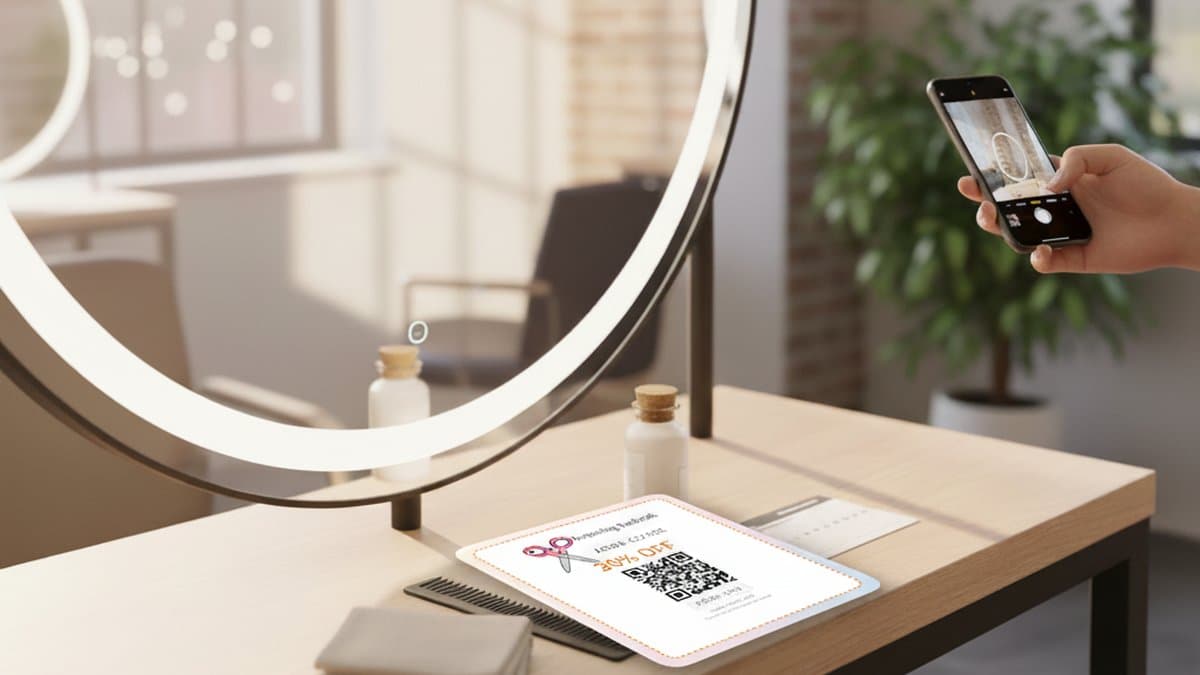
QR Code Coupons for Salons and Spas: Close the Re-Booking Gap
There's a moment that defines salon economics, and most owners never see it happen.
Picture your favorite regular — the one who's booked every six weeks for the last two years, gets the same color and a 30-minute trim, tips well, never complains. One day she misses an appointment. She texts that she'll re-book "next week." Next week becomes the week after. By the time eight weeks pass, she hasn't responded to the front desk's check-in message. By twelve weeks, she's quietly booked across town at a salon her coworker recommended.
You didn't do anything wrong. You just lost roughly $1,200 of annual revenue in a silence that nobody at your salon noticed.
That silence — the gap between visits where a regular either re-books or drifts — is exactly what a single-use QR coupon is built to close. Not the in-the-moment review trigger your salon already uses to collect Google reviews (different problem, also worth solving). This is the post-service silence — the four-to-eight-week window where loyalty actually breaks. This article is the playbook for closing it.
The Re-Booking Window: where salon loyalty actually breaks
Every salon service has a built-in expiry date written into the client's hair. A women's cut wants a re-shape at 8-10 weeks. Single-process color holds for 4-6 weeks before the roots get loud. Balayage stretches to 10-14 weeks but the gloss fades at 6. A men's fade looks intentional for about three weeks, then becomes a haircut someone is hiding.
That biology is your calendar — and it's also your most underused marketing asset.
Most owners look at the front of that window — the booking. They post on Instagram, run Groupon promotions for new clients, optimize the front desk script. Almost nobody works the back of the window, which is where regulars actually leak. A client who walks out the door without a re-booked appointment is 3-4× more likely to land somewhere else by week ten.
This is the gap a QR coupon is built for. Not as a discount — as a deadline. Handed at the chair, valid for one visit only, with a real expiry inside the natural service interval, the coupon turns "I'll re-book sometime" into "I have until the 14th to use this." Small mechanical change, large compounding effect.
What one re-booked client is actually worth
Owners discount coupons because they're thinking about the cost of the discount, not the value of the client they're defending. The salon math is unusually unforgiving on this — high ticket, low frequency, and a long enough gap between visits that the lifetime value of a single regular dwarfs the cost of any reasonable coupon you'd run to keep her.
Let's put numbers on it for a typical color client at a $$$ neighborhood salon:
The ratio is roughly 100 to 1 — every dollar spent on a re-booking coupon defends one hundred dollars of annual revenue, assuming the coupon causes one re-booking that would otherwise have leaked. You don't need that coupon to "work" 100% of the time for the math to be wildly positive. It needs to work 3% of the time to break even. Realistic redemption rates on single-use chair-handed coupons run 25–45%.
The asymmetry that makes this a no-brainer
A new color client costs the average salon $40–80 in acquisition (ads, intro discounts, Groupon margin). Keeping an existing one with a $15 coupon is 3–5× cheaper than acquiring her replacement, and she's worth more per visit because she already trusts the colorist with the formula. Every retention coupon you don't run is an acquisition cost you're choosing to pay instead.
Six coupon plays designed for the salon calendar
The mistake most salons make with coupons is running the same blunt percentage off across every customer and occasion. The plays below are tuned to the service intervals, the client segments, and the moments where salon clients actually drift.
1. The Pre-Book and Save coupon
Handed at checkout, redeemable only if the client books her next appointment on the spot or within seven days. Offer: $15 off or a free conditioning treatment / scalp massage / gloss refresh. Expiry: 7 days.
The friction the coupon removes is the procrastination cliff. The client knows she'll need a re-color in six weeks, but the friction of opening the booking app at home is exactly what kills 30–40% of the would-be re-bookings. The coupon collapses the "later" into "now" — and now you have her in the system, the colorist's notes are still in her chair card, and the next visit is locked.
2. The Color Drift Defender
Sent at week 5 of a color client's cycle (a few days before her natural re-booking moment). Channel: WhatsApp, SMS, or whatever you already use to remind clients. Offer: $20 off a color refresh, single-use, valid 10 days.
The job here is interception. By week 5, your color client is starting to notice the roots in the bathroom mirror, weighing her options, and being targeted on Instagram by every competitor in a five-mile radius. A coupon arriving in that window reframes you from "the usual $200 outlay" into "the $180 thing with the appointment already half-decided." It's the cheapest, most leveraged coupon a color salon can run.
3. The stylist hand-off referral
Hand a regular three single-use stickers — "Free haircut on me. Single use, valid until [date]." — and tell her to pass them to friends. The discount is shocking (a free haircut), the asymmetry is the trick: the regular doesn't have to "refer" anyone or feel salesy, she just hands a free haircut to someone who needed one.
The friend walks in, the QR is scanned, the friend is in your chair. Cost: one discounted haircut (perhaps $40–60 of opportunity cost). Value: a regular who already trusts your salon enough to vouch for it, plus a new client with a real chance of becoming a $1,500/year regular herself.
4. The "we noticed" birthday coupon
Most booking systems already store birthdays. A week before each one, send a personal coupon: "It's your birthday week — blowout or scalp treatment on us, anytime in the next 14 days." Single-use, time-bound, costs you almost nothing because it's a low-margin add-on, and salons consistently find this is one of the most talked-about gestures they make all year.
Birthdays beat anniversaries in salons because they're personal and predictable. Anniversaries (one year as a client, two years, etc.) work too but the data is messier; birthdays land cleanly.
5. The add-on upgrade coupon
This is the silent margin lift the other five plays don't cover. Hand a coupon for an add-on the client never asks for and rarely buys at full price — a deep conditioning treatment, a glaze, a brow tidy, a 10-minute scalp massage. Single-use, valid through the next two appointments.
The play here isn't acquisition or retention — it's average ticket. A client who'd have spent $185 on color + cut now adds a $25 glaze because she has a $25 coupon expiring. Your variable cost on the glaze is $4 in product and 8 minutes of chair time you'd already paid for. The math is unusually clean.
6. The slow-day refill coupon
Every salon owner knows their dead window. For most it's Tuesday morning and Wednesday afternoon, before the post-work rush. A standing happy-hour discount erodes margin every week, even on the days you didn't need it. A targeted single-use coupon does not.
Hand stickers on Saturday — your busiest day — that are valid only Monday through Wednesday for the next two weeks. "$15 off any service Mon–Wed before 2pm." Clients self-select into your dead hours because they're holding a coupon that only works then. Your peak revenue stays at full price; your trough fills with people who already love you.
Don't run all six at once. Pick the one that hurts most right now — drift among color clients, low average ticket, soft Tuesdays — and run only that for a month. You'll learn faster, and your team won't get confused about which sticker to hand to whom.
Stylist hand-offs vs front-desk hand-offs
This is the salon-specific dynamic that doesn't exist in most other businesses. Your clients are loyal to a person, not a brand. They book with Maya, not with the salon. When Maya leaves, 60–80% of her book leaves with her.
That changes who should hand which coupon, and it shapes the whole campaign.
| Coupon type | Who hands it | Why |
|---|---|---|
| Pre-Book and Save | Stylist, at the chair | The stylist is the trust anchor; the offer feels personal |
| Color Drift Defender | Stylist's WhatsApp or salon SMS | Either works; from-the-stylist messages convert better |
| Stylist hand-off referral | Stylist, hand-given to regular | The whole mechanic depends on stylist-to-client trust |
| Birthday | Front desk / salon system | Personal but coming from "the salon" is fine |
| Add-on upgrade | Stylist, at the chair | The stylist suggests, then hands the coupon to anchor it |
| Slow-day refill | Front desk, at checkout | Volume play; the front desk has the throughput |
The pattern: anything that needs the relationship to convert (re-booking, referral, add-on) goes through the stylist. Anything that's a volume play (birthdays, slow-day fill) goes through the front desk. Trying to centralize all of it at the front desk is the single most common reason salon coupon campaigns under-perform.
The independent-chair version
If you rent a chair in a larger salon (booth rental), every one of these plays is your personal campaign — not the salon's. The Pre-Book coupon, the Drift Defender, the stylist hand-off referral, even the slow-day refill (your slow days, not the salon's) — all of it. The same toolkit becomes your independent re-booking engine. You're not asking the salon for permission; you're handing single-use stickers to your own clients with your own offer.
Brief the team or the campaign dies
The single biggest predictor of whether a salon coupon campaign succeeds isn't the offer or the design. It's whether the team knows what to do when a client shows up with a sticker.
The fail mode is universal and embarrassing: a regular comes in three weeks after checkout, hands the front desk a printed sticker, and the receptionist says some version of "oh, let me check with Maya, I'm not sure how this works." The client feels awkward. Maya is mid-color on someone else. Five minutes pass. The coupon never gets redeemed cleanly, and the client quietly decides not to bring stickers back.
Do This
- ✓Run a 5-minute team huddle the morning the campaign goes live. Show the actual sticker, do one practice scan-and-redeem on a phone
- ✓Pick ONE coupon campaign per month. Multiple campaigns running in parallel confuses staff and clients
- ✓Print the offer wording on the sticker exactly as you want staff to honor it — 'Free conditioning treatment with any color, expires June 30' leaves zero room for interpretation
- ✓Keep redemption to ONE staff action (scan the QR with a phone, tap Redeem). If it needs POS integration to feel real, you've over-engineered it
Avoid This
- ✕Don't launch without telling stylists what the coupon is and how to redeem it — they're the trust anchor, and they need to look confident, not surprised
- ✕Don't allow 'I'll honor it but the coupon's already used' workarounds — the whole single-use mechanic depends on the lock being enforced every time
- ✕Don't price the coupon offer below your variable cost. A free coupon you lose money on isn't generosity, it's a leak
- ✕Don't run a coupon you can't measure. If you can't count redemptions, you can't tell which play actually moved the calendar
Case study: Mira & Co, a Brooklyn color salon
Mira runs a five-chair salon in Williamsburg with three full-time colorists and a part-time stylist. Average ticket $195, mostly color and balayage clients on 6–10 week cycles. Solid Google reviews, fully booked on Saturdays, struggling Tuesdays. The owner suspected she was losing color clients to a salon that opened nearby — but she had no idea how many, or when in the cycle the leak was happening.
She ran a six-week pilot with two of the plays from this article, sequenced deliberately.
- 1
Weeks 1–3: Pre-Book and Save
Every checkout: a $15-off sticker valid for 7 days, redeemable only on a booked next appointment. Front desk handed it; stylists mentioned it from the chair. 124 stickers handed out.
- 2
Weeks 4–6: Color Drift Defender
At week 5 of each color client's cycle, an automated WhatsApp went out with a single-use $20-off color refresh coupon, valid 10 days. 47 sent in the window.
- 3
Tracking
Each campaign had unique single-use codes. Redemptions counted automatically — no staff guesswork.
"I'd been told for years that coupons were beneath us — that real salons don't discount. The reframe was understanding that I wasn't discounting, I was paying a small cost to defend the most valuable clients I already had. The Drift Defender alone is the single highest-ROI thing I've done since I opened the salon." — Mira, owner
The numbers aren't the point — the method is. One coupon per goal, single-use, measured. That's a system, not a sale.
Setup: live before your next color appointment
- 1
Pick the one play that hurts most
Color drift, low average ticket, or soft Tuesdays. Don't try to ship all six in week one. The one that's actually leaking revenue is the one to start with.
- 2
Write the offer in one sentence
Plain English, with a specific number and a real expiry. 'Free deep conditioning with any color service, expires June 30.' Vague offers ('come back soon for a treat') don't convert.
- 3
Generate the QR coupon campaign
Pick a mascot, set the count (start with 50), set the expiry, generate the PDF sticker sheet. Every ReviewQR plan starts with a 14-day free trial, enough to test the whole loop before your first bill; Essentials ($10/month) covers 100 coupons in any rolling 30-day window, Growth ($25/month) covers 500.
- 4
Brief the team in a 5-minute huddle
Show the sticker, do one practice scan-and-redeem. Decide who hands it (stylist or front desk), at what moment, and what to say when they hand it.
- 5
Print, hand, measure
Print at home on sticker paper or a local print shop. Hand them for two weeks, then look at the redemption count. That number is your conversion — not 'how the campaign felt'.
Build your first salon coupon
If you're not yet collecting Google reviews at the chair, the Google review QR code generator sets that up in a couple of minutes — and the same account runs your coupons. Reviews bring strangers to the booking page; coupons close the gap between visits. Same toolkit, two jobs.
Common mistakes that quietly kill salon coupon ROI
Every salon that runs this for a few months learns the same lessons. Skip the months it would take you, here are the patterns owners regret:
- Running one standing public discount instead of single-use campaigns. A permanent "$10 off color on Tuesdays" trains every existing client to wait for Tuesday. A single-use Drift Defender sent only to clients at week 5 of their cycle doesn't, and the targeting is what makes it pay.
- Sending the Drift Defender to clients who just visited. A $20-off coupon arriving the week after a client paid full price reads as "I overpaid." Hold the coupon until week 5 of the natural cycle, not week 1.
- Discounting your highest-margin service by default. Color is your gross-margin engine; don't make it the default discount target. The add-on coupon (glaze, gloss, treatment) does more work because the marginal cost is tiny.
- Forgetting the team huddle. A stylist who looks confused at a sticker burns the trust the coupon was built on. Five minutes on a Monday morning solves it.
- No expiry, or "valid for 90 days." Long expiries kill urgency, which kills redemption. Two weeks for chair-handed coupons, ten days for messaged coupons.
- Running coupons you cannot count. If you can't see redemption numbers, you can't tell a working play from a money-losing one. Single-use QR coupons make this automatic — every code redeems exactly once, the count is your conversion.
For the broader logic on coupon design across business types, see our coupon ideas for small business playbook — the goals and mechanics map across niches, but the rhythm of a salon is genuinely its own thing. And if you're running a multi-location group, the QR Coupons launch overview covers the platform mechanics in one place.
Frequently asked questions
Do QR coupons actually work for salons and spas?
Yes, but for a specific job: closing the gap between visits. A salon's biggest revenue leak isn't unhappy clients — it's regulars who quietly drift after 6–8 weeks. A single-use QR coupon handed at the chair with a real expiry pulls the next visit forward by a week or two, which compounds over a year into thousands of dollars per regular.
What's the best discount to put on a salon coupon?
It depends on the goal. For pre-booking the next visit, $10–15 off (or a free add-on like a gloss or scalp treatment) is enough — the client already loves you, you just need to remove the procrastination. For winning a new client, be more generous: 20% off the first color or a free haircut with any color service. Always check the offer against your margin before printing.
When should I hand a coupon to a salon client?
At checkout, right after they've seen the result in the mirror and paid. That's the emotional peak combined with the practical moment — they have the coupon in hand, they remember why they're paying it forward, and the next visit is the most likely it'll ever be. Coupons mailed or emailed later convert at a fraction of that rate.
How do I keep a color client from switching salons when the price goes up?
Color clients are the most likely to drift because the gap between visits is long and competitors advertise heavily on price. A single-use "color refresh" coupon sent at week 5 (before they start price-shopping) with a real expiry reframes the next visit as a saved $20–30, not a $200 outlay. It's a small price to defend a $1,000+/year client.
Can a stylist run their own coupon campaign for their own clients?
Yes — and it tends to convert better than a salon-wide campaign because clients are loyal to the stylist, not the brand. The stylist hands a single-use sticker to their own regulars ("book your next color with me before June 15, conditioning treatment on me") and the redemption is tied to their chair. Most independent stylists running a chair in a salon use this as their personal re-booking engine.
How many coupons should a small salon print to start?
Start with 50. That covers about two weeks of full-time stylist hand-offs at a 5-chair salon and is enough volume to learn what offer redeems and what falls flat. Print more once you've seen the first round come back — most owners discover their first guess on offer/expiry is wrong, and a small first batch saves wasted stickers.
Keep reading
QR Code Coupons for Waxing Studios: The 4-Week Regrowth Reset
How waxing and brow studios stop the shave relapse and hold clients on a 4-week cycle with single-use QR coupons. Unit economics, three plays, room placement geometry, scripts, and a 6-minute setup.
Beauty & WellnessQR Code Coupons for Nail Salons: Win the Chip-Day Window
Single-use QR coupons built for the gel cycle. 14-day fill discount, tech-specific referral, pedi add-on bounce-back. With station-side scripts, the economics, and a 6-minute setup.
Beauty & WellnessQR Code Coupons for Tattoo Studios: Ride the Fresh-Ink Referral Moment
Tattoo clients do not rebook every three weeks. They show their fresh ink to everyone for two weeks straight. Here is how to use single-use QR coupons to turn that reveal moment into referrals, touch-up returns, and aftercare sales. With math, scripts, and a 6-minute setup.