QR Code Coupons for Juice Bars: Turn One Cleanse Into a Habit
How indie juice and smoothie bars use single-use QR coupons tied to the 7-day detox cycle, the cleanse comeback, and the gym-buddy referral to close the first-sip-to-habit gap. With math, scripts, and a 6-minute setup.
QR Code Coupons for Juice Bars: Turn One Cleanse Into a Habit
It is the first Monday in January, or the Monday after a long weekend, or the morning after a heavy week. A customer walks into your juice bar with a clear face and a clear plan: this is the week things change. They order the green juice with the ginger shot, they pay the eight dollars without flinching, and they walk out genuinely meaning to come back tomorrow.
You will probably never see them again. Not because the juice was bad. Because the plan was a feeling, and the feeling faded by Wednesday. The gym membership they bought the same week is already collecting dust. The meal-prep containers are still in the box. And the green juice habit, the one that was going to stick this time, died the same quiet death as the rest, somewhere between a busy Tuesday and a forgotten Thursday.
This is the central problem of running a juice or smoothie bar. Your product sells itself on a wave of good intentions, and good intentions evaporate. The customer who buys once on a burst of motivation is not a regular. They are a one-time donor to a goal they abandoned. And almost every indie juice bar in the country lets that customer walk out the door without putting a single thing in their hand that pulls them back inside the window where the intention is still alive.
The chains do not let that happen. Smoothie chains have apps, points, push notifications, and "your next reward is 40 points away" emails. The reason they invest in all of it is not the app itself. It is that a logged-in app member buys roughly twice as often as a walk-in, and the entire chain smoothie business runs on closing that gap. You do not need an app to close it. You need a single-use QR coupon, handed at the counter, with a 7-day expiry. This article is the playbook for using it.
The 7-Day Detox Restart: a health goal is a built-in return reason
Most small businesses have to manufacture a reason for the customer to come back. A coffee shop invents a loyalty stamp. A clothing store invents a sale. A restaurant invents a Tuesday special. The reason is artificial, bolted on, and the customer knows it.
A juice bar is different. Your customer arrives already carrying a reason to return, and they brought it with them: they are trying to be healthier. That is not a marketing message you have to sell. It is a goal they set for themselves, usually with a weekly rhythm built in. "I'm going to drink a green juice every Monday." "I'm doing a reset this week." "I want to get back on track." Every one of those statements is a recurring appointment the customer made with themselves, and your job is simply to be the place where that appointment gets kept.
The trouble is that the appointment is fragile. Health routines have a known failure point right at the start: the first week is when most new habits die. The customer who buys one juice on Monday is statistically most likely to lapse before the following Monday. So the single most valuable thing you can do is plant a flag inside that first week, before the motivation cools, that gives the routine somewhere concrete to land.
That flag is a single-use coupon with a 7-day expiry. The 7-day window is not arbitrary. It maps onto the customer's own weekly intention. "Come back in 7 days" reads to a motivated customer not as a discount deadline, but as the next instance of the thing they already told themselves they would do.
The coupon does not have to convince the customer that a green juice is good for them. They already believe that, which is why they walked in. The coupon just has to catch the intention before it evaporates and give it a specific date to fire on. That is a far smaller job than persuasion, which is exactly why it works.
The first-sip-to-habit gap (and the revenue trapped in it)
The number that runs a juice bar is not the price of a single smoothie. It is how many times per year a given customer comes back. A smoothie at $7 is a rounding error. A customer who buys 40 smoothies a year at $7 is $280 of revenue, and the difference between a one-time buyer and that $280 customer is entirely a question of frequency, not of ticket size.
Here is where most operators misread the situation. They look at a slow Tuesday and think the problem is foot traffic, so they discount on the menu board to pull in strangers. But the expensive leak is not the strangers who never came. It is the people who came once, liked it, and then drifted, because nothing reached into their first week and turned the visit into a rhythm. Those customers already cleared the hardest hurdle: they walked in and paid. Letting them lapse is throwing away the acquisition cost you already spent.
The asymmetry that makes the math run hot
A drifter who buys once every three weeks is worth about $123 a year at a $7 average ticket (roughly 17 visits). Compress that cadence to once every 10 days with a 7-day restart coupon working over 12 months, and the same customer becomes roughly $245 a year (about 35 visits). That is $122 of recovered annual revenue per drifter at a cost of maybe three or four $2 discounts a year, call it $8. The ratio runs better than 15 to 1 on coupon cost to revenue recovered, before you count a single add-on shot or protein scoop on the extra visits.
The discount is not a price cut. It is a frequency lever. The juice bar P&L is driven by visits per customer per year, and any coupon that shifts a drifter even one notch up the cadence ladder pays for itself many times over. You are not buying a sale at $2 of margin. You are buying a habit, and a habit compounds for the rest of the year.
Three coupon plays for the counter
The three plays below do three different jobs: catch the first-week drifter, bring back the cleanse buyer, and turn one gym-buddy into two customers. Each is a single-use QR code with a tight expiry. Run one for two weeks, read the data, then layer the next.
Play 1: The 7-Day Restart
Job: Catch the first-week drifter and convert one motivated visit into a weekly rhythm.
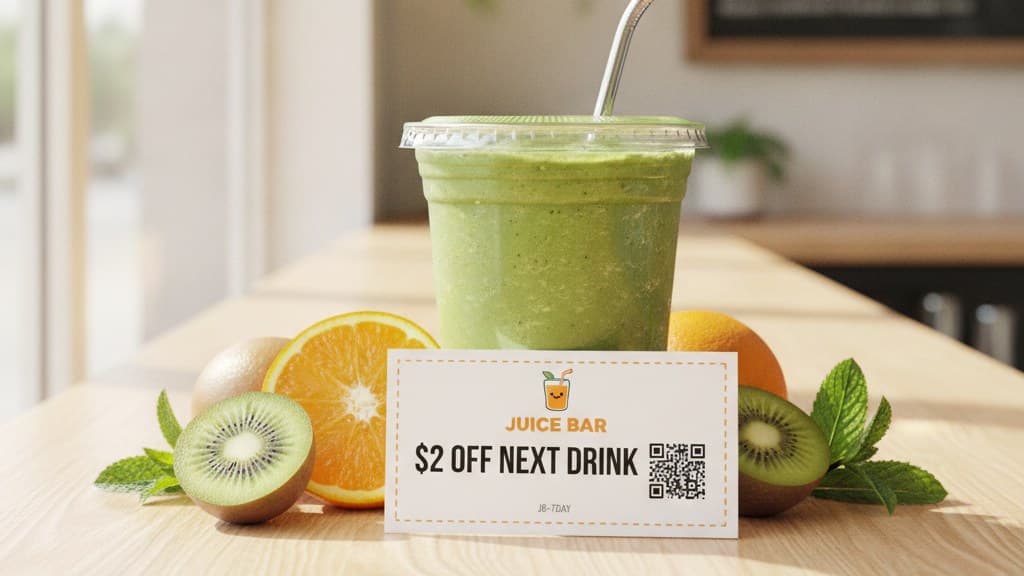
Every customer who buys a juice or smoothie gets a single-use QR coupon handed at pickup. $2 off any drink, valid 7 days from issue, one redemption. The expiry is the whole mechanic. It lands the next visit inside the same week the customer is still riding the motivation that brought them in today. Seven days later the goal is still fresh, the coupon is in their bag, and your counter is now the path of least resistance for the appointment they already made with themselves.
Offer shape: $2 off any juice or smoothie, valid 7 days from issue, one redemption. Best handed to: Every paying customer. Universal. Why it works: The discount is small. The 7-day deadline syncs to the customer's own weekly health intention, so it reads as a reminder, not a markdown.
Play 2: The Cleanse Comeback
Job: Turn a one-off cleanse purchase into a recurring monthly reset.
A customer who buys a 1-day or 3-day cleanse is making a bigger commitment than a single smoothie: they spent $40 to $120 and blocked out days of their life to do it. That is your most motivated buyer in the building. Hand them a single-use coupon for 15 percent off their next multi-day cleanse, valid 30 days. Cleanses run on a monthly or quarterly reset rhythm, so the 30-day window catches the natural moment they start thinking "I should do another one." The discount makes them book it with you instead of putting it off another month.
Offer shape: 15 percent off the next multi-day cleanse, valid 30 days, one redemption. Best handed to: Anyone who buys a 1-day or multi-day cleanse package. Why it works: The cleanse buyer has already proven they will spend big on a reset. The coupon shortens the gap to the next one and locks the booking to your bar.
Play 3: The Gym-Buddy Referral
Job: Convert one health-minded regular into a two-person habit.
Juice bars live next to gyms, yoga studios, and run clubs, and your customers travel in pairs and groups. The post-workout smoothie is a social ritual. Hand your regular a single-use referral coupon: bring a friend, both of you save $2 on your drinks. The friend is pre-qualified (they already work out with your customer) and the shared discount turns the visit into a small social event instead of a solo errand. The new customer then enters Play 1 with their own 7-day restart coupon at pickup.
Offer shape: Bring a friend, both save $2, valid 14 days, one redemption per code. Best handed to: Visible regulars who come in workout gear or talk about their gym. Why it works: The referral rides an existing relationship and an existing routine. You are not buying a stranger, you are borrowing your regular's social proof.
Do This
- ✓Run only one play at a time for the first two weeks until you have clean data
- ✓Use single-use codes so the discount stops at one redemption per code
- ✓Match the expiry to the play (7 days for restart, 30 for cleanse, 14 for referral)
- ✓Hand the coupon at pickup, with the cup, not at the register
- ✓Print on small cards or stickers that survive a condensation-wet cup
Avoid This
- ✕Don't put the offer on the menu board (it stops being targeted and trains regulars)
- ✕Don't pair it with a posted happy-hour discount (kills the gift framing)
- ✕Don't run a flat percentage off single drinks (gets screenshotted into deal groups)
- ✕Don't set the restart expiry past 10 days (the weekly-habit sync is the whole point)
- ✕Don't hand it at the register before the drink is made (reads as an upsell)
Where the QR lives on a smoothie cup
Car washes tuck coupons under the rearview mirror. Barbers slip them into the cape pocket. A juice bar has its own placement geometry, dictated by the fact that the customer's hands are about to be full of a cold, sweating cup. Five placements that consistently beat handing the coupon with the card receipt:
- 1
Tucked against the cup at pickup
A small QR card slipped between the cup and the customer's reaching hand at the pickup counter. The drink is made, it looks good, and the customer is in peak-anticipation mode. Three seconds of full attention while the routine intent is still hot.
- 2
Slipped into the drink carrier
If a customer takes two or more drinks in a cardboard carrier, drop the coupon card into the carrier slot. It travels with the order, survives the walk back to the car or the gym, and gets found when they unload the drinks.
- 3
As a sticker on the cup sleeve or lid
A peel-off QR sticker on the sleeve or pressed onto the lid keeps the coupon physically attached to the product. The customer cannot lose it without throwing away the cup, and they handle the cup for the next 20 minutes.
- 4
Inside the cleanse-pack box
For multi-day cleanse buyers, drop the Cleanse Comeback coupon inside the box they carry the bottles home in. They open that box every morning of the cleanse, so the coupon gets seen repeatedly across the exact days they are most committed to the routine.
- 5
On a small card at the straw-and-napkin station
A short stack of restart coupons next to the straws, where every customer pauses for two seconds anyway. Lower-attention than a hand-off, but it catches the grab-and-go crowd who skip the counter chat.
Pickup beats the register every single time. The register is where the customer is parting with money and looking at the card reader. Pickup is where the drink they chose for themselves lands in their hand and looks exactly as good as they hoped. Move the handoff to that moment and the coupon stops reading as a transaction and starts reading as part of the treat.
The restart math, run with real numbers
Let's stress-test the 7-Day Restart play at a single-counter juice bar that serves 80 drinks on an average weekday.
Assume you hand a single-use $2-off restart coupon to every paying customer across one normal week: roughly 400 weekday transactions plus 150 over the weekend, call it 550 coupons issued. Counter-handed single-use coupons in a health-routine context redeem at roughly 30 percent. That is 165 returning customers across the next 7 days, each spending a $7 average ticket on the discounted drink plus their normal add-on behavior.
You spent $330 on discounts and billed $1,155 in incremental revenue on visits that, for a meaningful share of those customers, would otherwise have slipped to three or four weeks out or never happened at all. The ratio is roughly three-and-a-half to one on discount cost to recovered revenue, before any add-on shots, protein scoops, or bowls on the return visits.
The honest way to read this number is not "165 extra customers." A share of those 165 would have drifted back to you on their own over the next month. What the coupon actually bought is the shift: pulling the next visit forward from week 3 or 4 into week 1, and turning a fading intention into a kept appointment before it died. That shift is real revenue and a real habit. Counting all 165 as net-new exaggerates it, and you do not need to exaggerate it for the math to win.
The counter-side script (or the coupon dies)
A QR card pushed across the counter without a word lands as litter. The same card handed with eight words lands as a nudge from someone who is on your side. The script does more work than the discount.
Bad version (sounds transactional): "Here's a coupon for next time, scan it."
Good version (sounds like a coach): "Same time next week. Keep the streak going."
The good version does three things the bad version misses. It names the deadline in the customer's own language (next week, not "valid 7 days"), it ties the return to the goal the customer already set (the streak), and it puts the cashier on the customer's team instead of in the role of a vendor pushing a promo. Same two-dollar discount, completely different framing.
Train every counter person on one sentence per play. Consistency across staff is the single biggest predictor of whether a campaign that should work actually shows up in the redemption data. Two cashiers who run the script and one who skips it will quietly cut your numbers by a third.
Setting up your first campaign in 6 minutes
- 1
Sign in to ReviewQR (14-day free trial)
Create an account with any email at reviewqr.app. The 14-day free trial (card on file, cancel anytime) is enough to test the 7-Day Restart play across your busiest couple of days before the trial ends. After that, Essentials is $10/month for 100 single-use coupons.
- 2
Pick the play that matches your moment
Default to Play 1 (7-Day Restart) as the universal pickup handoff. If you sell cleanses, run Play 2 (Cleanse Comeback) for those buyers specifically. Play 3 (Gym-Buddy Referral) is a layer to add once you have two weeks of restart data.
- 3
Set the offer and expiry
$2 off any drink, valid 7 days from scan, one redemption per code. The single-use limit is enforced automatically: once a code is scanned and marked redeemed at your counter, the second scan shows 'already redeemed.'
- 4
Print 50 cup cards or sleeve stickers
Plain cardstock is fine for round one. Skip the design polish. A QR plus 'Same time next week' is enough text. If your cups sweat, use a small laminated card or a water-resistant sticker so condensation does not wreck it.
- 5
Brief the pickup person
One eight-word script. 'Same time next week. Keep the streak going.' Practice it once before the shift. Swap the wording for cleanse buyers ('Book your next reset, fifteen percent off').
- 6
Hand at pickup, not the register
Against the cup, into the carrier, or on the sleeve. Anything but pushed across with the card receipt before the drink is even made.
If you run more than one location or want to see which counter person's handoff actually converts, the Essentials plan at $10/month gives 100 codes per month and lets you tag campaigns by play or staff member. That tag is the data point worth paying for: it tells you whose pickup script is landing and whose is not.
Common juice bar coupon mistakes
Mistake 1: Putting the offer on the menu board. A "$2 off your next smoothie" sign at the counter turns a precision tool into a blanket discount. Every daily regular sees it and uses it, and the discount lands on visits you were already going to bill at full price. The single-use QR mechanic only works when the coupon is invisible to regulars and visible only to drifters and first-timers.
Mistake 2: Stretching the restart expiry. "Valid 30 days" on the restart coupon breaks the entire mechanic. The 7-day window works because it syncs to the customer's weekly health intention. Push it to a month and it reads as "someday," which the brain files under "never." Keep restart at 7 days, cleanse at 30, referral at 14.
Mistake 3: Handing it at the register. The register, before the drink is even made, is the least generous moment of the visit. The customer is watching the card reader, not you. Move the handoff to pickup, when the cup lands in their hand and looks as good as they hoped, and redemption climbs noticeably.
Mistake 4: Running all three plays on day one. You will have no idea which one is working. Run the 7-Day Restart alone for two weeks, read the redemption rate, then layer the Cleanse Comeback or the referral on top.
Mistake 5: No script for the counter staff. An untrained handoff underperforms a trained one by a margin most owners refuse to believe until they watch two cashiers run the same week differently. The discount is small. The eight-word script is the lever that moves the number.
Mistake 6: Discounting your way to the wrong customer. A flat percentage off single drinks, advertised publicly, pulls in deal-hunters who come once for the discount and never return at full price. The single-use, counter-handed coupon does the opposite: it rewards the motivated customer who is one nudge away from a weekly habit, which is the customer worth keeping.
Related reading
This piece focuses on the coupon mechanic for juice and smoothie bars. For broader coupon plays across small-business categories, the coupon ideas listicle groups 23 plays by goal, and the QR coupons for small business overview covers the single-use mechanic at a higher level. When you are ready to compare the tools that run these campaigns, the best QR coupon app for small business breakdown puts the options side by side.
Frequently asked questions
Do QR coupons actually work at juice bars, or do customers just toss them?
They work when the coupon is handed at the counter with the cup, not stapled to a receipt the customer never looks at. Handed at pickup with one sentence, single-use QR coupons at indie juice and smoothie bars redeem at 25 to 40 percent inside a 7-day window. The reason is that a juice purchase already sits inside a health-routine mindset: the customer is buying the smoothie because they are trying to eat better this week, and a coupon that says "come do it again in 7 days" lands as a nudge toward a goal they already set for themselves. The same coupon emailed three days later converts at a fraction of the rate because the routine intent has cooled.
How do I compete with smoothie chain apps without building my own?
You stop trying to clone the points app and use the coupon to close the same gap the app closes: the gap between a one-time buyer and a weekly regular. Chain apps push for app downloads because a logged-in member buys roughly twice as often as a walk-in. You do not need an app to move that number. A single-use 7-day return coupon handed at the counter pulls the drifter's next visit forward from three weeks to one, which over a year is the same frequency lift the app delivers, without the build cost or the 20-percent points liability.
What discount should I put on a juice bar coupon?
Match the discount to the job. For a 7-day restart on a single smoothie, $2 off any drink is enough because the customer already wants the drink and only needs a small reason to pick this week instead of next. For a cleanse comeback, 15 percent off the next multi-day cleanse is the right pull because the ticket is larger ($40 to $120) and the discount needs to feel proportional. For a gym-buddy referral, "both of you save $2" works because the goal is the second customer, not the margin on the first.
When should the cashier hand the coupon over?
At pickup, when the cup hits the counter and the customer reaches for it. That is the peak-anticipation moment of the visit: the drink is made, it looks good, and the customer is about to taste something they chose because it is good for them. A small QR card tucked against the cup or slipped into the carrier lands as part of the treat. Handed with the card payment at the register, before the drink is even made, the same coupon reads as an upsell attempt and gets left on the counter.
Will running coupons train my regulars to expect discounts?
Not if the codes are single-use and handed selectively. The coupon never goes on the menu board or your Instagram. It gets handed at pickup to first-timers and infrequent buyers, and it expires in 7 days. Your daily-green-juice regular never sees one because they do not need one. Your once-every-three-weeks drifter sees one each visit, and the 7-day expiry quietly compresses their cadence toward weekly, which is where the annual revenue actually lives.
How many QR coupons should a juice bar print to start?
Start with 50. That covers roughly a week of pickup handoffs at a single-location juice bar and gives you a clean read on the redemption rate before you spend anything. Every ReviewQR plan starts with a 14-day free trial, which is enough to run a short test of the 7-day restart play on your busiest few days. Once the redemption rate is clear, the Essentials plan at $10 per month gives 100 codes monthly, which comfortably covers a normal one-counter operation.
Keep reading
QR Code Coupons for Ice Cream Shops: Beat the Weather Rollercoaster
How indie ice cream and dessert shops use single-use QR coupons to turn the hot-day rush into repeat traffic, fill the cold and rainy dead days, and close the one-scoop-and-gone gap. With math, scripts, and a 6-minute setup.
comparisonBest QR Coupon App for Small Business: 5 Tools Compared
Coupon Carrier, Voucherify, TapMango, OwnQR, ReviewQR — single-use QR coupon apps ranked by price, redemption flow, and small-business fit in 2026.
hospitalityHow Busy Cafés Train New Baristas Without Burning Out the Owner
Why your espresso calibration speech happens 9 times a month, the 7 procedures every café actually needs, and how review collection becomes a closing-shift ritual instead of an afterthought.