How to Get Repeat Restaurant Customers with QR Coupons
Bringing a diner back costs a fraction of finding a new one. Here's how restaurants use single-use QR coupons to drive repeat visits and grow sales.
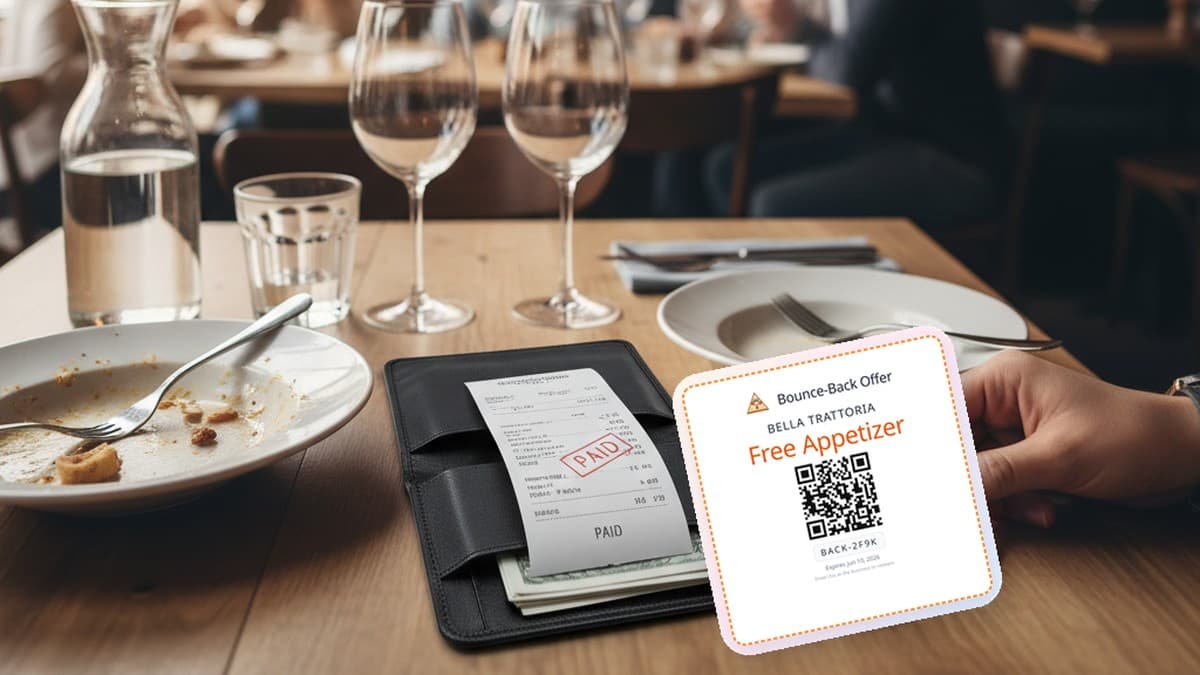
How to Get Repeat Restaurant Customers with QR Coupons
Most restaurant marketing budgets are pointed in the wrong direction. They chase the new diner — the one who's never heard of you, has to be found through ads or a delivery app or a discount marketplace, and who, statistically, will eat with you once and never come back. Meanwhile the cheapest growth a restaurant will ever get is sitting in the dining room right now: the guest who already likes the food and just needs a reason to return.
This is a guide to how to get repeat customers for a restaurant using single-use QR coupons — not as a way to discount your way to busy nights, but as the lowest-cost-per-customer growth channel you have. The premise is simple: a diner you've already won back is worth more and costs less than a stranger you have to find from scratch.
If you want the tactical version — filling Tuesday lunches and launching new menu items — we cover that in QR code coupons for restaurants. This article is about the economics underneath it: why repeat business is where the profit hides, and how a coupon bridges the gap.
Why a new diner costs more than a returning one
Every restaurant has two ways to do another dollar of business: find someone new, or bring someone back. Owners spend most of their attention and almost all of their marketing money on the first one — and it's the expensive one.
A new diner has to be acquired. That means paid social ads, a listing on a discount marketplace, a position in a delivery app's search results, or a deep one-time promotion that drops your margin to nothing in the hope they come back. Each of those carries a real cost per cover, and a chunk of the customers it brings in are deal-chasers who were never going to return.
A returning diner has already been acquired. They found you, they tried the food, they decided it was good. There's no ad to buy and no commission to pay. The only thing standing between them and another visit is forgetting — and the only cost to fix that is the marginal food cost of a small, well-designed offer.
The "five times" figure is a well-worn rule across repeat-purchase businesses, and restaurants sit at the extreme end of it: your acquisition channels are some of the most expensive in local retail (delivery commissions alone can run 15-30% of the ticket), while your cost to re-engage an existing guest is close to the price of a side dish. That gap is the entire opportunity.
The Second-Visit Gap
Here's the moment that decides a restaurant's growth, and almost nobody manages it: a first-time diner finishes a good meal, pays, says "that was great," and walks out the door. What happens next splits into two completely different futures.
In one, they mean to come back, life gets in the way, three months pass, and a new spot opens up the street. They never return — not because anything went wrong, but because nothing pulled them back. In the other, they're holding a small card that says "free starter on your next visit, good for three weeks," and eleven days later they're back at your host stand. Same diner, same meal, wildly different lifetime value.
We call that fork the Second-Visit Gap — the window between a successful first visit and a return that, left alone, most diners never cross. It's the single most expensive gap in the restaurant business, because the customer is already won. You paid the full acquisition cost to get them in the door once, and then let them evaporate for want of a two-dollar nudge.
The Second-Visit Gap is widest at exactly the moment it's cheapest to close: the diner is at peak goodwill, standing in your restaurant, having just decided the food was worth it. A coupon handed with the check converts at that peak. A reminder sent two weeks later, after the glow has faded, converts far worse.
A second visit does more than add one cover. It's the visit that turns a trial into a habit. The data across hospitality is consistent: once a guest visits a third or fourth time, their odds of becoming a long-term regular climb steeply, and regulars spend more per visit and refer more often. The whole game is getting them across the gap the first time — cheaply, and on purpose.
The repeat-customer math owners never run
Most owners track covers and average check. Very few track the number that actually drives profit: how much a retained customer is worth over time versus what it cost to keep them.
Run it once for your own restaurant and the priorities reorder themselves. Take a casual spot with a $24 average check:
The lifetime value of one rescued diner
A first-time guest who never returns is worth one $24 visit. The same guest, nudged into a habit of visiting once a month for a year, is worth twelve visits — roughly $288 in revenue. The coupon that bridged the Second-Visit Gap cost you the marginal food cost of one free appetizer: call it $2-3.
So a single retention coupon, redeemed once, can be the difference between a $24 customer and a $288 one. Even if only one in five diners you hand it to actually crosses the gap, the math still buries any acquisition channel you could buy.
This is why a small lift in repeat rate moves your bottom line more than a big push on new traffic. Studies of repeat-purchase businesses have long found that nudging retention up by even a few points can swing profit by double digits, because retained customers cost almost nothing to serve again and tend to spend more the longer they stay with you.
The reason owners don't run this math is that retention is invisible. You can see the ad spend and the Groupon payout. You can't see the diner who didn't come back. A coupon makes retention visible: every redemption is a customer you can prove you brought back, with a campaign attached and a cost you can name.
Why a single-use coupon is your cheapest retention tool
There's a reason to reach for a single-use QR coupon specifically, rather than the usual retention tactics restaurants try.
Versus paid ads: an ad pays to interrupt strangers, most of whom will never eat with you. A retention coupon spends nothing until a guest you've already won actually redeems it — you only pay (in food cost) for a result.
Versus a loyalty app: most loyalty apps charge a monthly fee, ask the customer to download something, and reward behavior you can't isolate. A QR coupon needs no app on the customer's side — they show a sticker or a link on their phone — and every redemption is tagged to a campaign so you know precisely what worked.
Versus a printed punch card: punch cards get lost, forgotten, and forged, and they reward your existing regulars for visits they'd have made anyway. A single-use coupon can be aimed at the specific guests you want to retain — first-timers, lapsed regulars — and it can't be cloned or screenshotted into a margin leak.
Do This
- ✓Pay only for results — a retention coupon costs nothing until a real guest redeems it
- ✓Stay invisible to full-price customers, so you never discount a visit that was happening anyway
- ✓Track every redemption to a campaign, day, and offer, so you can prove what drives repeat visits
- ✓Target the guests you actually want back — first-timers and lapsed regulars, not everyone equally
Avoid This
- ✕Don't pay an acquisition channel to find strangers when your dining room is full of half-retained customers
- ✕Don't reward loyalty you'd have gotten for free — aim offers at the gap, not at your Saturday regulars
- ✕Don't rely on a tactic you can't measure — if you can't see the redemption, you can't manage the retention
The single-use mechanic is what makes all of this safe. The offer can be generous — even a free item — because each code dies the moment a server taps Redeem. You're not running a public discount that trains the whole neighborhood to wait for a deal; you're handing a specific guest a specific reason to cross the Second-Visit Gap once.
The three-coupon habit ladder
Retention isn't one offer — it's a sequence. The goal is to walk a guest from a single trial visit into a durable habit, and each rung of the ladder has a different job. Run them in order.
Rung 1 — The Bounce-Back (turns visit one into visit two)
Handed with the first check, to every new guest, redeemable on the next visit inside a tight window. "Free appetizer with any entrée — your next visit, within 3 weeks." This is the rung that closes the Second-Visit Gap, and it's the highest-leverage coupon in the restaurant. The diner is at peak goodwill and holding a concrete, expiring reason to return. Nothing else you do moves repeat rate as much.
Rung 2 — The Third-Visit Nudge (turns a returnee into a regular)
Handed when a bounce-back coupon is redeemed. "Come back this month and dessert's on us." Two visits is a coincidence; three is the start of a habit. This rung is cheap insurance: the guest has now crossed the gap twice, and one more visit dramatically raises the odds they default to you without any prompt at all.
Rung 3 — The Regular's Reward (sustains the habit)
For guests who've clearly become regulars. A periodic, low-cost thank-you — "a coffee and dessert on us, just because you're one of our favorites" — sent over WhatsApp or handed in person. The job here isn't to drive a visit they weren't going to make; it's to make the relationship feel reciprocal so a competitor's grand opening doesn't pull them away.
Don't launch all three rungs at once. Start with the Bounce-Back alone — it's where the money is — and only add the Third-Visit Nudge once you see bounce-backs redeeming. Most owners never need to formalize Rung 3; their regulars are already regulars. The ladder is a path, not a checklist.
Designing offers that grow sales, not give away margin
The fastest way to lose money on retention coupons is to discount visits that were going to happen anyway. Every rule below exists to keep the offer pointed at incremental business — the visit that wouldn't have occurred without the nudge.
- Anchor to a real purchase. "Free starter with any entrée" protects your ticket. "$5 off, no minimum" invites a guest to order a coffee and leave. The redeemed visit should always carry a full-price item.
- Discount the cheap thing, not the expensive thing. Give away the appetizer, the dessert, the side, the drink — items with a marginal food cost of a couple of dollars. Never default to a percentage off the whole check, which hands away your highest-margin items too.
- Keep the window short. Two to three weeks. A short expiry is what manufactures the return soon, while the meal is still fresh in memory. A 90-day window just lets the coupon die in a wallet.
- Aim it at the gap. The whole point is to reach first-timers and lapsed diners, not the regulars who already come. If your Saturday-night crowd is redeeming retention coupons, you're subsidizing visits you already had.
- Brief the team first. A server fumbling the scan-and-redeem flow in front of a guest undoes the goodwill. Three minutes of practice on a test code before the first sticker goes out.
The one-line test for any retention offer
Before you print a coupon, ask: "If I gave this to a guest who was already coming back tomorrow, would I lose money?" If the answer is yes, tighten it — add a minimum, swap to a cheaper free item, shorten the window — until the only person it rewards is the one who wouldn't have returned without it.
Your reviewers are your most loyal segment
There's a free retention list hiding in your Google reviews. The diners who took thirty seconds to leave you five stars are, almost by definition, your most engaged customers — the ones most likely to come back and most worth keeping.
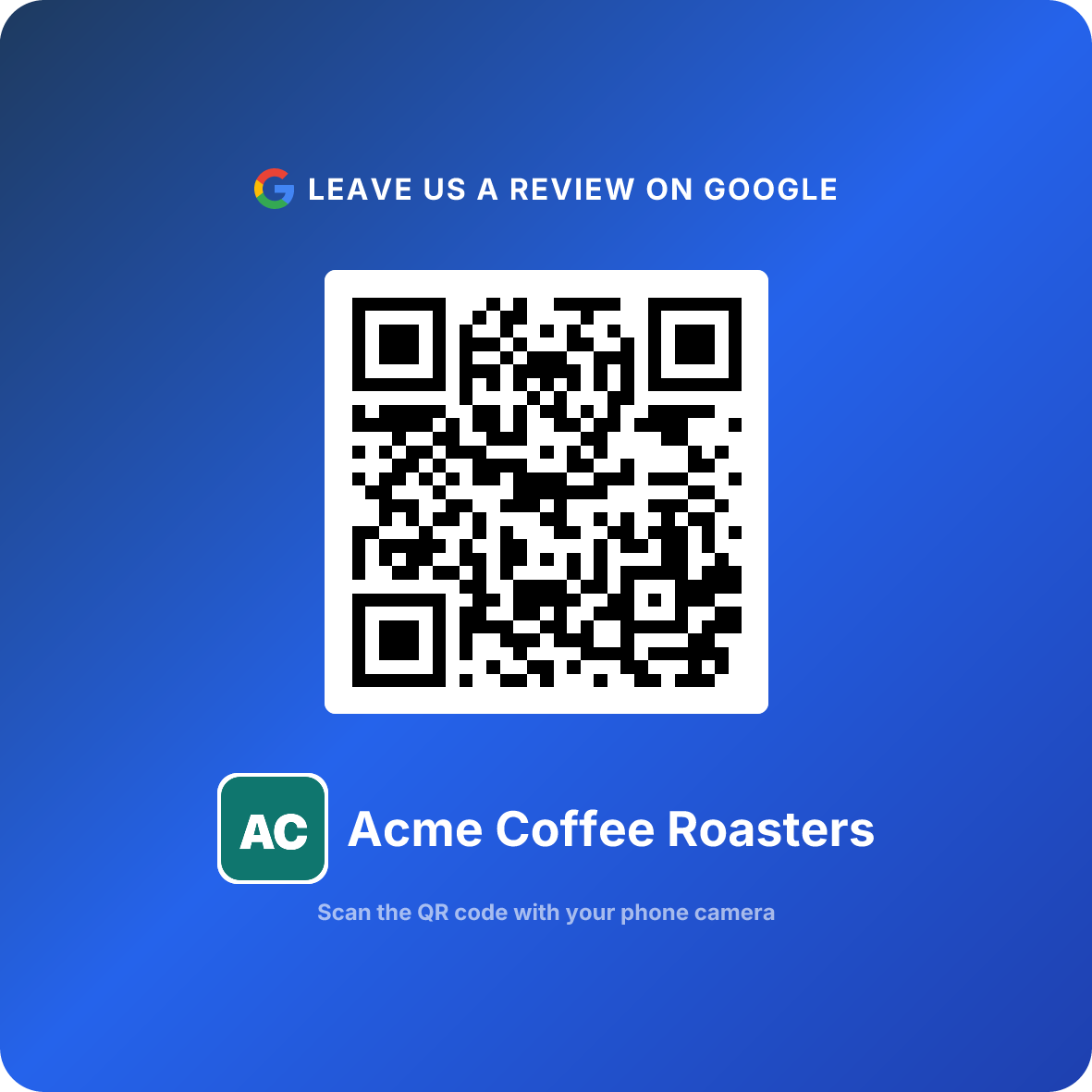
If you're already collecting reviews with a QR code on every check, you can close the loop: hand a single-use thank-you coupon to any guest who scans your review QR. "Thanks for taking the time — your next coffee and dessert are on us." It rewards the relationship, never the rating — Google's policy forbids offering anything in exchange for a review or conditioning a reward on a positive star count, and a thank-you given regardless of what they wrote is fully compliant.
The effect compounds. Reviews bring new diners in the door (your acquisition channel), and the thank-you coupon turns those reviewers into repeat customers (your retention channel) — the two cheapest growth engines a local restaurant has, feeding each other.
Case study: Ridgeline Burgers, Boise ID
Ridgeline is a fast-casual burger spot doing about 400 covers a week with a $19 average check. Owner Marcus Lee had a familiar problem: a steady stream of first-time customers from a delivery-app promotion he was paying dearly for, and almost no idea how many came back. When he actually looked, the answer stung — roughly one in four first-timers ever returned.
Instead of buying more new traffic, Marcus spent ninety days on retention. He ran the bottom two rungs of the ladder:
- Bounce-Back — a sticker handed with every order, dine-in and takeout: "Free order of fries with any burger, your next visit within 3 weeks."
- Third-Visit Nudge — handed when a bounce-back was redeemed: "One more visit this month and a shake's on us."
The results after three months:
"I'd been throwing money at a delivery app to find new people, and they'd order once and disappear. Turns out the fix was a fifty-cent sticker handed to people who already liked us. My repeat rate jumped fifteen points and it cost me a couple bucks of fries per customer. I cut the delivery promo and put the money into the kitchen instead." — Marcus Lee, Ridgeline Burgers
The detail Marcus cares about most: his redemption data told him the bounce-back was doing the work, so he didn't waste effort formalizing a loyalty program he didn't need. Retention became a number he could see and manage — not a hope.
Build your retention sequence in an afternoon
- 1
Find your repeat rate first
Even a rough estimate. Ask the team how many guests they recognize, or look at how many delivery/reservation customers order twice. If it's under a third, the Second-Visit Gap is your single biggest opportunity — start there.
- 2
Write one Bounce-Back offer
Anchor it to an entrée, give away a cheap item, set a 2-3 week expiry. 'Free appetizer with any entrée, your next visit within 3 weeks.' Resist the urge to launch three campaigns — one rung at a time.
- 3
Create the campaign and print the stickers
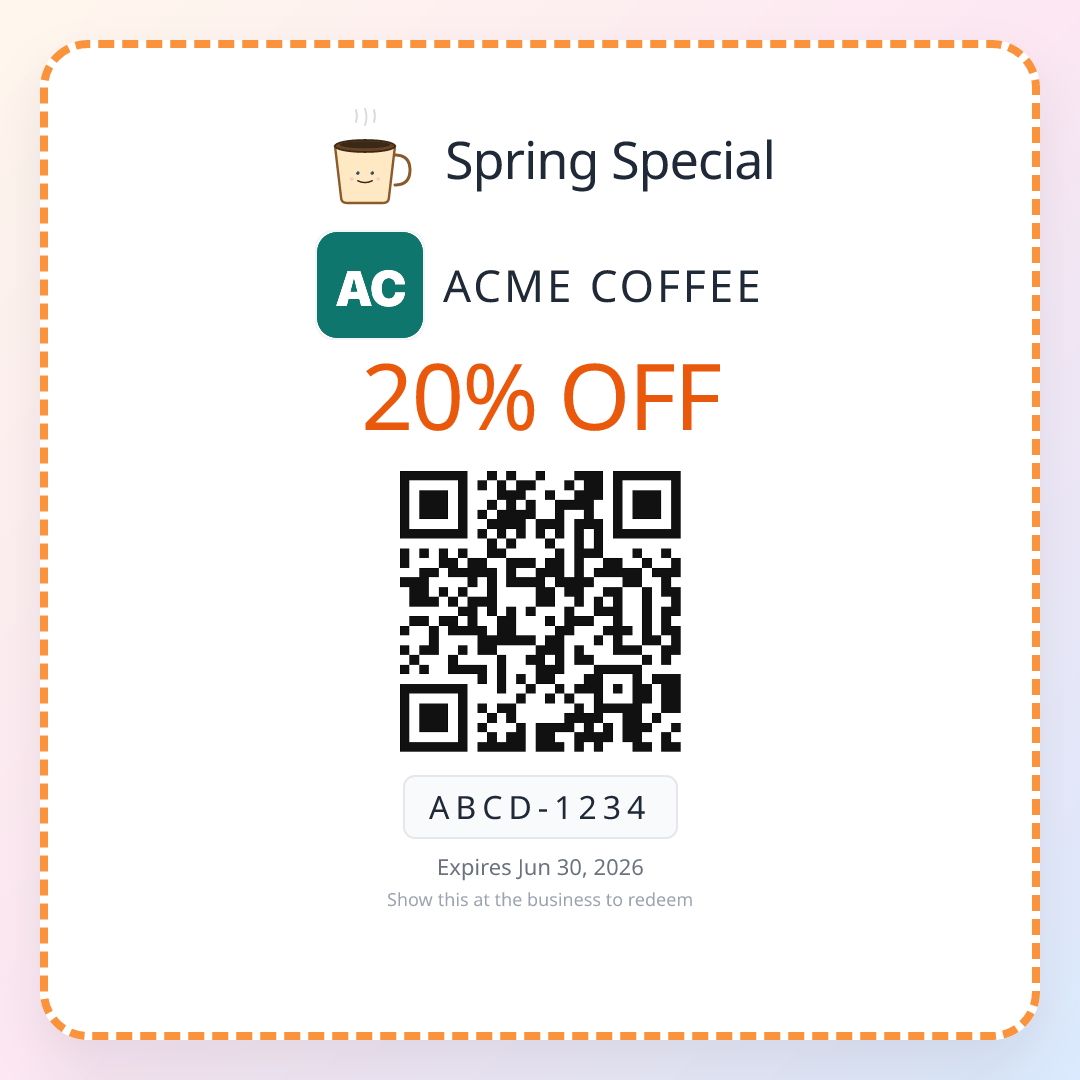
From your dashboard, open QR Coupons, click New Campaign, enter the offer, set the expiry, pick a mascot, and choose 50-100 codes. Download the PDF — it lays out a sticker grid ready for any local printer or home sticker paper.
- 4
Brief the team and hand them out at the check
Three minutes practicing the scan-and-redeem flow on a test code, then a sticker goes in every check presenter and takeout bag. The check is the peak-goodwill moment — that's where the bounce-back belongs.
- 5
Read the redemptions, then add Rung 2
After a few weeks, your redemption data shows whether the bounce-back is working. Once it is, hand the Third-Visit Nudge to guests who redeem. Let the data, not a template, decide whether you ever need Rung 3.
Start with a Google review QR code
If you haven't set up review collection yet, do that first — your reviewers feed the retention loop, and it's the cheapest acquisition you'll ever run. Then layer coupons on top: see the full QR Coupons feature, the tactical QR code coupons for restaurants playbook for slow-shift and launch campaigns, or the broader QR coupons for small business guide for how this works across local businesses.
Frequently asked questions
Is it cheaper to bring back an old customer or find a new one for a restaurant?
Bringing back an existing diner is far cheaper — usually a fraction of the cost. A new customer has to be found through ads, third-party delivery commissions, or discount marketplaces, all of which carry a real acquisition cost. A returning diner already knows you and already liked the food; the only cost to win them back is the marginal food cost of a small offer, which is often a few dollars.
What's a good repeat-visit rate for a restaurant?
It varies by concept, but most independent restaurants see only 20-30% of first-time diners ever return. Casual and fast-casual spots that actively prompt a second visit can push that toward 40-50%. The single biggest lever isn't food quality — it's whether the guest leaves with a concrete reason to come back within a few weeks.
How do QR coupons increase repeat business without killing my margin?
Because a single-use coupon only discounts the visit that wouldn't have happened anyway. Your full-price regulars never see it. The diner who redeems it pays for an entrée and a drink at full price and only saves on the small item the coupon covers, so you capture incremental revenue at a marginal food cost of well under 10%.
What offer brings a first-time diner back the fastest?
A "bounce-back" coupon handed with the first check, redeemable on the next visit within two to three weeks: "Free appetizer with any entrée on your next visit." The short window and the fact that they're holding it at the exact moment they decided your food was worth it are what convert a one-time guest into a second visit.
Are QR coupons better than a restaurant loyalty punch card?
For driving repeat visits, yes. A punch card rewards behavior you can't measure and is easily lost or forgotten. A single-use QR coupon is trackable — you see exactly which campaign, which day, and which offer brought someone back — and you can target it to the specific guests you want to retain rather than rewarding everyone equally.
How do I combine QR coupons with collecting Google reviews?
Your reviewers are your most loyal segment, so close the loop: hand a single-use thank-you coupon to any diner who scans your review QR code. The coupon thanks them for the relationship, never for a positive rating — Google forbids rewarding reviews — and it turns your most engaged customers into repeat visitors at almost no cost.
Keep reading
Restaurant Google Reviews: 40-60 New in 90 Days (QR)
How restaurants collect 40-60 Google reviews in 90 days with table-tent QR codes. Real placement data, server scripts, conversion rates by placement, and what to avoid.
Restaurants & FoodQR Code Coupons for Food Trucks: The Tomorrow's-Spot Tease
Food trucks lose customers to geography, not food. How single-use QR coupons that double as a location reveal turn one-off encounters into route regulars. Unit economics, three plays, truck-surface placement, scripts, and a 6-minute setup.
Restaurants & FoodQR Code Coupons for Bakeries: The Morning-Pastry Habit Loop
How bakeries use single-use QR coupons stickered to the pastry bag to turn occasional buyers into standing weekly regulars. With the habit-loop mechanic, the math, counter scripts, and a 6-minute setup.