QR Code Coupons for Boba Shops: Win the Second Sip Before the Chain App Does
How indie bubble tea shops use single-use QR coupons to beat chain rewards apps at the first-visit-to-second-visit cliff. Concept, math, three plays, placement geometry, and a 6-minute setup.
QR Code Coupons for Boba Shops: Win the Second Sip Before the Chain App Does
Turn one visit into many
Hand out single-use QR coupons that pull customers back through your door. Part of your Customer Comeback System. 14-day free trial, cancel anytime.
Create a couponIt is a Friday afternoon and the line out your door is eight people deep. A pair of high schoolers orders brown sugar boba with extra pearls, splits a photo of the drink before the first sip, and walks out laughing. They loved it. They told you so. They tipped.
You will probably never see them again.
Not because the drink was bad. Because three blocks away there is a Kung Fu Tea with a rewards app, and two blocks the other way there is a Gong cha with a punch-card promo, and somewhere between this Friday and their next boba craving, one of those shops will become the default and you will become the place they tried once. The drink was never the problem. The problem is that nothing left your shop in their hand that pulls them back before a competitor claims the habit.
This is the quiet bleed of every indie bubble tea shop in the country. You win the first visit on flavor and vibe, and then you lose the customer in the gap before the second visit, to a chain that spent a fortune building an app for exactly that gap. You do not need the app. You need to win the second sip, and you need to do it in the first week, with a single-use QR coupon that rides out the door on the cup sleeve.
The Second-Sip Stamp: winning the first week
The old paper punch card had one genuinely good idea buried inside it: the very first stamp. Not the tenth, where the customer finally earns the free drink. The first one, handed at the end of visit one, that turns a stranger into someone with a tiny stake in coming back. Most punch cards waste that idea by burying it under nine more stamps the customer never completes. The card ends up in a junk drawer, and the shop never sees the reward redeemed.
The Second-Sip Stamp keeps the good idea and throws away the rest. It is a single-use QR coupon handed at pickup on the first visit, valid for one week, that does exactly one job: get the customer back through the door a second time inside the window where a default has not yet formed.
That window is short and it is decisive. A bubble tea craving recurs every few days for the core customer. The first time someone tries your shop, they are running on novelty, not habit. If the second visit happens inside that first week, you are no longer the place they tried once. You are becoming a place they go. If the second visit does not happen, the next craving routes to whoever is closest or whoever has the app, and you fall out of the rotation before you were ever in it.
The coupon does not have to sell the customer on boba. The craving does that on its own schedule. The coupon just has to make sure that when the next craving hits, your shop is the cheapest and most top-of-mind option in the customer's pocket.
The first-visit-to-second-visit cliff (and what it costs)
Every retail category has a retention curve, and for low-ticket, high-frequency businesses like bubble tea the steepest drop is between visit one and visit two. A first-time customer has no relationship, no default, and no reason beyond the drink itself to choose you again over the equally good shop down the street. Industry retention data across quick-serve drinks consistently shows that customers who make a second visit inside the first week are dramatically more likely to become regulars than those whose second visit slips past two weeks, if it happens at all.
The chains know this number cold. It is the entire reason Gong cha, Kung Fu Tea, Chatime, and every other franchise pushes you to download the app at the register on visit one. The app is not really about points. It is about owning a slot on the customer's phone before the indie shop down the block can claim the habit.
The asymmetry that makes the math wildly positive
A first-time boba customer who never comes back is worth one drink: about $6. The same customer, converted into a once-every-two-weeks regular by a successful second visit, is worth roughly $150 a year. The single-use coupon that bridges visit one to visit two costs you, on a free-topping offer, about 30 cents in product. You are spending 30 cents to swing a customer from a $6 lifetime value toward a $150 one. Even if only one in five coupons converts a true regular, the ratio runs many times over on coupon cost to customer value recovered.
The mistake most owners make is treating the discount as lost margin on a drink that would have sold anyway. On a second-visit coupon, that framing is backwards. The drink would not have sold anyway. The whole point of the coupon is the visits that were never going to happen without it. The boba business runs on visit frequency per customer per year, and any coupon that converts a one-and-done into a twice-a-month habit pays for itself before the second pearl is sipped.
Three coupon plays a boba shop can run
The plays below each do a different job: convert the first-timer, turn one customer into two, and re-fire interest when you launch something new. Each one is a single-use QR code with a tight expiry. Pick one to start, layer the others after two weeks of redemption data.
Play 1: The Second-Sip Return
Job: Pull the first-time customer back inside the 7-day window before a default forms.
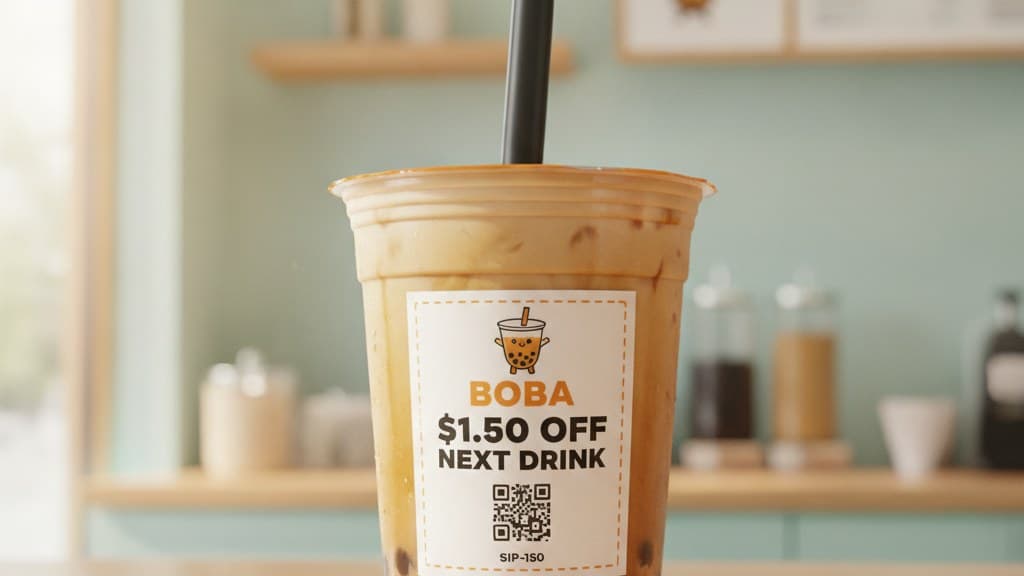
Every customer who looks new, or who you simply choose to hand it to during a shift, gets a single-use QR coupon on the cup sleeve at pickup. Free topping or $1.50 off any drink, valid 7 days from issue, one redemption. The 7-day expiry is the entire mechanic. It lands the second visit inside the same week as the first, while the novelty is still warm and before the customer's craving has been claimed by the shop with the app.
Offer shape: Free topping (pearls, pudding, or popping boba) or $1.50 off any drink, valid 7 days, one redemption. Best handed to: First-time and infrequent customers, on the cup sleeve at pickup. Why it works: The craving recurs on its own. The coupon just makes sure your shop is the default when it does, inside the only window where the default is still up for grabs.
Play 2: The Bring-a-Friend Pair
Job: Turn one paying customer into two, and let your regulars do your customer acquisition.
Boba is rarely a solo ritual. It is what friends get together, what couples grab on a walk, what a group orders after class. This play leans into that. The coupon unlocks a second drink at half off when two drinks are bought together, valid 14 days, one redemption. The customer brings a friend who has never been to your shop, the friend becomes a first-timer (who then gets a Second-Sip Return coupon of their own), and your existing customer did the introduction for you.
Offer shape: Buy one drink, get the second half off when redeemed together, valid 14 days, one redemption. Best handed to: Repeat customers and anyone who orders two or more drinks. Why it works: It converts your happiest customers into a referral channel, and every friend they bring enters the top of the Second-Sip funnel as a fresh first-timer.
Play 3: The New-Flavor First Taste
Job: Re-fire lapsed and infrequent customers when you launch a seasonal or limited drink.
When you drop a new flavor (a summer mango yakult, a seasonal taro, a limited matcha series), the launch is a reason to reach back to customers who have drifted. Hand a single-use coupon, in-store and on the cup sleeve, for $2 off the new drink, valid 10 days. The novelty of the flavor plus the discount plus the deadline gives a drifting customer three reasons to come back at once, and a limited drink creates the urgency a standing menu never can.
Offer shape: $2 off the new or seasonal drink, valid 10 days, one redemption. Best handed to: Every customer during launch week, with extra emphasis on infrequent visitors. Why it works: A limited drink is inherently time-boxed, so the coupon's urgency and the flavor's urgency reinforce each other instead of competing.
Do This
- ✓Run only one play at a time for the first two weeks until you have data
- ✓Use single-use codes so each coupon stops at one redemption
- ✓Lead with a free-topping offer (low product cost, high perceived value)
- ✓Hand the coupon on the cup sleeve at pickup, not at the register
- ✓Match the expiry to the play (7 days for second-sip, 14 for bring-a-friend, 10 for new flavor)
Avoid This
- ✕Don't post the coupon on the storefront window or your social feed (it stops being targeted)
- ✕Don't run a percentage off (60 cents on a $6 drink reads as not worth the scan)
- ✕Don't make the expiry longer than 14 days (the craving cycle is days, not months)
- ✕Don't hand it during payment (the customer's attention is on the card reader)
- ✕Don't stack it with a paper punch card (pick one mechanic, not two)
Where the QR lives on the cup
Car washes tuck coupons under the wiper. Barbers slip them into the cape pocket. A boba shop has its own placement geometry, dictated by the fact that the customer leaves holding a cold, sweating cup they will not put down until it is empty. Five placements that consistently beat handing the coupon at the register:
On the cup sleeve at pickup
The cardboard or foam sleeve is the single best surface in the shop. The customer holds it for the entire walk home and every sip after. A QR sticker on the sleeve, applied as the drink is handed over, gets seen dozens of times before the cup is empty. This is the default placement and the one to start with.
Stuck to the lid dome
For shops that seal with a flat film and a dome lid, a small QR sticker on the dome sits right under the straw, in the customer's eyeline with every sip. It survives the walk home better than a loose card and is impossible to miss while drinking.
Tucked under the carrier tray tab
When someone orders two or more drinks in a paper carrier, slip the coupon card under the carrier handle. Group orders are your highest-value visits, and the carrier guarantees the coupon travels with the whole group instead of going to one person.
Printed on the back of the punch card you're replacing
If you already hand out a paper loyalty card, print the QR coupon on the back. The customer already pockets the card, so the coupon rides along at zero added handling, and it gives the lonely first stamp something useful to do.
On a small table tent at the pickup counter
For walk-up regulars who wave off a sleeve, a counter table tent with the QR lets them scan on their own while they wait for the name to be called. It catches the customer who would have left empty-handed but still has thirty seconds of idle attention at the counter.
The pickup counter beats the register every single time. The register is where the customer is paying, counting change, or deciding whether to tip, and their attention is fully spent. The pickup counter is where the drink they have been anticipating finally lands in their hand. Move the handoff from one counter to the other and the coupon stops competing with the transaction and starts riding the best moment of the visit.
Turn one visit into many
Hand out single-use QR coupons that pull customers back through your door. Part of your Customer Comeback System. 14-day free trial, cancel anytime.
Create a couponThe second-sip math (with real numbers)
Let's stress-test the Second-Sip Return play across a single-location shop doing 120 drinks on an average weekend day.
Assume you hand the coupon to first-time and infrequent customers only, roughly 40 percent of a weekend's pickups, so about 48 coupons a day, 96 across a Saturday and Sunday. Cup-sleeve coupons to a mobile-native boba crowd redeem at roughly 25 percent. That is 24 second visits across the next 7 days, each spending about $6 on the discounted drink plus, often, a friend's drink alongside it.
You spent about $8 in product on free toppings. You billed $144 in drinks on visits that, for most of those 24 customers, were not going to happen at your shop at all. The ratio is roughly eighteen-to-one on coupon cost to revenue, and that is before counting the friends who came along, the upsells on the discounted drink, and the share of those 24 who become twice-a-month regulars worth $150 a year each.
The honest framing matters here. Not all 24 second-visitors are pure new revenue. A few would have wandered back on their own. The real thing the coupon bought is the shift: it moved the second visit from "maybe, eventually, at whichever shop is closest" to "this week, at your shop, before a competitor became the default." That shift, repeated across a season, is what converts one-and-done first-timers into the regulars your whole business runs on.
The pickup-counter script (or the coupon dies)
A QR sticker handed across the counter without a word is just packaging. A QR sticker handed with five words from whoever calls the name is a small gift riding the best moment of the visit. The script does more work than the discount.
Bad version (sounds like marketing): "Here's a coupon, scan it for a discount next time."
Good version (sounds like a gift): "Free topping if you're back this week."
The good version does three things the bad version misses. It names the reward in plain words (free topping), it sets the deadline without sounding like a sales pitch (this week), and it comes from the person handing over a drink the customer is already excited about, so it reads as generosity instead of a promo. Same 30-cent topping, completely different framing.
Train every counter person on one short line per play. Consistency across staff is the biggest predictor of whether a coupon program that should work actually shows up in redemption data. Two staff members saying the line and one staying silent will quietly halve your numbers.
Setting up your first campaign in 6 minutes
Sign in to ReviewQR (14-day free trial)
Use any email to create an account at reviewqr.app. The 14-day free trial (card on file, cancel anytime) is enough to test the Second-Sip Return play across a couple of busy afternoons at a single-location shop. After that, Essentials is $10/month for 100 single-use coupons.
Pick the play that matches your week
If you are not launching a new flavor, start with Play 1 (Second-Sip Return) as your standing offer. If a seasonal drink is dropping inside the next 7 days, run Play 3 (New-Flavor First Taste) for launch week. Play 2 (Bring-a-Friend Pair) is a layer to add once you have two weeks of data on Play 1.
Set the offer and expiry
Free topping or $1.50 off any drink, valid 7 days from scan, one redemption per code. The single-use mechanic is enforced automatically: once a code is scanned and marked redeemed at your counter, a second scan shows 'already redeemed.'
Print 50 cup-sleeve stickers or wallet cards
Plain sticker stock works for round one. Skip the design polish. QR plus 'Free topping, back this week' is enough text. If your drinks sweat heavily, a small water-resistant sticker on the lid dome survives the walk home better than the sleeve.
Brief the pickup-counter staff
One five-word script. 'Free topping if you're back this week.' Practice it once before the shift. The person calling names is the right person to deliver it, because the drink is changing hands at that exact moment.
Hand at pickup, not the register
On the cup sleeve, the lid dome, or the carrier tray. Anything but the register, where the customer's attention is on paying.
If your shop runs more than one register or you want to track which staff member's handoff converts best, the Essentials plan at $10/month gives 100 codes per month and lets you tag campaigns by shift or staffer. That tag tells you whose pickup-counter handoff actually drives second visits, which is the data point worth $10 a month once you are past the test phase.
Common boba shop coupon mistakes
Mistake 1: Posting the coupon publicly. A "free topping" sign in the window or a post on the shop's Instagram kills the precision tool. Every regular sees it, every regular claims it, and the discount lands on visits you were already going to bill at full price. The single-use QR mechanic depends on the coupon being invisible to regulars and visible only to first-timers and drifters at the pickup counter.
Mistake 2: Running a percentage off. Ten percent off a $6 drink is 60 cents, which reads as not worth pulling out a phone. On a small ticket, a free topping or a flat dollar-fifty off lands far harder, and percentages get screenshotted and passed around college deal groups where they reach everyone except the customer you were aiming at.
Mistake 3: Long or vague expiries. "Valid this month" reads as "I have time," and the brain files it under forever. The boba craving cycle runs in days. 7 days for the second-sip, 14 for bring-a-friend, 10 for a new flavor. The short deadline is half the mechanic.
Mistake 4: Handing the coupon at the register. The register is the least generous moment of the visit, when the customer is paying and possibly deciding on a tip. Move the handoff to the pickup counter, when the drink they have been waiting for finally lands in their hand. Redemption climbs noticeably.
Mistake 5: Running all three plays at once on day one. You will not be able to tell which one is working. Run a single play alone for two weeks, read the redemption rate, then layer a second on top.
Mistake 6: No script for the counter staff. A silent handoff underperforms a five-word handoff by a margin most owners do not believe until they watch two staff members run the same shift differently. The topping is cheap. The five words are the lever.
Related reading
This piece focuses on the coupon mechanic for bubble tea. For the closest cousin in the daily-drink world, the QR code coupons for coffee shops playbook covers the second-cup mechanic on a similar small ticket and daily craving cycle. For broader coupon plays across small-business categories, the coupon ideas listicle groups 23 plays by goal, and the QR coupons for small business overview covers the single-use mechanic at a higher level. When you are ready to compare tools, see best QR coupon app for small business.
Frequently asked questions
Do QR coupons work for boba shops, or does the young crowd just ignore them?
The boba demographic is the single best audience for a QR coupon. The core bubble tea customer is between 16 and 30, scans QR codes without a second thought, and already has a phone in one hand while waiting for the drink. A single-use QR coupon handed on the cup sleeve at pickup redeems at 20 to 35 percent inside a 7-day window, which is higher than almost any other small-business category, precisely because the customer is mobile-native and the next craving is rarely more than a few days away. The mistake is not the QR. The mistake is handing it at the register before the drink is in their hand, when their attention is on paying, not on coming back.
How do I compete with Gong cha, Kung Fu Tea, and Chatime rewards apps?
You stop trying to out-app them and use the coupon to win the one battle the app cannot fight: the second visit inside the first week. Chain rewards apps are built for the customer who already comes back. They reward visit ten, not visit two. The indie shop loses customers at the first-visit-to-second-visit cliff, where a first-timer tries you once, has a fine drink, and then drifts to whichever shop is closest to their next craving. A single-use 7-day coupon handed at pickup plants a flag inside that exact window, before the customer has formed a default. You do not need a points system. You need to win the second sip.
What discount should I put on a bubble tea coupon?
Match the discount to the small ticket. On a $5.50 to $7 drink, $1.50 off or a free topping (pearls, pudding, popping boba) is the sweet spot. The free-topping framing usually outperforms the dollar discount because it costs you 20 to 40 cents in actual product while reading as a $0.75 to $1 value to the customer, and it nudges the customer toward a more customized, more memorable drink that builds the habit. Avoid percentage-off coupons on a small ticket. Ten percent off a $6 drink is 60 cents, which reads as not worth the scan, and percentages get photographed and shared in college deal groups.
When should staff hand the coupon to the customer?
At pickup, on the cup sleeve or stuck to the cup, when the name is called and the drink changes hands. That moment is the peak of the entire visit: the drink is fresh, cold, and exactly what the customer wanted, and the first sip is seconds away. A small QR coupon handed in that window lands as a thank-you riding on a wave of anticipation. Handed at the register during payment, the same coupon competes with the customer counting cash or tapping a card, and it gets shoved in a pocket unread.
Will coupons cannibalize the regulars who already come every week?
Not if the codes are single-use and handed selectively. The coupon never goes on the storefront window or the shop's social media. It rides the cup sleeve at pickup, aimed at first-timers and infrequent visitors, and it expires in 7 days. Your twice-a-week regular who already has a default does not need the nudge and rarely bothers to scan. Your tried-you-once drifter sees the coupon at the one moment it matters, and the 7-day expiry pulls the second visit forward before a competing shop becomes their default. The coupon shifts the people on the fence, not the people already inside.
How many QR coupons should an indie boba shop print to start?
Start with 50. At a shop doing 80 to 150 drinks a day, that is about half a weekend of pickups and gives you a clean first read on the redemption rate. Every ReviewQR plan starts with a 14-day free trial, which is enough to test the cup-sleeve handoff over a couple of busy afternoons before the trial ends. Once the redemption rate is clear, the Essentials plan at $10 per month gives 100 codes monthly, which comfortably covers a single-location shop running the second-sip play as its standing offer.
Ready to Implement This Strategy?
Create your custom QR code in 2 minutes and start collecting Google reviews today.
Create Your QR Code NowMore Google Review Guides
QR Code Coupons for Bakeries: The Morning-Pastry Habit Loop
How bakeries use single-use QR coupons stickered to the pastry bag to turn occasional buyers into standing weekly regulars. With the habit-loop mechanic, the math, counter scripts, and a 6-minute setup.
Restaurants & FoodHow to Get Repeat Restaurant Customers with QR Coupons
Bringing a diner back costs a fraction of finding a new one. Here's how restaurants use single-use QR coupons to drive repeat visits and grow sales.
Restaurants & FoodQR Code Coupons for Restaurants: Fill Slow Shifts and Bring Diners Back
How restaurants use single-use QR code coupons to fill Tuesday lunches, launch new menus, win back lapsed regulars, and protect peak-hour margin.