QR Code Coupons for Bakeries: The Morning-Pastry Habit Loop
How bakeries use single-use QR coupons stickered to the pastry bag to turn occasional buyers into standing weekly regulars. With the habit-loop mechanic, the math, counter scripts, and a 6-minute setup.
QR Code Coupons for Bakeries: The Morning-Pastry Habit Loop
Turn one visit into many
Hand out single-use QR coupons that pull customers back through your door. Part of your Customer Comeback System. 14-day free trial, cancel anytime.
Create a couponIt is 7:40 on a Saturday morning and the croissants came out twenty minutes ago. A customer you have never seen before walks in, breathes it all in, and buys two pains au chocolat and a sourdough loaf. She is delighted. She tells you it smells incredible. She means it. And then she walks out and you will probably not see her again for six weeks, if at all, because tomorrow morning her bread comes from the supermarket aisle on the way home from somewhere else.
She did not decide to leave you. She did not compare your croissant to anyone else's and find it wanting. She just does not have a bakery habit yet, and a habit is the only thing that survives a busy week. The supermarket has location and muscle memory on its side. You have a better croissant and no system for making sure she tastes the second one.
That is the quiet problem with running a bakery. Your product is genuinely loved on first contact, more than almost any other small business can claim, and yet most of the people who love it never come back often enough to matter. The fix is not a louder sign or a bigger window display. It is a small artifact that rides home in the pastry bag, sits on the customer's kitchen counter, and gives her a concrete reason to make you part of next week instead of an occasional treat.
The Morning-Pastry Habit Loop: build the week, not the visit
A coffee shop lives or dies on a single transition: visit one to visit two. A bakery is different. A bakery lives on a loop. Your best customers are not the ones who came back once. They are the ones for whom Saturday morning is the bakery, the ones who would feel like something was missing if they skipped a week. That is not a second visit. That is a standing habit with a fixed slot in the week.
Every bakery has two kinds of customers, and almost all of your lost revenue sits in the gap between them. There is the ritual regular, who has installed you into a recurring slot: the Saturday pastry run, the Tuesday loaf, the Friday treat for the office. And there is the occasion buyer, who shows up when something reminds them, a birthday, a guest, a craving, and then disappears for weeks because nothing keeps you in the rotation. The occasion buyer is not a worse person. They simply never got a cue that turned the bakery from a sometimes-thing into a weekly thing.
The Morning-Pastry Habit Loop is the job of installing that cue. A habit needs three things: a trigger, an easy action, and a small reward. A single-use coupon stickered to the bag is all three at once. It is the trigger sitting on the kitchen counter, the easy action of a pre-order or a quick scan, and the small reward of a few dollars off the next bag. Run it right and you are not buying a visit. You are buying a slot in someone's week.
What a weekly bakery regular is actually worth
A bakery runs on frequency, not on ticket size. A single visit is modest, around $11 once you blend a couple of pastries, a loaf, and the occasional coffee. The money is in how many of those visits the year holds. A household that has made you their Saturday ritual is worth many times what any one receipt suggests, and the gap between that household and an occasion buyer is enormous.
Picture two customers. The first has made you their weekend ritual: roughly 50 visits a year at $11, about $550 in annual revenue, and that is before the birthday cakes and holiday orders a true regular brings. The second loves your croissant just as much but only comes when something reminds them, about once every six weeks: 9 visits a year, around $99. Same affection for the product, completely different cadence, and the difference is more than $450 a year per customer.
The asymmetry that makes the math wildly positive
An occasion buyer at 9 visits a year is worth about $99. Pull that same customer up to a visit every three weeks (the realistic effect of a habit-building coupon working over 12 months) and you reach roughly 17 visits, about $187. That is $88 of recovered annual revenue per occasion buyer at a cost of maybe three $3 discounts, about $9. The ratio runs close to 10 to 1 on coupon cost to revenue recovered, and that is before any cake order, holiday box, or office tray the now-regular customer brings with them.
The point is not to discount your way to volume. The point is that a bakery coupon is not a price cut, it is a habit lever. Any coupon that moves an occasion buyer from nine visits a year to seventeen pays for itself many times over, because the business compounds on visit count, not on per-bag margin.
Three coupon plays for a bakery
The three plays below each do a different job: install the weekly ritual, capture the annual celebration, and clear the end-of-day surplus while filling a dead slot. Each is a single-use QR code with an expiry matched to its job. Run one for two weeks, read the redemption rate, then layer the next.
Play 1: The Friday Pre-Order Weekend Box
Job: Turn an occasional buyer into a standing weekend habit through pre-commitment.
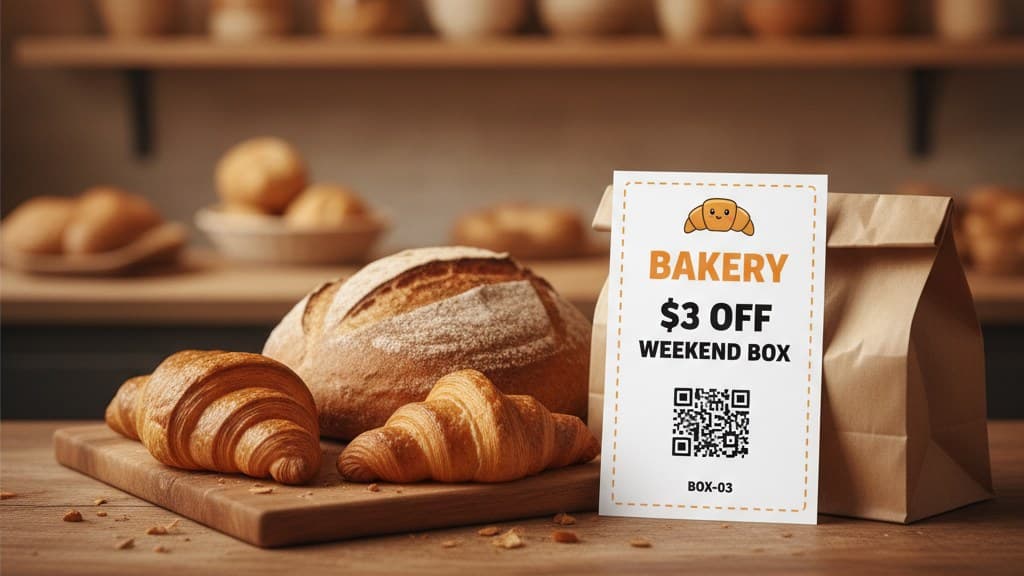
This is the play the whole article is built around, because pre-commitment is what converts an impulse into a loop. Through the week, every customer who buys a bag gets a single-use QR coupon stickered to the fold: $3 off a weekend pastry box ordered by Friday, picked up Saturday, one redemption. The customer scans, picks a box, and reserves a Saturday slot. The act of reserving is the habit forming.
The Friday deadline is deliberate. It forces the decision while the week is still open and lands the pickup on the morning a bakery is busiest and best stocked, so the customer's first habit-visit is also your strongest impression. Do this for a few weeks and the Saturday box stops needing a coupon at all. It becomes the thing they just do.
Offer shape: $3 off a weekend pastry box ordered by Friday, picked up Saturday, one redemption. Best handed to: Every weekday and first-time buyer who is not already a Saturday regular. Why it works: The pre-order is a small commitment, and committed customers form habits. The deadline manufactures the decision; the Saturday pickup manufactures the impression.
Play 2: The Celebration-Cake Repeat
Job: Capture the once-a-year custom cake so the next birthday comes back to you, not to the supermarket bakery counter.
A custom cake is a high-ticket, high-emotion order, and most bakeries do nothing to make sure the next one returns. Tuck a single-use coupon into the cake box at pickup: $10 off your next custom cake, valid 12 months, one redemption. The wide expiry is the point. You are not chasing a quick return, you are planting a flag on the next birthday or anniversary so that when the occasion comes around the customer already has a reason, and a relationship, with you instead of defaulting to the grocery store.
The flat-dollar framing matters because a customer cannot guess what a custom cake should cost, so a percentage means nothing while $10 off reads as concrete and generous on an emotional purchase.
Offer shape: $10 off your next custom cake, valid 12 months, one redemption. Best handed to: Every custom cake pickup, tucked inside the box. Why it works: Celebration orders run on an annual cycle, so the long expiry matches the real timing, and the high ticket means even a generous discount stays profitable.
Play 3: The Slow-Sunday End-of-Day Bundle
Job: Move the day's remaining pastries before they go stale and fill the dead late-afternoon slot.
Every bakery faces the same daily math: bake too little and you sell out and disappoint people; bake enough and you have a tray of perfectly good pastries at 4 p.m. that will not survive to tomorrow. Hand a single-use coupon, scannable in the slow afternoon window, for a flat-price end-of-day bundle: a mixed bag of the day's remaining pastries for $6, valid same day, one redemption. The customer who has flexible timing comes in during your deadest hour, the surplus clears at a profit instead of going in the bin, and a price-sensitive shopper discovers your quality at low risk.
Offer shape: Mixed bag of the day's remaining pastries for a flat $6, valid same day, one redemption. Best handed to: Walk-ins earlier in the day who seem price-aware or time-flexible, and via a small counter card after 3 p.m. Why it works: It converts waste into margin and seeds new habit-formers with a low-risk first taste, without ever discounting the morning fresh-bake rush.
Do This
- ✓Run only one play at a time for the first two weeks until you have data
- ✓Use single-use codes so each discount stops at one redemption
- ✓Match the expiry to the play (14 days for the weekend box, same-day for the bundle, 12 months for the cake)
- ✓Stick the QR on the fold of the bag so it rides home and stays visible on the counter
- ✓Tie the discount to a basket or box, never to a single $2 pastry
Avoid This
- ✕Don't post the coupon in the window or on social (it stops being targeted)
- ✕Don't discount the morning fresh-bake rush, the one window that sells itself
- ✕Don't run a percentage off (gets photographed and shared in local Facebook groups)
- ✕Don't make the weekend-box expiry longer than 14 days (urgency is half the mechanic)
- ✕Don't hand a coupon to the regular who already buys a loaf every Tuesday
Where the QR rides home
A bakery has a placement advantage most food businesses share but few use well: the product leaves in packaging that goes home and sits in the most-passed-through room in the house, the kitchen. The job is to put the QR on the part of the order that survives the trip and stays visible on the counter for a day or two. Five placements that consistently beat handing a paper coupon at the register:
Stickered on the fold of the kraft pastry bag
The single best spot. A small QR sticker pressed onto the fold where you seal the bag rides home on the counter, where the customer empties it for breakfast and sees the coupon while the croissant is still warm. The kitchen counter is the bakery's version of the closet rod: a high-traffic surface where the next-purchase decision actually gets made.
Tucked under the lid of the cake or box
For boxed orders, a small card laid on top of the pastries or under the cake box lid is found at the exact moment of peak delight, when the box is opened at home or at the table. That is the strongest possible emotional frame for the Celebration-Cake Repeat coupon.
On the bread sleeve or loaf bag
Bread buyers are your most habit-prone customers, the ones already half on a weekly cadence. A QR printed on the paper loaf sleeve reaches them on the cutting board, mid-routine, which is the ideal place to nudge the weekend-box upsell.
On the pre-order claim slip
For phone and online pre-orders, print the QR on the pickup slip the customer holds. They are already thinking about your bakery at that moment, so it is a natural place to seed the next order, and a backup for customers who toss the bag fast.
A counter card by the pickup tray
For walk-out customers who decline a bag or grab a single pastry, a small tent card by the pickup point is the fallback. It is the weakest of the five because it never rides home to the counter, but it beats no coupon at all, and it is the right surface for the after-3 p.m. end-of-day bundle.
The handoff beats the register every time. The register is the rushed, paying, counting-change moment. The handoff, when you slide the warm bag across the counter, is the generous one, and it is the only one where the coupon gets to ride home in the bag. Move the sticker to the bag and the kitchen counter does the rest of the work for free.
Turn one visit into many
Hand out single-use QR coupons that pull customers back through your door. Part of your Customer Comeback System. 14-day free trial, cancel anytime.
Create a couponThe weekend-box math (with real numbers)
Let's stress-test the Friday Pre-Order Weekend Box across a single-counter neighborhood bakery that hands out about 100 pastry bags in a week.
Sticker every one of those 100 bags with a single-use coupon for $3 off a weekend box ordered by Friday, picked up Saturday. Because the sticker rides home and sits on the kitchen counter rather than dying in a pocket, bag-sticker coupons redeem at roughly 18 percent. That is 18 pre-ordered weekend boxes inside the window, each at an $18 box ticket, each costing you a $3 discount.
You spent $54 on discounts and billed $324 in weekend boxes, most of which would otherwise never have happened because the customer would have drifted to the supermarket aisle by Saturday. The ratio is roughly six-to-one on discount cost to recovered revenue, before counting the loaves, coffees, and cake orders the new weekend regulars bring once the habit sticks.
Be honest about the number. Not all 18 boxes are purely "extra," because a few of those customers would have wandered in on Saturday anyway. What the coupon actually buys is the shift: it pulls a vague intention into a committed Saturday pickup, and it makes the habit form at your counter instead of nowhere. That shift is real revenue and a real habit. Calling all 18 boxes "new" overstates it.
The counter script at handoff (or the coupon dies)
A QR sticker on the bag with no words is wallpaper. A QR sticker on the bag with one sentence at the handoff is a small gift. The sentence does more work than the discount.
Bad version (sounds like a chore): "There's a coupon on the bag if you want to order ahead sometime."
Good version (sounds like a tip from someone who knows): "Three off a weekend box, order by Friday."
The good version names the value, names the deadline, and tells the customer exactly what to do, so when they spot the sticker on the counter on Thursday it already has meaning. Same $3 discount, completely different framing.
Train every counter person on one sentence per play. Consistency is the single biggest predictor of whether a coupon program that should work shows up in your redemption data. One counter person who says the line and one who silently bags the order will quietly cut your numbers in half.
Setting up your first campaign in 6 minutes
Sign in to ReviewQR (14-day free trial)
Create an account with any email at reviewqr.app. The 14-day free trial (card on file, cancel anytime) is enough to test the bag-sticker handoff across a few busy mornings before the trial ends. After that, Essentials is $10/month for 100 single-use coupons.
Pick the play that matches your week
Start with Play 1 (Friday Pre-Order Weekend Box) as your universal weekday handoff. If you do a steady custom-cake trade, run Play 2 (Celebration-Cake Repeat) alongside it. Save Play 3 (Slow-Sunday Bundle) for once you have two weeks of weekend-box data.
Set the offer and expiry
$3 off a weekend box ordered by Friday, valid 14 days from issue, one redemption per code. The single-use mechanic is automatic: once a code is scanned and marked redeemed at your counter, a second scan shows 'already redeemed.'
Print 50 bag stickers
Plain sticker labels work for round one. Skip the design polish. The QR plus 'Weekend box. $3 off. Order by Friday.' is enough text. Size it to press onto the fold where you seal the kraft bag.
Brief the counter
One sentence: 'Three off a weekend box, order by Friday.' Practice it once before the morning rush. Make sure every counter person says it, not just the chatty one.
Sticker at the handoff, never at the register
Press the sticker on the bag fold as you slide it across the counter with the warm order. The handoff is generous and the bag rides home. The register is rushed and feels like part of the bill. Always the handoff.
If you run more than one location or want to tag campaigns by play and read which one converts, the Essentials plan at $10/month gives 100 codes per month and per-campaign tracking. That tracking is what tells you whether the weekend box out-pulls the end-of-day bundle, which is the data point worth $10 a month once you are running more than one play.
Common bakery coupon mistakes
Mistake 1: Discounting the morning fresh-bake rush. The 7 a.m. croissant sells itself. Putting a coupon on the one window of the week that is already full is pure margin given away. Point every coupon at the gap (the occasion buyer, the slow afternoon, the next celebration), never at the rush that needs no help.
Mistake 2: Posting it in the window. A "$3 off a weekend box" sign in the window kills the targeting. Every Saturday regular uses it, and the discount lands on boxes you were going to sell at full price. The single-use QR mechanic only works when regulars never see it and occasion buyers always do.
Mistake 3: Tying the discount to a single pastry. "$1 off any croissant" trains people to buy one cheap thing. Tie the discount to a box, a bundle, or a basket so the coupon rewards the behavior you actually want, the bigger and more habitual order.
Mistake 4: Vague or mismatched expiries. A 90-day expiry on the weekend box reads as "I have forever" and the sticker becomes counter clutter. Match the clock to the job: 14 days for the weekend box, same day for the end-of-day bundle, 12 months for the celebration cake. The deadline is half the mechanic.
Mistake 5: Rewarding the wrong customer. A stamp card rewards the tenth croissant, by which point the customer is already a loyal regular. Point the coupon at the occasion buyer and the first-timer, the customers who have not yet built the habit, not the ones who already come every week.
Mistake 6: No script at the handoff. A silently stickered bag converts far below a bag handed with one sentence. The discount is small. The sentence at the handoff is the lever, and untrained handoffs underperform trained ones by more than most owners believe until they watch two counter staff work the same morning.
Related reading
This piece is about the coupon mechanic for bakeries. For the broader single-use QR coupon playbook across small-business categories, the QR coupons for small business overview covers the mechanic at a higher level, and the coupon ideas listicle groups 23 plays by goal (attract new, boost average sale, build loyalty). If your bakery also runs a coffee bar, the QR coupons for coffee shops playbook covers the second-cup transition that pairs neatly with the habit loop here. And if you are comparing tools before you commit, best QR coupon app for small business lays the options side by side.
Frequently asked questions
Do QR coupons actually work for a bakery, or do regulars just ignore them?
They work when the coupon does a job your morning rush does not do on its own: turn an occasional buyer into a standing weekly habit. A bakery has two kinds of customers, the weekly-ritual regular and the once-a-month occasion buyer, and almost all of your lost revenue sits in the gap between them. A single-use QR coupon stickered to the pastry bag rides home, gets seen on the kitchen counter, and gives the occasional buyer a concrete reason to come back inside the week instead of drifting to the supermarket aisle. You never hand one to the Saturday regular who already shows up like clockwork, so you are not discounting the visits you were going to bill at full price anyway.
What discount should a bakery put on a coupon?
Keep it small and tie it to a basket, not a single item. For the weekend pre-order box, $3 off a box ordered by Friday is the right size: it nudges the pre-commitment without cutting much margin on a $18 box. For the slow-Sunday end-of-day bundle, frame it as a flat bundle price (for example, a mixed bag of the day's remaining pastries for $6) rather than a percentage, because the customer cannot price the surplus and a flat number reads as concrete. For a custom cake repeat, a flat $10 off the next celebration cake is enough to make a customer who buys one cake a year remember you for the next birthday.
When should the counter staff hand over the coupon?
With the bag, at the moment the customer is handed their warm pastries, not at the register while they are paying. The register is the least generous moment in the transaction: the customer is counting change and looking at the door. The handoff, when you slide the kraft bag across the counter and they can already smell it, is the moment a small extra gift lands as a kindness rather than a sales pitch. Stick the QR on the fold of the bag so it travels home and gets seen on the kitchen counter.
How is a QR coupon better than the punch card or stamp app I already use?
A stamp card rewards the tenth croissant, by which point the customer is already a loyal regular who would have come anyway. A single-use QR coupon does the opposite job: it targets the occasional buyer and the first-timer, the customers who have not yet formed the habit, and pulls them back inside a tight window before the habit goes to someone else. There is no card to reprint, no stamps to fake, no app for the customer to download, and you can see exactly how many coupons redeemed instead of guessing.
Won't running coupons train my customers to wait for a discount?
Not if the codes are single-use and handed selectively. The coupon is never posted in the window or on your social feed, so the weekday-morning regular who buys a loaf every Tuesday never sees one and never starts gaming it. You hand it to the occasion buyer, the weekend tourist, and the first-timer. The single-use code stops at one redemption, so the discount lands on the visit you were at risk of losing, not on the standing habit you already have.
What is the best coupon play for a bakery to start with?
The Friday Pre-Order Weekend Box. It does the most work because it installs a recurring habit instead of a one-off return. You sticker the pastry bag through the week with a single-use coupon for $3 off a weekend box ordered by Friday, the customer pre-commits to a Saturday pickup, and the pre-commitment is what turns a sometimes-buyer into a standing weekly ritual. Run it for two weeks, read the redemption rate, then layer the slow-Sunday bundle and the cake repeat.
How many QR coupons should a bakery print to start?
Start with 50, which covers roughly a week of pastry-bag stickers at a single-counter bakery and gives you a clean read on the redemption rate. Every ReviewQR plan starts with a 14-day free trial, enough to test the bag-sticker handoff across a few busy mornings before you pay anything. Once the redemption data looks good, the Essentials plan at $10 per month gives 100 codes monthly, which comfortably covers a normal one-location bakery.
Ready to Implement This Strategy?
Create your custom QR code in 2 minutes and start collecting Google reviews today.
Create Your QR Code NowMore Google Review Guides
How to Get Repeat Restaurant Customers with QR Coupons
Bringing a diner back costs a fraction of finding a new one. Here's how restaurants use single-use QR coupons to drive repeat visits and grow sales.
Restaurants & FoodQR Code Coupons for Restaurants: Fill Slow Shifts and Bring Diners Back
How restaurants use single-use QR code coupons to fill Tuesday lunches, launch new menus, win back lapsed regulars, and protect peak-hour margin.
Restaurants & FoodRestaurant Google Reviews: 40-60 New in 90 Days (QR)
How restaurants collect 40-60 Google reviews in 90 days with table-tent QR codes. Real placement data, server scripts, conversion rates by placement, and what to avoid.