Punch Card for Business: Why It Fails and What Replaces It
A punch card back-loads the whole reward onto a visit most customers never reach. The math on why paper and app punch cards fail, and the single-use QR coupon that replaces them, with three plays, placement geometry, and a counter script.
Punch Card for Business: Why It Fails and What Replaces It
Turn one visit into many
Hand out single-use QR coupons that pull customers back through your door. Part of your Customer Comeback System. 14-day free trial, cancel anytime.
Create a couponSomewhere behind your counter there is a stack of punch cards. You ordered five hundred of them because the price per card fell off a cliff at five hundred, and you have handed out maybe two hundred and thirty over eight months. You know roughly how many have come back completed, because it is a number small enough to count from memory.
Now picture the transaction that happens ten times a day. A customer reaches the till, and someone on your staff asks: "do you have your card?" The customer pats a jacket pocket, opens a wallet, closes it, and says some version of "I think it's in my other bag." Your staff member hands over a fresh card. That customer now owns three punch cards with two punches each, which is functionally zero punch cards.
Here is the part almost nobody looks at directly. The customers who do complete a card are, overwhelmingly, the people who were already coming in every week. You gave them a free item. The customer you actually lost, the one who came in twice in March and never again, held a card with two punches on it and got nothing, because the entire reward was sitting eight visits away on a card that promised them something they would never reach.
That is not a paper problem. Moving it to an app does not fix it. The reward is in the wrong place.
The Tenth-Punch Trap
A punch card is a bet that a customer will make nine unrewarded visits in order to earn a tenth. Read that sentence back slowly, because it describes an incentive structure that fires only after the customer has already proven they do not need it.
The failure is in the timing, not the generosity. Customer churn at a counter business is front-loaded and steep. The largest single drop happens between the first visit and the second. The next largest happens between the second and the third. By the time somebody is on their fifth visit, they are not deciding whether to come back anymore, they are running a habit. A punch card spends its entire budget on that habit customer and spends nothing at all during the two or three visits where the decision is genuinely open.
There is a second, quieter failure that operators feel every day but rarely name: the retrieval tax. A punch card only works if the customer produces it at the exact moment of payment, which is the most rushed six seconds of the visit. Every card that stays in a coat pocket is a punch that never happens, and every missed punch makes the card feel further from completion, which makes it more likely to be abandoned. The card degrades itself.
Digital punch card apps solve the retrieval tax and nothing else. The customer no longer has to carry paper, but they now have to install an app, create an account, and remember to open it at the till, and the reward is still parked at visit ten. You have traded a pocket problem for a home screen problem and kept the structural one.
What a punch card program actually costs
Run the numbers on a small counter business with an eight dollar average ticket. This is deliberately the boring version, with no optimism baked in.
A genuine regular visits about twice a month. That is twenty four visits a year, or roughly $192 in annual value. A first-time customer who never returns is worth $8. Everything interesting about small-business retention lives in the distance between those two numbers.
Now price the two mechanics against that distance.
The punch card gives away one free item (a real cost of about $8, assuming you are handing over the product rather than a discount) but requires nine paid visits first. That reward only ever reaches a customer who has already crossed into the habit zone. Its cost is real and its influence on the outcome is close to zero, because you are paying a customer to keep doing what they were already doing.
The single-use coupon gives away two dollars, expiring in fourteen days, handed on the visit where the customer has not yet decided anything. If it moves one drifter from a single annual visit to six visits a year, that customer goes from $8 to $48 of annual value. The cost of moving them is two or three redeemed coupons across the year, call it $6.
The asymmetry that makes this work
A punch card spends about $8 on a customer already worth $192 a year, and changes their behaviour by roughly nothing. A single-use next-visit coupon spends about $6 a year on a customer worth $8, and can plausibly move them to $48. That is $40 of recovered annual value for $6 of discount, a ratio of roughly 7 to 1, and it is spent precisely at the visit where the outcome is still in play rather than long after it has been decided.
This is the whole argument in one line: a punch card rewards loyalty that already exists, and a next-visit coupon buys loyalty that does not exist yet. Only one of those is a growth lever.
Three plays that replace the card
You do not need all three. Pick the first one, run it alone for two weeks, and only layer the others once you have a redemption number you trust.
Play 1: The Second-Visit Bridge
Job: Carry the customer across the exact gap where a punch card is silent, which is visit one to visit two.
Every first-time or unfamiliar customer gets a single-use QR coupon at the moment their order changes hands. Two dollars off, valid fourteen days, one redemption. That is the whole play, and it is deliberately unimpressive on paper, because the discount is not what does the work. The deadline does. Fourteen days is short enough to land inside the same week-shaped rhythm the customer already lives in, and long enough that they are not being asked to change their plans today.
Offer shape: $2 off any order, valid 14 days from issue, one redemption. Best handed to: First-time customers and any face your staff does not recognise. Why it works: It puts the reward on the visit that is actually at risk, and it asks the customer to carry nothing, remember nothing, and produce nothing at the till next time except a phone they were holding anyway.
Play 2: The Rolling Punch
Job: Keep the escalation feeling that made punch cards popular, without a card.
At each redemption, hand a fresh single-use code with a slightly higher value. Two dollars off on the first, three on the second, a free item on the fourth. The customer experiences the same "this one is worth more than the last one" progression that a punch card sells, but the sequence lives in your stack behind the counter instead of in their wallet. Nothing to lose, nothing to forget, nothing to reissue when it goes through a wash cycle.
The reason this beats a ten-punch card is that every single step is individually rewarding. If the customer drops out after step two, they still received two real rewards and you still bought two extra visits. When someone drops out of a punch card at punch two, both of you got nothing.
Offer shape: A chain of single-use codes, escalating value, each valid 14 to 21 days. Best handed to: Any customer who redeems a code. Hand the next one at the moment you mark the current one redeemed. Why it works: It converts a back-loaded reward into a sequence of front-loaded ones, and moves the burden of continuity from the customer to the operator, where it belongs.
Play 3: The Bring-Them-With-You Pair
Job: Do the one thing a punch card structurally cannot do, which is travel to somebody who is not your customer yet.
Hand two codes instead of one. The first is theirs. The second is explicitly for whoever they bring next time, and both are only worth something when redeemed on the same visit. A punch card can never do this, because a punch card is a single-owner object that measures one person's history. A single-use code is a bearer instrument, so it can be given away, and giving it away is the entire point.
Offer shape: Two single-use codes, $3 off each, both valid 21 days, redeemable together. Best handed to: Customers on their second or third visit, once they clearly like the place but before they are a fixture. Why it works: The customer is not being asked to recommend you, which is uncomfortable. They are being handed a small thing to give somebody, which is not.
Do This
- ✓Run one play alone for two weeks before layering a second
- ✓Keep expiry between 14 and 21 days on every code
- ✓Hand the code at the moment the order changes hands, not at the card reader
- ✓Use fixed amounts off, not percentages
- ✓Hand a fresh code at every redemption so the chain never breaks
Avoid This
- ✕Don't hand codes to daily regulars (they were coming anyway)
- ✕Don't advertise the offer on the storefront or social media
- ✕Don't run a code with no expiry (the deadline is most of the mechanic)
- ✕Don't require an app download or an account to redeem
- ✕Don't keep issuing punch cards alongside the codes (pick one, or staff will default to the familiar one)
Where the code lives once the card is gone
The punch card had one home: the customer's wallet, which is exactly why it failed. A single-use code has no home, which is a feature. It is a disposable object that needs to survive one journey, from your counter to a phone camera, and then it is finished. That changes the placement question entirely.
Stapled to the receipt, handed as one object
The receipt is the only piece of paper in the transaction the customer is already expecting to receive. Attaching the coupon to it means the handoff costs your staff zero extra seconds and zero extra words. The receipt gets folded into a pocket, and the coupon goes with it. Most receipts get discarded within the day, but the coupon strip survives because it is visually distinct from the numbers.
On the bag or the lid, under the fold
For anything that leaves in packaging, the sticker goes where the customer's hand has to move it to get at the product. On a takeaway bag that is under the fold at the top. On a cup that is the sleeve. The customer encounters it at home, five to twenty minutes after leaving, which is the calmest and most receptive moment in the entire visit.
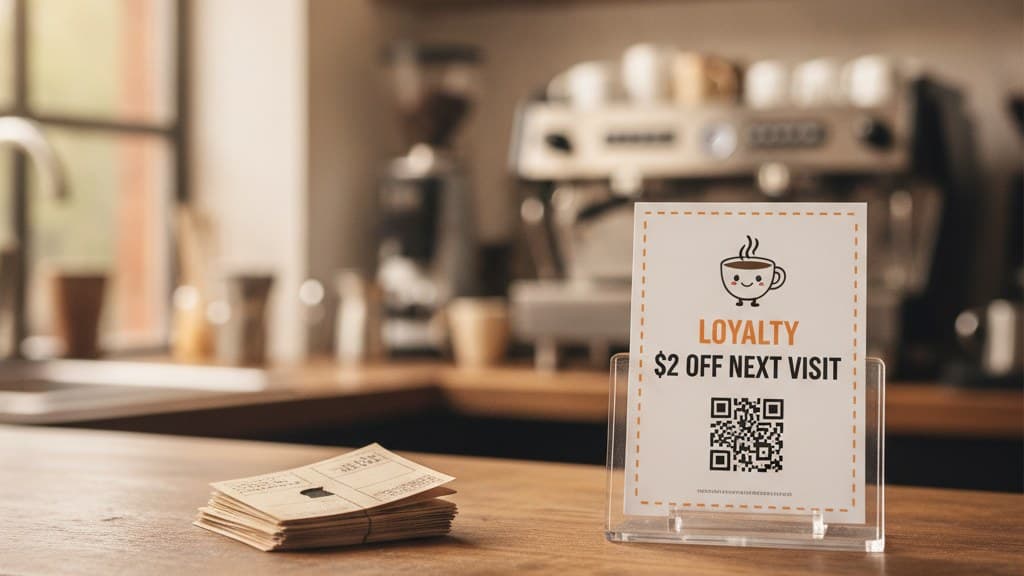
In the empty acrylic stand where the punch cards used to sit
Not as a self-serve pile, which converts poorly, but as your staff's grab point. The stand is already in the muscle memory of everyone behind your counter and already at the right height. Refilling it with pre-cut coupon cards means the handoff does not require anyone to turn around or open a drawer, which is the difference between a play that runs every shift and one that runs when the owner is watching.
Tucked into the product itself
For retail, the code goes inside the box, under the tissue, or clipped to the tag. For a service, it goes with whatever aftercare item the customer takes home. This placement trades immediacy for staying power: the customer finds it later, often at the exact moment they are thinking about the product, and it reads as a small extra rather than a promotion.
On the back of your Google review card
If you already hand out review cards, the reverse side is unused real estate and it is the best coupon placement you own. Front asks for something, back gives something. Keep the two independent: never make the coupon conditional on a review being left, because trading a reward for a review breaks Google's policy and can get your reviews filtered.
Notice that four of those five require no new object. The punch card program needed a bespoke printed item that existed for no other reason. The coupon rides on paper and packaging you are already buying, which is a quiet but real reduction in what the program costs you to run.
Turn one visit into many
Hand out single-use QR coupons that pull customers back through your door. Part of your Customer Comeback System. 14-day free trial, cancel anytime.
Create a couponTwo hundred customers, run both ways
Take the same month, the same shop, and the same two hundred customers who are not yet regulars. Run the punch card version and the coupon version side by side, using an eight dollar average ticket.
The punch card version. Two hundred cards issued. Assume a completion rate at the generous end of what small operators actually observe, call it seven percent. Fourteen cards come back complete. You hand over fourteen free items, a real cost of about $112. Those fourteen customers made nine paid visits each to get there, which sounds excellent until you ask the honest question: would they have made those nine visits without the card? For most of them, yes. They are your regulars. The other one hundred and eighty six customers received nothing, because the reward was never within reach.
The coupon version. Two hundred single-use codes handed at the counter, $2 off, fourteen day expiry. Coupons handed directly into someone's hand, with a sentence attached, redeem in the range of twenty five to thirty five percent. At thirty percent that is sixty return visits inside two weeks.
Roughly the same money leaves the business either way, $112 against $120. What it buys is not remotely the same. The punch card bought fourteen rewards handed to people who had already decided to stay. The coupon bought sixty return visits from people who had not.
Do not read all sixty of those visits as pure new revenue. A share of those customers would have drifted back on their own eventually. The honest claim is narrower and still worth having: the coupon pulled the visit forward into a two week window, and it put the visit in your shop rather than in whichever competitor the customer happened to walk past first. Pulling a visit forward and winning it are both real. Calling all sixty "extra" is how operators end up disappointed by programs that were actually working.
The counter script that replaces "do you have your card"
The single most damaging sentence in a punch card program is the one your staff says ten times a day. "Do you have your card?" is a retrieval demand aimed at a customer who is mid-payment, and it fails most of the time. Worse, each failure is a tiny moment of mild embarrassment for the customer, which is a strange thing to build a loyalty program on.
Replace it with a handoff that asks for nothing.
Bad version (a demand, and it puts the work on the customer): "Do you have your punch card? No? Here, take a fresh one, you need ten."
Good version (a gift, eight words, no retrieval): "This one's yours. Fourteen days. Nothing to carry."
The good version does three things at once. It states ownership immediately, so the object reads as a gift rather than an ad. It gives the deadline in plain language, which is where the urgency comes from. And the last three words quietly do the competitive work: they name the exact thing the customer disliked about punch cards without ever mentioning punch cards.
Train one sentence, not a paragraph, and train every person who works the counter on the same one. Consistency between staff members is the single largest predictor of whether a coupon program shows up in your redemption data. Two people running the script and one skipping it will halve your numbers, and you will spend a month blaming the offer.
Setting up your first campaign in 6 minutes
Create your account (14-day free trial)
Sign up with any email at reviewqr.app. The fourteen day free trial (card on file, cancel anytime) covers a full test run of the Second-Visit Bridge at a small counter business. After the trial, Essentials is $10/month for 100 single-use coupons and Growth is $25/month for 500.
Start with Play 1 only
The Second-Visit Bridge is the play to run first because it targets the visit where you are actually losing people, and because it needs no staff judgement beyond recognising an unfamiliar face. Leave the Rolling Punch and the Pair for week three.
Set the offer and the expiry
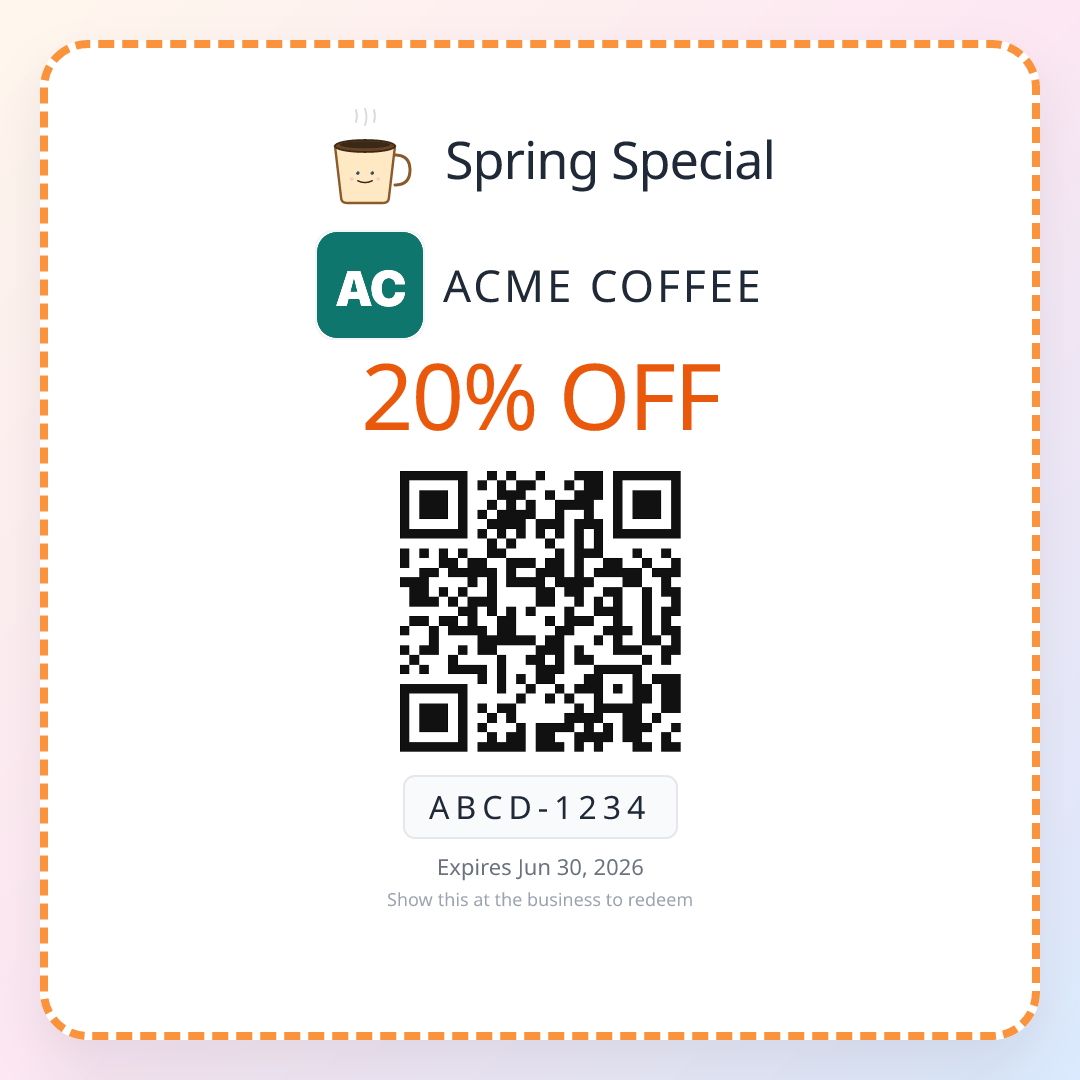
$2 off any order, valid 14 days from issue, one redemption per code. Single-use is enforced automatically: once a code is scanned and marked redeemed at your counter, a second scan of the same code shows 'already redeemed', so a photographed coupon cannot circulate.
Print 100 small cards
Plain cardstock, business card size, no design work. QR plus '$2 off, 14 days' is sufficient text. Do not print five hundred on the first run. You will want to change the offer or the wording after two weeks, and a box of obsolete cards is the most common reason a program quietly stops.
Retire the punch cards on the same day
Do not run both. Staff will default to the mechanic they already know, your data will be uninterpretable, and customers will ask why they are being handed two loyalty things. Take the punch cards off the counter, honour any completed ones already in circulation, and move on.
Brief the counter on one sentence
'This one's yours. Fourteen days. Nothing to carry.' Say it out loud with each staff member once before their first shift on the new program. That single rehearsal is worth more than the discount amount.
At the end of two weeks you will have a redemption percentage, which is the only number that matters and the number a punch card program never gives you. Under twenty percent means the handoff moment is wrong (you are probably handing at the card reader rather than with the order). Over forty percent means you can likely reduce the discount without losing the effect.
Common punch card mistakes
Mistake 1: Digitising the card instead of replacing it. Moving punches into an app removes the wallet clutter and leaves the reward sitting at visit ten, where it still cannot influence anything. If you are switching mediums, switch the structure at the same time or you have simply bought a subscription.
Mistake 2: Tuning the number of punches. Ten to eight, eight to six, six with a bonus stamp on signup. Operators iterate on this for years. It does not work, because no punch count fixes a reward that arrives after the churn. Move the reward forward instead of moving the finish line back.
Mistake 3: Issuing to everyone, including the daily regulars. Your Monday-to-Friday nine a.m. customer does not need a discount to come in on Tuesday. Every code handed to a regular is margin donated for zero behaviour change. Hand codes to unfamiliar faces and second-visit customers, and let the regulars pay full price for the thing they already love.
Mistake 4: No expiry, or an expiry so long it reads as none. "Valid until the end of the year" is stored by the brain as "later", and later is where coupons go to die in glove compartments and junk drawers. Fourteen days for the second-visit play, twenty one for the pair play. The tightness is doing at least half the work.
Mistake 5: Percentages instead of fixed amounts. "Fifteen percent off" is arithmetic the customer has to perform, and it scales with the order, which means your biggest tickets get your biggest discounts. "$2 off" is instantly legible and caps your exposure per code at exactly two dollars.
Mistake 6: Letting the handoff happen at the card reader. The moment of payment is the least generous-feeling second of the visit, and anything handed over during it reads as part of the transaction. Wait until the order itself changes hands. That is three seconds later and a completely different emotional register.
Related reading
This article covers the structural case against punch cards. For the mechanic itself explained from scratch, start with QR coupons for small business, and for a menu of offers organised by what you are trying to fix, the coupon ideas listicle groups twenty three plays by goal. If you are comparing tools before committing, best QR coupon app for small business covers the options side by side. Punch cards are most entrenched in drink counters, so the QR code coupons for coffee shops and QR code coupons for boba shops playbooks are the closest niche equivalents to this piece. And since the best coupon placement you own is the back of something you already print, see Google review cards with a QR code for the front of that card.
Frequently asked questions
Are paper punch cards still worth it for a small business?
Only if you are honest about what they are actually buying you, which is a discount handed to people who were already coming back. A punch card puts one hundred percent of its incentive on the tenth visit, but the visit where a customer decides whether you are part of their week is the second one. Single-digit shares of issued cards ever get completed, and the ones that do are almost always held by regulars who would have kept visiting with or without the card. So the card costs you a free item on your most loyal customers and does nothing at all for the first-time visitor who quietly never comes back. The paper is not the problem. The placement of the reward is.
What is a digital punch card, and is it different from a QR coupon?
A digital punch card is the same mechanic moved into an app or a wallet pass: the customer still collects, and the reward still sits at the end. It fixes the carrying problem (nothing to lose in a wallet) but keeps the structural one (nothing happens for nine visits). A single-use QR coupon is different in kind, not in medium. It puts a small, specific, expiring reward on the very next visit, which is the visit the business is actually at risk of losing. One is a collection game. The other is a return ticket. If you switch mediums but keep the reward at visit ten, you have bought yourself an app subscription and changed nothing.
Do I need an app to run a loyalty program for a small business?
No, and for most counter businesses an app is the single most expensive way to solve the cheapest problem you have. An app requires the customer to download something, create an account, and remember to open it at the till, which is three points of friction stacked in front of a two dollar reward. The realistic install rate for an independent shop app is small, and the people who install it are your regulars again. A printed single-use QR coupon needs no download, no account, and no app icon. The customer points a camera they already have at a card they were just handed. That is the entire onboarding.
How many punches should a punch card have?
The number of punches is the wrong lever, which is why operators keep tuning it and keep getting the same result. Going from ten punches to eight does not fix a card whose reward fires after the churn has already happened. The number that matters is how many days pass before the customer has a reason to come back, and the answer should be fourteen or fewer. Rather than shortening the card, split it: give a small reward on the next visit, then hand a fresh code at each redemption. The customer still feels the escalation that made punch cards work in the first place, and they carry nothing between visits.
Will customers miss the feeling of collecting stamps?
A small share genuinely enjoy it, and you can keep that feeling without keeping the card. What people like about a punch card is escalation: the sense that this visit is worth more than the last one. You can reproduce that by handing a fresh single-use code at every redemption and stepping the value up (two dollars off, then three, then a free item on the fourth). The escalation survives, the wallet clutter does not, and crucially the customer never has to answer the question that kills punch cards at the counter, which is whether they remembered to bring the card.
What does it cost to switch from punch cards to QR coupons?
Less than a reprint of the punch cards you are already buying. Every ReviewQR plan starts with a fourteen day free trial (card on file, cancel anytime), which is enough to run a full month of second-visit coupons at a small counter business and get a real redemption number instead of a guess. After the trial, Essentials is ten dollars a month for one hundred single-use coupons, and Growth is twenty five dollars a month for five hundred, which covers a busy multi-location counter operation. Printing is the same cardstock and the same print shop you were already using for the punch cards.
Ready to Implement This Strategy?
Create your custom QR code in 2 minutes and start collecting Google reviews today.
Create Your QR Code NowMore Google Review Guides
Google Review Cards: Sizes, Copy, and the QR Code That Makes Them Work
What to print on a Google review card, what size to cut it, where to hand it, and the exact numbers on how many reviews 300 cards produce. Includes copy templates and print specs.
guides23 Coupon Ideas for Small Business: Win Customers, Boost Sales, Build Loyalty
23 proven coupon ideas for small business — grouped by goal: attract new customers, raise the average sale, and turn first-timers into regulars. Plus how to keep them margin-safe.
guidesQR Code for Business Reviews: The Complete Playbook for 2026
A QR code for business reviews turns happy customers into reviews without friction. Here is how it works, where to place it, and what to expect in 30 days.