QR Code Coupons for Car Washes: Close the Member-vs-Drifter Gap
How indie car wash operators use single-use QR coupons after rain weeks, at the bay exit, and on the receipt to close the gap between membership frequency and drifter frequency. With math, scripts, and a 6-minute setup.
QR Code Coupons for Car Washes: Close the Member-vs-Drifter Gap
Turn one visit into many
Hand out single-use QR coupons that pull customers back through your door. Part of your Customer Comeback System. 14-day free trial, cancel anytime.
Create a couponA storm front rolls through your area on a Wednesday afternoon. By Thursday morning, every car in your neighborhood has a hood streaked with mineral spots, side panels covered in road grime, and a windshield that looks like it was finger-painted by a toddler. The forecast says clear skies through the weekend.
This is the single highest-intent forty-eight hours your car wash will see all month. The customers who are about to walk into your bays already know they need a wash. They are not weighing it. They are not price-shopping. They are looking for the nearest open bay between their commute and their kid's soccer practice.
And almost every indie car wash in the country will let those forty-eight hours pass without putting a single artifact into a customer's hand that gets them back the second time.
The big chains do not let that happen. They have unlimited-wash apps with push notifications. They have membership programs with auto-pay. The reason they invest so heavily is not that the app is profitable on its own. The reason is that the app closes the gap between members washing 2.4 to 2.6 times per month and non-members washing about once every 2.5 to 3 months. That is a six-to-seven-times frequency gap, and the entire chain car wash business runs on closing it.
You do not need a membership program to close that gap. You need a single-use QR coupon, handed at the bay exit, with a 14-day expiry. This article is the playbook for using it.
The Rain-to-Wash Reset: weather is your marketing calendar
Nearly every other small business has to manufacture demand. Coffee shops invent loyalty programs to nudge a regular into visit seven. Salons send "we miss you" emails six weeks after a missed appointment. Restaurants run Tuesday specials because Tuesdays are dead.
A car wash sits on top of a marketing calendar nature delivers for free. Rain creates dirty cars. Salt-treated winter roads create grime. Pollen season streaks every windshield in the county. Heat waves bake bug splatter onto bumpers. Each of these is a 24-to-72-hour high-intent window where the customer arrives at your bay already pre-sold.
The opportunity is not in capturing the visit. The opportunity is in capturing the second visit.
A customer who came in after Wednesday's storm is more likely to come back inside the next 14 days than at any other point in the year. Their car already feels clean. The contrast between this week and next week is sharp. And the salt or pollen or grime that drove them in once is still falling. A single-use coupon with a 14-day expiry, handed at the bay exit, plants a flag exactly inside that window. The coupon does not have to convince the customer that a wash is worth it. The forecast already did that. The coupon just gives the customer a small reason to choose your bay over the express tunnel two miles closer to his office.
The Member-vs-Drifter gap (and what it costs you)
The frequency gap between members and drifters is the single most-studied number in the car wash industry, and most indie operators look at it the wrong way. They see the 2.4× figure and think "unlimited members are the goal, I need to build a membership program." The math says something less dramatic and more actionable: members are not washing more because they bought a membership. They are washing more because the membership removed friction at the decision moment. The decision moment is the seven seconds between a dirty windshield catching the customer's eye and the customer either turning into your lot or not.
For a member, those seven seconds resolve to "the wash is free at the margin, turn in." For a drifter, those seven seconds resolve to "is it worth $12 today, maybe next week." A coupon that lives in the drifter's pocket flips the decision the same way the membership does, for the same operational reason. It removes the "is it worth it today" calculation by pre-committing the customer to a discounted next wash.
The asymmetry that makes the math wildly positive
A drifter customer at one wash every 2.5 months is worth roughly $58 per year at a $12 average ticket. A drifter who is shifted up to one wash every six weeks (the realistic effect of a 14-day bounce-back coupon working over 12 months) is worth roughly $103 per year. That is $45 of recovered annual revenue per drifter at an incremental cost of two or three $3 discounts per year. The ratio runs roughly 5 to 1 on coupon-cost-to-revenue-recovered, and that is before the upsell-at-counter on each of those extra visits.
The mistake most operators make in their first coupon program is thinking about the discount as a price cut. It is not. It is a frequency lever. The car wash math runs on visit count per customer per year, not on per-wash margin. Any coupon that adds even one wash per year to a drifter pays for itself many times over.
Three coupon plays the indie operator can run
The plays below are tuned to the three different jobs a car wash coupon should actually do: capture the rain-week drifter, defend the existing customer's frequency, and upsell the bay exit. Each one is a single-use QR code with a tight expiry. Pick one to start, layer the others after two weeks of data.
Play 1: The Rain-Week Recovery
Job: Capture the 48-hour post-rain drifter and pull them back inside 14 days.
The rain stops on Thursday. By Saturday morning, your bays are at capacity with first-time customers and infrequent visitors whose car just needs the dirt off. Every customer who pays for a wash in that 48-hour window gets a single-use QR coupon handed at the bay exit. $3 off any wash, valid 14 days from issue, one redemption.
The expiry is the entire mechanic. It puts the next wash inside the same weather cycle that brought them in this time, which is the highest-intent window they will see all month. Two weeks later, the salt or pollen or whatever is still in the air, the coupon is in their pocket, and your bay is now the path of least resistance.
Offer shape: $3 off any wash, valid 14 days from issue, one redemption. Best handed to: Every customer that pays during a 48-hour post-rain window. Why it works: The discount is small. The deadline does the work. The customer already wanted the second wash; the coupon just decides whose bay it happens at.
Play 2: The 30-Day Drifter Pull-Up
Job: Compress the gap between visits for the once-every-2.5-months customer.
Hand this one universally to every customer, every visit, regardless of whether it just rained. $4 off any wash, valid 30 days from issue, one redemption. The 30-day expiry is wider than Play 1 because the goal is different: not to capture a specific high-intent window, but to shift the drifter's natural frequency from 10 weeks to 6 weeks. Over a year, that single shift adds 2 to 3 extra washes per drifter to your bay count.
Offer shape: $4 off any wash, valid 30 days from issue, one redemption. Best handed to: Every paying customer. Universal. Why it works: The 30-day expiry catches the drifter inside the next natural wash-need window without trying to pull them in unnaturally early.
Play 3: The Interior-Upsell Voucher
Job: Convert exterior-only customers to exterior-plus-interior on the next visit, without selling them anything at the till today.
Most indie car washes lose interior-cleaning revenue to time pressure at the bay. The customer who came in for an exterior-only wash often wanted the interior detail too but did not have 25 extra minutes that morning. Hand them a single-use coupon valid for 30 days that lets them add interior for half off on the next visit. The next visit is not under the same time pressure, the price is now framed as a discount instead of an upsell, and the upsell happens at the next bay exit instead of the current pay station.
Offer shape: Add interior detail for $7 (normally $14), valid 30 days, one redemption. Best handed to: Customers who buy exterior-only and asked about pricing or duration of the interior package. Why it works: It removes the time-pressure objection from the upsell entirely and books the upsell at the future visit instead of the current one.
Do This
- ✓Run only one play per location for the first two weeks until you have data
- ✓Use single-use codes so the discount stops at one redemption per code
- ✓Match the expiry to the play (14 days for rain-week, 30 for drifter and upsell)
- ✓Track which bay or attendant handed the coupon so you can see whose handoff converts
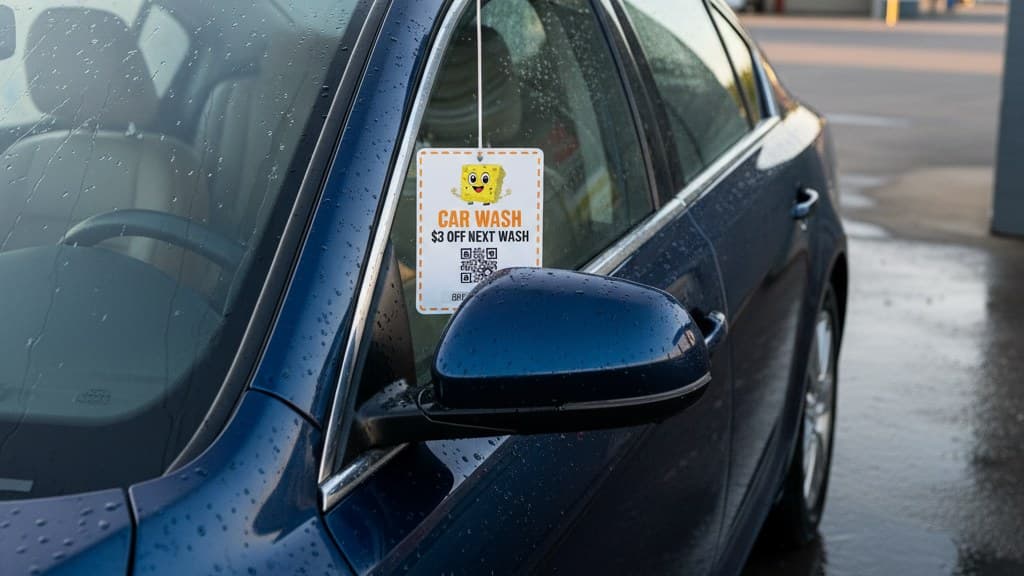
- ✓Print on small water-resistant cards or rearview-clip tags
Avoid This
- ✕Don't put the coupon on the public storefront sign (it stops being targeted)
- ✕Don't pair with a posted discount (kills the gift framing)
- ✕Don't run a percentage off (gets photographed and shared in 'cheap eats' Facebook groups)
- ✕Don't make the expiry longer than 30 days (urgency is half the mechanic)
- ✕Don't hand at the pay station (the receipt cupholder is where coupons die)
Where the QR actually lives in the bay
Coffee shops drop coupons on cup sleeves. Barbers tuck them into the cape pocket. Car washes have their own placement geometry, dictated by the fact that the customer is sitting in or standing next to a car the entire visit. Five placements that consistently outperform handing the coupon at the pay station:
Tucked under the rearview mirror clip
A small QR card with a sticky tab slides onto the rearview mirror at the bay exit while the attendant towels off the windshield. The customer sees it the moment he gets back in and reaches for the rearview to check his side mirrors. Three seconds of attention with the car still in a clean-and-fresh emotional state.
Stapled to the receipt holder
If you issue a printed receipt, attach the coupon as a tear-off strip to the receipt itself. The customer folds the receipt into the cupholder and the coupon goes with it. Most receipts get tossed at the next trash can; the coupon strip survives because it is visually separate.
Inside the floor-mat care kit
If you sell or hand out air fresheners, tire shine wipes, or interior detailing kits at upsell, drop the QR coupon into the kit packaging. The customer finds it the next time they reach for the kit, which is usually the next wash cycle.
On the back of a wash-of-the-month flyer
If you run a monthly featured wash, print the coupon on the back of the flyer you already hand out. Existing physical objects already make it to the customer's hand; piggybacking on them costs you nothing.
Slipped under the windshield wiper
For drive-through tunnels where the attendant has 3 seconds at the exit, the wiper-clip placement is fastest. The customer notices it at the next stoplight, which is usually less than a mile from your bay.
The bay exit beats the pay station every single time. The pay station is where the customer is parting with money and looking at the next thing on their to-do list. The bay exit is where the car looks clean for the first time in two weeks. Move the handoff three minutes later, redemption rates climb meaningfully.
Turn one visit into many
Hand out single-use QR coupons that pull customers back through your door. Part of your Customer Comeback System. 14-day free trial, cancel anytime.
Create a couponThe rain-week math (with real numbers)
Let's stress-test the Rain-Week Recovery play across a single-bay indie operation that sees 60 wash transactions on an average rain-week Saturday.
Assume a 48-hour post-rain window of Saturday-Sunday, with 60 wash transactions Saturday and 50 Sunday. That is 110 customers, each receiving a single-use $3-off bounce-back coupon valid 14 days. Bay-exit-handed coupons at car washes redeem at roughly 30 percent. That is 33 returning customers across the next 14 days, each spending $9 average ticket on the discounted wash plus their normal upsell behavior.
You spent $99 on the discounts. You billed $396 in incremental revenue on visits that would have, in aggregate, not happened until 6 to 10 weeks later (and a meaningful share would have happened at a competitor's bay during that window). The ratio is four-to-one on discount cost to recovered revenue, before counting any upsells on the discounted visits.
The mistake to avoid here is counting all 33 returning customers as "additional" revenue. A share of them would have come back to you anyway over the following 8 weeks. The honest number is what the coupon shifted: pulling the next wash forward from week 8 to week 2, and giving you the visit instead of the competitor across town. The shift is real money. The "extra" framing exaggerates it.
The bay-exit script (or the coupon dies)
A QR coupon slipped under a windshield wiper without a word lands as a parking ticket. A QR coupon slipped under a windshield wiper with eight words from the attendant lands as a small kindness. The script is doing more of the work than the discount.
Bad version (sounds transactional): "Here's a coupon, scan for next time."
Good version (sounds like a gift): "Two weeks. The salt's still on the road. Don't lose it."
The good version does three things the bad version misses. It gives the customer the deadline in plain words (two weeks), it ties the coupon to a real reason to come back (the salt is still on the road), and it makes the wash attendant the authority on when the next wash should happen instead of a vendor pushing a promo. Same three-dollar discount, dramatically different framing.
Train every bay attendant on a single-sentence script per play. Consistency across attendants is the biggest predictor of whether a coupon campaign that should work shows up in redemption data. Two attendants running the same script and one ignoring it will quietly halve your numbers.
Setting up your first campaign in 6 minutes
Sign in to ReviewQR (14-day free trial)
Use any email to create an account at reviewqr.app. The 14-day free trial (card on file, cancel anytime) is enough to test the Rain-Week Recovery play across a single rain-weekend at a one-bay operation. After that, Essentials is $10/month for 100 single-use coupons.
Pick the play that matches your week
If a storm is in the forecast inside the next 7 days, run Play 1 (Rain-Week Recovery) first. If the forecast is dry, run Play 2 (30-Day Drifter Pull-Up) as the universal handoff. Play 3 (Interior Upsell) is a layer to add after you have two weeks of data on Play 1 or 2.
Set the offer and expiry
$3 off any wash, valid 14 days from scan. One redemption per code. The single-use mechanic is enforced automatically: once a code is scanned and marked redeemed at your pay station, the second scan shows 'already redeemed.'
Print 50 wallet-size cards or wiper tags
Plain cardstock works for round one. Skip the design polish. QR + 'Until day 14' is enough text. If your bay sees water at exit, use a small laminated card or a water-resistant sticker on a wiper-clip.
Brief the bay-exit attendant
One eight-word script. 'Two weeks. The salt's still on the road. Don't lose it.' Practice it once with the attendant before the shift starts. Sub a different reason if the weather is different (pollen, bugs, dust, etc.).
Hand at the bay exit, not the pay station
Tucked under the wiper clip, the rearview clip, or onto the receipt as a tear-off strip. Anything but the cupholder at the pay station.
If your operation runs more than one bay and you want per-attendant tracking, the Essentials plan at $10/month gives 100 codes per month and lets you tag campaigns by attendant or bay. That tag is what tells you whose bay-exit handoff is actually converting, which is the data point worth $10 a month if you have two or more bays.
Common car-wash coupon mistakes
Mistake 1: Public storefront promotion. Putting a "$3 off your next wash" sign at the storefront kills the precision tool. Every regular sees it, every regular uses it, and the discount lands on visits you were going to bill at full price anyway. The single-use QR mechanic depends on the coupon being invisible to regulars and visible only to drifters and first-timers.
Mistake 2: Vague or long expiries. "Valid 90 days" reads as "I have time." The brain stores that as "forever" and the coupon dies in a glove compartment. 14 days for rain-week, 30 for universal drifter, 30 for upsell. Picky precision is doing the work.
Mistake 3: Coupon at the pay station instead of the bay exit. The pay station is the least generous-feeling moment in a car wash visit. Move the handoff three minutes later, after the towel-off, when the customer is looking at a clean car for the first time. Redemption rates climb noticeably.
Mistake 4: Running all three plays at once on day one. You will not know which one is working. Run one play alone for two weeks, look at the redemption rate, then layer a second play on top.
Mistake 5: No script for the attendant. Untrained handoffs underperform trained handoffs by a factor most owners do not believe until they A/B test two attendants in the same week. The discount is small. The eight-word script is the lever.
Mistake 6: Stacking the coupon with an unlimited membership in the same customer's account. If you do offer a membership, exclude members from the coupon program. They are already at member frequency; the coupon does nothing for them but cost you margin.
Related reading
This piece focuses on the coupon mechanic for car washes. If you also detail cars (interior reconditioning, ceramic coating, paint correction), the QR code coupons for auto detailing playbook covers the quarterly-reset mechanic at higher ticket sizes. For the review side of the same operation, the Google reviews for auto detailing guide covers the in-bay review ask. For broader coupon mechanics across small-business categories, the coupon ideas listicle groups 23 plays by goal, and the QR coupons for small business overview covers the single-use mechanic at a higher level. For a side-by-side of QR coupon tools, see best QR coupon app for small business.
Frequently asked questions
Do QR coupons actually work at car washes, or do customers just ignore them?
They work when the coupon is handed at the right moment. Handed at the bay exit with the towel and the receipt, single-use QR coupons at indie car washes redeem at 25 to 40 percent inside a 14-day window. The reason is that the moment of payment at a car wash sits inside the highest-attention moment of the visit: the customer just watched their car go from dirty to clean, the dopamine is fresh, and they are physically about to drive a clean car away. A coupon dropped into that moment lands. Dropped into a follow-up email three days later, the same coupon converts at one tenth the rate.
How do I compete with chain car wash apps without building one?
You stop trying to clone the membership and start using the coupon to close the same frequency gap the membership closes. The reason chains push the unlimited app is that members wash 2.4 to 2.6 times per month while non-members wash about once per 2.5 to 3 months. That is a 6-to-7-times frequency gap, and an app is one way to close it. A single-use 14-day return coupon is another way to close it, without taking on the subscription churn risk or the monthly retention work.
What discount should I put on a car wash coupon?
Pick the discount that matches the wash tier you most need to move. For a Tuesday rain-recovery push, $3 off the basic wash is enough because the customer is already in a pro-wash mindset (their car got rained on or muddy) and only needs a small nudge on the price. For an exterior-only customer to upgrade to interior next visit, $5 off the interior or "add interior for $7" is the right pull. For a second-wash inside 14 days, $4 off any wash works because the goal is the frequency, not the upgrade.
When should the attendant hand the coupon to the customer?
At the bay exit, after the towel-off, before the customer pulls back into traffic. That is the highest-engagement moment of the entire visit. The car is clean, the customer has a fresh towel in hand, and traffic is about to absorb their attention again. A small QR card slipped under the rearview mirror clip or tucked into the receipt holder lands as a small kindness. Handed at the pay station, the same coupon reads as part of the transaction and gets shoved into a cupholder without a glance.
Will running coupons cannibalize my existing regulars?
Not if the coupons are single-use and selectively handed. The coupon does not get advertised on the storefront sign or social media. It gets handed at the bay exit to customers who are not already on a wash cadence, and it expires in 14 days. Your once-a-week regular never sees one. Your once-every-two-months drifter sees one every visit, and the 14-day expiry pulls his next wash forward by a week, which over a year adds two to three extra washes to his calendar.
How many QR coupons should an indie car wash print to start?
Start with 50. That covers about ten days of standard volume at a single-bay indie operation and gives you a clean read on the redemption rate. Every ReviewQR plan starts with a 14-day free trial, which is enough to run a one-week test of the bay-exit handoff before the trial ends. Once redemption data is clean, the Essentials plan at $10 per month gives 100 codes monthly, which covers a normal one-bay operation comfortably.
Ready to Implement This Strategy?
Create your custom QR code in 2 minutes and start collecting Google reviews today.
Create Your QR Code NowMore Google Review Guides
Google Reviews for Auto Repair Shops: QR Code Playbook
How mechanic shops turn the relief of a fixed car into Google reviews — glovebox cards, service advisor scripts, and QR code placements that work.
AutomotiveAuto Detailing Google Reviews: QR Code Guide
Collect more Google reviews for your detailing shop with QR codes. Covers dashboard hangers, waiting area displays, and mobile detailing strategies.
AutomotiveQR Code Coupons for Auto Detailing: The Quarterly Reset Playbook
How auto detailing shops turn a one-time full detail into a quarterly habit with single-use QR coupons handed at the reveal. Unit-economics math, three plays, placement geometry, scripts, and a 6-minute setup.