QR Code Coupons for Auto Detailing: The Quarterly Reset Playbook
How auto detailing shops turn a one-time full detail into a quarterly habit with single-use QR coupons handed at the reveal. Unit-economics math, three plays, placement geometry, scripts, and a 6-minute setup.
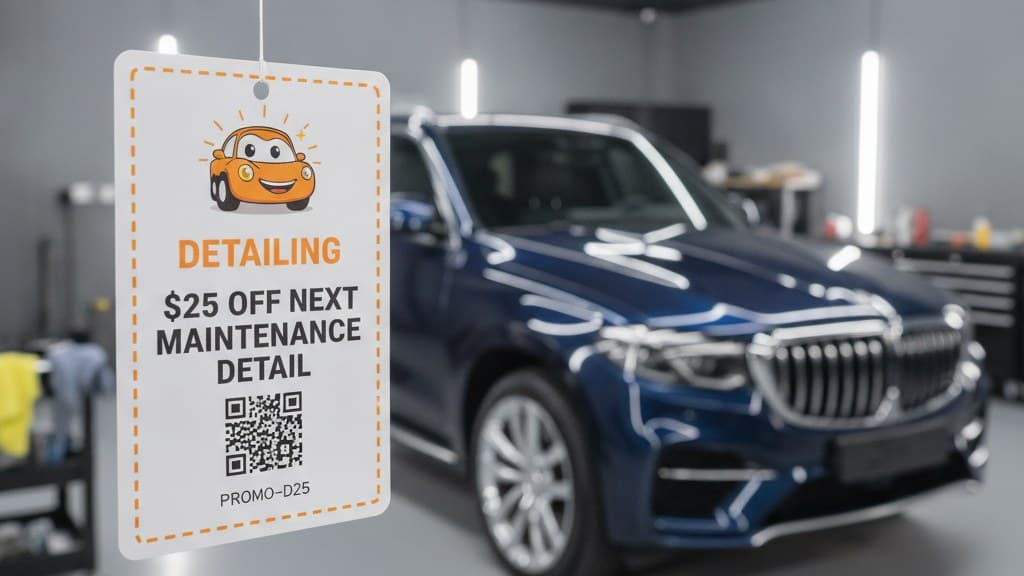
QR Code Coupons for Auto Detailing: The Quarterly Reset Playbook
Turn one visit into many
Hand out single-use QR coupons that pull customers back through your door. Part of your Customer Comeback System. 14-day free trial, cancel anytime.
Create a couponA customer books a full detail in April. Clay bar, paint correction, ceramic sealant, interior extraction, the works. Two hundred and forty dollars. They pick the car up, they cannot stop touching the paint, they tell you it looks better than the day they bought it. They mean every word.
Then they disappear for fourteen months.
Not because they were unhappy. Because in their mind, detailing is a thing you do once, like getting the carpets professionally cleaned before a party. They do not know that the sealant you laid down is already breaking down by July, that the leather you conditioned is drying out again by August, that the wheels you decontaminated are re-embedding brake dust by September. You know the car is on a clock. They think they bought a permanent result.
That gap between what you know about the car and what the customer knows is the single most expensive thing in a detailing business. And almost every indie detailer lets it stay open, because the only tools they reach for to close it are a text message three months later (ignored) or a membership plan the customer will not sign up for after a single visit.
There is a third tool. A single-use QR coupon, handed at the reveal, timed to when the protection wears off. This article is the playbook for running it.
The Quarterly Reset: the clock the customer cannot see
Most small businesses have to invent a reason for the customer to come back. A barber leans on the fact that hair grows. A nail salon leans on the fact that gel chips. Auto detailing sits on a biological-grade cycle just as reliable, except almost no customer knows it exists.
Here is the clock. A quality carnauba wax lasts six to eight weeks. A synthetic sealant lasts three to five months. Even a ceramic coating, the premium tier, needs a maintenance wash and topper every quarter to hold its hydrophobic edge. Interiors accumulate a season's worth of dust, UV drying, and spill residue in roughly the same window. Brake dust re-bonds to wheels within weeks. The professional standard the whole industry quietly runs on is a maintenance detail every three months to keep a car at the level a full detail delivered on day one.
The customer does not live inside that standard. They experience the detail as a one-time miracle and assume it holds until it visibly falls apart, which is usually a year or more later, by which point the car needs another full correction (expensive, painful, and easy to keep postponing) rather than a cheap maintenance top-up.
The opportunity is not to sell the full detail more often. It is to introduce the customer to the maintenance detail on the quarterly clock they never knew was ticking. That is the Quarterly Reset, and a single-use coupon with a 90-day expiry is the cleanest way to hand it to them.
What one converted drifter is actually worth
Run the numbers on a single customer and the case makes itself.
A once-a-year detailing customer buys one full detail at, say, a $220 average ticket. That is $220 of annual value, and it arrives in a lump, at the moment they finally cannot stand how the car looks anymore.
Now take that same customer and convert them to the Quarterly Reset. They keep the annual full detail as their spring reset, and they add three maintenance details across the year at a $90 average ticket. That is $220 plus $270, or $490 of annual value, from a customer who costs you nothing extra to acquire because they are already standing in your bay.
The asymmetry that makes the math wildly positive
Converting one annual-only customer to a quarterly-maintenance rhythm adds roughly $270 in recovered annual revenue. The cost to trigger that conversion is a single $25-off coupon on the first maintenance detail. That is better than a 10-to-1 return on the discount, and it compounds every year the customer stays on the quarterly cadence, because the coupon only has to be spent once to reset the habit.
The instinct to treat the discount as a giveaway is the wrong frame. On a high-ticket, low-frequency service, the entire business runs on visits-per-customer-per-year, not on per-visit margin. A coupon that adds even one maintenance detail to a drifter's year has already paid for itself several times over, and the realistic effect is three added visits, not one.
Three coupon plays built for high-ticket detailing
Detailing coupons are not restaurant coupons. The ticket is high, the frequency is low, and the decision is considered rather than impulsive. That means the discount is never the point. The timing and the framing are the point. Each play below is a single-use QR code with an expiry chosen to land inside a real window. Start with one, layer the others once you have two weeks of redemption data.
Play 1: The 90-Day Protection Reset
Job: Convert the one-time full-detail customer into a quarterly maintenance customer.
Every customer who picks up a full detail gets a single-use QR coupon handed at the reveal: $25 off a maintenance detail, valid 90 days, one redemption. The 90-day expiry is not arbitrary. It is set to the exact point where the sealant you just laid down has worn thin and the car is quietly sliding back toward where it started. The coupon lands in the customer's hand at the peak-emotion moment and detonates right when their car needs it most.
Offer shape: $25 off a maintenance detail, valid 90 days from issue, one redemption. Best handed to: Every full-detail customer, at the reveal. Why it works: It introduces the maintenance-detail tier the customer did not know existed, on the exact clock the protection actually runs on. The deadline does the persuading; the discount just lowers the first-time friction.
Play 2: The Second-Vehicle Garage Coupon
Job: Capture the other car (or two) sitting in the same household's driveway.
The customer standing in your bay watching you reveal their SUV almost certainly has a second vehicle at home that has never been professionally detailed. At the reveal, when they are most impressed with the result, hand them a single-use coupon: $40 off a full detail on a second household vehicle, valid 45 days, one redemption. The 45-day window is wide enough to survive a scheduling conversation with a spouse and tight enough to keep the urgency alive.
Offer shape: $40 off a full detail on a second vehicle, valid 45 days, one redemption. Best handed to: Customers who mention a spouse's car, a truck, a project car, or a kid's first vehicle. Why it works: The buying decision is already made emotionally. They just watched what you can do. The coupon removes the "is it worth it for the other car too" hesitation and puts a deadline on it.
Play 3: The Seasonal Decontamination Swing
Job: Create a predictable off-peak visit tied to the season, not the calendar.
Two moments a year justify a detail on pure logic: the end of winter (road salt, grime, and brine baked into paint and underbody) and the peak of pollen season (a fine acidic film etching into clear coat). Hand a single-use coupon timed to whichever swing is next: $30 off a decontamination detail, valid 30 days, one redemption. The season provides the reason; the coupon provides the nudge and the deadline.
Offer shape: $30 off a seasonal decontamination detail, valid 30 days, one redemption. Best handed to: Every customer served in the 4 to 6 weeks before a salt-out or pollen-up window. Why it works: The customer's own car is visibly suffering from the season, so the coupon feels like a timely warning from an expert rather than a sales push.
Do This
- ✓Run one play per shop for the first two weeks until you have a clean redemption read
- ✓Use single-use codes so the discount stops at one redemption per code
- ✓Match the expiry to the play (90 days for the reset, 45 for the second car, 30 for seasonal)
- ✓Point the discount at the maintenance detail, not the full detail, on the reset play
- ✓Track which service tier and which detailer handed each coupon so you can see what converts
Avoid This
- ✕Don't advertise the coupon on your storefront or social feed (it stops being targeted)
- ✕Don't run a percentage-off on a $200 ticket (it gets screenshotted and shared)
- ✕Don't hand it at the invoice (it reads as an upsell and dies in the door pocket)
- ✕Don't stack it on top of a customer who already books quarterly (you are paying for nothing)
- ✕Don't set the reset expiry past 90 days (the whole mechanic is the protection-wear window)
Where the QR lives between the seat and the invoice
A car wash hands the coupon at the bay exit. A barber tucks it in the cape pocket. Auto detailing has its own placement geometry, dictated by the reveal being the emotional high point and the finished interior being a pristine, high-attention space you just spent hours perfecting. Five placements that consistently beat handing the coupon with the invoice:
Clipped to the rearview mirror at the reveal
A small QR card on a soft loop hangs from the rearview mirror while you walk the customer around the finished car. It is the first thing they see when they sit down in their spotless interior, at the exact peak of the reveal emotion. Nothing else in the cabin competes for attention because you just cleaned everything else.
Inside the care-instructions packet
Most detailers hand a short care card (don't wash for 48 hours, avoid automatic tunnels, etc.). Print the coupon as the back page of that packet. The customer keeps the care card because it feels important, and the coupon rides along with it into the glovebox instead of the trash.
In the branded pickup gift bag
If you hand over a microfiber towel, an air freshener, or a sample of quick-detailer spray at pickup, drop the QR coupon into the bag. The customer rediscovers it the next time they reach for the towel, which is usually the next time the car needs attention.
On a static cling in the windshield corner
A small removable static cling in the lower corner of the windshield, with the QR and 'next reset: 90 days,' sits in the driver's eyeline every single drive. It is the detailing equivalent of the oil-change sticker, except it points at a coupon instead of a mileage number.
As a tear-off strip on the itemized invoice
For customers who want the paperwork, attach the coupon as a perforated tear-off on the invoice itself. It survives the invoice getting filed because it visually separates from the bill and reads as a separate object worth keeping.
The reveal beats the invoice every time. The invoice is the moment the customer is parting with two hundred dollars and bracing for the total. The reveal is the moment they love you. Move the handoff from one to the other, three minutes earlier, and redemption climbs without touching the discount.
Turn one visit into many
Hand out single-use QR coupons that pull customers back through your door. Part of your Customer Comeback System. 14-day free trial, cancel anytime.
Create a couponThe reveal-week math (with real numbers)
Let's stress-test the 90-Day Protection Reset across a detailing shop that completes 40 full details in a month.
Every one of those 40 full-detail customers gets a single-use $25-off maintenance-detail coupon at the reveal, valid 90 days. Reveal-handed detailing coupons redeem at roughly 25 percent because the emotional context is strong and the timing lines up with real protection wear. That is 10 maintenance details booked across the following quarter, each at a $90 average ticket.
You spent $250 on the discounts. You billed $900 in maintenance-detail revenue that, for most of those customers, would not have happened at all inside the quarter (and for a share of them, would not have happened until the car needed a full correction a year later, if it happened with you at all). The ratio runs better than three-to-one on discount cost to recovered revenue, before counting the upsells that happen once a customer is standing in your bay again, and before counting the second and third quarters those same customers now come back for.
Do not count all 10 redeemers as pure new revenue. A couple of them might have drifted back to you eventually. The honest number is what the coupon shifted: it pulled the next visit forward from "someday, maybe a full detail" to "this quarter, a maintenance detail," and it planted the quarterly rhythm that turns a once-a-year customer into a four-times-a-year customer. That rhythm, not the single redemption, is where the real money is.
The reveal-side script (or the coupon dies)
A QR card handed over in silence with the invoice lands as a receipt. The same card handed at the reveal with eight words lands as expert advice. The script is doing more work than the discount.
Bad version (sounds like an upsell): "Here's a coupon for next time if you want it."
Good version (sounds like a warning from an expert): "Ninety days. That's when the protection starts fading."
The good version does three things the bad version misses. It states the deadline in plain numbers (ninety days), it ties the coupon to a real reason rooted in the work you just did (the protection fades), and it casts you as the expert who knows the car's clock instead of a vendor pushing a promo. Same $25, completely different weight.
Train every person who does a reveal on one sentence per play. On a low-volume, high-ticket service, consistency at the reveal is the single biggest predictor of whether a coupon program that should work actually shows up in your redemption numbers. One detailer who nails the line and one who mumbles it will quietly halve your rate.
Setting up your first campaign in 6 minutes
Sign in to ReviewQR (14-day free trial)
Use any email to create an account at reviewqr.app. The 14-day free trial (card on file, cancel anytime) is enough to run the 90-Day Protection Reset across two weeks of full-detail reveals at most indie or mobile operations. After that, Essentials is $10/month for 100 single-use coupons.
Pick the play that matches your month
If you are heading into a salt-out or pollen window, lead with Play 3 (Seasonal Decontamination). Otherwise run Play 1 (90-Day Protection Reset) as your default reveal handoff. Layer Play 2 (Second-Vehicle) on top once you see the reset redeeming.
Set the offer and expiry
$25 off a maintenance detail, valid 90 days from issue, one redemption. The single-use mechanic is enforced automatically: once a code is scanned and marked redeemed, a second scan shows 'already redeemed.'
Print 20 mirror-hang cards or care-packet inserts
Plain cardstock is fine for round one. Skip the design polish. QR plus 'next reset: 90 days' is enough text. If you hand a care-instructions packet, print the coupon on the back of it so the two travel together into the glovebox.
Brief whoever does the reveal
One eight-word line. 'Ninety days. That's when the protection starts fading.' Practice it once before the shift. Swap the reason to match the play (salt, pollen, the second car) so it always sounds like advice, not a pitch.
Hand it at the reveal, not the invoice
Clipped to the rearview, tucked in the care packet, or dropped in the pickup gift bag. Anywhere except stapled to the bill at the pay moment.
If you run mobile or multiple detailers and want per-tier tracking, the Essentials plan at $10/month gives 100 codes monthly and lets you tag campaigns by service tier or detailer. That tag is what tells you whether the reset is converting off full details, off ceramic jobs, or off interior-only work, which is the data point worth ten dollars a month once you are turning real volume.
Common auto detailing coupon mistakes
Mistake 1: Pointing the discount at the full detail instead of the maintenance detail. Discounting the full detail cannibalizes the annual purchase the customer was going to make anyway and trains them to wait for a coupon. Point the reset play at the cheaper maintenance tier, which is a service most drifters do not even know you offer. You are adding a visit, not discounting an existing one.
Mistake 2: Running a percentage-off on a high ticket. "20% off any detail" on a $240 job is a $48 giveaway that gets screenshotted and passed around a local Facebook car group within a day. Use a fixed dollar amount tied to a specific service tier, and keep it single-use.
Mistake 3: Handing the coupon at the invoice. The invoice is the least generous-feeling moment of the whole transaction. The reveal is the most generous. Move the handoff to the walkaround, when the customer is still circling the car in disbelief, and the same coupon converts far better.
Mistake 4: Setting a vague or year-long expiry. "Valid one year" reads as "forever" and the coupon dies in a glovebox. The 90-day reset expiry is the entire mechanic, because it is timed to the exact point the protection wears down and the car needs you again.
Mistake 5: Running all three plays at once on day one. You will not know which one moved the numbers. Run one play alone for two weeks, read the redemption rate, then layer a second on top.
Mistake 6: No script at the reveal. A coupon handed in silence is a receipt. A coupon handed with one expert sentence about the protection clock is advice. On a considered, high-ticket service, the eight-word line is a bigger lever than the dollar amount on the card.
Related reading
This piece focuses on the coupon mechanic for detailing shops. If you also run or partner with a wash operation, the QR code coupons for car washes playbook covers the higher-frequency, lower-ticket version of the same idea. For the review side of the same detailing operation, the Google reviews for auto detailing guide covers the reveal-moment review ask that pairs perfectly with the coupon handoff. For broader coupon mechanics across small-business categories, the coupon ideas listicle groups plays by goal, and the QR coupons for small business overview covers the single-use mechanic at a higher level. For a side-by-side of QR coupon tools, see best QR coupon app for small business.
Frequently asked questions
Do QR coupons work for auto detailing, or is the frequency too low?
They work precisely because detailing frequency is low and you are trying to raise it. A one-time full-detail customer who never returns is the norm in this business, not the exception. The job of the coupon is not to trigger an impulse buy the way a coffee coupon does. The job is to convert a single annual detail into a quarterly maintenance habit, which is the natural interval at which paint protection degrades and interiors re-soil. Handed at the reveal with a single-use QR coupon valid 90 days, the maintenance-detail bounce-back redeems at 20 to 30 percent, and each redemption is worth $80 to $120, so even a modest rate pays for itself many times over.
How is a QR coupon different from a detailing membership or maintenance plan?
A membership asks the customer to commit to recurring billing before they trust the cadence. A single-use coupon lets the cadence prove itself first. You hand the customer a $25-off maintenance-detail coupon that expires in 90 days, timed to when their fresh sealant will have worn down. If they redeem it, they have now experienced the quarterly rhythm without signing anything. That redeemed second visit is the moment to pitch the plan, not the first. The coupon is the on-ramp to the membership, not a competitor to it.
What discount should I put on an auto detailing coupon?
Match the discount to the job the coupon is doing. For the 90-day maintenance reset, $25 off a maintenance detail is enough because the customer already saw the transformation and the deadline is doing most of the work. For pulling in a second household vehicle, $40 off is the right pull because you are asking them to detail a car that was not on their mind today. For a seasonal salt or pollen decontamination push, $30 off with a 30-day window creates the urgency the season already justifies. Avoid percentage-off discounts on a $200 ticket, since that number gets screenshotted and shared.
When should I hand the detailing customer the coupon?
At the reveal, the moment they first see the finished car. That half-second where they stop walking because they do not recognize their own vehicle is the single highest-emotion point of the entire transaction. A small QR card clipped to the rearview mirror or tucked into the care-instructions packet lands as part of the gift. Handed at the invoice, the same coupon reads as an upsell attached to a bill and gets folded away unread. Move the handoff to the walkaround and redemption climbs.
Will detailing coupons cannibalize customers who would have paid full price?
Not if the coupon is single-use and points at the maintenance detail rather than the full detail. Your customer who already books a full correction every spring is not the target. The target is the once-a-year drifter who does not know their car needs quarterly upkeep. The coupon introduces them to the cheaper maintenance detail on a 90-day clock, which adds visits that would never have happened, at a service tier that did not compete with the annual full detail they already buy.
How many QR coupons should a detailing shop print to start?
Start with 20. A detailing shop turns fewer, higher-ticket cars than a car wash, so a small batch covers weeks of reveals and still gives you a clean read on redemption. Every ReviewQR plan starts with a 14-day free trial, which is enough to run the 90-day maintenance-reset play across two weeks of deliveries before the trial ends. Once the redemption rate is clear, the Essentials plan at $10 per month gives 100 codes monthly, which comfortably covers a busy single-bay or mobile detailing operation.
Ready to Implement This Strategy?
Create your custom QR code in 2 minutes and start collecting Google reviews today.
Create Your QR Code NowMore Google Review Guides
QR Code Coupons for Car Washes: Close the Member-vs-Drifter Gap
How indie car wash operators use single-use QR coupons after rain weeks, at the bay exit, and on the receipt to close the gap between membership frequency and drifter frequency. With math, scripts, and a 6-minute setup.
AutomotiveGoogle Reviews for Auto Repair Shops: QR Code Playbook
How mechanic shops turn the relief of a fixed car into Google reviews — glovebox cards, service advisor scripts, and QR code placements that work.
AutomotiveAuto Detailing Google Reviews: QR Code Guide
Collect more Google reviews for your detailing shop with QR codes. Covers dashboard hangers, waiting area displays, and mobile detailing strategies.