QR Code Coupons for Pet Groomers: The 'We Miss Charlie' Card
Single-use QR coupons designed for the pet grooming calendar. Pet-name personalization, the 6-week return discount, multi-pet household plays, and birthday cards. With economics, scripts, and a 6-minute setup.
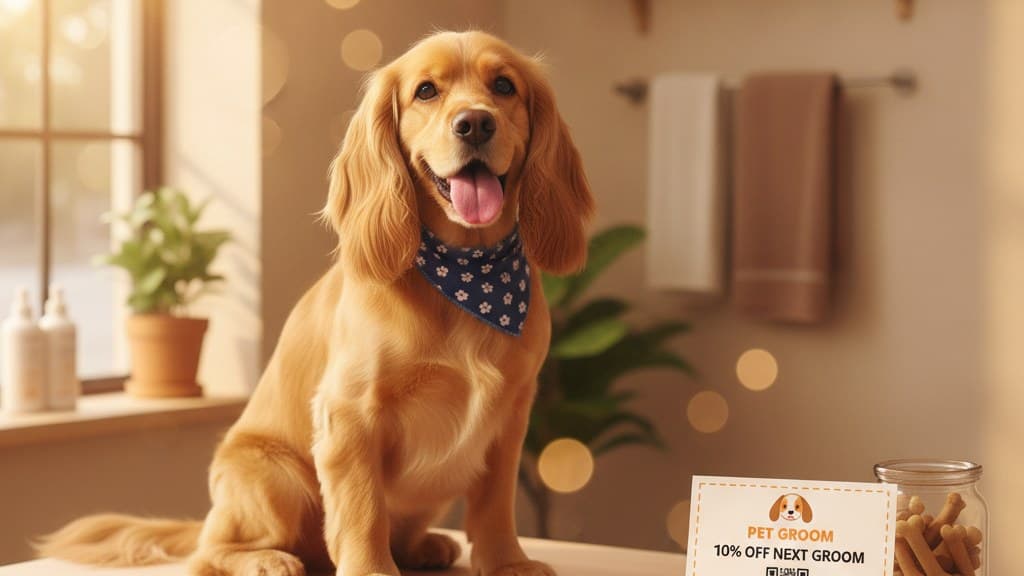
QR Code Coupons for Pet Groomers: The 'We Miss Charlie' Card
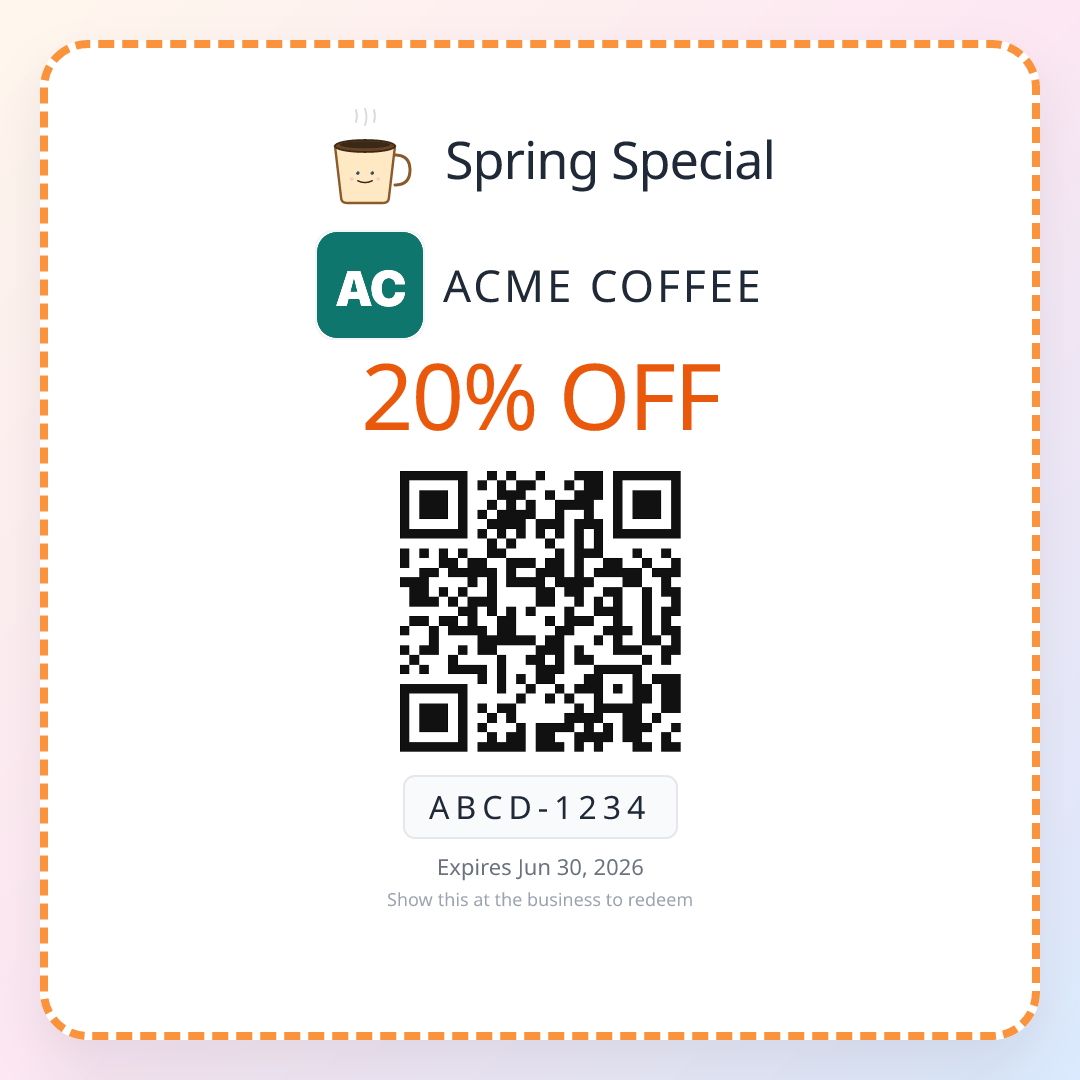
Turn one visit into many
Hand out single-use QR coupons that pull customers back through your door. Part of your Customer Comeback System. 14-day free trial, cancel anytime.
Create a couponThe intake form at almost every independent pet grooming shop asks the same three questions. The owner's name. The pet's name. The pet's breed. Everyone fills it in. Almost nobody thinks twice about it.
But sit with the answer for a moment. Your client base does not contain Sarah and David and Jennifer. It contains Charlie. It contains Biscuit. It contains Daisy and Moose and Pepper and Luna. The owners pay the bill, but the relationship is filtered through a small living creature who has a name, a personality, and a haircut your shop is responsible for.
This is the single most undervalued marketing asset in independent pet grooming, and almost no shop uses it. The corporate chains certainly do not. PetSmart cannot send a card that says "we miss Charlie." They can send "we miss you," which lands the same way a hardware-store mailer lands. You, however, can. And the single-use QR coupon with the pet's name on it, handed at the right moment, is the cheapest, smallest, most embarrassingly effective marketing intervention an independent groomer can make.
The 'We Miss Charlie' Card: why the pet name does the work
Pet grooming sits on top of a clean biological cycle. A standard breed-cut dog wants a fresh groom every four to six weeks. A doodle or poodle wants one every five to eight. A short-coated dog can stretch eight to twelve. Cats are even longer. Inside those windows, the appointment-or-no-appointment decision is being made one of two ways: either the owner has the next groom already booked, or the owner is trying to remember whether to call.
The "trying to remember" cohort is where your business leaks. A client who doesn't re-book at pickup is two to three times more likely to drift to another groomer by the time the next groom is due. Not because she stopped liking you. Because somebody else got there first when the dog started looking shaggy and the search bar was open.
The 'We Miss Charlie' Card stops the leak. It is a single-use QR coupon, valid for the next visit, expiring inside the pet's natural groom window, handed at pickup with the pet's name on the card itself. The personalization is the entire mechanic. The dollar amount is decoration.
Most shops know this intuitively. They hand a "next time" reminder at checkout. The reminder almost never works because it lacks two things: a deadline (so the client treats it as advisory) and a name (so the brain encodes it as marketing, not personal). Add both, and the conversion math changes more than the small format change suggests.
What one re-engaged pet client is actually worth
Pet groomers chronically undervalue their regulars because the per-visit ticket is mid-sized and the visit frequency is moderate. Both of those numbers, multiplied across a year, get serious quickly.
A small-to-medium dog at six-week cadence with one full groom plus an occasional add-on (de-shed, nail trim, sanitary trim, ear cleaning) lands at roughly $560 to $720 in annual revenue per regular client. A large-breed regular at the same cadence pushes $900 to $1,200. A two-dog household sits in the $1,000 to $1,800 range. The numbers are conservative.
The ratio runs roughly 70 to 120 to 1 depending on the breed. Every dollar spent defending a regular's cadence protects somewhere between seventy and a hundred and twenty dollars of annual revenue. The coupon does not need to convert at a high rate for the math to be wildly positive. It needs to save one regular per year per ten coupons handed out to pay for itself many times over.
The asymmetry that makes pet groomer coupons a no-brainer
A new pet client costs the average shop $40 to $80 in acquisition between social ads, intro offers, and the wash-out rate on walk-ins who never re-book. Keeping a six-week regular with a $10 coupon is four to eight times cheaper than acquiring her replacement, and she is worth more per visit because she already trusts you with the dog's coat pattern, behavior quirks, and ear sensitivity. Every retention coupon you do not run is an acquisition cost you are choosing to pay instead.
Three coupon plays designed for the grooming calendar
The mistake most shops make in their first coupon program is running one blunt "10% off" across every visit. The plays below are tuned to three different jobs a groomer coupon should actually do: defend the cadence, celebrate the pet, and bundle the multi-pet household.
Play 1: The 6-Week Return
Job: Defend the regular's cadence on the visit where pet clients actually drift.
Hand this one at pickup, every visit, every client. Single-use, $10 off, valid 42 days from issue (the outer edge of a normal six-week window). The card has the pet's name on it: "Until day 42 for Charlie." The expiry is the entire mechanic. It lines up with the breed's natural re-groom window so the client either uses the coupon before the dog starts looking shaggy, or watches it die exactly when the dog is at peak need, which is the same week he is most likely to drift to a competitor.
Offer shape: $10 off any full groom, valid 42 days from issue, one redemption, pet name printed on the card. Best handed to: Every paying client at the end of every pickup. Universal. Why it works: It puts a hard deadline on re-booking that the client physically carries home. The pet name does the emotional work. The $10 is the wrapper.
Play 2: The Pet Birthday Card
Job: Generate a non-discount touchpoint that rewards the pet, not the wallet.
Pull the pet birthdays from your intake forms (if you do not capture them, start). A week before the pet's birthday, send a card or print a sticker that says: "Charlie turns 5 next week. The de-shed treatment is on us at her next visit." Single-use QR, valid 30 days from the pet's birthday, no dollar discount, free add-on of a specific service.
Offer shape: Free de-shed treatment (normally $20), valid 30 days from pet birthday, one redemption. Best handed to: Every client whose pet birthday is in the next 7 days. Why it works: It celebrates the pet, not the bill. Birthday cards aimed at people land flat in a pet's calendar; birthday cards aimed at the pet land in the family album. The retention effect is disproportionate to the cost of the free add-on.
Play 3: The Multi-Pet Same-Visit Bundle
Job: Convert two-dog households from staggered visits to same-visit bookings.
Most multi-pet households book staggered (Charlie this week, Biscuit in three weeks), partly out of convenience, partly because the client never thought to ask. Hand the multi-pet household a coupon that says: "$15 off when both Charlie and Biscuit come the same visit." Single-use, 60 days, one redemption per household. The single same-visit booking smooths your schedule and locks in both pets to a synchronized cadence going forward.
Offer shape: $15 off the combined ticket when both pets come the same visit, valid 60 days, one redemption. Best handed to: Identified multi-pet households at the next single-pet pickup. Why it works: It buys a scheduling change, not a discount. The client gets to combine two trips into one, the shop gets two grooms in one block, both sides benefit operationally.
Do This
- ✓Always print or write the pet's name on the card
- ✓Match the expiry to the breed cycle (35-42 days for short coats, 42-56 for long)
- ✓Hand at the leash pickup, not the till
- ✓Track which groomer handed which coupon so you can see whose hand-off converts
- ✓Use single-use codes so the discount stops at one redemption per household
Avoid This
- ✕Don't run a generic 'we miss you' card with no pet name (kills the redemption rate)
- ✕Don't make the expiry longer than the breed's groom cycle
- ✕Don't post the coupon on Instagram or your storefront (kills the targeting)
- ✕Don't stack a discount on top of an already-discounted intro groom
- ✕Don't send the birthday card on the OWNER's birthday (this is about the pet)
Where the QR actually lives at pickup
Coffee shops drop coupons on cup sleeves. Barbers tuck them into the cape pocket. Pet groomers have their own placement geometry, dictated by the fact that the client is holding a leash, a bag of supplies, and a freshly groomed pet who would rather go home. Five placements that consistently outperform handing the coupon at the counter:
Clipped to the leash at hand-off
A small QR card on a tiny clothespin clip attaches to the leash itself. The client takes the leash, the coupon comes with it, and the find happens at the car door when the leash gets re-clipped. Three seconds of attention with the pet right there as the emotional anchor.
Tucked into the take-home bag
If you send clients home with a bag (sample shampoo, brush, treat), drop the coupon card into the bag at packing. Most bags get opened at home; the card surfaces in the family kitchen, which is the right context.
Slipped under the bandana knot
If you send the dog home with a bandana, tuck the coupon card under the knot at the back. The client removes the bandana that evening and finds the coupon. The bandana is already an emotional moment; the coupon piggybacks on it.
Stapled to the groom report card
If you hand out a quick groom report ('Charlie did great today, ear cleaning recommended next visit'), staple the coupon to the report. Report cards already make it onto the fridge; the coupon goes with.
Inside the photo packet
If you take a 'fresh groom' photo and send it to the client, include a printable coupon on the back of a physical photo card or as a second attachment. The photo is the most-shared groomer artifact in the social world; the coupon rides along.
The counter beats almost nothing, but the leash hand-off beats the counter every single time. Move the placement three minutes later, after the client has seen the dog and laughed once, and redemption rates climb meaningfully.
Turn one visit into many
Hand out single-use QR coupons that pull customers back through your door. Part of your Customer Comeback System. 14-day free trial, cancel anytime.
Create a couponThe 6-week math (with real numbers)
Let's stress-test the 6-Week Return play across a single-groomer shop with 80 regular clients at six-week cadence.
A regular at six-week cadence grooms 8.5 times a year. Assume 60 percent are six-week regulars who would re-book anyway and 40 percent are wavering clients who might or might not return. The coupon does not change behavior for the loyal 60 percent (they were coming back anyway), but for the wavering 40 percent the coupon pulls forward roughly 1.5 visits per year per client at a 40 percent redemption rate.
For 32 wavering clients, that is 48 additional grooms per year that would have leaked to a competitor or been delayed past the natural window:
You spent $480 on the discounts. You billed $3,600 in recovered revenue, plus any add-on services on those grooms. The ratio runs roughly seven-and-a-half to one, and that is before you count the compounding effect: a wavering client who comes back this time at a discount is materially more likely to come back next time at full price.
The mistake to avoid here is treating the 60 percent loyal-anyway grooms as "wasted" coupon cost. They are not wasted because most loyal clients do not redeem coupons they did not need. The redemption data will show this: the 6-Week Return play tends to redeem heavily in the wavering segment and lightly in the loyal segment, because loyal clients re-book on autopilot and forget about the coupon. The math self-corrects.
The leash hand-off script (or the coupon dies)
A QR coupon handed in silence lands as a flyer. A QR coupon handed with one sentence about the pet by name lands as a small kindness. The script is doing more of the work than the discount.
Bad version (sounds transactional): "Here's a coupon for next time."
Good version (uses the pet name): "This is for Charlie. Forty-two days. We'll see him before he gets shaggy again."
The good version does three things the bad version misses. It addresses the pet, not the client (which signals the relationship is with the dog). It gives a precise deadline (forty-two days) that the client can hold in her head. And it ties the deadline to the dog's biology ("before he gets shaggy"), which makes the coupon feel like animal-care advice rather than a discount push. Same ten-dollar discount, dramatically different framing.
Train every groomer in the shop on a single-sentence script with a slot for the pet's name. Consistency across the team is the single biggest predictor of whether a coupon campaign that should work actually shows up in redemption data.
Setting up your first campaign in 6 minutes
Sign in to ReviewQR (14-day free trial)
Use any email to create an account at reviewqr.app. The 14-day free trial (card on file, cancel anytime) is enough to test the 'We Miss Charlie' Card across your first two weeks of regulars. After that, Essentials is $10/month for 100 single-use coupons.
Pick one play, not three
Run the 6-Week Return first. It is the most universal and the easiest to brief the groomers on. Add the Pet Birthday Card after you have two weeks of redemption data on the first play.
Set the offer and expiry
$10 off any full groom. Expires 42 days from scan. One redemption per code. The single-use part is enforced automatically: once a code is scanned and marked redeemed at your counter, the second scan shows 'already redeemed.'
Print 30 cards with pet-name space
Wallet-size cards on plain cardstock. Leave a handwritten blank for the pet name, or merge the name in if your booking software supports it. The hand-written name actually outperforms the merged version because it looks more personal.
Brief the leash hand-off
One sentence per groomer. 'This is for [Pet]. Forty-two days. We'll see him before he gets shaggy again.' Practice once with the team before the shift starts.
Hand at the leash, not the till
Right after the client sees the dog freshly groomed. Clip the card to the leash, tuck it under the bandana, or drop it in the take-home bag. Anything but the counter receipt.
If your shop runs more than one groomer and you want per-groomer tracking, the Essentials plan at $10/month gives 100 codes per month and lets you tag campaigns by groomer. That tag is what tells you whose leash hand-off is converting, which is the data point worth $10 a month if you have two or more groomers.
Common pet groomer coupon mistakes
Mistake 1: Generic "we miss you" with no pet name. The pet name is the entire mechanic. A coupon that says "we miss you" reads as direct mail. A coupon that says "we miss Charlie" reads as a personal note. Same coupon, three times the redemption rate.
Mistake 2: Expiry longer than the groom cycle. "Valid 90 days" defeats the purpose. The dog will look shaggy and get groomed somewhere else inside those 90 days. The coupon expires after the next visit is already booked elsewhere. Match the expiry to the breed cycle.
Mistake 3: Coupon at the counter, not the leash. The counter is where the client is reaching for the credit card. The leash hand-off is where the client is looking at the dog. Coupons at the leash convert at materially higher rates because the emotional state is different.
Mistake 4: Public promotion of the coupon. Posting "$10 off your next groom!" on Instagram defeats the single-use mechanic. Every regular sees it, every regular uses it, the discount lands on visits you were going to bill at full price.
Mistake 5: Birthday card on the owner's birthday. Pet birthdays drive the emotional response. Owner birthdays drive nothing in this context (the owner does not associate the groomer with their own birthday). Always anchor the celebration to the pet.
Mistake 6: No script for the leash hand-off. Untrained hand-offs underperform trained ones by a factor most owners do not believe until they A/B it across two groomers in the same week. The coupon is small. The script is the lever.
Related reading
This piece focuses on the coupon mechanic for pet groomers. For broader coupon plays across small-business categories, the coupon ideas listicle groups 23 plays by goal, and the QR coupons for small business overview covers the single-use mechanic at a higher level. For a side-by-side of QR coupon tools, see best QR coupon app for small business. If you also run a barber shop or salon (the closest service-cycle analogs to pet grooming), the QR coupons for barber shops and QR coupons for salons and spas pieces cover the same biological-cycle mechanic on different verticals.
Frequently asked questions
Do QR coupons actually work for pet groomers?
Yes, and for one specific reason: pet groomers have something almost no other small business has. The customer relationship is filtered through a creature with a name, and that name is the emotional handle. A "We miss Charlie" card with a single-use QR coupon at week six lands at a redemption rate of 35 to 50 percent at independent shops. The same generic "we miss you" email to the same client list converts at a fraction of that. The name is doing the work. The discount is the wrapping paper.
What discount should I put on a pet groomer coupon?
Pick the discount that matches the job. For a 6-week return at full groom, $10 off works because the client already loves you and the dollars need to clear the procrastination, not the loyalty. For a multi-pet add-on, "$15 off when both pets come the same visit" beats one big single-use because it forces the second dog into the same appointment. For a pet birthday, a free nail trim or de-shed add-on is more emotionally resonant than a dollar discount because it celebrates the pet rather than discounting the service.
When should the groomer hand the coupon to the client?
At the pickup, after the leash hand-off, before the client opens the wallet. The moment of peak generosity at a pet groomer is the silent five seconds when the client sees the dog freshly groomed, makes the involuntary "aww" face, and the dog wags its tail at her. The cut is fresh, the verdict is positive, and the client is emotionally open. A coupon placed in that moment lands as a gift to the dog, not as a marketing artifact aimed at the client. Handed at payment, the same coupon reads as part of the bill.
Will pet name personalization scale across hundreds of clients?
Yes, because most independent pet groomers already capture the pet name on every intake form. The "We miss Charlie" card is a single template with the pet name inserted at checkout, which can be done by hand on a printed coupon in five seconds. Larger shops automate it via the booking software's merge fields. The personalization does not need to be elaborate. The pet name alone, hand-written or merged onto the card, increases redemption rates by roughly 3x over the same coupon without the name.
What about clients with multiple pets?
Multi-pet households are where the coupon math gets unusually positive. A client who brings two dogs is worth roughly 1.8x what one dog is worth (the second dog gets a small bundle discount but otherwise pays nearly full price). A coupon that incentivizes booking both pets the same visit, instead of staggered weeks, smoothes the groomer's schedule and locks in both pets to the same cycle. The single coupon costs you $15 and earns you a recurring two-dog booking pattern, which compounds over years.
How many QR coupons should a small pet groomer print to start?
Start with 30. That covers about three weeks of regular pickups at a single-groomer shop and gives a clean read on which offer redeems best. Most groomers discover their first guess on offer and expiry is wrong, and a small first batch keeps that lesson cheap. Every ReviewQR plan starts with a 14-day free trial, which is enough to test the "We Miss Charlie" card across your first two weeks of regulars before the trial ends.
Ready to Implement This Strategy?
Create your custom QR code in 2 minutes and start collecting Google reviews today.
Create Your QR Code NowMore Google Review Guides
Spring Clean Your Online Reputation with a QR Code
Boost your Google reviews this spring. Learn how to create a review QR code in 60 seconds, where to place it, and seasonal strategies that drive 3-5x more reviews.
guidesQR Code for Reviews: 2-Minute Setup + 3-5x More in 90 Days
How local businesses use QR codes to collect 3-5x more Google reviews in 90 days. Simple generator, real placement tactics, scan-rate data, and what to put on the card.
guidesHow to Create a QR Code for Google Reviews (Free, No Expiry)
Step-by-step guide to creating a free QR code for Google reviews. Learn why QR codes outperform traditional methods and how to track results with analytics.