QR Code Coupons for Tattoo Studios: Ride the Fresh-Ink Referral Moment
Tattoo clients do not rebook every three weeks. They show their fresh ink to everyone for two weeks straight. Here is how to use single-use QR coupons to turn that reveal moment into referrals, touch-up returns, and aftercare sales. With math, scripts, and a 6-minute setup.
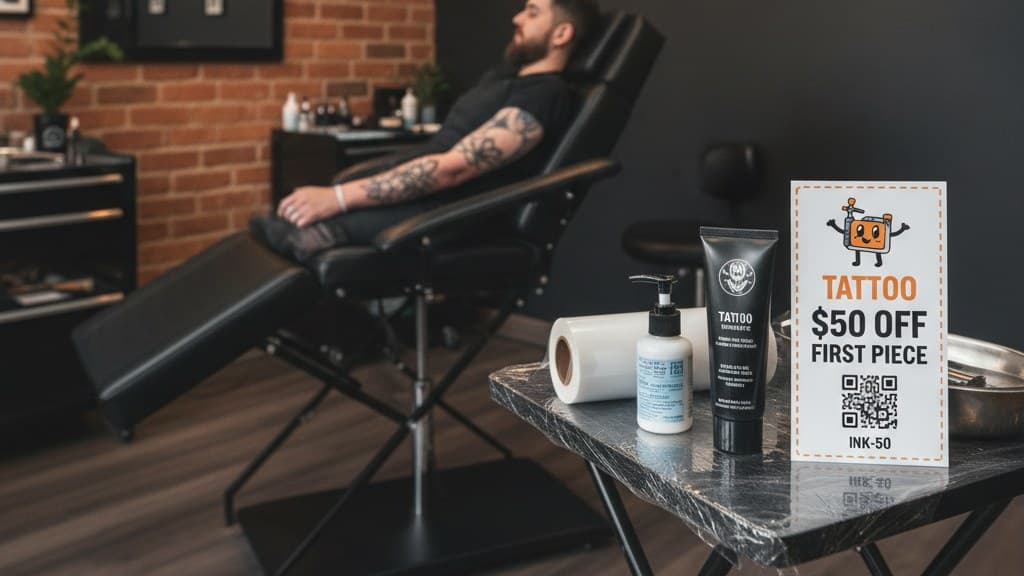
QR Code Coupons for Tattoo Studios: Ride the Fresh-Ink Referral Moment
Turn one visit into many
Hand out single-use QR coupons that pull customers back through your door. Part of your Customer Comeback System. 14-day free trial, cancel anytime.
Create a couponA client steps out of your chair after four hours under the needle. You peel back the wrap, wipe the piece down, and turn them toward the mirror. There is a half-second pause, then the exhale. "Oh, that's sick." They lift their phone, angle the light, fire off six photos, and before they have even left the studio the first one is already on their story with your tag on it.
For the next two weeks, that person becomes a walking billboard for your work. They roll up a sleeve at the office. They show their sister at dinner. Someone at the gym says "who did that?" and they say your name. A tattoo is the rare purchase people cannot stop displaying, and the fresh-ink window is the loudest two weeks of word-of-mouth you will ever get for free.
And almost every studio lets it pass without putting a single thing in that client's hand that turns "who did that?" into a booked appointment.
This is the part where a tattoo studio is different from a nail salon or a barber shop, and where most coupon advice falls apart. Your client is not coming back in three weeks. They might come back in three months, or next year, or after they have saved up for the next piece. Cadence is not your lever. So the question is not "how do I pull this client back sooner." The question is "how do I capture the friend they are about to show this to." This article is the playbook for using a single-use QR coupon to do exactly that, plus two supporting plays for touch-ups and aftercare.
The Fresh-Ink Referral Moment: your loudest two weeks
Every other small business has to manufacture a reason for a customer to talk about them. A coffee shop hopes someone mentions the latte art. A car wash prays for a Google review. A tattoo studio gets the opposite problem solved for free: the client physically cannot stop showing the product to people for two weeks straight, because it is attached to their body and it is the most interesting thing about their week.
That window has a shape. It peaks in the first 48 hours, when the piece is fresh, the bandage comes off for the first reveal, and the client is posting and texting photos. It stays loud through the first week of healing, when everyone who sees them in person asks about it. It tapers over the second week as the novelty settles. By week three it is just another tattoo they have, and the conversations stop.
Most studios do nothing with that window except hope the Instagram tag does some work. The tag is fine. It is also passive. It reaches strangers scrolling past, most of whom forget it in four seconds. What the window actually contains is dozens of real, in-person conversations where a person your client knows and trusts is looking at your work and feeling a flicker of "maybe I should." That flicker is the most valuable thing in your funnel, and it dies on the vine unless the client has something concrete to hand the friend.
A single-use QR coupon handed at the reveal, designed to be passed to a friend, converts that flicker into a booking. It gives the client a physical thing to hand over ("here, this gets you fifty off your first piece, and I get fifty off my next one"), it puts a deadline on it, and it routes the friend straight to your studio instead of letting them "look into it sometime." The client was already going to show the tattoo off. The coupon just makes the showing-off bookable.
Why a tattoo client is a referral engine, not a repeat customer
Here is the math most studios get wrong. They look at a one-time client who paid $300 and think of them as a $300 customer. That is the floor, not the ceiling. A tattoo client is worth two things you are probably not counting: their own future pieces, and the friends they bring.
The future-pieces number is real but slow. A genuine collector comes back for more work over years, and a single client can be worth $1,000 to $3,000 in lifetime work if they bond with the artist. But you cannot rush that, and a coupon will not make someone want their next tattoo before they are ready. So leave it as upside.
The referral number is the one you can actually pull on a lever. Every happy client sits inside a social circle where tattoos are, statistically, contagious. People with tattoos tend to know other people with tattoos, and other people who are thinking about their first. When your client shows fresh work to that circle during the loud window, they are doing warm, trusted, in-person marketing that no ad budget can buy. The only thing missing is a mechanism that turns the conversation into a booking.
The asymmetry that makes referral the obvious play
A mutual referral coupon costs you $100 when it works: $50 off the friend's first piece, $50 off the existing client's next one. In exchange you acquire a brand-new client whose first piece averages $200 to $300, who arrives pre-sold by someone they trust, and who carries the same $1,000-plus lifetime collector potential as anyone else. Spending $100 to acquire a warm, pre-qualified client is a fraction of what the same client costs through paid social, where you are buying cold strangers who have never seen your work. The fresh-ink referral is the cheapest qualified client you will ever book.
The reframe is simple. Stop thinking of the coupon as a discount on a transaction. Think of it as the cheapest customer-acquisition channel you have, triggered at the exact moment your client is most persuasive, aimed at the warmest leads in your market.
Three coupon plays for the chair
The three plays below do three different jobs: capture the friend at the peak moment, bring the client back for a touch-up that re-opens the relationship, and lift the retail attach on aftercare. The referral is the hero. Start there, layer the others once you have data.
Play 1: The Fresh-Ink Referral
Job: Convert the loud two-week window into a booked friend.
Hand this at the reveal, to every client, every session. A single-use QR coupon built as a mutual reward: the friend saves $50 on a first piece of $150 or more, and when the friend books and redeems, the referring client gets $50 off their next session. The minimum spend keeps it aimed at real work instead of bargain flash, and the mutual structure gives your client a selfish reason to actually hand it over rather than pocket it.
Offer shape: Friend saves $50 on a first piece ($150 minimum); referring client saves $50 on their next session when the friend redeems. Single-use, valid 60 days. Best handed to: Every client, at the reveal, while the piece is fresh. Why it works: It arms the client at the exact moment they are most proud and most likely to be asked "who did that?" The 60-day window is wide because a friend booking a tattoo needs time to decide on the piece, but the social proof is immediate.
Play 2: The Touch-Up Return
Job: Bring the client back into the studio during the heal, which re-opens the conversation about their next piece.
Most studios offer free touch-ups, but clients forget to book them, and a forgotten touch-up is a missed chance to get the client back in the chair while they still love the work. A single-use QR coupon that says "book your free touch-up within 30 days, no charge" does two things: it makes the free touch-up feel like a tracked, valuable thing instead of a vague offer, and it gets the client back into the studio, in front of your portfolio and the other artists' flash, at a moment when they are primed to start dreaming about piece number two.
Offer shape: Free touch-up, book within 30 days via the QR. Single-use. Best handed to: Every client whose piece may need a touch-up (most of them). Why it works: It converts a vague "come back if you need it" into a deadline the client acts on, and every touch-up visit is a fresh exposure to your studio's other work.
Play 3: The Aftercare Bundle Bounce-Back
Job: Lift the retail attach and bring the client back for a high-margin restock.
Aftercare is the most under-sold revenue in most studios. The client needs balm, fragrance-free lotion, and sometimes a second-skin film for the first week, and they will buy it somewhere. Hand them a single-use QR coupon for a discounted aftercare bundle redeemable at the studio, valid 30 days. They come back for the restock during the heal, you capture margin you were leaving to the drugstore, and you get one more in-person touch while the relationship is warm.
Offer shape: Aftercare bundle (balm + lotion + film) at a bundle price, valid 30 days, one redemption. Best handed to: Every client at checkout, especially first-timers who do not own aftercare yet. Why it works: The client needs the products anyway. The coupon decides whether they buy them from you or from a pharmacy shelf, and it books one more warm visit.
Do This
- ✓Lead with the referral play. It is the hero for a low-frequency business.
- ✓Set a minimum spend on the referral so it aims at real work, not bargain flash
- ✓Use single-use codes so each discount stops at one redemption
- ✓Tag the coupon by artist so you can see whose chair-side handoff brings friends in
- ✓Hand the referral card at the reveal, not at the front desk
Avoid This
- ✕Don't run a public 'tattoos $50 off' banner (kills the work, attracts bargain hunters)
- ✕Don't discount the existing client's next piece as the main offer (frequency is too low to matter)
- ✕Don't skip the minimum spend (you will get $50-off requests on $60 pieces)
- ✕Don't set the referral expiry too short (a friend needs time to commit to a tattoo)
- ✕Don't hand it silently (the script is doing more work than the discount)
Where the QR rides out of the studio
A nail salon hands the coupon at the drying station. A car wash slips it under the wiper. A tattoo studio has its own geometry, built around the aftercare moment, the client's phone, and the fact that the client is about to become your most active promoter for two weeks. Five placements that consistently beat a silent handoff at the till:
Clipped to the aftercare instruction card
Every client leaves with aftercare instructions. Print the referral QR on the back or clip a small card to it. The aftercare card is the one object the client is guaranteed to keep and re-read during the heal, which is the exact window the referral needs to live in.
Tucked into the aftercare product bag
If you sell or hand out balm, lotion, or second-skin film, drop the QR card into the bag. The client opens that bag every day for a week to dress the tattoo, so the coupon gets seen daily during the loudest part of the window.
On the artist's station, handed at the reveal
Keep a small stack of referral cards at each station. The strongest handoff is the artist personally giving the client a card in the reveal moment, with one line. A coupon from the artist who just made the art carries far more weight than one from the front desk.
In the post-session thank-you DM
Most studios message or tag the client after the session. Drop the referral link in that message. Tattoo clients live on their phones in the 48 hours after a session, posting and replying, so a link there gets opened almost immediately.
On the deposit or booking card for the next piece
If you take a deposit or hand a booking card for future work, print the touch-up or aftercare QR on it. The client keeps booking cards, and it pairs the next-piece intent with a reason to come back sooner.
The reveal moment beats the front desk every time. The front desk is where the client is paying a large invoice and bracing for the total. The reveal is where they are proud, photographing, and rehearsing how they will show this off. Move the referral handoff three minutes earlier, to the chair, and it lands as a gift instead of an upsell.
Turn one visit into many
Hand out single-use QR coupons that pull customers back through your door. Part of your Customer Comeback System. 14-day free trial, cancel anytime.
Create a couponThe fresh-ink referral math (with real numbers)
Let's stress-test the Fresh-Ink Referral across a studio that does roughly 100 tattoo sessions a month across its artists.
Assume all 100 clients receive a single-use mutual referral QR at the reveal. Referral coupons convert lower than rebooking coupons because the friend has to actually want a tattoo and commit to a design, so assume a conservative 15 percent of those cards bring a friend who books within 60 days. That is 15 new referred clients a month, each spending an average $250 on a first piece, each costing $100 in mutual discount ($50 to the friend, $50 to the referrer).
You spent $1,500 to book $3,750 in brand-new first-piece revenue, a 2.5-to-1 return before you count a single thing beyond the first session. And the first session is the smallest part of the value. Of those 15 new clients, a share will bond with the artist and come back as collectors worth $1,000 or more in lifetime work. The referral coupon is not really buying $3,750 of first pieces. It is buying 15 new entries into your collector funnel, at $100 of acquisition cost each, sourced from the warmest leads in your market.
The honest caveat: not every referred friend is purely incremental, because a few would have found you anyway through the Instagram tag or word of mouth without the coupon. What the coupon actually buys is conversion and speed. It turns a vague "I should get that artist's info" into a booked, deposited appointment inside 60 days, and it gives the friend a concrete push past the fence. Counting all 15 as net-new slightly overstates it, so do not. The push and the speed are still real money.
The chair-side script (or the coupon dies)
A referral card handed in silence is a business card nobody asked for. The same card handed with eight words at the reveal is a warm introduction with a discount attached. The script carries more weight than the discount.
Bad version (sounds transactional): "Here's a referral card if you know anyone."
Good version (sounds like a gift): "Show it off. Your friend's first piece, fifty off."
The good version does three things the bad one misses. It gives the client permission and a prompt to do the thing they were already going to do (show it off), it names the concrete benefit for the friend (first piece, fifty off), and it implies the social motion (you show, they book) without sounding like a sales pitch. Same $50 incentive, completely different framing.
Brief every artist on the same one-line script. In a multi-artist studio, the single biggest predictor of whether the referral program shows up in your redemption data is whether every artist actually says the line at the reveal. One artist who skips it quietly removes a third of your referral volume.
Setting up your first campaign in 6 minutes
Sign in to ReviewQR (14-day free trial)
Use any email to create an account at reviewqr.app. The 14-day free trial (card on file, cancel anytime) is enough to test the Fresh-Ink Referral across your first couple of weeks of sessions. After that, Essentials is $10/month for 100 single-use coupons.
Start with the referral, not the touch-up
Run Play 1 (the Fresh-Ink Referral) first. It is the hero play for a low-frequency business and the one with the biggest upside. Add the Touch-Up Return and Aftercare Bundle once you have two weeks of referral data.
Set the offer, minimum, and expiry
Friend saves $50 on a first piece of $150 or more; referrer saves $50 on their next session when the friend redeems. Valid 60 days, one redemption per code. The single-use mechanic is enforced automatically: once a code is redeemed, a second scan shows 'already redeemed.'
Print 20 to 30 referral cards
Plain cardstock works for round one. Skip the heavy design. A QR plus 'Your friend's first piece, $50 off, 60 days' is enough text. Keep a small stack at each artist's station.
Brief the artists on one line
Eight words: 'Show it off. Your friend's first piece, fifty off.' Run it past each artist once before the day starts so it is said the same way at every reveal.
Hand at the reveal, not the till
Clipped to the aftercare card, dropped in the aftercare bag, or handed at the station in the reveal moment. Anywhere but silently at the front desk with the invoice.
If your studio runs several artists and you want per-artist tracking, the Essentials plan at $10/month gives 100 codes per month and lets you tag campaigns by artist. That tag tells you whose chair-side handoff actually brings friends through the door, which in a multi-artist shop is the number that settles a lot of arguments.
Common tattoo studio coupon mistakes
Mistake 1: Treating the coupon as a rebooking tool. A tattoo client is not a nail client. They will not come back in three weeks because of a discount. Pour your effort into the referral, where the frequency problem disappears because you are reaching the friend, not waiting on the client.
Mistake 2: No minimum spend on the referral. Without a floor like "$150 or more," you will field $50-off requests on tiny flash pieces and walk-in lettering, which torches the math. The minimum keeps the offer aimed at real work.
Mistake 3: Running it as a public banner. "Tattoos $50 off" on the window or your Instagram grid cheapens the studio and attracts bargain hunters. The single-use QR mechanic only works when the coupon is a private, trusted handoff from a client to a friend, invisible to the public.
Mistake 4: Handing it at the front desk. The till, with a four-hundred-dollar invoice on the screen, is the least generous moment of the visit. Move the handoff to the chair at the reveal, when the client is proud and photographing.
Mistake 5: No script. A silent card is litter. A card handed with one line from the artist is a warm intro. Untrained handoffs underperform trained ones by more than most owners expect, and in a multi-artist shop the inconsistency is where your referral volume quietly leaks.
Mistake 6: Forgetting the aftercare margin. Clients buy aftercare somewhere. If you do not hand them a reason to buy it from you, you are donating that high-margin revenue to a drugstore shelf. The aftercare bounce-back is the easiest money in the three plays.
Related reading
This piece focuses on the referral mechanic that fits a low-frequency, high-emotion business like a tattoo studio. For higher-frequency beauty-wellness niches where the lever is rebooking cadence instead of referral, the QR code coupons for nail salons playbook covers the chip-day return window and the QR code coupons for salons and spas playbook covers the four-to-eight-week color and treatment gap. For broader coupon mechanics across small-business categories, the coupon ideas listicle groups 23 plays by goal, and the QR coupons for small business overview covers the single-use mechanic at a higher level. To compare QR coupon tools side by side, see best QR coupon app for small business.
Frequently asked questions
Do QR coupons work for tattoo studios, or is the frequency too low?
They work, but not as rebooking tools the way a nail or barber coupon works. A tattoo client does not come back every three weeks, so the lever is not cadence. It is the referral. For about two weeks after a session a client shows the fresh piece to everyone they meet, which is the single strongest organic-share window in any service business. A single-use QR coupon handed at the chair, designed to be passed to a friend, rides that wave. The client is already doing the marketing by showing the tattoo off. The coupon just gives the friend a reason to walk in and book.
What should a tattoo studio put on a coupon?
Lead with the referral, not a discount on the existing client's next piece. Because frequency is low, the highest-value action a happy client can take is bringing a friend while the ink is fresh and the stories are flowing. A mutual "you both save $50" on the friend's first piece (with a sensible minimum spend) converts far better than a touch-up discount, because tattoo clients run in social circles where ink is contagious. Keep a touch-up and an aftercare offer as secondary plays, but the referral is where the money is.
When should the artist hand over the QR coupon?
At the chair, right after the reveal, while the client is still looking at the fresh piece in the mirror and reaching for their phone to photograph it. That reveal moment is the emotional peak of the entire experience. The client is proud, they are about to post it, and they are mentally rehearsing how they will show it to friends. A referral card handed there gets pocketed with intent. Handed at the front desk while they are paying a four-hundred-dollar invoice, the same card reads as an upsell and gets left on the counter.
Will a referral discount cheapen my studio or attract bad clients?
Not if you set a minimum spend and keep the coupon a private, single-use handoff rather than a public "tattoos $50 off" banner. A minimum like "valid on first pieces of $150 or more" filters out the bargain hunters and keeps the offer aimed at real work. The single-use QR mechanic means the discount cannot be screenshotted and spread, so it never becomes a public price cut. It stays what it is: a warm introduction from a client the friend already trusts, with a small incentive attached.
How is this different from just asking clients to tag the studio on Instagram?
An Instagram tag is exposure. A referral coupon is a booking. Tags are valuable and you should still ask for them, but a tag puts your studio in front of strangers who scroll past. A single-use QR coupon handed to the client to pass along gives a specific friend a specific reason to walk in, with a deadline and a discount, routed through the artist the client already vouches for. One builds reach. The other books a chair. Run both, but do not confuse the tag for the conversion.
How many QR coupons should a tattoo studio print to start?
Start with 20 to 30. A studio does not run the same volume as a coffee shop, so a small batch covers a couple of weeks of sessions and gives a clean read on referral redemption. Every ReviewQR plan starts with a 14-day free trial, which is enough to test the fresh-ink referral handoff before the trial ends. Once you see the redemption rate, the Essentials plan at $10 per month gives 100 codes monthly and lets you tag campaigns by artist, so you can see whose chair-side handoff actually brings friends through the door.
Ready to Implement This Strategy?
Create your custom QR code in 2 minutes and start collecting Google reviews today.
Create Your QR Code NowMore Google Review Guides
QR Code Coupons for Waxing Studios: The 4-Week Regrowth Reset
How waxing and brow studios stop the shave relapse and hold clients on a 4-week cycle with single-use QR coupons. Unit economics, three plays, room placement geometry, scripts, and a 6-minute setup.
Beauty & WellnessQR Code Coupons for Nail Salons: Win the Chip-Day Window
Single-use QR coupons built for the gel cycle. 14-day fill discount, tech-specific referral, pedi add-on bounce-back. With station-side scripts, the economics, and a 6-minute setup.
Beauty & WellnessQR Code Coupons for Barber Shops: Close the 3-Week Fade Window
Single-use QR coupons built for the barber calendar. Slow-day fade refresh, 14-day return discount, buddy-cut referral. With chair-side scripts, economics, and a 6-minute setup.