QR Code Coupons for Waxing Studios: The 4-Week Regrowth Reset
How waxing and brow studios stop the shave relapse and hold clients on a 4-week cycle with single-use QR coupons. Unit economics, three plays, room placement geometry, scripts, and a 6-minute setup.
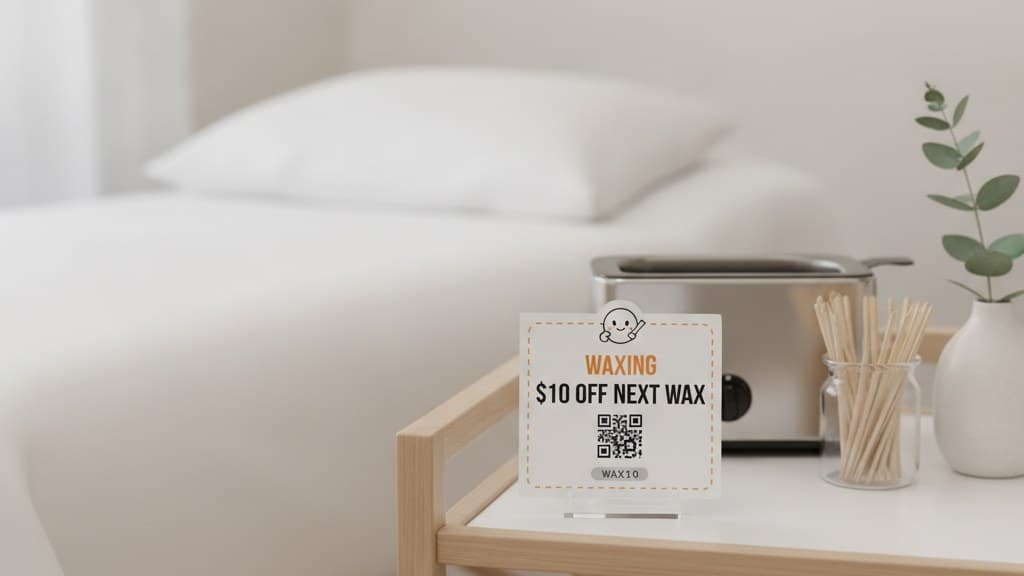
QR Code Coupons for Waxing Studios: The 4-Week Regrowth Reset
Turn one visit into many
Hand out single-use QR coupons that pull customers back through your door. Part of your Customer Comeback System. 14-day free trial, cancel anytime.
Create a couponA client books a Brazilian in March. She is nervous, you talk her through it, and she leaves smoother than she has been in years. She tells you she wishes she had done this ages ago. She means it.
Week two, she looks great and thinks about nothing. Week three, there is a stretch of stubble that is not long enough for you to work with yet, and she has a wedding on Saturday. So she shaves. Just this once.
She never comes back. Not because she was unhappy, and not because of anything that happened in your room. She comes back four months later, if she comes back at all, with a full grow-out, a wax that hurts more than the last one did, and a quiet suspicion that waxing is not for her.
That is the entire retention problem in a waxing studio, and almost nothing in the standard playbook touches it. Text reminders arrive when it is already too late. A loyalty stamp card rewards the tenth visit when the client is churning at the second. A membership asks someone to promise a monthly cadence they have not proven they can keep. Meanwhile the actual decision point, week three, alone in a bathroom, with a razor in hand, goes completely unattended.
There is a tool that reaches that moment. A single-use QR coupon, handed while the client is getting dressed, with an expiry that lands before the razor does. This article is the playbook.
The 4-Week Regrowth Reset: the window that closes when they shave
Most service businesses have to manufacture a reason for the customer to return. Waxing does not. The reason is written into hair biology, and it runs on a schedule tighter than almost any other beauty service.
Here is the clock. After a wax, hair has to reach roughly a quarter inch before you can grip it again, which takes about two weeks. Brows sit on a two to three week cycle. Underarms and bikini land around four. Legs stretch to four or six. Across a typical studio book, four weeks is the honest average, and it is a hard floor as much as a target: too early and there is nothing to grab, too late and the client is walking around visibly regrown.
That creates a window rather than a date. Roughly days 21 through 35 are when the client both can be waxed and wants to be. Book them inside that window and everything compounds. Their hairs stay synchronized in the same growth phase, so each wax is faster, cleaner, and less uncomfortable than the last, and the client starts telling people that waxing gets easier over time.
Miss the window and it does not just delay the next appointment. It resets the whole thing. A shave cuts hair at the surface and puts the follicles back on wildly different timelines. The next wax is patchier, more painful, and less satisfying, which is exactly the experience that convinces someone waxing was oversold. The client does not blame the razor. They blame you, silently, by never rebooking.
That is the 4-Week Regrowth Reset. Your entire retention job is getting a client to commit to an appointment inside a two-week window that opens after they leave your room and closes the moment they reach for a razor. A single-use coupon with a 35-day expiry is the cheapest, most reliable way to plant a deadline in that window.
Why a waxing book is really a calendar of near-misses
Waxing economics are unusual in a way that makes the coupon math almost embarrassing. The ticket is modest, the frequency is high, and the marginal cost of an additional appointment is close to nothing once the room and the esthetician are already paid for. That combination means the business does not live on per-visit margin. It lives on visits per client per year, and nothing else comes close in importance.
Take a studio with a $45 average ticket across brows, bikini, underarm, and leg services.
A client on the cycle books roughly every four weeks, allows for a couple of vacations and schedule slips, and lands at about 11 visits a year. That is $495 in annual value from one person, at zero acquisition cost after the first appointment.
The same client as a drifter shaves between appointments, comes back when the grow-out gets unbearable, and books maybe 5 times a year. That is $225. Same client, same enthusiasm on the day, same quality of work. The only difference is whether anything intervened during week three.
The asymmetry that makes this the easiest math in beauty
Pulling one drifter back onto a four-week cadence is worth roughly $270 in additional annual revenue. The cost of triggering it is a single $10-off coupon that gets spent once. That is better than a 25-to-1 return on the discount, and it renews every year the client holds the cycle, because you only have to buy the habit once.
Compare that to what the same $10 buys anywhere else. A local ad spend that produces one new client at $30 to $60 acquisition cost is a worse deal than a coupon that recovers a client you already earned, already trained, and already have a rapport with. The drifter is not a stranger. She is sitting in your book right now with a gap where the next appointment should be.
Three coupon plays timed to the growth cycle
Waxing coupons are not discount promotions. The client is not price-shopping, and a percentage off does nothing to solve the actual problem, which is a decision made in a bathroom on day 22. Every play below is a single-use QR code with an expiry chosen to land inside a real biological window. Run one alone for two weeks before layering anything on top.
Play 1: The 28-Day Regrowth Reset
Job: Get the next appointment booked before the razor gets involved.
Every client who leaves your room gets a single-use QR coupon handed while they are getting dressed: $10 off their next wax, valid 35 days, one redemption. The 35-day expiry is the whole mechanic. It sits just past the four-week cadence, which means it expires at precisely the moment a client who has not rebooked is about to give up and shave. The client is not being sold anything. They are being handed a deadline that agrees with their own body.
Offer shape: $10 off any wax service, valid 35 days from service, one redemption. Best handed to: Every client, every visit, without exception. This is the default handoff. Why it works: The deadline is real and the client can feel it on their own skin. The discount is not persuading anyone. It is giving them a small, concrete reason to open the booking app on the day they were already thinking about it.
Play 2: The Regrow Amnesty
Job: Recover the client who shaved, without making her feel judged for it.
Everyone shaves eventually. The problem is that shaving carries a small charge of embarrassment, and embarrassment is a powerful reason not to rebook. This play removes it in advance. Hand a second card, or keep a stack at the desk for lapsed clients: $15 off a reset wax, valid 21 days, one redemption, with the explicit framing that it is for whenever life got in the way. The short 21-day window is deliberate, because this card is issued to someone who has already grown out enough to be waxed today.
Offer shape: $15 off a reset wax, valid 21 days, one redemption. Best handed to: Clients who mention a vacation, a wedding, or a busy stretch coming up, and any client who has drifted past eight weeks. Why it works: It reframes shaving as a normal interruption instead of a failure, and it names a price for getting back on cycle. The $15 is not buying desire. It is buying past the awkwardness of walking back in.
Play 3: The Brow-to-Body Bridge
Job: Raise the ticket on your highest-frequency, lowest-value clients.
Brow clients are your best-behaved regulars and your smallest tickets. Someone on a three-week brow cadence at $20 is worth about $340 a year, which is less than a bikini client seeing you half as often. They also already trust you with the most nerve-wracking part of their face, which makes them dramatically warmer prospects for a first body service than any stranger walking in off the street. Hand your brow regulars a single-use coupon: $20 off a first-time underarm, bikini, or leg wax, valid 45 days, one redemption. The wider window gives the client room to work up to it.
Offer shape: $20 off a first body wax service, valid 45 days, one redemption. Best handed to: Brow-only clients on their third or later visit, once the trust is established. Why it works: The barrier to a first body wax is nerves, not price, and nerves fall away when the person holding the strip is someone you already let near your eyebrows. The coupon supplies the small push and the deadline that turns "someday" into a booking.
Do This
- ✓Run Play 1 alone for two weeks so you get a clean redemption baseline
- ✓Use single-use codes so one card equals one discounted service, no screenshots
- ✓Match the expiry to the play (35 days for the reset, 21 for amnesty, 45 for the bridge)
- ✓Hand the card during redressing, while the client is still alone in the room
- ✓Tag which service type each coupon was handed after, so you can see what converts
Avoid This
- ✕Don't post the coupon publicly (a targeted rebook tool becomes a discount ad)
- ✕Don't run percentage-off (it invites price comparison on a service that isn't price-shopped)
- ✕Don't set the reset expiry past six weeks (past the cycle, the deadline stops meaning anything)
- ✕Don't hand it to a client who already rebooks like clockwork (you're paying for a visit you had)
- ✕Don't hand it at the card reader with people waiting behind her
Where the QR lives between the bed and the front desk
A barber tucks the coupon in the cape pocket. A detailer clips it to the rearview mirror. A waxing studio has its own geometry, and it is defined by one unusual fact: there is a private, unhurried minute at the end of every appointment when the client is alone in the room getting dressed, with nothing to look at and nothing to do. Almost no other service business has that. Five placements that beat the front desk:
Handed with the aftercare card during redressing
You already give an aftercare instruction (no heat, no gym, no sun for 24 hours, exfoliate from day three). Hand the QR coupon in the same motion, as the second half of the same piece of advice. The client is calm, alone, and paying attention, and the two cards travel home in the same pocket because they arrived together.
Taped inside the redressing mirror frame
The one place every client looks before leaving the room is the mirror. A small card in the lower corner of the frame, with the QR and 'book by day 35,' catches the exact moment they are checking your work and feeling good about it. It costs nothing and it works on the clients your esthetician forgets to hand a card to.
Printed on the back of the rebook card
If your front desk hands a physical appointment card, print the coupon on the reverse. The card gets kept because it holds a date, which means the coupon gets kept too. This is the cheapest way to make the coupon survive the trip to the bottom of a handbag.
On the ingrown-serum and exfoliant shelf tag
Clients browsing your retail shelf on the way out are, by definition, thinking about the weeks between appointments. A small QR card on the shelf tag next to the exfoliating mitt or ingrown treatment catches them mid-thought, in the exact frame of mind where a next-appointment deadline makes sense.
Tucked into the intake clipboard for first-timers
First-time clients are the ones who churn hardest, because they have no cycle to fall back on. Clip a coupon to the intake form so it is in their hands before they even get on the bed, and reference it once during the service. First-visit coupons handed pre-service redeem noticeably better than ones handed after, because the client has had the entire appointment to think about it.
The redressing minute is the asset almost every studio wastes. It is private, it is unrushed, and the client is looking at a result she is happy with. The front desk is the opposite of all three. Moving the handoff back by ninety seconds, from the register into the room, changes redemption more than any change to the dollar amount will.
Turn one visit into many
Hand out single-use QR coupons that pull customers back through your door. Part of your Customer Comeback System. 14-day free trial, cancel anytime.
Create a couponThe 28-day math (with real numbers)
Let's stress-test Play 1 against a two-room studio that performs 120 waxing services a month.
Every one of those 120 clients gets a single-use $10-off coupon handed during redressing, valid 35 days. Coupons handed in-room on a biological deadline redeem strongly, because the client is not being asked to want something new, only to schedule something they already intended. A conservative read is 25 percent. That is 30 appointments booked inside the window that were, for most of those clients, not going to land there.
You spent $300 in discounts and billed $1,350 in service revenue, a ratio better than four-to-one before counting retail attach on those visits. And that understates it badly, because it prices a recovered appointment as a single $45 transaction when what you actually bought is a client staying synchronized on the cycle. A client who books on day 30 instead of shaving on day 22 does not just give you one appointment. She gives you the next one too, and the one after that, because the cycle held.
Be honest about the denominator. Some share of those 30 clients were going to rebook anyway, and the coupon simply paid them $10 to do what they already planned. That is the real cost of running this play on your whole book. It is still overwhelmingly worth it, because the drifters and the reliable regulars are indistinguishable at the moment you hand the card, and one recovered drifter at $270 of annual value pays for twenty-seven wasted $10 discounts. Do not try to guess who needs it. Hand it to everyone.
The room-side script (or the code never gets scanned)
A QR card handed over in silence at a card reader is a receipt. The same card handed during redressing with one sentence is expert advice. On a service where the failure mode is a decision made at home, the sentence matters more than the discount.
Bad version (sounds like a promo): "Here's a coupon for next time if you want to use it."
Good version (sounds like aftercare): "Four weeks. Don't shave, or we start over."
The good version does three things the bad one misses. It gives the deadline as a plain number the client can put in a calendar. It names the actual failure mode out loud, which is the only way the client connects the razor to the patchy wax she would otherwise blame on you. And it comes from the person who just did the work, which makes it advice rather than marketing.
Say it while handing the aftercare card, not while ringing them up. Every esthetician in the studio needs the same line, delivered the same way, at the same point in the appointment. On a high-frequency, low-ticket service, the difference between one esthetician who says it cleanly and one who mumbles it while turning away is roughly half your redemption rate, and you will never see that in the numbers because it hides inside an average.
Setting up your first campaign in 6 minutes
Sign in to ReviewQR (14-day free trial)
Create an account with any email at reviewqr.app. The 14-day free trial (card on file, cancel anytime) is enough for a solo esthetician or a single-room studio to run the reset play for about two weeks and get a real redemption read. After that, Essentials is $10/month for 100 single-use coupons.
Start with Play 1 and nothing else
The 28-Day Regrowth Reset is the default handoff for every client, every visit. Do not launch the amnesty or the brow-to-body bridge in week one. You need one clean baseline number before you can tell whether anything you add later is helping.
Set the offer and the 35-day expiry
$10 off any wax service, valid 35 days from issue, one redemption. Single-use is enforced automatically: once a code is scanned and marked redeemed, a second scan shows 'already redeemed,' so a screenshot passed to a friend does nothing.
Print 20 aftercare-sized cards
Plain cardstock, cut to the same size as your aftercare card so the two stack. No design work needed for round one. QR plus 'book by day 35' is the entire copy. If you already print aftercare instructions, put the coupon on the back and you are done.
Brief every esthetician on one line
'Four weeks. Don't shave, or we start over.' Said while handing the aftercare card, during redressing, before the client leaves the room. Run it once out loud at the start of a shift so nobody improvises a softer version.
Hand it in the room, never at the register
The redressing minute is private and unhurried. The register is a transaction with a queue behind it. Same card, same discount, materially different redemption rate.
If you run multiple rooms or want to see which services and which estheticians actually drive redemptions, the Essentials plan at $10/month gives 100 codes monthly and lets you tag campaigns. That tag is what tells you whether your resets are converting off brows, off bikini, or off first-timers, which is the difference between guessing at your retention problem and reading it.
Common waxing studio coupon mistakes
Mistake 1: Setting the expiry outside the growth window. A 90-day coupon is not a lenient version of a 35-day coupon. It is a different, useless object. The entire mechanic is that the deadline lands before the razor does. Past six weeks, the client has already shaved and the card is just a discount she may or may not remember.
Mistake 2: Handing it at the front desk. The register is the worst moment of the appointment: card reader out, next client waiting, receipt printing. The redressing minute is private, calm, and free of competition. Ninety seconds earlier is the single highest-leverage change most studios can make.
Mistake 3: Running a percentage-off instead of a dollar amount. "20% off any service" invites the client to compare your prices against the studio down the road, which is a conversation you were winning by not having. A flat $10 on a specific next appointment keeps the frame on scheduling, not on price.
Mistake 4: Only giving coupons to clients who seem likely to lapse. You cannot tell. The enthusiastic first-timer who swears she is a convert is statistically your highest churn risk, and the quiet regular is fine either way. Hand it to everyone and let the math absorb the waste. The alternative is missing exactly the client the play exists for.
Mistake 5: Skipping the shave conversation. Estheticians often avoid saying "don't shave" because it sounds like scolding. The result is a client who shaves, gets a worse wax, and concludes waxing does not work on her. Naming the failure mode in seven plain words during aftercare is not scolding. It is the most useful thing you will say all appointment.
Mistake 6: Launching all three plays at once. Amnesty cards and brow-to-body bridges are good plays that will tell you nothing if they go out alongside the reset in week one. Run the reset alone, get a number, then layer.
Related reading
This piece covers the coupon mechanic for waxing and brow studios specifically. If you also run color or treatment services, the QR code coupons for salons and spas playbook covers the longer 4 to 8 week re-booking gap, and QR code coupons for nail salons covers the tight 10 to 14 day chip-day version of the same timing logic. For the review side of the same studio, Google reviews for salons and spas covers the post-service ask that pairs naturally with the aftercare handoff. For broader mechanics across categories, the coupon ideas listicle groups plays by goal, and the QR coupons for small business overview explains the single-use mechanic. For a side-by-side of tools, see best QR coupon app for small business.
Frequently asked questions
Why do waxing clients disappear even when they loved the service?
Because the thing that ends the relationship happens at home, not in your room. A waxing client needs roughly a quarter inch of regrowth before you can work, which means there is a two-week stretch where they look fine and think about nothing. Somewhere in week three or four, life gets busy, a beach day or a date shows up, and they shave. The moment they shave, the growth cycle they had been building with you desynchronizes, the next wax will be patchier and more uncomfortable, and the client quietly decides waxing did not work for them. They do not churn because of your service. They churn because the window closed and nobody handed them a reason to book inside it.
What is the right expiry for a waxing coupon?
Thirty-five days, counted from the day of service. That number is not arbitrary. It sits just past the standard four-week regrowth cadence, so the coupon expires right around the point where a client who has not rebooked is most likely to reach for a razor. A 35-day window gives them room to move an appointment by a week without losing the discount, and it still lands the deadline inside the biological cycle instead of outside it. Anything longer than about six weeks stops being a deadline and becomes a piece of paper in a drawer.
How is a QR coupon different from a waxing membership or unlimited plan?
A membership asks a client to commit to monthly billing before they have proven to themselves that they can hold a four-week cadence. Most first-time and second-time waxing clients cannot make that promise honestly, so they decline it, and declining feels like a small no that colors the rest of the visit. A single-use coupon asks for nothing. It hands them one discounted appointment inside the window and lets the cadence prove itself. Once a client has strung together three on-cycle visits, the membership pitch converts far better, because now you are asking them to formalize a habit they already have rather than buy one they do not.
What discount actually moves a waxing client, and does it eat my margin?
Ten dollars off the next wax is enough for the regrowth reset, because the deadline is doing most of the persuading and the client already knows what your work feels like. For a lapsed client who shaved and is embarrassed to come back, fifteen dollars off carries more weight, since you are paying to remove awkwardness rather than to create desire. For moving a brow-only regular into their first body service, twenty dollars off is the right pull because that is a genuinely new purchase. On a service business where the room and the esthetician are already paid for, an added visit at a ten-dollar discount is nearly all contribution margin, so the discount is not coming out of profit. It is buying a visit that would otherwise not have existed.
When exactly should the client get the coupon?
In the room, while they are getting dressed, not at the front desk while a card reader is out. The redressing minute is the calmest, most private moment of the appointment. The client is alone with their result, the discomfort has already faded, and nothing else is competing for their attention. A small QR card handed with the aftercare instructions rides home in the same pocket as the aftercare card. At the front desk, that same coupon lands during a payment transaction with people waiting behind them, and it gets folded into a wallet unread.
How many coupons should a waxing studio start with?
Twenty. A single-room studio or a solo esthetician turns enough services in two weeks to get a clean redemption read from twenty codes, and every ReviewQR plan starts with a 14-day free trial, so round one costs nothing. Run the 28-day regrowth reset alone on those twenty, read the rate, and only then decide whether to scale. A busier multi-room studio or brow bar will burn through twenty quickly, and the Essentials plan at $10 per month gives 100 codes monthly, which covers a full book plus the two secondary plays.
Ready to Implement This Strategy?
Create your custom QR code in 2 minutes and start collecting Google reviews today.
Create Your QR Code NowMore Google Review Guides
QR Code Coupons for Tattoo Studios: Ride the Fresh-Ink Referral Moment
Tattoo clients do not rebook every three weeks. They show their fresh ink to everyone for two weeks straight. Here is how to use single-use QR coupons to turn that reveal moment into referrals, touch-up returns, and aftercare sales. With math, scripts, and a 6-minute setup.
Beauty & WellnessQR Code Coupons for Barber Shops: Close the 3-Week Fade Window
Single-use QR coupons built for the barber calendar. Slow-day fade refresh, 14-day return discount, buddy-cut referral. With chair-side scripts, economics, and a 6-minute setup.
Beauty & WellnessQR Code Coupons for Salons and Spas: Close the Re-Booking Gap
Single-use QR coupons designed for the salon calendar — pre-book at the chair, defend color clients, slow-day refill, stylist-led referrals. With economics and a step-by-step setup.