QR Code Coupons for Bowling Alleys: The Empty-Lane Tuesday
A bowling center sells time on a fixed asset, and unsold time evaporates. How indie alleys and FECs use day-part-locked single-use QR coupons to move weekend overflow into dead hours, fill party packages, and recruit league bowlers. Math, three plays, placements, and a 6-minute setup.
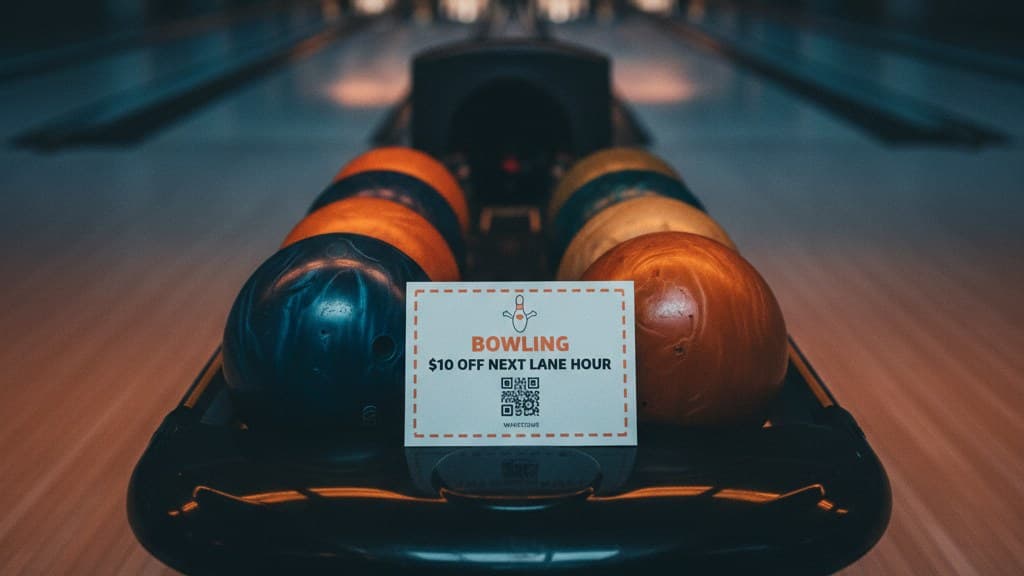
QR Code Coupons for Bowling Alleys: The Empty-Lane Tuesday
It is 2:40 on a Tuesday afternoon. Your house has twenty-four lanes. Three of them are running: a pair of retirees on 7 and 8, and a dad with a kid on 19 who is here because school let out early.
Everything else is on. The lights over all twenty-four lanes are on. The pinsetters are warm. The air handling is running. The desk attendant is scrolling her phone. The snack bar fryer is up to temperature for the four orders it will take before five o'clock. Your lease, your insurance, and your loan on the scoring system do not know or care that twenty-one lanes are sitting empty, and they are billing you the same as they will on Saturday at nine.
Four days from now, that same building will have a forty-minute wait for a lane, a line at the shoe counter, and three parties who leave because they will not wait. You will turn away money on Saturday and give away money on Tuesday, in the same week, in the same room.
That is the bowling problem, and it is not the retention problem the rest of this series covers. A barber loses a client to a three-week drift. A waxing studio loses one to a razor. A bowling center does not really lose customers at all. It loses hours. You are not selling haircuts or lattes, you are selling time on a fixed asset, and time is the only inventory that cannot be carried into next week. A Tuesday at 2pm that goes unsold is not sitting in the back room waiting for Saturday. It is simply gone.
The chains solved this with apps. Bowlero pushes MVB Rewards, the FEC down the highway has a points program and a birthday club, and both of them exist for one reason: to move demand out of the four hours a week when they cannot serve it and into the sixty hours a week when they are burning money to stand empty. You do not need to build an app to do the same thing. You need a single-use coupon that is only valid when your lanes are dark.
The Empty-Lane Tuesday: you are selling time, and it expires
Every other niche in this series runs on a clock the customer's own life enforces. Hair grows out in three weeks. Gel polish chips on day twelve. Ceramic sealant stops beading at ninety days. The operator's job in those businesses is to plant a deadline inside a window the customer's body or car is already counting down.
A bowling center has the opposite structure. Nobody develops a physical need to bowl. There is no biological countdown, no wear cycle, no chip day. What a bowling center has instead is a capacity curve that is violently uneven, and the entire game is flattening it.
Look at where the hours actually go in a typical independent house:
- Friday and Saturday after 6pm. Full or near it. You are turning parties away. This is roughly ten to twelve hours a week.
- Monday through Thursday, 6pm to 9pm. League block. In a healthy house this is your foundation, and it is already sold, thirty-plus weeks a year, to your most valuable customers.
- Weekday noon to 5pm. Near empty. Seniors, a few students, the occasional corporate outing.
- Sunday evening and weeknights after 9pm. Empty. Lights on, nobody bowling.
- School holidays and rainy weekends. Chaotic, unpredictable, and mostly good.
The revenue is stacked into a handful of hours, and the costs are spread evenly across all of them. That is the whole thesis. And it means the coupon in this niche does a job it does not do anywhere else in this series: it does not create demand, it relocates it.
That distinction changes the mechanic entirely. In a barber shop, the coupon's job is to make a return visit happen that otherwise would not. In a bowling center, plenty of the return visits would happen anyway. What you are buying with the discount is the hour they happen in. You are paying a family ten dollars to come on Tuesday afternoon instead of jamming your Saturday queue, and on Tuesday afternoon that ten dollars buys you an hour of revenue in a building that was going to be empty and expensive regardless.
Which is why every bowling coupon must be day-part locked. An unrestricted "$10 off a lane hour" card that gets redeemed at 8pm on a Saturday is not a marketing expense. It is a discount on a lane you had already sold.
What an empty lane actually costs you
Start with what a group is worth when they walk in, because bowling has a ticket structure most operators under-count. A party of four on a casual visit does not buy one thing. They buy four:
That is roughly $100 for a party of four, and the important number inside it is that lane time is only about 28 percent of the ticket. The other 72 percent is shoes, food, and games, and none of it happens unless the lane gets booked first.
This is the piece indie operators consistently get wrong when they think about discounting. They look at "$10 off an hour of lane time" and see a third of the lane revenue walking out the door. What is actually happening is a $10 discount on a $100 party, or ten percent of the visit, applied to the one line item that has essentially no cost of goods behind it. On a Tuesday at 2pm the marginal cost of running lane 12 for an hour is a rounding error. The pinsetter is already maintained, the building is already lit and heated, the attendant is already on the clock. You are not giving away a product. You are giving away a slice of an hour you were going to eat anyway, in exchange for a fryer order and twenty-four dollars of arcade swipes.
Now the annual view. A casual bowling household in a mid-sized market goes about twice a year: once around a birthday, once when the weather is bad and the kids are feral. Two visits at $100 is $200 a year. A household that has been shifted onto a rough quarterly rhythm, plus one extra weather-driven visit, lands around five visits a year, or $500.
The asymmetry, and why the group ticket makes it lopsided
A casual household at two visits a year is worth about $200. Shift that same household to five visits a year and it is worth about $500. That is $300 of recovered annual revenue bought with a single $10 lane-hour discount, an asymmetry north of 30 to 1. The reason it runs so much higher than the barber or coffee shop version is that bowling is a group purchase: one coupon, in one organizer's pocket, moves four to six people and their whole snack-bar and arcade spend. You are not funding one person's return. You are funding a party's.
Hold that 30-to-1 loosely, though. It is a ceiling, not a forecast. It assumes the shift from two visits to five actually holds for a full year, which it will for some households and not for most. The honest version of the claim is narrower and still worth acting on: for a household whose next visit is genuinely in doubt, a $10 discount on your cheapest input buys a $100 group ticket, and it buys it during an hour you were paying to keep empty.
Three plays for a house with 24 lanes and four busy hours
These three do different jobs at wildly different ticket sizes. Play 1 fills dead hours at a $100 ticket. Play 2 chases party bookings at roughly four times that. Play 3 is not really a coupon play at all, it is a recruiting funnel into the highest-value customer a bowling center has. Run Play 1 alone for a month before you touch the others.
Play 1: The Empty-Lane Tuesday
Job: Move weekend overflow demand into the hours you are already paying to keep open.
Friday and Saturday nights, your desk is the busiest place in the building and there is a wait for lanes. Every party that finishes and returns their shoes gets one single-use code: $10 off an hour of lane time, valid Sunday through Thursday, before 5pm or after 9pm, expires in 30 days.
The restriction is not fine print, it is the entire play. You are deliberately excluding the hours you can already sell and the league block you cannot afford to disturb. What is left is exactly the inventory that is currently worth nothing. And you are handing it to the best possible audience: people who just had a good time in your building, who are standing at your desk, and a meaningful share of whom just waited thirty minutes for a lane and would genuinely rather come on a Tuesday next time.
Offer shape: $10 off one hour of lane time. Valid Sun-Thu, before 5pm or after 9pm. Expires 30 days. One redemption. Best handed to: The organizer of every departing party on Friday and Saturday nights. Why it works: It costs you a slice of an hour with no cost of goods, and it buys a full group ticket during a window where your alternative was an empty lane and the same electric bill.
Play 2: The Birthday-Party Scout
Job: Convert the parents standing around at somebody else's party into next quarter's party bookings.
Every birthday party you host puts eight to fifteen adults inside your building with nothing to do for ninety minutes except watch you deliver a birthday party. They are watching how the host handled the cake, whether the staff was patient with the kids, how loud it was, whether the pizza was edible. They are, whether they would admit it or not, running a venue evaluation. It is the highest-intent booking audience you will ever have, and almost every center lets them walk out with nothing.
Hand each accompanying adult a single-use code for $25 off a party package, valid 60 days. Not in the goodie bag, where it goes home with a seven-year-old and dies. Into the adult's hand, at pickup, when they are standing in your lobby waiting for their kid to find one shoe.
The 60-day expiry is the part people get wrong. Every other play in this series runs on a tight deadline because urgency is the mechanic. Party planning does not work that way. A parent will not book until their own kid's birthday is six to eight weeks out, so a 14-day coupon is guaranteed to expire before the decision is even live. Give it two months and accept that this play converts slowly, at maybe five to eight percent, on a ticket around $380.
Offer shape: $25 off a party package. Valid 60 days. One redemption. Best handed to: Every accompanying adult at pickup from a birthday party. Why it works: They have just watched you deliver the exact product they will need in a few months, and the coupon converts a passive impression into a booking with your name on it.
Play 3: The League Tryout Pass
Job: Turn a casual weeknight bowler into a league bowler, which is the single highest-value conversion in the building.
A league bowler is worth more than any other customer you have, and it is not close. Thirty-two weeks a year at roughly $18 a night is around $576 in committed, predictable revenue, before they buy a single beer or a ball. They show up in January when nobody else does. They bring three teammates. They are the reason your Tuesday at 7pm is not the same disaster as your Tuesday at 2pm.
Leagues do not grow by advertising. They grow when somebody who already bowls occasionally meets the people who bowl every week. So the coupon's real job here is to physically put a casual bowler in the building during the league block, standing near a captain who is short a bowler.
Give any repeat casual bowler a code for a free practice hour, valid only on a league night, in the half hour before the block starts. Then have the desk walk them over to a captain. The coupon costs you an hour of lane time on a night that is otherwise already sold, and the outcome you are fishing for is a $576 annual commitment.
Offer shape: One free practice hour, valid only Mon-Thu, 5:30pm to 6:30pm. Expires 45 days. One redemption. Best handed to: Casual bowlers you recognize on their second or third visit, especially anyone who has asked about leagues or averages. Why it works: It is not really a discount, it is an invitation with a low-friction excuse attached. The conversion rate will be small and the value of each conversion is enormous.
Do This
- ✓Print the valid days and hours on the card itself so the desk never has to argue
- ✓Give one code to the group organizer, not one to every person in the party
- ✓Discount lane time, which has no cost of goods, rather than food, which does
- ✓Give the party-scout play 60 days and the lane-hour play 30
- ✓Tag codes by the night they were handed out so you can see which weekend converts
Avoid This
- ✕Don't make any code valid Friday or Saturday after 6pm
- ✕Don't let a code be redeemable during the league block
- ✕Don't post the offer on your marquee or Facebook page (it stops being targeted and becomes a permanent price cut)
- ✕Don't discount shoe rental or the snack bar (real COGS, and neither is the reason they didn't come)
- ✕Don't run a percentage off a party package (it gets screenshotted and shared in local parent groups)
Where the QR lives in a bowling center
Most businesses in this series have to invent a moment to hand something over. A bowling center already has one, and it is better than anything a coffee shop or a car wash can engineer: every single customer must come back to the desk to return their shoes. They cannot leave without it. There is no drive-off, no side exit, no "I'll just grab it and go." It is a guaranteed, universal, end-of-visit touchpoint where the customer is standing still, in a good mood, with their hands momentarily empty.
That is your bay exit, and nothing else in the building competes with it. Five placements, in rough order of how well they work:
- 1
In the shoe-return handoff at the desk
The single best placement in the building. The customer hands over the rentals, the attendant hands back their own shoes, and the card goes on top of them. Hands are already engaged in an exchange, eye contact is already happening, and there is a natural two-second pause while they swap footwear. This is the one moment every customer passes through without exception.
- 2
On the scoring console at the end of the tenth frame
A small stand-up card clipped to the ball return or the console housing, positioned so it is visible while the party is finishing the last frame and deciding whether to book another game. If your scoring system supports a custom end-of-game screen, put the same QR there. The party is having the come-back-again conversation at exactly that moment.
- 3
In the adult's hand at birthday party pickup
For Play 2 specifically. Not in the goodie bag, not on the table with the plates. The party host hands it directly to each adult as they collect their kid, with one sentence. A card in a goodie bag is a card in a landfill by Sunday.
- 4
On the food basket liner or the snack bar receipt
Printed on the paper liner that goes in the basket, or stapled to the snack bar ticket. It reaches the party mid-visit rather than at the end, which is worse timing, but it reaches the person holding the wallet, which is often better targeting than whoever happened to return the shoes.
- 5
At the arcade redemption counter
When a kid is cashing in tickets for a plastic spider, an adult is standing behind them doing absolutely nothing for four straight minutes. It is the longest stretch of undivided adult attention in your building. A small counter-top card with the QR gets read there simply because there is nothing else to look at.
Notice what is missing from that list: the front door, the marquee, and the lobby poster. Those are broadcast surfaces, and a broadcast surface turns a targeted single-use coupon into a public discount. The whole point of the QR mechanic is that your Saturday-night regulars never see it and your twice-a-year households see one every visit.
The dead-Tuesday math (with real numbers)
Run the Empty-Lane Tuesday play across four weekend nights at a mid-sized independent house.
Two Fridays and two Saturdays, roughly 50 departing parties per night, gives you about 200 organizers receiving a single-use code. Group-purchase coupons redeem lower than individual ones, because redemption requires aligning several people's calendars rather than one person's whim, so plan on 20 percent rather than the 30 to 40 percent you would see on a solo coffee or car wash coupon.
You spent $400 on lane-time discounts. You billed $4,000 during hours the building was open and empty. That is a ten-to-one ratio, and unlike most coupon math, the cost side is unusually soft: forty extra lane hours spread across a month of weekday afternoons and late nights consumed almost no incremental cost beyond the fryer oil and the pins.
Two honesty checks on that number. First, a share of those 40 parties would have visited you anyway within a couple of months, so the coupon did not create all of that revenue, it relocated it into a dead hour and pulled it forward. That relocation is genuinely valuable in a fixed-cost business, but it is not the same as new money. Second, the ratio looks bigger than a barber shop's because the ticket is a group ticket. Ten dollars buying a hundred-dollar party is arithmetic about party size, not evidence that bowling coupons are four times better than haircut coupons.
The number that should actually decide whether you keep running this is narrower than the ratio: how many of those 40 redemptions landed in hours that had fewer than five lanes running. That is the count that tells you the play is doing its job. If most redemptions cluster at 4:45pm on a Friday, your day-part restriction is too loose and you are just discounting lanes you would have filled.
The shoe-return script (eight words, at the one exit everybody uses)
A card placed silently on top of returned shoes gets left on the counter. The same card with eight words attached goes into a pocket. The attendant's sentence is doing more work than the ten dollars.
Bad version (sounds like a promo): "Here's a coupon for ten dollars off, you can scan it for your next visit, it's good for a month."
Good version (sounds like an inside tip): "Tuesdays are dead. Ten off. Bring the crew."
The good version does three things the bad one misses. It names the day, which removes the hardest decision the customer has to make later. It tells them the value in two syllables. And it says crew, which is the word that matters most, because it speaks to the one person in the group who organizes things. That person just spent the evening herding five people into a building. Telling them to bring the crew casts them in the role they already play, and they are the only person in the party whose decision actually produces a return visit.
That is the deeper point about this niche. You are not marketing to a customer. You are recruiting an organizer. Every group has exactly one, they are usually the one who paid or the one returning the shoes last, and a program that hands coupons to everybody is diluting its codes across five people who will never make the call.
Train one sentence, and train it identically across every desk attendant. Consistency across staff predicts redemption more reliably than the size of the discount does. Two attendants running the script and one skipping it will quietly halve the whole campaign.
Setting up your first campaign in 6 minutes
- 1
Sign in to ReviewQR (14-day free trial)
Create an account with any email at reviewqr.app. The 14-day free trial (card on file, cancel anytime) is enough to cover the departing parties on one busy Saturday and get a first read on whether the off-peak shift happens at all. After that, Essentials is $10/month for 100 single-use coupons.
- 2
Pick the dead hours you are actually trying to fill
Pull up last month's lane-utilization report, or just walk the floor at 2pm Tuesday and 9:30pm Wednesday and count running lanes. Write down the two windows with the lowest counts. Those two windows, and nothing else, are what the coupon will be valid for.
- 3
Set the offer and the day-part lock
$10 off one hour of lane time, valid Sunday through Thursday, before 5pm or after 9pm, expiring in 30 days, one redemption per code. The single-use enforcement is automatic: once the desk marks a code redeemed, a second scan shows 'already redeemed.' The day-part restriction goes in the coupon text so it is visible on the card and on the scan screen.
- 4
Print 50 wallet-size cards
Plain cardstock, no design budget. The card needs four things and no more: the QR, '$10 OFF A LANE HOUR', the valid days and hours in a size the desk can read across a counter, and the expiry. If the hours are not legible on the card, your desk will end up honoring it on a Saturday to avoid an argument.
- 5
Brief the desk on the eight-word script
'Tuesdays are dead. Ten off. Bring the crew.' Say it out loud once with each attendant before the Friday shift. Swap the day if your dead window is a different one. The sentence must name a specific day, not 'off-peak' or 'weekdays.'
- 6
Hand it at the shoe return, to the organizer only
On top of the returned street shoes, to whoever is doing the returning or whoever paid. One card per party, never one per person. Then track how many come back inside 30 days and, more importantly, what hour they came back in.
Once you have a month of redemption data and want to compare Friday-handed codes against Saturday-handed ones, or the lane-hour play against the party-scout play, the Essentials plan at $10 per month gives 100 codes monthly with campaign tagging. For a single house running two plays, a hundred codes a month is about right, since you are only covering organizers and not every warm body in the building.
Common bowling alley coupon mistakes
Mistake 1: Letting the code work on Friday and Saturday night. This is the one that turns a marketing program into a straight revenue cut. Those hours are capacity constrained. Every discounted lane there is a lane you had already sold at rack rate to somebody else, and in a bad case you also pushed a full-price party into the wait line. Day-part lock every single code, and print the restriction where the desk can read it.
Mistake 2: Letting a code land inside the league block. Bumping or crowding a league to seat a discounted walk-in party trades $576 of committed annual revenue for one $100 evening. Leagues are the most valuable customers in the building and the most easily annoyed. Exclude 6pm to 9pm Monday through Thursday explicitly.
Mistake 3: Discounting the food instead of the lane. Operators reach for the snack bar because it feels generous, but food carries real cost of goods and it was never the reason the family stayed home. Lane time on an empty Tuesday costs you close to nothing and is the only line item standing between the customer and the other 72 percent of the ticket. Discount the free thing.
Mistake 4: Handing a coupon to every person in the party. Six codes to a party of six buys exactly one return visit, the same as one code would have. Bowling groups make a single collective decision. Find the organizer, which is nearly always whoever paid or whoever is handling the shoes, and give them one.
Mistake 5: Putting the party-scout coupon in the goodie bag. It goes home with a child, gets emptied onto a kitchen counter with a plastic dinosaur and half a cupcake, and is in the trash by Sunday night. The person who books parties is the adult in your lobby. Hand it to them directly.
Mistake 6: A 14-day expiry on anything group-scheduled. Every other article in this series argues for tight deadlines, and bowling is the exception. Getting five adults to agree on a night takes weeks. Thirty days is the floor for a lane-hour coupon, and 60 for a party package, because the decision cycle is genuinely that long. A deadline the customer cannot physically meet does not create urgency, it just creates an expired code.
Related reading
A bowling center is really two businesses sharing a roof, so two other playbooks in this series apply directly. The snack bar side is a small restaurant, and how to get repeat customers for a restaurant covers the second-visit mechanic on the food half of your ticket. If you run seasonal swings, where a rainy Saturday saves the month and a stretch of good weather kills it, the ice cream shop coupon playbook is built entirely around weather volatility and the same demand-relocation logic. For the review side of a venue business, the Google reviews playbook for gyms and fitness studios covers asking for reviews in a facility where customers arrive in groups. For broader mechanics, the coupon ideas listicle groups 23 plays by goal and the QR coupons for small business overview explains the single-use mechanic from the top. For a side-by-side of tools, see best QR coupon app for small business.
Frequently asked questions
Won't discounting lane time train my customers to wait for a deal?
Not if the coupon is single-use and day-part locked, because there is nothing to wait for. A posted "Tuesdays are half price" sign trains people to wait, since the deal is permanent and public. A single-use code handed to one party on a Saturday night, good for one off-peak hour inside 30 days, is a one-time gift with a deadline. The customer cannot plan their year around it, cannot forward it to a friend, and cannot use it twice. The discount that trains people to wait is the one that never goes away.
Which hours should a bowling coupon actually be valid for?
The hours you are currently heating, lighting, and staffing for nobody. In most houses that is weekday afternoons from roughly noon to five, and late nights after the league block clears around nine. It is not Friday and Saturday after six, when you are capacity constrained and every discounted lane is a lane you would have sold at rack rate. And it is not the weeknight league block, because bumping a league to seat a discounted walk-in party trades a 32-week commitment for one hour of revenue. Print the valid window on the card so the desk never has to argue about it.
How much should I take off an hour of lane time?
Enough to be worth organizing a group around, which is more than you would discount a coffee. Ten dollars off an hour of lane time reads as real money to a family and costs you almost nothing on a Tuesday afternoon, because the marginal cost of running one more lane in a building that is already open, warm, and staffed is close to zero. The pinsetter, the lease, and the desk attendant are paid either way. Discount the lane, not the food. Lane time is the slice of the ticket with no meaningful cost of goods behind it.
Who in the group should get the coupon?
The organizer, and only the organizer. Bowling is never an individual purchase. Somebody in every group picked the night, texted five people, and drove. That person is your actual customer, and they are usually the one who paid at the desk or handed over the shoes last. Give one code to that person, not six codes to six people, because the group is going to make exactly one decision about coming back and you only need to fund one. Handing a coupon to every person in a party of six burns six codes to buy the same single return visit.
Do QR coupons work for birthday party bookings, or is the lead time too long?
They work, but the expiry has to respect how parties get planned. A parent standing in your center at somebody else's kid's party is silently evaluating you as a venue, which makes it the highest-intent booking moment you will ever get for free. The catch is that they will not book until their own kid's birthday is six to eight weeks out. A 14-day coupon is useless there. Give the party-scout coupon 60 days, put it in the adult's hand rather than the goodie bag, and accept that this play converts slowly and at a much higher ticket than the lane-hour play.
How many coupons should an indie bowling center start with?
Twenty, handed only to departing parties on two weekend nights, which is enough to see whether the off-peak shift happens at all. Every ReviewQR plan starts with a 14-day free trial, so that first read costs nothing. After that, the Essentials plan at $10 per month gives 100 codes monthly. A hundred codes is not enough to cover every party that walks through a busy house, and it is not meant to be. It covers every organizer on your two busiest nights of the month, which is the only group where the coupon changes the outcome.
Keep reading
QR Code Coupons for Auto Detailing: The Quarterly Reset Playbook
How auto detailing shops turn a one-time full detail into a quarterly habit with single-use QR coupons handed at the reveal. Unit-economics math, three plays, placement geometry, scripts, and a 6-minute setup.
food-beverageQR Code Coupons for Ice Cream Shops: Beat the Weather Rollercoaster
How indie ice cream and dessert shops use single-use QR coupons to turn the hot-day rush into repeat traffic, fill the cold and rainy dead days, and close the one-scoop-and-gone gap. With math, scripts, and a 6-minute setup.
food-beverageQR Code Coupons for Juice Bars: Turn One Cleanse Into a Habit
How indie juice and smoothie bars use single-use QR coupons tied to the 7-day detox cycle, the cleanse comeback, and the gym-buddy referral to close the first-sip-to-habit gap. With math, scripts, and a 6-minute setup.