QR Code Coupons for Eyewear Stores: The Annual Frame Refresh
An optical shop sees each patient once a year and loses the sale to a website in the parking lot. How independent eyewear stores use single-use QR coupons to raise capture rate, attach a second pair, and harvest expiring vision benefits. Math, three plays, placements, and a 6-minute setup.
QR Code Coupons for Eyewear Stores: The Annual Frame Refresh
A patient finishes her exam at 3:15 on a Thursday. Her prescription changed slightly, nothing dramatic. The doctor prints the script, hands it over, says the frames are just out front whenever she is ready, and moves to the next room.
She walks fifteen feet to the frame board. She picks up a frame she likes. She turns it over, sees $289 on the sticker, and puts it back. She picks up two more, tries one on in the little mirror, and genuinely likes how it looks. Then she says the sentence you have heard four thousand times: "I love it, I just want to think about it."
She is in her car eleven minutes later. Her phone is out. The prescription is on her lap, and she is typing the numbers into a website that will sell her a complete pair for ninety-five dollars.
You did the refraction. You paid for the equipment, the lane, the doctor's time, the front desk that verified her insurance, and the forty minutes of chair time. You collected an exam fee that barely covers the chair. And the four hundred dollars of actual margin in that transaction, the frame and the lenses, just left the building in a photograph.
That is the eyewear problem, and it is genuinely unlike every other business in this series. A barber loses a client to a three-week drift. A bowling alley loses an hour of empty lane time. An optical shop does not lose the visit at all. The patient shows up. The patient is happy. The patient buys somewhere else. Your churn does not happen over months of silence. It happens in the parking lot, in under ten minutes, while the good impression you just made is still warm.
The Annual Frame Refresh: you cannot sell more often, only closer
Every previous playbook in this series works by shortening a gap. Hair grows out in three weeks, so you plant a deadline at day fourteen. Gel polish chips on day twelve, so you make the fill discount land on day ten. Ceramic sealant stops beading at ninety days, so you build a quarterly rhythm on a clock the customer cannot see.
Optical has a clock too, and it is the slowest one in the entire series. A prescription is typically good for one to two years. Vision plans reset a frame allowance every twelve or twenty-four months depending on the plan. Most adults replace their glasses somewhere between eighteen months and three years, and no amount of marketing changes that, because the underlying driver is the physiology of a lens inside an eyeball. You cannot make somebody need glasses more often. If you try, you will just look desperate.
So throw out the frequency lever. It does not exist here. What optical has instead is the largest single-transaction ticket of any niche in this series, arriving on a date you can predict to within a few weeks, attached to a customer who is standing in your building at the exact moment the decision is made.
That combination produces a different job for the coupon. The Annual Frame Refresh is not a campaign to make someone come back sooner. It is the recognition that your patient will spend three to five hundred dollars on eyewear this year whether or not you do anything, and the entire contest is over where. Three specific leaks decide that:
- The exam-to-dispensary walk. They got the refraction from you and bought nothing. This is the biggest and fastest leak in the store, and it happens in the same hour.
- The one-pair ceiling. They bought from you, they left with a single pair, and they will squint through a windshield for the next two years rather than come back for sunglasses. The measurements are already done and the prescription is on file, so this is the cheapest sale you will ever not make.
- The unused benefit. They have an allowance that vanishes on December 31, they know it vaguely, and they will remember on December 28 when your lab cannot turn a job around in time.
None of those three is a frequency problem. All three are timing and proximity problems, and a single-use coupon with the right deadline attached is close to the perfect instrument for all three.
What a showrooming patient actually costs you
Optical operators tend to think in complete-pair revenue, so let us build the year around a single patient and see where the money is.
The exam is not the business. It is the appointment that lets the business happen. Once you subtract the doctor's time, the lane, the equipment amortization, and the staff hour spent verifying insurance and working the phone, an exam is close to a break-even service that exists to put a person in front of a frame board.
The frame and the lenses are the business. About $350 of a $460 visit, and effectively all of the margin, sits in a purchase the patient can decline without any awkwardness at all, because declining looks exactly like "let me think about it."
Now stretch it to a year. A showrooming patient is worth roughly $110 to you: one exam, no eyewear. The same patient converted at the dispensary is worth roughly $460. Add a second pair and she is closer to $700.
The asymmetry, and why this is the lowest ratio in the series (and the best one)
A patient who exams with you and buys online is worth about $110 this year. The same patient, converted at your frame board, is worth about $460. That is $350 recovered on a single $50 coupon, an asymmetry of about 7 to 1. That is far below the 25 to 1 and 40 to 1 you will see in the waxing and food truck playbooks, and it is a better number anyway. Those ratios are large because the ticket is tiny. A $3 coupon that recovers $135 is still, in absolute terms, $135. Here, one redemption moves $350 in a single afternoon. Ratios do not pay rent. Dollars do.
Hold the 7 to 1 honestly, though. A share of the patients who redeem would have bought from you anyway, and the coupon simply paid fifty dollars to hurry a decision that was already going your way. That is real leakage and every optical coupon program has it. The number that survives scrutiny is narrower: for a patient who is genuinely undecided at the frame board, fifty dollars is a very cheap instrument to move three hundred and fifty, and this is the only niche in the series where a single redemption is worth more than a month of a coffee shop's entire campaign.
There is also a longer number nobody puts on a card. An optical patient retained for a decade buys perhaps five or six complete pairs and ten exams, which lands somewhere north of two thousand dollars, and brings a spouse and two children into the same practice. The first captured pair is what anchors that. But do not run your budget on a decade you have not earned yet. Run it on the $350.
Three plays for a business that sees each customer once a year
These three attack the three leaks named above, and they run on three completely different clocks. Play 1 is a matter of days. Play 2 is a matter of weeks. Play 3 runs on a calendar somebody else set. Run Play 1 alone for a month before you add the others, because it is the only one that touches capture rate, and capture rate is the number that decides whether an independent dispensary survives.
Before you launch anything, check your managed vision care agreements. Most plans prohibit combining a store discount with a covered benefit, and a coupon applied to the covered portion of a claim can jeopardize your panel status. Every play below is written to stay clear of that line: aim the discount at private-pay patients, at the out-of-pocket amount above the frame allowance, and at second pairs, which almost no plan covers. When in doubt, your billing manager knows this answer better than any article does.
Play 1: The Exam-Room Walk-Out
Job: Convert the patient who took the prescription and left without buying.
Every dispensary knows its capture rate, which is the share of exam patients who buy their eyewear on site. In most independent practices it sits somewhere between fifty-five and seventy percent. The thirty to forty-five percent who walk out are not unhappy. They liked you. They just want to look around, and the looking around takes four minutes on a phone.
Every patient who leaves without an order gets a single-use code clipped to their printed prescription: $50 off a complete pair, valid 14 days, one redemption.
The fourteen days is deliberate and it is short for a reason. In every other article in this series, a short expiry manufactures urgency. Here it simply matches reality. A patient comparison-shops eyewear in the first week after the exam or never. By week three the prescription is in a drawer, the intent has cooled, and the money has either been spent online or postponed for a year. A ninety-day coupon in this play is a coupon that arrives after the decision.
Offer shape: $50 off a complete pair (frame plus prescription lenses). Expires 14 days. One redemption. Best handed to: Every exam patient who leaves without placing an order, at the moment the prescription is handed over. Why it works: It reaches a warm, high-intent patient who is holding the exact document they are about to type into a competitor's website, and it makes the comparison happen with fifty of your dollars already sitting on your side of the scale.
Play 2: The Second-Pair Window
Job: Break the one-pair ceiling on a patient whose measurements you already have.
The second pair is the most under-sold item in independent optical, and the economics are absurd in your favor. The exam is done and paid for. The pupillary distance, the segment heights, and the frame measurements are all in the file. There is no chair time, no insurance verification, and no new acquisition cost of any kind. The only real cost is the lens order itself. A second pair is a full-ticket sale with essentially none of the overhead that made the first one expensive.
The reason patients do not buy one is not price. It is that at the moment of the first purchase they cannot yet imagine needing another. That changes after about ten days of wear, when they get in the car at 5pm and realize their new progressives are useless against a low sun, or sit down at a laptop and find the intermediate zone is a compromise.
So do not pitch the second pair during the first sale. Hand the code at pickup, when the first pair is being adjusted and they are looking in the mirror liking what they see, and give it sixty days: $75 off a second complete pair.
Sixty days is long by this series' standards and correct here. The trigger for this purchase is an experience the patient has not had yet. You are handing them a coupon that only becomes relevant in week two, so a fourteen-day expiry would kill the play before the reason to use it exists.
Offer shape: $75 off a second complete pair, same prescription. Expires 60 days from dispense. One redemption. Best handed to: Every patient at pickup, during the adjustment, especially first-time progressive wearers and anyone who drives a lot. Why it works: Second pairs are almost never covered by insurance, which makes them safe to discount, and every expensive step of the sale has already been paid for by the first pair.
Play 3: The Benefit-Expiry Recall
Job: Harvest allowances and flexible spending dollars before they evaporate on December 31.
This is the only play in the entire series where the deadline is not yours. Vision plan allowances and FSA balances genuinely disappear at the end of the benefit year, and the patient genuinely loses real money by ignoring it. You do not have to manufacture urgency, justify it, or defend it. You just have to be the person who mentions it first.
Starting in October, every patient who comes through the door with an unused allowance, plus everyone on your recall list whose prescription is a year old, gets a code for $40 off a complete pair, valid through December 31. Print the same code on the recall card you already mail.
The date on the coupon is the point. It is not "expires in 60 days," it is the actual calendar date the patient's benefit dies, which makes the card function as a reminder rather than a promotion. Run it in October, not December. By mid-December your lab turnaround becomes the binding constraint, and a complete pair ordered on the 20th may not be dispensed in time to bill against the closing year.
Offer shape: $40 off a complete pair, applied to the out-of-pocket amount. Expires December 31. One redemption. Best handed to: Patients with an unused benefit, and your entire twelve-month recall list, starting the first week of October. Why it works: It borrows a deadline the patient already believes in, from an authority you did not have to become, and it lands eight weeks before your competitors send the same message.
Do This
- ✓Define 'complete pair' as frame plus prescription lenses, printed on the card
- ✓Clip the walk-out code physically to the printed prescription
- ✓Give the second-pair play 60 days and the walk-out play 14
- ✓Aim discounts at private-pay, second pairs, and the amount above the frame allowance
- ✓Start the benefit-expiry campaign in October so the lab has time to deliver
Avoid This
- ✕Don't discount the exam (it is chair time with real cost and it is not what you're losing)
- ✕Don't use a percentage on tickets this large (20% off a $500 progressive job is $100)
- ✕Don't apply a coupon to the covered portion of a managed vision claim
- ✕Don't post the offer on the window or Facebook (it becomes a permanent price cut)
- ✕Don't hand the code at check-in (it reads as a promotion before it can read as a nudge)
Where the QR lives in an optical shop
Optical has a placement advantage no other niche in this series has, and most dispensaries waste it entirely. There is one object every single patient carries out of the building, and it is the one object they will look at again within the hour: the printed prescription. It goes into a wallet, or gets photographed on the way to the car, and it is the literal input to the competitor's checkout. Nothing else in the store is even close.
Five placements, in rough order of how well they work:
- 1
Clipped to the printed prescription itself
The single highest-leverage surface in optical retail. Staple or paperclip a wallet-size card to the script before it leaves the exam room. The patient cannot separate your offer from the document they are about to shop with, and when they photograph the prescription in the parking lot, they photograph the QR next to it. If you do exactly one thing from this article, do this one.
- 2
On the dispensing table during the adjustment
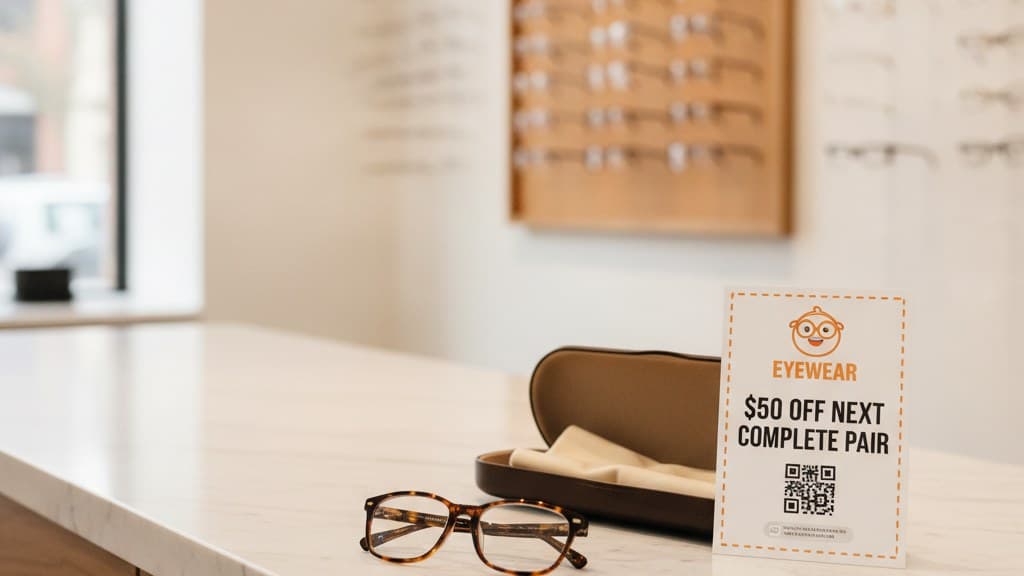
For the second-pair play. The patient is seated, the optician is bending temples, and there is a two-minute stretch of quiet attention while they check the fit in the mirror. Their hands are empty and they are actively pleased with how they look. Set the card on the tray with the cleaning cloth and the case, not on the counter where it becomes receipt clutter.
- 3
At the frame board mirrors
Small standing cards at each mirror on the frame boards. This is where the patient is standing alone, holding a $289 frame, having a silent internal argument about whether it is worth it. It is the only moment in the store where they are considering the purchase with nobody talking to them. A card that answers the price objection at exactly that spot does not need a script attached.
- 4
Inside the case, under the cleaning cloth
The case goes home and gets opened every night for two years. It is the longest-dwell object of any placement in this entire series. A card tucked under the cloth gets found on day one or day thirty, and either way it is found by somebody who is currently wearing the product. Best surface for the second-pair code if you would rather not hand it over in person.
- 5
Printed on the annual recall card
For the benefit-expiry play. You already mail or email a recall reminder at the twelve-month mark. Adding a dated single-use QR to a card you are already sending costs you nothing in postage and converts a passive appointment nudge into an offer with a real deadline on it. Send it in October, not December.
Notice what is not on that list: the front window, the sidewalk sign, and your Facebook page. A poster in the window is a public price cut. It reaches everyone including the patients who were going to pay full price, which is most of them, and it permanently repositions your dispensary as the place that always has fifty dollars off. The whole point of a single-use code is that the loyal patient who buys every eighteen months without complaint never sees one, and the patient hovering at the frame board with her phone half out of her purse gets one every time.
The capture-rate math (with real numbers)
Run the Exam-Room Walk-Out play for a month at a single-doctor independent practice.
Say you do 200 comprehensive exams a month, which is a busy but ordinary solo lane. At a 60 percent capture rate, 120 patients order eyewear and 80 walk out with a prescription and no order. Those 80 are the entire target. You do not coupon the 120 who already bought, because you would simply be paying $50 apiece for sales you already had.
Redemption on a high-ticket coupon runs lower than on a coffee or car wash card, because a $350 purchase is a considered decision rather than an impulse. Plan on 15 percent, not the 25 to 30 percent you would see on small-ticket plays.
You spent $600 and billed $4,200. That is a seven-to-one return, and the operational number underneath it matters more than the ratio: your capture rate moved from 60 percent to 66 percent. Six points of capture, held for a year, is roughly 72 additional complete pairs and something like $25,000 of eyewear revenue that used to leave in a photograph.
Two honesty checks. First, some share of those 12 patients were going to come back and buy from you anyway, so the coupon paid $50 to accelerate a sale you had already won. Assume a third of them and the ratio drops toward five to one, which is still an obviously good trade. Second, this math assumes the discount lands where your plan agreements allow it. If most of your book is managed vision care with tight discount rules, your addressable pool is smaller than 80, and you should size the campaign to the private-pay and above-allowance slice rather than to the whole walk-out list.
The metric to actually watch is not the ratio and not the redemption count. It is capture rate, monthly, before and after. That single number tells you whether the card changed anything, and it is the number your practice was always going to be judged on.
The prescription-handoff script (eight words that mention the internet)
A card clipped to a prescription with no sentence attached gets thrown away with the parking receipt. A card with eight words attached goes into a wallet. And in this niche the sentence has to do something strange, which is acknowledge out loud that the patient is about to price-shop you.
Bad version (pretends the internet does not exist): "Here's fifty dollars off if you decide to get your glasses with us, we do free adjustments and our lenses are much better quality than what you'll find online."
Good version (concedes the shopping, keeps the anchor): "Compare it online. This is fifty off here."
Almost every optician's instinct is to argue against online eyewear at the handoff: lens quality, PD accuracy, free adjustments, remakes. All of it is true and none of it works, because it sounds like fear. The patient has already decided to check her phone in the car, and a defensive speech confirms that she should.
The good version does the opposite. It grants her the comparison she was going to make anyway, which instantly makes you the confident party, and then it hands her fifty dollars that only spends in one place. The arithmetic she runs in the parking lot changes shape: not "$350 here versus $95 online," but "$300 here with the person who measured me and will adjust these for free forever, versus $95 online plus a remake if the pupillary distance is off."
You will still lose the patient who genuinely has a ninety-five dollar budget. You were never going to win her and the coupon was not for her. It was for the seventy-percent patient who needed a reason to stop deliberating.
Train the sentence identically across the doctor, the optician, and the front desk. In a practice this small, one staff member skipping the handoff quietly removes a quarter of the campaign, and nobody will ever tell you it happened.
Setting up your first campaign in 6 minutes
- 1
Sign in to ReviewQR (14-day free trial)
Create an account with any email at reviewqr.app. The 14-day free trial (card on file, cancel anytime) covers about two weeks of walk-out patients in most independent dispensaries. That is enough to see whether capture rate moves at all before the trial ends. After that, Essentials is $10/month for 100 single-use coupons.
- 2
Pull your actual capture rate first
Count last month's comprehensive exams, then count complete-pair orders. Divide. That number is your baseline and the only thing that will tell you later whether the campaign worked. If you cannot produce it in five minutes, fixing that is more valuable than any coupon.
- 3
Check your plan agreements before you set the offer
Confirm with whoever handles your billing which of your managed vision plans allow a store discount and on what portion of the claim. That answer decides whether you hand the code to every walk-out or only to private-pay and above-allowance patients. Five minutes here prevents a genuinely expensive mistake later.
- 4
Set the offer and the expiry
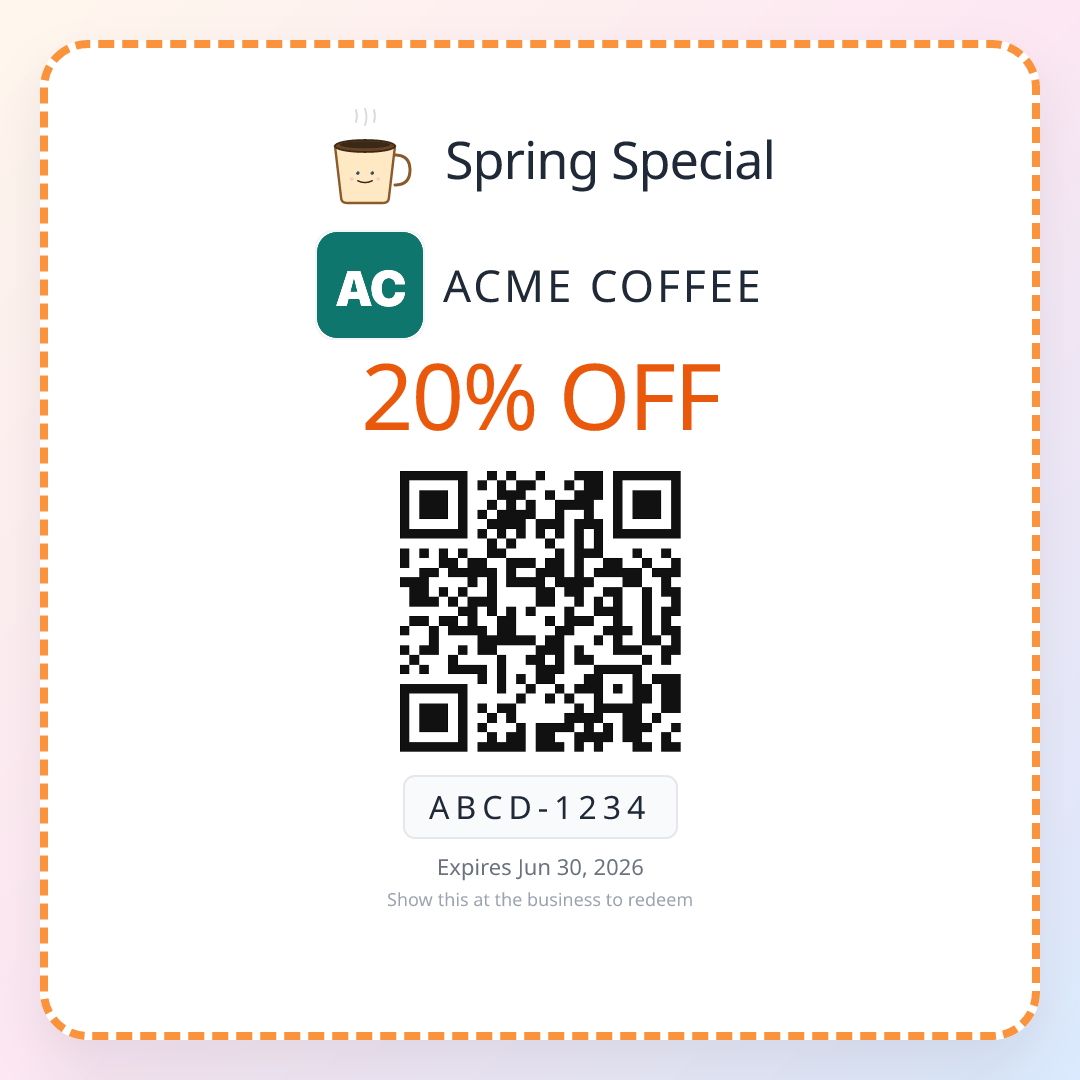
$50 off a complete pair, expiring in 14 days, one redemption per code. Write 'complete pair = frame + prescription lenses' into the coupon text so it appears on the card and on the scan screen. Single-use enforcement is automatic: once staff mark a code redeemed, a second scan returns 'already redeemed.'
- 5
Print 50 wallet-size cards and put them in the exam lane
Plain cardstock. The card needs the QR, '$50 OFF A COMPLETE PAIR', the complete-pair definition, and the expiry date. Keep the stack in the exam room with the prescription pad, not at the front desk, because the handoff has to happen while the prescription is still in the doctor's hand.
- 6
Brief everyone on the eight-word script
'Compare it online. This is fifty off here.' Say it out loud once with the doctor, each optician, and the front desk. Then clip a card to every prescription that leaves without an order, and check capture rate again in thirty days.
Once you want to run the second-pair and benefit-expiry plays alongside the walk-out play, or compare codes handed in the exam room against codes handed at the frame board, the Essentials plan at $10 per month gives 100 codes monthly with campaign tagging. In most niches a hundred codes a month is tight. In optical it is generous, because you are only couponing the patients who left holding a prescription and nothing else.
Common optical shop coupon mistakes
Mistake 1: Discounting the exam instead of the eyewear. A cheap exam brings in patients who are shopping for a cheap exam, and the exam is the part of your business with real per-unit cost and thin margin. Worse, it advertises that the appointment is the product. It is not. The appointment is the invitation. Discount the frame and the lenses, which is the part you are actually losing to a website.
Mistake 2: Running a percentage off. Optical tickets are large and highly variable, which makes percentages unpredictable in a way they never are at a coffee counter. Twenty percent off a single-vision job is thirty dollars. Twenty percent off progressives with anti-reflective and a designer frame is a hundred and forty. Flat dollars let you forecast the cost of a campaign before you run it.
Mistake 3: Applying the coupon to a covered benefit. Most managed vision plans prohibit stacking a store discount on the covered portion of a claim, and the penalties for getting this wrong are considerably worse than a lost sale. Aim every code at private-pay, second pairs, and the out-of-pocket amount above the frame allowance.
Mistake 4: Sending the benefit-expiry reminder in December. Everyone sends it in December, so all of them arrive in the same week, cancel each other out, and land when your lab cannot deliver in time anyway. October is uncontested, and it gives the patient eight weeks to book, choose, and receive. A deadline the patient physically cannot meet is not urgency, it is an apology waiting to happen.
Mistake 5: Handing the code at check-in. A coupon offered before the exam reads as a promotion and sets a discount expectation on a purchase that has not been considered yet. The same coupon offered with the prescription, after the patient has already declined, reads as a nudge. Identical card, completely different meaning, and the difference is entirely about which side of the decision it lands on.
Mistake 6: Treating the coupon as a price-match tool. Fifty dollars will not turn a $350 pair into a $95 pair, and any campaign designed to win the budget shopper is designed to lose money. The coupon exists for the patient who liked the frame, trusted the optician, and stalled. Pointing it at anybody else is how a promotion turns into a discount you can never take back.
Related reading
Optical sits in the same awkward spot as a few other high-ticket, low-frequency businesses, where one sale a year has to carry the whole relationship. The auto detailing coupon playbook is the closest structural cousin in the series, built around the same problem of a large ticket on a slow clock. For the review side of a retail business where the purchase is emotional and considered, the jewelry store Google reviews playbook covers asking at the moment of highest satisfaction, which in optical is the mirror at the dispensing table. If you want the broader mechanics, the coupon ideas listicle groups 23 plays by goal, and the QR coupons for small business overview explains the single-use mechanic from the top. For a side-by-side of tools, see best QR coupon app for small business.
Frequently asked questions
My patients only need glasses once a year. Doesn't that make coupons pointless?
It makes the usual coupon pointless and this one more valuable. Every other niche uses a coupon to increase how often somebody visits. You cannot do that. Nobody's eyes get worse faster because you sent a card. What you can change is where the once-a-year purchase lands, and that is the entire game in optical. Your patient is already going to spend three or four hundred dollars on eyewear this year. The only open question is whether they spend it at your dispensary or type their prescription into a website in your parking lot. The coupon is not buying frequency, it is buying the sale that was already scheduled.
Can I stack a coupon on top of a vision insurance benefit?
Usually not on the covered portion, and you need to check your specific provider agreements before you run anything. Most managed vision plans prohibit combining a store discount with a covered benefit, and violating that can put your panel status at risk. The good news is that this restriction points you at the three places where a coupon is both legal and most useful anyway: private-pay and out-of-network patients, the out-of-pocket amount above the frame allowance, and second pairs, which almost no plan covers. Second pairs in particular are pure private-pay, which makes them the safest and most profitable place in the store to discount.
Should the discount be a percentage or a dollar amount?
Dollars, and it is not close in this niche. Optical tickets are large enough that percentages get dangerous fast. Twenty percent off a $500 progressive job with anti-reflective coating is a hundred dollars, and you will not know that until the lens order is priced. A flat fifty dollars off a complete pair is a number you can forecast, print on a card, and explain across a counter in one sentence. Define complete pair explicitly as frame plus prescription lenses so the discount never lands on a $60 pair of readers or a bottle of cleaning spray.
How do I compete with $95 online glasses using a $50 coupon?
You do not, and you should stop trying. The coupon is not a price match and it will never win a patient who has genuinely decided that $95 is the budget. It is aimed at a completely different person: the patient who wanted to buy from you, liked the frame, trusted the optician, and walked out saying they would think about it. That patient is at maybe seventy percent already. Fifty dollars is not closing a three-hundred-dollar price gap, it is closing a three-day deliberation. Those are different jobs and only one of them is winnable.
When should the benefit-expiry campaign go out?
October, not December. By the first week of December your patient is buying gifts, your lab is backed up, and a complete pair ordered on December 20 may not be dispensed before the benefit year closes. October gives them eight weeks to book an exam, choose frames, and get the job back from the lab with room to spare. It also puts you weeks ahead of the chains, who all send the same reminder in the same two weeks of December and cancel each other out. The deadline is real either way. You just want to be the first person who mentions it.
How many coupons should an independent optical shop start with?
Twenty, handed only to patients who walk out of an exam without buying, which in most independent dispensaries is about two weeks of walk-outs. Every ReviewQR plan starts with a 14-day free trial, so the first read on whether capture rate moves costs nothing. After that, the Essentials plan at $10 per month gives 100 codes monthly. In optical that is a generous allowance rather than a tight one, because you are not couponing every warm body who enters the store. You are couponing the specific patients who left holding a prescription and no frame.
Keep reading
Florist Google Reviews: 25-40 per Valentine's Weekend
How flower shops collect 25-40 Google reviews per Valentine's or Mother's Day weekend using QR codes on bouquet tags and delivery cards. QR generator + playbook.
Retail & ShopsQR Code Coupons for Dry Cleaners: The Hanger-Tag Bounce-Back
How dry cleaners use single-use QR coupons stapled to the poly bag to pull drifting customers back before their garments pile up. With the closet-visibility mechanic, math, counter scripts, and a 6-minute setup.
Retail & ShopsSpring Clean Your Online Reputation with a QR Code
Boost your Google reviews this spring. Learn how to create a review QR code in 60 seconds, where to place it, and seasonal strategies that drive 3-5x more reviews.