Small Business Loyalty Program: No App, No Points, Just a Coupon
Every loyalty program charges the customer an enrollment tax before it can reward anything, and only your regulars ever pay it. The math on what that costs, and the three-play coupon system that replaces it, with placement geometry and a counter script.
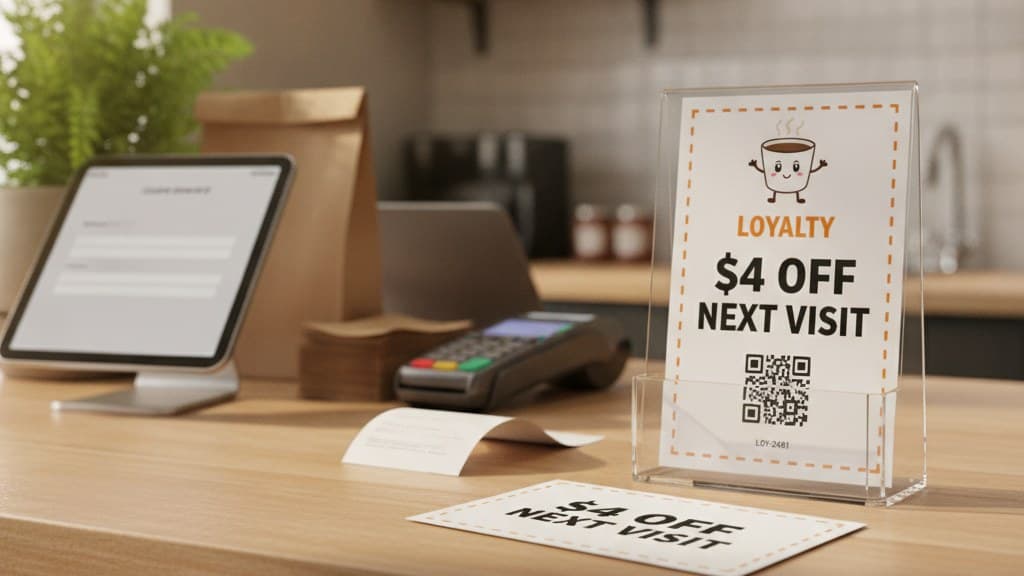
Small Business Loyalty Program: No App, No Points, Just a Coupon
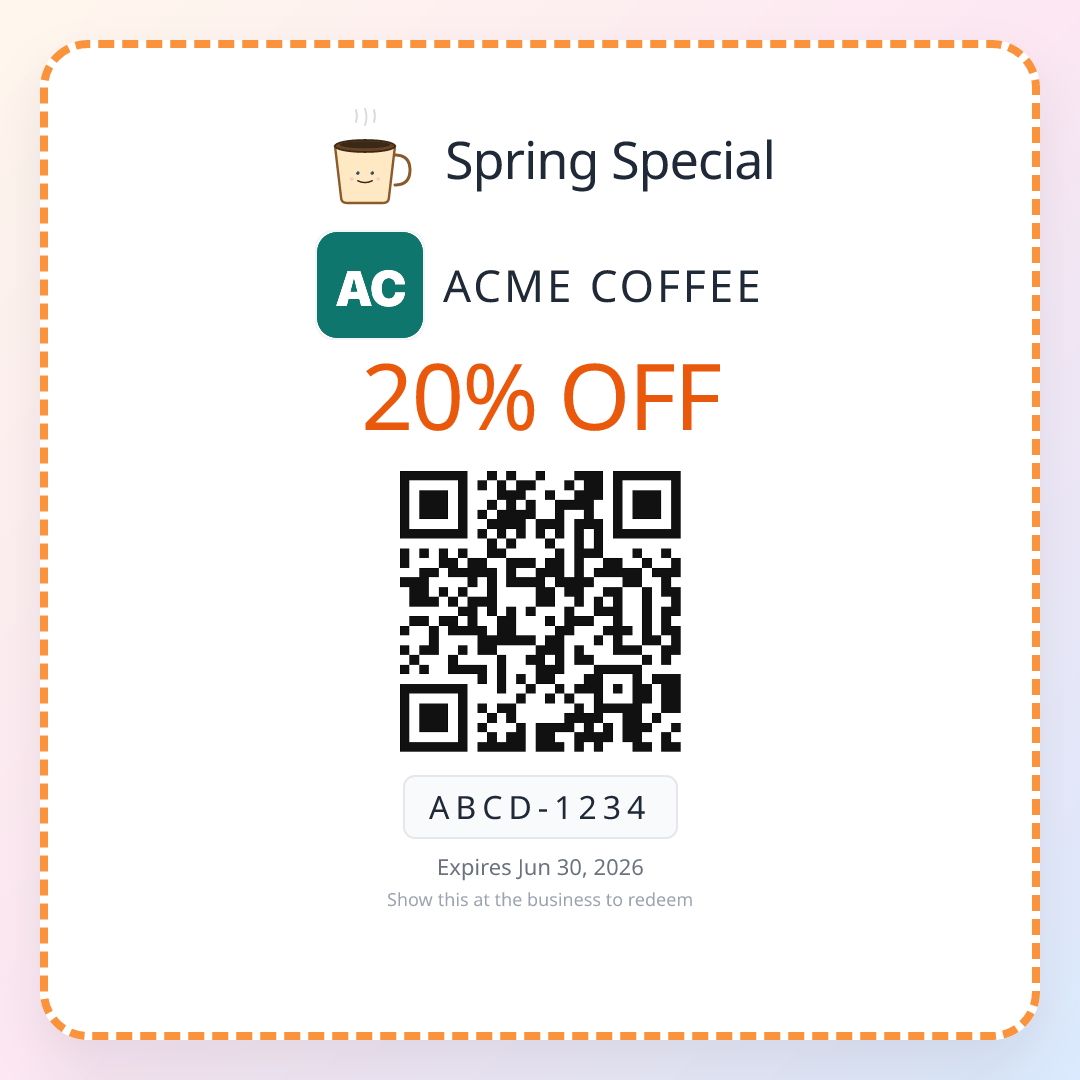
Turn one visit into many
Hand out single-use QR coupons that pull customers back through your door. Part of your Customer Comeback System. 14-day free trial, cancel anytime.
Create a couponThere is a tablet on a counter somewhere, angled toward the customer, and on it is a screen that says Join our rewards program. Underneath is a field for an email address and a keyboard that is slightly too small. Behind the customer there are two people waiting, and the customer knows this, and so they do the thing almost everyone does: they smile, say "I'm fine thanks," and take their bag.
The owner of that business is paying somewhere between forty and ninety dollars a month for the software behind that screen. When they open the dashboard, they see a member count that goes up slowly and a chart of points issued, and both numbers look like progress. What the dashboard does not show is the shape of who joined. Scroll the member list and you will recognise most of the names. They are the Tuesday regular, the woman who comes every other Thursday, the guy who has been coming since before you repainted. They enrolled because they were already loyal, and the program then rewarded them for it.
Meanwhile the customer who came in twice in March and never again was never a member, was never going to be a member, and got nothing. They were the only person in this story whose mind was still open, and the entire program was built in a way that could not reach them.
That is not a software problem, and switching vendors will not fix it. The problem is that a loyalty program charges admission.
The Enrollment Tax
Every loyalty program, without exception, asks the customer to pay something before it will give them anything. Not money. Friction. An email address, a phone number, an app install, a password, a card to keep in a wallet, thirty seconds at a counter while other people wait. Call it the enrollment tax, because that is exactly how it behaves: a toll collected at the entrance, priced in awkwardness rather than currency.
Here is the part that matters. The tax is not distributed evenly, and it is not distributed randomly. It is paid, overwhelmingly, by people who have already decided they like you. Willingness to hand over an email address at a counter is not a neutral signal, it is a loyalty signal. So the gate is doing precisely the opposite of what the program was bought to do: it admits the committed and turns away the undecided.
Watch it happen in real time at any counter. A first-time customer, mid-transaction, is asked to join something. They have no relationship with you yet, no evidence that membership will ever be worth anything, and a live audience of strangers behind them. Declining is free and instant. Joining costs thirty seconds and a small amount of social exposure. Almost every undecided customer declines, and they are right to, because from where they are standing the offer is genuinely bad.
Now watch the regular. Same question, completely different calculation. They already know they will be back. Membership is obviously worth it, the awkwardness is low because they know your staff, and so they join. Your dashboard records this as a win. It is a win in the way that getting your own money back is a win.
This is why operators who change loyalty platforms rarely change their outcome. The mechanism that is failing sits in front of the software, at the moment of the ask, and every platform implements that moment the same way. A different vendor collects the same tax with a nicer interface.
The alternative is not a better program. It is removing the gate entirely: a reward that is already the customer's before any conversation happens, that requires no membership because there is nothing to be a member of, and that reaches the undecided customer precisely because it never asks them to decide anything.
What a loyalty program actually costs you
Take a business with an eighteen dollar average ticket. That covers a lot of ground: a lunch counter, a nail bar, a small service call, a neighbourhood retailer. Deliberately unglamorous numbers, no optimism baked in.
A customer who drifts visits maybe twice a year. That is $36 of annual value. A customer who forms a habit visits every six or seven weeks, call it eight times a year, which is $144. The entire business of retention lives in the $108 gap between those two people, and they are frequently the same person on two different paths.
Now price the two mechanics against that gap.
A conventional loyalty program costs you a subscription in the range of forty to ninety dollars a month, roughly $600 a year at the low end, plus the rewards themselves. Because enrollment self-selects for regulars, most of those rewards land on the $144 customer, who was going to be a $144 customer regardless. You are buying a discount on revenue you already had, and paying a subscription for the privilege of tracking it.
A single-use coupon costs four dollars when redeemed, expires in twenty one days, and is handed to whoever is standing there, membership status irrelevant because there is no membership. If it moves one drifter onto the habit path, that customer goes from $36 to $144. Getting them there costs perhaps three redeemed coupons across the year, so $12.
The asymmetry that makes this work
A points program spends its rewards on a customer already worth $144 a year and changes their behaviour by close to nothing, because they had already chosen you before they enrolled. A no-signup coupon spends about $12 a year on a customer worth $36, and can plausibly move them to $144. That is $108 of recovered annual value for $12 of discount, a ratio near 9 to 1, and it is spent on the only customer in your shop whose decision is still open.
The subscription comparison is almost an aside, but it is not nothing. Six hundred dollars a year of loyalty software against one hundred and twenty for five hundred coupons a month is the difference between a fixed cost you have to justify and one you barely notice. The real argument is still the placement of the reward. The software bill is just the tip you leave for getting it wrong.
Three plays that do the job without a program
A loyalty program is really three jobs wearing one coat: recognising your regulars, giving people a reason to come back on a particular date, and smoothing things over when a visit goes badly. Points programs bundle all three behind a single enrollment gate and do all three indifferently. Unbundled, each one is a two-line play you can run this week.
Run one. Give it a fortnight. Only add a second once the first has produced a redemption number you believe.
Play 1: The Unspoken Tier
Job: Recognise your regulars without a ledger, a balance, or a tier badge.
Print two denominations of coupon, say three dollars and six. The three dollar card is the default and goes to anyone. The six goes to faces your staff recognise, handed with a half sentence: "this one's a bit better, you're in here a lot." No announcement, no rules published anywhere, no membership status to be checked. The tiering lives in your team's heads, which is where it already lived before anyone sold you software to store it.
This sounds informal because it is, and that is the source of its power. A points tier is an entitlement the customer can audit and be annoyed by. An unspoken tier is a small human gesture, which lands as recognition rather than as a transaction, and recognition is the thing your regulars actually wanted from the loyalty program in the first place.
Offer shape: Two fixed denominations, $3 default and $6 recognised, both valid 21 days, one redemption each. Best handed to: Everyone gets the $3. The $6 goes to faces staff know by sight. Why it works: It delivers the emotional payload of a tier (being known) with none of the administrative payload, and it never forces a customer to prove who they are in order to be treated like a regular.
Play 2: The Calendar Coupon
Job: Create a dated reason to return that belongs to the business, not to the customer's file.
Loyalty programs hang their occasions on customer data: birthday rewards, anniversary-of-signup perks, points expiry warnings. All of that requires a database, which requires enrollment, which brings back the tax. So invert the ownership of the occasion. Pick a date you control, a genuinely slow fortnight, a reopening, a new line landing, the week after a local event empties the neighbourhood, and issue one batch of coupons tied to it.
Everyone who comes in during the run-up gets the same card with the same window on it. The customer needs no profile, no history, and no membership to qualify, because the qualifying event is yours rather than theirs. You also get something a birthday reward never gives you: all the redemptions land inside one countable window, so the read on whether it worked is unambiguous.
Offer shape: One batch, single fixed amount off, valid only inside a named 10 to 14 day window. Best handed to: Every customer in the two weeks before the window opens. Why it works: It produces the concentration a slow period needs, and it sidesteps enrollment completely by attaching the occasion to the calendar instead of to a customer record.
Play 3: The Staff-Discretion Float
Job: Fix the visit that went wrong, in the ten seconds where fixing it is still possible.
Give each person on shift a small stack of single-use codes, say five, to hand out at their own judgement. A twenty minute wait. An order remade. A customer who mentions they came because a friend sent them. A regular who arrives four minutes after you stopped serving the thing they came for. Staff decide, on the spot, without asking a manager and without opening anything.
A points program handles this appallingly. The recovery gesture requires the customer to be enrolled, or a manager to adjust a balance afterwards, by which time the customer has left with the bad version of the story. A code in a pocket can be given away in the same breath as the apology, which is the only moment it is worth anything. Cap the float per shift and you have capped the cost exactly, while handing your team something most of them have wanted for years: permission to make it right.
Offer shape: 5 single-use codes per person per shift, fixed amount, valid 21 days. Best handed to: Whoever your team decides, at their discretion, in the moment. Why it works: Service recovery has a shelf life measured in seconds, and a coupon is the only reward instrument that can be handed over inside that window without a lookup, a login, or a membership.
Do This
- ✓Run one play alone for a full fortnight before adding a second
- ✓Keep every code to a fixed amount off, never a percentage
- ✓Put a 21 day expiry on the card in words the customer reads without effort
- ✓Hand the code with the order or the goodbye, never at the card reader
- ✓Cap the staff float per shift so the cost is known in advance
Avoid This
- ✕Don't ask for an email, a phone number, or a signup of any kind
- ✕Don't hand codes to daily regulars outside Play 1 (they were coming anyway)
- ✕Don't publish the tier rules, it turns recognition into an entitlement
- ✕Don't run a points program alongside this (staff will default to the familiar one)
- ✕Don't make any reward conditional on a customer leaving a review
Where the reward lives when there is nothing to join
A membership card had one home, the customer's wallet, and that is where loyalty programs went to die. A single-use code has no home at all. It exists to survive one short journey, from your hand to a phone camera, and then it is spent. That changes the placement question from "where will they keep it" to "where will they definitely notice it", and the answer depends on the shape of your business rather than on the mechanic.
With the order, three seconds after the payment
For any counter business, the handoff moment is when the product changes hands, not when the card machine beeps. Those two moments are seconds apart and emotionally unrelated. Anything given during payment is filed by the customer as part of the bill. The same card given as the bag crosses the counter is filed as a small extra, and the difference in how it is received is larger than the difference in what it is worth.
In the chair, before they stand up
For appointment businesses (a nail bar, a grooming table, a treatment room, a barber chair) the best moment is while the customer is still seated and still in the good mood the service created. Standing up begins the leaving sequence: coat, phone, card, door. Hand the card during the last thirty seconds of the service and it goes into the same pocket as everything else, unhurried.
Stapled to the invoice or the job sheet
For trades and service calls there is no counter, but there is always paperwork the customer keeps deliberately rather than by accident. An invoice gets filed, photographed, or stuck to a fridge. A coupon attached to it inherits that care, which is why this placement outlives every other one on the list, and why a longer window is defensible here.
Inside the packaging, under the fold
For retail and takeaway, put the card where the customer's own hand must move it to reach the product: under the fold of a bag, beneath the tissue, clipped to the tag. They meet it five to twenty minutes after leaving, at home, unhurried and already pleased with the purchase. That is the calmest and most receptive moment in the whole visit, and nothing else in your shop can reach it.
In the spot where the signup tablet used to be
If you have been running a points program, there is a piece of counter real estate already dedicated to it: a tablet, a clipboard, a small sign about joining. It is at the right height and already in every customer's line of sight. Replace what sits there with a small stack of pre-cut coupon cards for staff to reach into. Keep the location, drop the gate.
Four of those five need no new object. The loyalty program required a bespoke piece of hardware or a bespoke printed card that existed for no other purpose. The coupon rides on the receipt, the invoice, the bag and the counter you are already paying for, which is a quiet but real reduction in what the program costs to run and, more importantly, in how much has to go right for it to run at all.
Turn one visit into many
Hand out single-use QR coupons that pull customers back through your door. Part of your Customer Comeback System. 14-day free trial, cancel anytime.
Create a couponThree hundred customers, run both ways
Same month, same business, same three hundred customers who are not yet regulars. Eighteen dollar average ticket. Run the points program and the coupon system against each other.
The points program version. Three hundred customers pass the counter and are asked to join. Enrollment at a counter, asked mid-transaction, lands somewhere in the high teens for most independent operators, so call it eighteen percent: fifty four new members. Now apply the selection effect honestly. Roughly seven in ten of the people willing to stop and enroll are already habitual customers, so about thirty eight of those fifty four were staying regardless. You have genuinely newly-captured around sixteen people out of three hundred, and you will pay a subscription every month to keep tracking all of them. The other two hundred and forty six customers passed through the program without touching it.
The coupon version. Three hundred single-use codes, four dollars off, twenty one days, handed into a hand with a sentence attached. Coupons given directly by a person, rather than displayed or emailed, redeem in the range of twenty five to thirty five percent. At thirty percent, that is ninety return visits inside three weeks.
Set the two outcomes side by side. The points program produced fifty four enrollments, of which sixteen represent anything new, and no return visits that can be attributed to it with a straight face. The coupon system produced ninety countable return visits and cost $360 in discount plus $25 of software for the month, netting around $1,235 of billed revenue against roughly $385 of cost.
Do not bank all ninety of those visits as pure new revenue. Some share of those customers would have wandered back on their own at some point. The honest claim is narrower and still worth a great deal: the coupon pulled the visit forward into a three week window you can measure, and it put the visit in your business rather than in whichever competitor the customer happened to pass first. Pulling a visit forward and winning it are both real outcomes. Counting all ninety as incremental is how operators end up disappointed by a program that was genuinely working.
There is a second difference, and over a year it may matter more than the money. One of those two systems told you a number. Ninety of three hundred, thirty percent, measured in twenty one days. The other told you fifty four people typed an email address.
The counter script that replaces the signup ask
The most expensive sentence in a loyalty program is the one your staff repeats forty times a day. "Would you like to join our rewards program? I just need an email address." It asks for something, it asks during payment, it asks in front of an audience, and it is declined by exactly the customers you most need.
Replace it with a handoff that asks for nothing at all.
Bad version (a request, aimed at the wrong moment, with a cost attached): "Would you like to join our rewards program? It's free, I just need your email and a phone number."
Good version (a gift, eight words, no gate): "This one's yours. Nothing to join. Three weeks."
Those eight words do three jobs. This one's yours establishes ownership before any conversation can start, so the object reads as a gift rather than as an advertisement. Nothing to join pre-empts the objection the customer has already formed, because they have been asked to join things at counters all week and their defences are up. Three weeks supplies the deadline, which is where most of the actual behaviour change comes from.
Train the sentence, not the concept. One line, identical from every person on the counter, rehearsed out loud once before their first shift on it. Consistency between staff is the single largest predictor of whether any of this shows up in your redemption data. Two people saying it and one skipping it will roughly halve your numbers, and you will spend a month blaming the offer.
Setting up your first campaign in 6 minutes
Create your account (14-day free trial)
Sign up with any email at reviewqr.app. The fourteen day free trial (card on file, cancel any time) is enough to run a full batch and get a real redemption percentage. After the trial, Essentials is $10/month for 100 single-use coupons and Growth is $25/month for 500. Every plan includes a Google review QR code.
Pick one play, and only one
Start with the Unspoken Tier if you have a strong regular base you want to hold, or the Calendar Coupon if you have a specific slow fortnight coming up. Leave the staff float until week three. Running two plays at once makes the redemption number uninterpretable, and the redemption number is the whole point of the first fortnight.
Set a fixed amount and a 21 day expiry
Four dollars off, valid 21 days, one redemption per code. Single-use is enforced for you: once a code is scanned and marked redeemed at your counter, any second scan of the same code returns 'already redeemed', so a photographed card cannot circulate through a group chat.
Print 100 cards, not 500
Business card stock, no design work needed. The QR, the amount, and '21 days' is enough text. You will want to change the wording or the amount after two weeks, and a box of four hundred obsolete cards is the single most common reason these programs quietly stop running.
Switch the points program off the same day
Do not run both. Staff revert to the mechanic they already know, your data becomes unreadable, and customers get asked two different loyalty questions in one transaction. Honour any balances already earned, take the signup prompt off the counter, and put the card stack where it stood.
Rehearse one sentence with every person on the counter
'This one's yours. Nothing to join. Three weeks.' Said out loud, once each, before their first shift on the new program. That single rehearsal moves your redemption rate more than a dollar of extra discount will.
On day fifteen you will have a percentage. Under twenty percent and the handoff moment is wrong, which almost always means the card is being given at the card reader instead of with the order. Over forty percent and you are being more generous than you need to be, so drop the amount by a dollar and watch what happens. Neither of those adjustments is available to a program whose primary metric is how many people joined it.
Common small business loyalty program mistakes
Mistake 1: Treating enrollment as a success metric. Members joined is the number every loyalty dashboard leads with, and it is the number least connected to revenue. It counts people who were already coming back agreeing to be counted. Ask instead what percentage of issued rewards came back redeemed inside a fixed window, and notice how many programs cannot answer.
Mistake 2: Asking for the signup during payment. Payment is the least generous ten seconds of any visit, with a queue behind the customer and a card in their hand. Any request made there is declined on reflex. If you insist on collecting emails, collect them at the moment the order changes hands, not at the terminal, and expect the same answer anyway.
Mistake 3: Running points at independent-business volume. Points need scale to feel like progress. At eight visits a year and an eighteen dollar ticket, a customer's balance creeps upward at a rate indistinguishable from standing still, so the program stops registering as a reason to do anything. A fixed amount with a date needs no accumulation to be legible.
Mistake 4: Publishing your tier rules. The moment a tier is written down, it becomes an entitlement to be audited, argued with, and gamed, and your staff lose the ability to use judgement. Keep recognition unspoken and discretionary and it stays a human gesture, which is what your regulars actually wanted.
Mistake 5: Rewards with no expiry. "Your points never expire" is sold as generosity and functions as sedation. A reward with no deadline is filed mentally under later, and later is where coupons and points balances go to die in glove compartments and abandoned apps. Twenty one days is short enough to act on and long enough to be reachable.
Mistake 6: Tying any reward to leaving a review. It is tempting, because you are already handing out cards and you would also like the reviews. Do not do it. Trading a discount for a review breaks Google's policy and risks having your reviews filtered or your profile penalised. Ask for the review and give the coupon as two independent things, on two sides of the same card if you like, with no condition connecting them.
Related reading
If you are new to the mechanic itself, QR coupons for small business explains it from scratch and is the right starting point. For a menu of offers grouped by the problem you are trying to fix, the coupon ideas listicle covers twenty three plays. The closest relative to this article is punch card for business, which takes apart the other classic loyalty instrument and explains why the tenth punch arrives long after the decision was made. If you are comparing tools before you commit, best QR coupon app for small business puts the options side by side. And since the best coupon placement you own is usually the back of something you already print, Google review cards with a QR code covers the front of that card.
Frequently asked questions
What is the simplest loyalty program for a small business?
A small, fixed, expiring reward handed to the customer at the end of a visit, with nothing to sign up for. That is the entire program. No account, no points balance, no card to carry, no app on a home screen. The customer takes an object, points a camera at it within three weeks, and comes back. Everything a conventional loyalty program adds on top of that (tiers, ledgers, member emails, enrollment prompts) exists mainly to serve the software, not the customer and not you. If you strip a loyalty program back to the part that changes behaviour, what survives is a deadline and a reason, and both of those fit on a business card.
Do I need an app for a small business loyalty program?
No, and for most independent businesses an app is the most expensive possible answer to the cheapest problem you have. An app asks the customer to download something, create an account, and then remember to open it at the counter while someone waits behind them. That is three separate points of friction stacked in front of a reward worth a few dollars. The people willing to clear all three are your regulars, who were coming back anyway. A printed single-use QR coupon needs no download and no account. The customer uses a camera they are already holding on a card they were just handed, and the onboarding is finished before they reach the door.
Is there a free loyalty program for small business owners?
Not in any honest sense, and the phrase hides where the cost actually sits. A paper punch card has no software fee and still costs you real margin, because you hand free product to people who had already decided to stay. A free tier on a loyalty app usually caps members or strips the reporting, which means you find out whether it worked only after you upgrade. With ReviewQR the free part is a fourteen day trial with a card on file that you can cancel any time, which is long enough to hand out a real batch of coupons and get a redemption percentage instead of a guess. After that, Essentials is ten dollars a month for one hundred single-use coupons and Growth is twenty five dollars a month for five hundred.
Points or discounts: which works better for a small business?
Points work when you have enough transaction volume that a fraction of a cent per visit adds up to something the customer can see moving, which describes an airline and a supermarket chain and almost no independent business. At your volume, points accumulate too slowly to feel like progress, so the balance sits at a number that means nothing and the program quietly becomes wallpaper. A fixed amount off, with a date on it, needs no accumulation and no mental arithmetic. The customer knows exactly what they hold and exactly how long they hold it for, which is the whole reason it gets used.
How do I know if my loyalty program is actually working?
You need one number, and most loyalty programs are structurally incapable of producing it. Ask what percentage of the rewards you issued in a given fortnight came back redeemed. A coupon system answers that on day fifteen: codes issued, codes redeemed, percentage. A points program answers with enrollment counts and member totals, which measure sign-ups rather than returned visits, and enrollment is exactly the metric that looks healthiest when nothing is happening. If a program cannot tell you a redemption rate, you are not measuring loyalty, you are measuring how many people once typed an email address into a tablet.
What does it cost to run a coupon-based loyalty program?
Two line items, and neither is large. The software is ten dollars a month on Essentials for one hundred single-use coupons, or twenty five on Growth for five hundred, and every plan starts with a fourteen day free trial (card on file, cancel any time) and includes a Google review QR code. The printing is business card stock from whichever print shop you already use, and a hundred cards is the correct first order. The third cost is the one people forget to count and the only one that scales: the discount itself, which you control exactly, because a fixed amount off caps your exposure per code at that amount no matter how large the order is.
Ready to Implement This Strategy?
Create your custom QR code in 2 minutes and start collecting Google reviews today.
Create Your QR Code NowMore Google Review Guides
QR Code for Reviews: 2-Minute Setup + 3-5x More in 90 Days
How local businesses use QR codes to collect 3-5x more Google reviews in 90 days. Simple generator, real placement tactics, scan-rate data, and what to put on the card.
guidesHow to Create a QR Code for Google Reviews (Free, No Expiry)
Step-by-step guide to creating a free QR code for Google reviews. Learn why QR codes outperform traditional methods and how to track results with analytics.
guidesGoogle Review Tap Card vs QR Code: Cost, Setup, and What Customers Actually Do
An NFC tap card converts better than a QR code at the counter and worse everywhere else. The honest numbers on cost per review, phone compatibility, and which one earns the return visit.