QR Code Coupons for Food Trucks: The Tomorrow's-Spot Tease
Food trucks lose customers to geography, not food. How single-use QR coupons that double as a location reveal turn one-off encounters into route regulars. Unit economics, three plays, truck-surface placement, scripts, and a 6-minute setup.
QR Code Coupons for Food Trucks: The Tomorrow's-Spot Tease
Turn one visit into many
Hand out single-use QR coupons that pull customers back through your door. Part of your Customer Comeback System. 14-day free trial, cancel anytime.
Create a couponA guy in a work jacket waits eleven minutes in your line on a cold Tuesday, orders the birria, eats it standing up against a parking meter, and comes back to the window to tell you it was the best thing he has eaten all year. He means it. He asks if you are here every day.
You are not. Tomorrow you are at a business park nine miles east. Thursday you are downtown. Saturday you are at a brewery until close. You tell him to follow you on Instagram. He nods, pulls out his phone, does not follow you on Instagram, and walks back to his job.
He never eats your food again. Not because he found something better, and not because anything went wrong. He just could not find you, and after two or three failed attempts to remember the name of a truck he saw once, he stopped trying.
That is the food truck retention problem, and it is not the same problem restaurants have. A restaurant loses customers to competitors, to price, to a bad night. A truck loses them to geography. Every retention tool ever built assumes the business stays where the customer left it, which is the one thing a truck cannot promise. Punch cards assume a return trip to the same address. Loyalty apps assume the customer downloads something for a business they have visited once. Social media assumes they remember to look.
There is one thing that reaches the guy in the work jacket: a card that answers his actual question, where will you be, and carries a discount along for the ride. This article is the playbook.
The Tomorrow's-Spot Tease: your best customer can't find you
Every other article in this series starts with a clock. Hair grows back in three weeks. Gel polish chips on day twelve. Sealant wears off in ninety days. The operator's job is to plant a deadline inside a window the customer's own body or car is already enforcing.
A food truck has no such clock. Nobody develops a biological need for your al pastor on a fixed schedule. What a truck has instead is a map, and the map is the problem.
Here is the mechanic in one sentence: the reason a food truck customer does not come back is almost never desire, it is address. Break the failure down and it is embarrassingly mundane. They do not remember your name, only "that Korean taco truck by the hardware store." They search that phrase and get nothing. They drive past the hardware store on Thursday and you are not there. They conclude, without ever forming the thought consciously, that you were a one-time thing. A food truck is a business that disappears every single night and has to be rediscovered every single morning.
That is why the mechanic for this niche is inverted from every other one. In a barber shop or a waxing studio, the coupon is the point and the information is decoration. On a truck, the information is the point and the coupon is the reason they scan. Nobody scans a QR code to save three dollars. Plenty of people scan a QR code to find out where dinner is tomorrow, and once they have scanned it, the three dollars is sitting right there giving them a reason to act on what they just learned.
That is the Tomorrow's-Spot Tease. One scan, two payloads: your next three stops, and a single-use discount that expires inside one loop of your route. The customer gets the thing they actually wanted. You get a deadline on a business that has no natural deadlines at all.
What a customer who knows your route is actually worth
Food truck economics make the coupon math look almost silly, and it is worth being upfront about why before quoting a ratio at you.
Start with the honest numbers. Call the average ticket $15, which covers a main plus a drink at 2026 street food prices in most markets. Food cost runs 28 to 35 percent on a well-run truck, so the contribution margin on that $15 is roughly $10 once you have already paid for the truck, the fuel, the permit, and the two people inside it. Those fixed costs are the entire story. A truck that serves 60 orders in a service and a truck that serves 90 orders in the same service have nearly identical costs. Everything above the break-even count is close to pure margin, which means volume per service is the only lever that matters.
Now split your customers into the two populations that actually exist on a truck.
The chance encounter eats your food when they physically bump into it. They walk past on a lunch break, they see the line at a street fair, they happen to be at the brewery. Across a year, that is maybe 3 visits, and only because your route and their life overlapped by accident. Call it $45 a year.
The route-aware customer knows roughly where you are. They do not track you obsessively. They just know you do Tuesdays at the business park and Fridays downtown, and when they are in that zone and hungry, you are the default. Once a month across a 12-month operation is conservative for this person. That is 12 visits, or $180 a year.
The gap is information, not loyalty
Moving one customer from chance encounter to route-aware is worth roughly $135 in additional annual revenue. The thing that moves them is not a better sandwich, it is knowing where you park. The cost of buying that transition is a single $3-off coupon spent once. That is better than a 40-to-1 return on the discount.
That ratio is real, but be skeptical of it in the right way. It is flattering precisely because the ticket is small and the coupon is small, and dividing a small number by a smaller number produces a big one. The honest way to read food truck coupon math is not "40-to-1 returns." It is this: your discount is so cheap relative to a year of a customer's business that you should stop optimizing the discount entirely and put all your attention on volume and targeting. Three dollars versus four dollars is noise. Handing 100 cards versus handing 12 is the whole game.
Three plays for a business with no fixed address
One rule sits above all three plays, and it is specific to trucks: do not hand these to everyone. Almost every other niche in this series says the opposite, because a barber cannot tell at the chair who is about to drift. A truck can. Your regulars identify themselves loudly. They know your name, they order without reading the menu, and they turn up in the first ten minutes of service. Save your codes for people whose second visit is genuinely uncertain.
Play 1: The Tomorrow's-Spot Tease
Job: Convert a chance encounter into a planned visit.
Every first-timer gets a single-use QR code on their food. The scan lands on your coupon page, which shows $3 off their next order valid 10 days, and, right above it, your next three stops with dates. That ordering matters. The customer scanned to save three dollars, but what they keep is the schedule, and the schedule is what makes the three dollars usable.
The 10-day expiry is calibrated to your route, not to urgency theater. A weekly rotation means the customer gets at least one, usually two realistic chances to reach you somewhere convenient. Run a two-week loop and stretch it to 14 days. The rule is one full loop plus slack, never less.
Offer shape: $3 off any order, valid 10 days from issue, one redemption. Best handed to: First-timers, and anyone who asks "are you here every day?" Why it works: It answers the question the customer actually asked out loud, and attaches a deadline to the answer. You are not selling a discount. You are removing the logistics failure that was going to kill the relationship.
Play 2: The Festival Bounce-Back
Job: Convert one-off event traffic into weekday route traffic.
A street fair, a brewery night, or a food truck rally puts more strangers in front of you in six hours than three weeks of normal service. Almost none of them become customers, because the event ends and everyone goes home to a neighborhood you do not serve. Most trucks accept this as the nature of events. It does not have to be.
At events, hand a different code: $4 off at any regular weekday stop, valid 14 days, one redemption, with your weekday schedule on the landing page. The higher discount is doing real work here, because you are asking someone to make a deliberate trip to a location they did not choose, which is a bigger ask than returning to a stop they already frequent.
Offer shape: $4 off at a weekday stop, valid 14 days, one redemption. Best handed to: Everyone in an event line. This is the one context where volume beats targeting, because nobody at a festival is already a regular. Why it works: You are fishing for the slice of the crowd who happens to work near one of your weekday stops and simply never knew you existed. Most of the codes will die unredeemed. The ones that land convert a stranger from a Saturday crowd into a Tuesday regular, which is the highest-value transition available to a truck.
Play 3: The Group-Order Bridge
Job: Turn a solo office customer into the person who organizes lunch for eight.
The single largest order a truck gets is not from a hungry individual. It is from one person in an office who says "the taco truck is downstairs, I'm going, text me what you want." That person is worth ten times a normal customer, and they are almost always created by accident. You can create them on purpose.
Hand solo customers at business parks and office stops a code for $5 off an order of three meals or more, valid 21 days, one redemption. The longer window is deliberate: organizing a group lunch takes a coordination event, usually a specific Tuesday when three coworkers happen to be in the office and hungry at the same time. That does not happen on demand inside a week.
Offer shape: $5 off an order of 3+ meals, valid 21 days, one redemption. Best handed to: Solo customers at office and business-park stops, on their second or later visit. Why it works: It gives someone a small, concrete reason to be the person who suggests the truck, and being the person who suggests the truck is a social role they will keep occupying long after the coupon is spent. You are not buying an order. You are recruiting an advocate inside a building you cannot enter.
Do This
- ✓Put your next three stops on the coupon landing page, above the discount
- ✓Match the expiry to one full loop of your route, plus a few days of slack
- ✓Hand codes to first-timers and schedule-askers, not to your Tuesday regulars
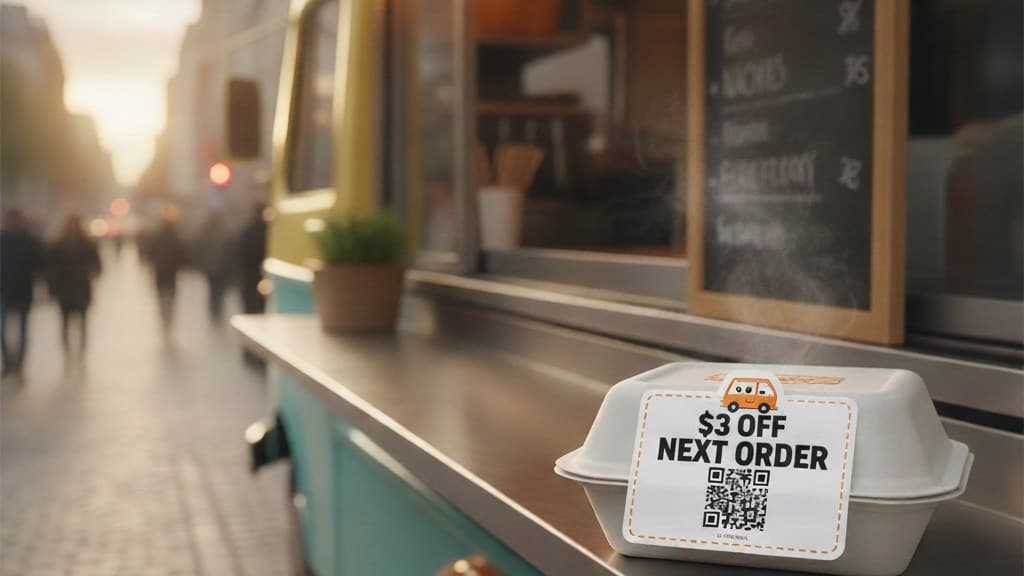
- ✓Use stickers applied during prep so the rush handoff costs zero seconds
- ✓Run a different code at events so you can see festival conversion separately
Avoid This
- ✕Don't set a 3-day expiry (the customer may have no reachable stop inside it)
- ✕Don't hide the schedule behind the discount (the schedule is why they scan)
- ✕Don't burn codes on the guy who has ordered the same torta every week since March
- ✕Don't try to hand a card and say a sentence during peak rush (it will not happen)
- ✕Don't publish the code publicly (a targeted recovery tool becomes a blanket price cut)
Where the QR lives on a truck with four square feet of surface
A salon has a mirror. A detailer has a rearview. A truck has a serving window, a menu board, and roughly four square feet of usable customer-facing surface, all of it outdoors, some of it greasy, all of it moving to a different location tonight. The placement problem is genuinely harder here, and it has one saving grace: your customer is holding a container that you controlled thirty seconds ago.
A sticker on the clamshell lid or the bag
This is the highest-value placement on a truck and it is not close. Apply the stickers during prep, before service, so the handoff at the window costs zero extra seconds during a rush. The customer discovers it when they open the food, which is the single best emotional moment you get all day. A card handed at the window competes with a wallet, a phone, and a drink. A sticker on the lid competes with nothing.
On the condiment and napkin caddy
Everyone reaches for napkins, nobody reaches for a flyer. A small laminated QR card zip-tied to the caddy catches customers in a moment of low-stakes idleness, standing there with food in one hand. Laminate it. This surface gets hot sauce on it weekly and a paper card lasts about two services.
Waist-high on the A-frame at the back of the line
People at the back of a food truck line are the most bored, most phone-in-hand humans in your operation, and they will be standing there for eight minutes. Put the QR on the sidewalk sign facing the queue, not facing the street. Traffic-facing signage is for people driving past too fast to scan. Queue-facing signage is for people with nothing else to do.
On the window ledge where the food lands
There is a two-second window between you setting the container down and the customer picking it up, and their eyes are already pointed at that exact square foot of stainless steel. A small vinyl decal there gets seen by every single customer without anyone having to say anything. It works on the days your window person is buried and forgets the script entirely.
On the side panel next to the menu, at eye level
The menu board is where customers look while deciding, which makes the adjacent panel the one piece of truck exterior that reliably gets read. Frame this one around the schedule rather than the discount: 'Scan for tomorrow's spot.' People who are still choosing an order are not receptive to a coupon, but they are extremely receptive to finding out you exist beyond today.
The unifying principle is that a truck cannot rely on a spoken handoff, because the spoken handoff evaporates the moment a rush starts, which is exactly when your highest-volume first-timers are in line. Every placement above works while your window person is too busy to say anything. Build the program so it survives your best day, not your slowest one.
Turn one visit into many
Hand out single-use QR coupons that pull customers back through your door. Part of your Customer Comeback System. 14-day free trial, cancel anytime.
Create a couponThe lunch-rush math (with real numbers)
Take a truck that serves roughly 1,400 orders a month across a mix of weekday stops and weekend events. You are not going to hand 1,400 coupons, and you should not want to. Most of those orders are regulars or repeat traffic where the coupon changes nothing.
Instead you hand 100 codes over the month, targeted at first-timers and anyone who asks about the schedule. Because that group is selected rather than blanket, and because the scan delivers information they actively want, redemption runs higher than a typical counter handoff. A conservative read is 25 percent.
Five to one on the month, before counting anything downstream. And the downstream is where this actually pays, because a recovered visit priced as a single $15 transaction badly undersells what you bought. A first-timer who successfully finds you a second time has learned your route. That is a durable piece of knowledge. They now belong to the $180-a-year population instead of the $45-a-year population, and you never have to buy that transition again.
The number to watch is not the redemption rate. It is where the redemptions happen. If 20 of your 25 redemptions land at one stop, that stop is your real business and the rest of your route is costing you fuel. Trucks routinely keep unprofitable stops for years out of habit, and a tagged coupon campaign is the cheapest route audit you will ever run. Tag the codes by stop and read the map after two months.
The window-side script (seven words, handed over with the food)
On most service businesses the script is the whole program. On a truck it is a bonus, because during a rush there is no script, only speed. Use it during the slow two-thirds of your service, where it converts far better than any card handed in silence.
Bad version (sounds like a flyer): "There's a coupon on there for next time if you want it."
Good version (answers the question they actually have): "Scan it. That's where we'll be tomorrow."
Seven words. It works because it does not sound like marketing at all, it sounds like directions, and directions are the thing your customer genuinely needs from you. The discount never gets mentioned. They find it on the page after they have already scanned, at which point it reads as a bonus rather than a pitch, and a bonus discovered is worth several times a discount announced.
Say it while the food is changing hands, not after they have turned away. Everyone working your window says the same seven words the same way. If you run events with hired help who have never worked your truck before, write the line on masking tape and stick it to the inside of the window frame where only staff can see it.
Setting up your first campaign in 6 minutes
Sign in to ReviewQR (14-day free trial)
Create an account with any email at reviewqr.app. The 14-day free trial (card on file, cancel anytime) is enough to run the Tomorrow's-Spot Tease across two or three services and see whether the location-reveal mechanic actually pulls people back. After that, Essentials is $10/month for 100 single-use coupons.
Put your schedule on the coupon description, above the offer
Your next three stops with dates, written plainly. This is the part that makes the whole mechanic work on a truck and it is the part every operator skips. Update it once a week, on the same day you plan your route. If your schedule is already public somewhere, copy it across rather than maintaining two versions.
Set the offer and match the expiry to your loop
$3 off any order, one redemption, expiry equal to one full rotation of your route plus a few days. Weekly rotation gets 10 days. Two-week loop gets 14. Single-use is enforced automatically, so a screenshot forwarded to a coworker shows 'already redeemed' rather than a second free discount.
Print 20 stickers, not 20 cards
Cheap round vinyl labels, QR plus the words 'tomorrow's spot inside.' Stickers survive grease and go on during prep, which means they cost nothing at the window. Cards require a free hand you will not have. If you only have paper, staple it to the bag before service starts.
Brief the window on one line and one rule
The line is 'Scan it. That's where we'll be tomorrow.' The rule is first-timers and schedule-askers only. Run both out loud before service so nobody improvises a softer version or starts handing them to the regulars.
Run one play for two weeks before adding anything
The Tomorrow's-Spot Tease alone, on weekday stops only. You need one clean baseline number before the festival bounce-back or the group-order bridge can tell you anything useful.
If you run events on top of a weekday route, or you want to see which stop your redemptions actually come from, the Essentials plan at $10/month gives 100 codes monthly and lets you tag campaigns. On a truck that tag is worth more than it is anywhere else, because it doubles as a profitability read on every location you park at.
Common food truck coupon mistakes
Mistake 1: Leading with the discount instead of the schedule. Nobody pulls out a phone in a parking lot to save three dollars. They will absolutely pull out a phone to find out where dinner is on Thursday. Put the stops above the offer on the landing page and on the sticker copy. The discount is the payload, not the hook.
Mistake 2: A short expiry on a truck that moves. Urgency works when the customer can act on it. A three-day coupon issued to someone whose neighborhood you visit every other Friday is not urgent, it is impossible, and impossible offers teach customers to ignore your cards. One full route loop plus slack, always.
Mistake 3: Handing cards instead of applying stickers. The moment your program requires a free hand and a spare sentence, it stops running during rushes. Rushes are where your first-timers are. A program that only works when you are slow is measuring the wrong customers.
Mistake 4: Giving codes to your regulars. Every other niche in this series tells you to hand coupons to everyone, because most businesses cannot tell who is drifting. You can. The man who has ordered the same torta every Tuesday since March does not need three dollars off, and on a limited monthly code allowance, every code you spend on him is one you did not spend on someone whose second visit was genuinely in doubt.
Mistake 5: Skipping events because "those people live too far away." They mostly do. That is not a reason to hand out nothing, it is a reason to hand out a code you can measure separately. A festival crowd is the biggest pile of strangers you will ever meet, and the small fraction who work near a weekday stop are exactly the customers you have no other way of reaching.
Mistake 6: Never reading the map. The redemption rate is the boring number. The distribution across stops is the interesting one. If one location generates most of your returns, you have learned something worth more than the entire coupon program, and you learned it for the price of a few discounted tacos.
Related reading
This piece covers the coupon mechanic for mobile food operators specifically. If you also run a fixed location, QR code coupons for restaurants and how to get repeat customers for a restaurant cover the second-visit gap when the customer always knows where you are. For fast-ticket counter service with a similar impulse profile, see QR code coupons for ice cream shops and QR code coupons for boba shops. For broader mechanics across categories, the coupon ideas listicle groups plays by goal, and the QR coupons for small business overview explains the single-use mechanic. For a side-by-side of tools, see best QR coupon app for small business.
Frequently asked questions
Why do food truck customers rave about the food and then never come back?
Because they cannot find you. Every other food business gets found again by accident: the customer drives past, sees the sign, and remembers. A truck has no sign that stays put. The customer who loved your birria on a Thursday has no idea you are three neighborhoods over on Friday, parked at a brewery on Saturday, and off on Sunday. They are not choosing a competitor. They are failing a logistics problem you handed them. Every retention tool built for restaurants assumes a fixed address, which is exactly the assumption a truck breaks.
What expiry works for a truck that parks somewhere different every day?
Match it to one full loop of your route, then add a few days of slack. Most trucks run a repeating weekly or biweekly rotation, so a ten-day expiry means the customer gets at least one realistic chance to reach you at a stop that is convenient for them, plus a buffer for the week they were traveling or busy. A three-day coupon is cruel on a truck, because the customer might genuinely have no reachable stop inside it. A ninety-day coupon is worthless, because by then they have forgotten you exist. Ten days is the honest middle for a weekly rotation, fourteen if you run a two-week loop.
Should I hand coupons to festival crowds who live nowhere near my weekday stops?
Yes, and this is the play most trucks skip. Festival and event traffic is the largest pile of strangers you will ever serve, and almost none of them convert to weekday customers, because the event ends and you both go home. A coupon handed at a festival is the only thread connecting that crowd to your regular route. Accept that most of them are geographically hopeless. You are fishing for the ten percent who happen to work near one of your weekday stops and never knew you existed until that Saturday. On a low-cost single-use code, ten percent of a festival crowd is an excellent return.
Won't a coupon just discount people who were going to come back anyway?
On a truck, less than you would think, and you can steer around it. Most niches have to hand coupons to everybody because they cannot tell a regular from a drifter at the counter. A truck can. Your regulars announce themselves: they know your name, they order the same thing, they show up in the first ten minutes of service. The person asking where you will be next week is by definition not yet a regular. Hand the coupon to first-timers and to anyone who asks about your schedule, and skip the guy who has ordered the same torta every Tuesday since March. You are not being stingy. You are spending a limited number of codes on the people whose next visit is genuinely in doubt.
My hands are full during a rush. When do I actually hand this out?
You do not hand it. You attach it. During a real lunch rush nobody has a free hand for a card and a sentence, which is why coupon programs die on trucks. Put the QR on a sticker that goes on the clamshell lid or the bag, applied in advance during prep, so the handoff costs zero seconds at the window. The customer finds it when they open the food, which is the single best emotional moment you get. Save the spoken version for the slow hours, when you actually have ten seconds to say the line.
How many coupons should a food truck start with?
Twenty, handed only to first-timers over two or three services, which is enough to see whether the location-reveal mechanic pulls people back at all. Every ReviewQR plan starts with a 14-day free trial, so the test is free. Once you have a redemption rate, the Essentials plan at $10 per month gives 100 codes monthly. A hundred is not enough to cover every order on a busy truck, and it is not supposed to be. It is enough to cover every first-timer and every schedule question you get in a month, which is the only group where the coupon changes the outcome.
Ready to Implement This Strategy?
Create your custom QR code in 2 minutes and start collecting Google reviews today.
Create Your QR Code NowMore Google Review Guides
QR Code Coupons for Boba Shops: Win the Second Sip Before the Chain App Does
How indie bubble tea shops use single-use QR coupons to beat chain rewards apps at the first-visit-to-second-visit cliff. Concept, math, three plays, placement geometry, and a 6-minute setup.
Restaurants & FoodHow to Get Repeat Restaurant Customers with QR Coupons
Bringing a diner back costs a fraction of finding a new one. Here's how restaurants use single-use QR coupons to drive repeat visits and grow sales.
Restaurants & FoodQR Code Coupons for Restaurants: Fill Slow Shifts and Bring Diners Back
How restaurants use single-use QR code coupons to fill Tuesday lunches, launch new menus, win back lapsed regulars, and protect peak-hour margin.