Groupon Alternatives for Small Business: Bring Customers Back, Not Deal Hunters
Deal sites bring a crowd that comes once and moves on to the next deal. The Groupon alternatives that bring the same customer back a second time, what each costs, and the one that works without a POS.
A café owner with two locations and more than ten years in hospitality told us something in October that we have heard in other words since. Deal apps do bring people in. They are the wrong people. They come for the one-plus-one, they go round every place on the app with an offer, and they do not come back. In his words: as the owner, he is the one who loses.
That is the problem with Groupon for a small local business, and it is not the commission. It is who the deal attracts.
The short answer
If you want customers who come back, the alternative to Groupon is not another deal site. It is a coupon you give your own customers, for their next visit. The discount goes to someone who already chose you at full price, and it gives them a reason to choose you again.
| If this is you | Use | What it costs |
|---|---|---|
| Local shop, café, salon or restaurant, no POS integration wanted | ReviewQR, single-use QR coupons | 12¢ per coupon, paid once (from $3 for 25), or $10/month for 100 |
| Already on Square or Toast | Your POS's built-in loyalty or marketing add-on | Check your plan; usually a monthly fee |
| New business that needs to be seen fast | A deal site, run as a paid ad with a fixed number of vouchers | A share of each voucher, agreed per deal |
| Free and simple | A Google Business Profile offer post, or a paper punch card | Free, but no per-customer limit and no count |
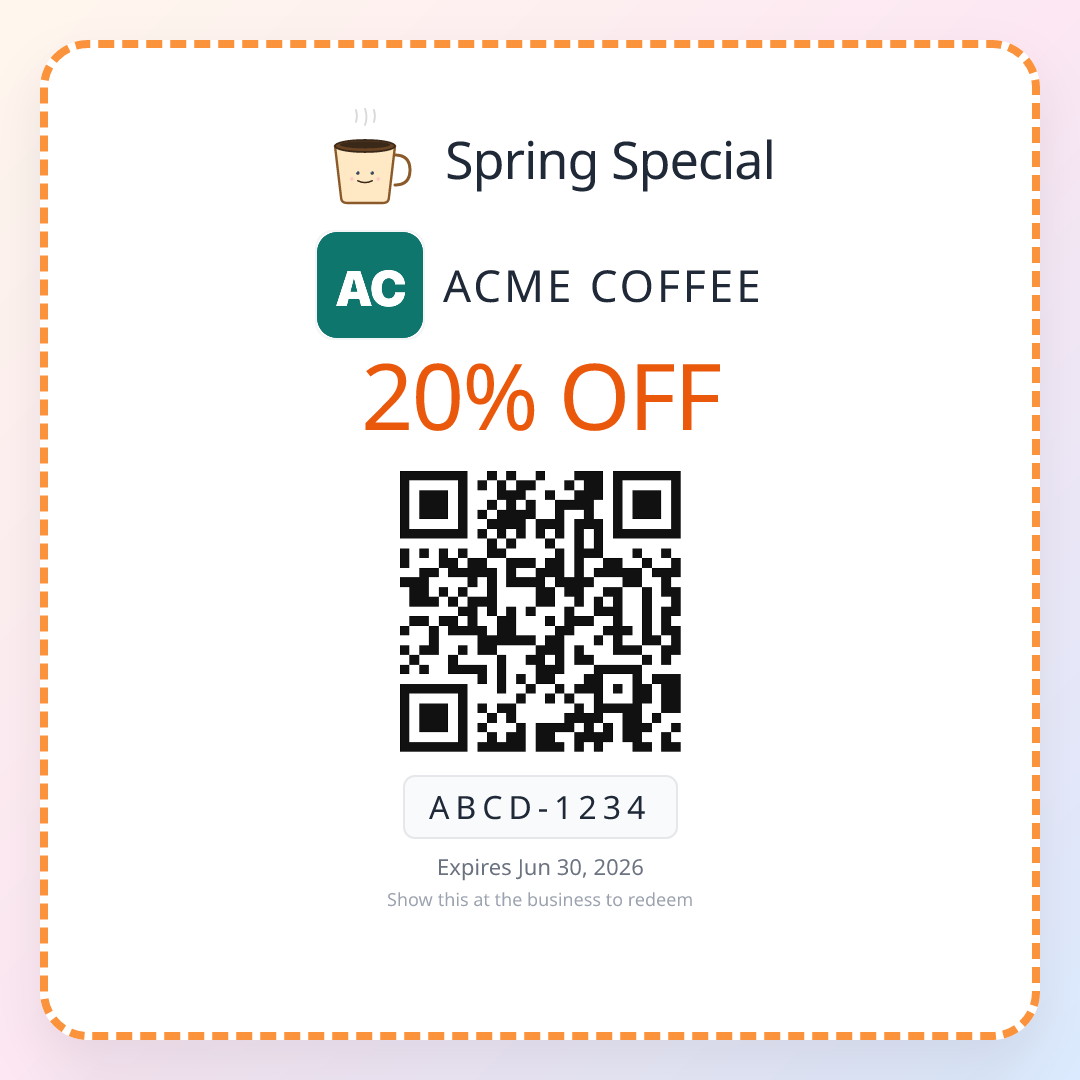
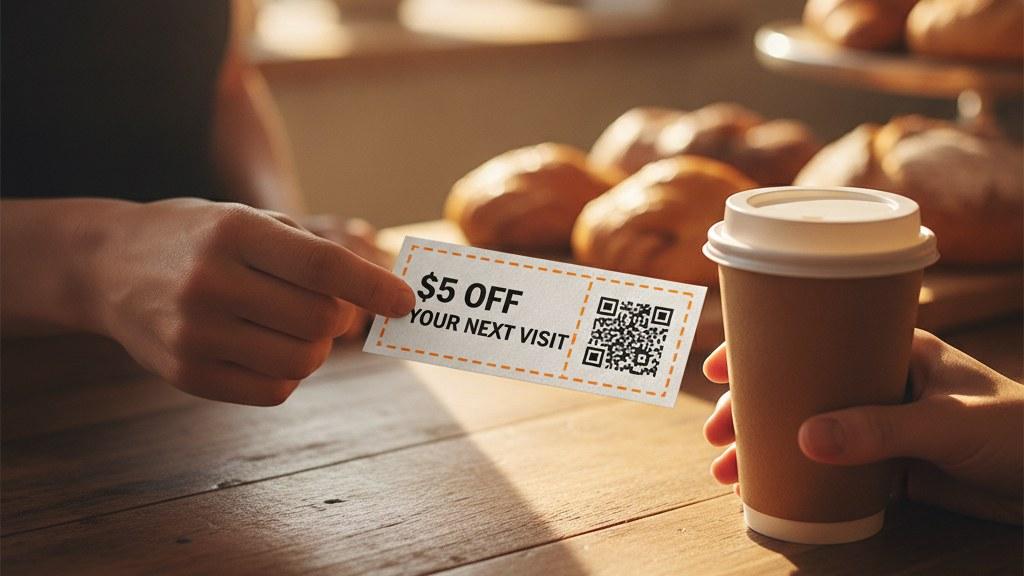
We make ReviewQR, so weigh the first row with that in mind. Each customer gets their own QR coupon, on paper or as a link. Staff scan it with a phone at the counter. It works once, it stops after its expiry date, and it does not appear on any app next to the café down the road.
The Deal-Hunter Loop
Here is what a deal site does, step by step:
- It puts your offer on a list, next to every other offer in your area.
- The people who read that list are choosing by price. That is why they are there.
- They buy your voucher, visit once, and go back to the list.
- Next week, the list has a new offer. Yours is old.
We call this the Deal-Hunter Loop: the deal brings in a customer whose next visit is also decided by a deal, and you are rarely the next one. The café owner put it more bluntly: the platforms grow on the back of the businesses. A café with thousands of followers brings the app its audience, pays in product, and the app keeps the customer relationship.
A coupon you hand out yourself breaks the loop at step 1. It is not on a list. Nobody sees it except the customer you gave it to, who has already paid you full price once.
What Groupon really costs a small business
Groupon says there is no fixed commission: the rate is agreed per deal, nothing is paid upfront, and the cut is taken when a voucher is redeemed. Published estimates for merchant deals run from about 20% to 50% of the voucher price. The cut comes on top of the discount, and deal-site discounts are deep, often 40% to 60% off.
An example with round numbers, a $40 service:
| Deal site | Your own coupon | |
|---|---|---|
| Who gets the offer | Anyone browsing deals | A customer who just paid $40 |
| What the customer pays this visit | $20 voucher | $40, full price |
| What you receive this visit | About $10 to $16, after a 20% to 50% cut | $40 |
| Offer on the next visit | None, unless they buy another deal | $8 off, valid for 4 weeks |
| Cost of 100 offers | About $2,400 to $3,000 of service given away, before anyone returns | $12 for 100 coupons, plus $8 for each one actually used |
The deal site pays you for a first visit at a fraction of the price. The coupon pays nothing for the first visit, because the customer already paid, and costs you $8 only when someone comes back. If 30 of 100 return, the second visits cost you $240 in discounts and $12 in coupons, and you took $32 each for 30 visits you would otherwise not have had.
Three Groupon alternatives that bring customers back
1. The second-visit coupon. Every first-time customer leaves with a coupon for their next visit: a fixed amount off, valid for three to four weeks. The first visit is the hardest one to get. The second is where a customer starts to become a regular, and a short window gives it a date. See how to turn a first visit into a second one.
2. The bounce-back. Hand coupons out on your busiest days, valid only in your quietest weeks. A restaurant hands them out in December for January; a car wash on a sunny Saturday for the following midweek. The busy day fills the quiet one. The whole method is in the bounce-back offer guide.
3. The win-back. Customers who have not been in for two or three months get one generous coupon, sent as a link by email or message. One code each, so a forwarded email does not turn into fifty discounts.
All three use the same tool: single-use coupons, one code per customer, stopped after one scan. That is what lets you be generous. A free coffee on a code anyone can copy is a liability. A free coffee on a code that works once, for one person, is a gift with a known price.
When a deal site still makes sense
Groupon and similar sites are not useless. They are a paid ad that charges per customer. They fit when:
- You are new and nobody knows you exist. A deal site puts you in front of thousands of local people in a week.
- An extra customer costs you almost nothing. Empty escape-room slots, spare spots in a fitness class, an idle salon chair on a Tuesday.
- You have a plan for the second visit. Hand every voucher customer a single-use coupon for a next visit at a fair discount. The deal buys the first visit, your own coupon works on the second.
If none of those is true, you are paying a share of every voucher to reach people who are choosing by price.
Set up your own offer in 6 minutes
- 1
Pick the visit you want
Second visit, a quiet week, or customers you have not seen in a while. One goal per offer.
- 2
Write a fixed-amount offer
For example $8 off your next visit. About 15 to 20 percent of your average ticket, easy to read at a glance.
- 3
Set the window
Three to four weeks. Short enough to have a deadline, long enough to fit a normal week.
- 4
Print or send
Print the coupons for the counter or the bag, or send them as links. Each customer gets their own code.
- 5
Scan at the counter
Staff scan the QR with a phone. Valid, already redeemed or expired, on screen in a second.
- 6
Read the count
Coupons handed out against coupons redeemed, per offer. That is how many customers came back.
Related reading
- Best QR coupon app for small business: five tools compared on price and single-use redemption.
- Single-use coupons: why one code per customer beats a code everyone shares.
- Bounce back coupon: fill your quiet weeks from your busy ones.
- Small business coupons: 23 ideas: offers grouped by goal.
Frequently asked questions
What is the best Groupon alternative for a small local business?
If the goal is customers who come back, the best alternative is not another deal site. It is a coupon you give to your own customers for their next visit, so the discount goes to people who already chose you at full price. ReviewQR does this with single-use QR coupons: each customer gets their own code, staff scan it with a phone, it works once, and it needs no POS. Coupons cost 12 cents each, paid once, or $10 a month for 100. If you already run Square or Toast, their built-in loyalty tools are the other good option.
How much does Groupon take from a merchant?
Groupon says there is no fixed commission: the rate is agreed per deal before launch, nothing is paid upfront, and the commission is taken when a customer redeems the voucher. Published estimates for merchant deals run from about 20 percent to 50 percent of the voucher price. That cut comes on top of the discount itself, which on a deal site is often 40 to 60 percent off, so the business can receive a quarter to a half of its normal price per voucher.
Do Groupon customers come back?
Some do, but the offer selects for people who shop by discount. They found you through a list of deals, so the next deal on that list competes for their next visit. Many owners report that most voucher customers never return at full price. A coupon handed to a customer who already paid full price works the other way: it rewards someone who chose you, and nudges a second visit.
Is Groupon worth it for a new business?
It can be, when you need to be seen fast and an extra customer costs you very little, for example empty slots in an escape room, a class or a salon chair. Run it as a paid ad with a fixed number of vouchers and a plan to turn those visitors into regulars, for example a single-use coupon for a second visit handed to every voucher customer.
Can I run my own deal without a deal site?
Yes. Write the offer, choose who gets it and how long it lasts, and give each customer their own code. With single-use QR coupons you can print them or send them as links, staff scan them at the counter, and each code stops after one use, so a photo of it in a group chat cannot be reused. You keep the whole price, minus the discount you chose.
Do I need a POS integration to track coupons?
No. A single-use QR coupon is checked by scanning it with any phone: the page shows whether it is valid, already redeemed or expired. ReviewQR keeps the count of coupons handed out and redeemed per offer, so you can see how many customers came back without connecting a till.
Keep reading
Podium Pricing 2026: What It Costs per Month, and a $10 Alternative
Podium starts at $399 a month on an annual contract, before the add-ons. What you get for it, what a small business ends up paying, and a $10/month alternative for Google reviews with no contract.
comparisonBirdeye Alternative: ReviewQR at $10/mo vs $299/mo
Birdeye costs $299/mo with 12-month contracts. ReviewQR is $10/mo with no contracts. See why 180+ small businesses chose the simpler way to collect reviews.
comparisonBest QR Coupon App: 5 In-Store Coupon Tools Ranked (2026)
Which QR coupon app should a small shop use? 5 tools ranked by price and in-store redemption tracking: ReviewQR, Coupon Carrier, Voucherify, TapMango, OwnQR.