Bounce-Back Offer: What It Is, When It Starts, and Five That Work
A bounce-back offer is a coupon handed out on a busy day that can only be spent on a quiet one. How the delayed start works, what one costs against what it brings back, three bounce-back plays (including a win-back campaign for lapsed customers) and the offer to run in five kinds of business.
Bounce-Back Offer: What It Is, When It Starts, and Five That Work
The Saturday before Christmas, a neighbourhood restaurant turns tables until eleven. Every booking is taken. Walk-ins wait at the bar with a drink and a buzzer. The kitchen runs out of the lamb by nine. It is the best night of the year and nobody on the floor has time to notice it.
Three weeks later, on a Tuesday in January, the same room has four tables seated at eight o'clock. Two servers are folding napkins. The owner is doing the arithmetic on whether to close early, and the answer is yes.
The people who packed the room in December did not stop liking the place. They spent too much in December, they promised themselves a quiet January, and nobody gave them a reason to make an exception. A bounce-back offer is that reason, handed to them on the busy night and timed for the empty one.
The Busy-to-Quiet Bridge
A bounce-back offer is a coupon a customer receives with today's purchase that is only good on a later visit, inside a set window. Every business has a "next time" discount of some kind. What makes a bounce-back different is the start date. It cannot be spent today, tomorrow or this week. It begins after a gap, and the gap is chosen so the coupon lands where your trade goes quiet.
That is the Busy-to-Quiet Bridge: the busy day hands out the coupons, the quiet day collects them. You are not discounting December, when people would have come anyway. You are using December's crowd to fill January.
Three things make a bounce-back offer work:
- A delayed start. The coupon opens on a date after the rush, not on the next visit. Without it you are giving a discount to people who were already coming back next week.
- A short window. Three to four weeks from the start date. Long enough to fit a normal life, short enough that waiting has a cost.
- A fixed amount. Eight dollars off, not twenty percent off. Easy to understand at a glance, and it does not grow with the size of the order.
Every trade has its own rush and its own lull, which decides where the bridge goes:
| Business | Hand out during | Valid during | Why that gap |
|---|---|---|---|
| Restaurant | Mid to late December | First full week of January to end of January | Holiday crowd, then the January spending freeze |
| Car wash | The first sunny weekend after rain | Tuesday to Thursday for the next three weeks | Weekend queue, empty weekday bays |
| Garden centre, florist | Mother's Day, spring rush | July and August | Spring peak, summer heat lull |
| Ice cream, dessert shop | Hot weekends in July | September and October | Summer queue, autumn drop |
| Salon, nail studio | Prom and wedding season, December | The four weeks after | Booked-out weeks, then gaps in the diary |
What a bounce-back costs against what it brings back
The math of a bounce-back offer is unusual because of when you pay. Take a restaurant with a $54 average check for a table of two. These are planning numbers, so swap in your own.
The cost of a coupon that is not used: the card it was printed on. A few cents.
The cost of a coupon that is used: $8 off a $54 check, on a Tuesday in January. The room was open, the heating was on, the servers were on the rota. The fixed costs of that night were going to be paid whether the table was full or empty. The only new cost of the visit is the food on the plate and the $8.
What the visit brings in: $54 now. And if that table enjoys a quiet January dinner more than a loud December one (many do, it is a different restaurant without the crowd), some of them come back on their own in spring. A couple who returns four times a year is worth about $216 a year, from a single $8 card.
Compare that with what it costs to win a new couple in January: an ad, a listing, a promotion on a delivery app that takes a large cut of every order. The bounce-back customer is already yours. They sat in your room four weeks ago. You are only reminding them.
The asymmetry
An unused bounce-back coupon costs a few cents. A used one costs $8, on a night when the table would have been empty, and brings in a $54 check. That is roughly 6.75 to 1 on the visit alone, before counting a single return visit in spring. The discount is paid only by customers who show up, and only on the days you chose.
Three bounce-back plays
A bounce-back offer can do three jobs. Start with the first one, run it through one full window, and add the others after you have seen your own numbers.
Play 1: The Bounce-Back Card
Job: Move this week's crowd into next month's lull.
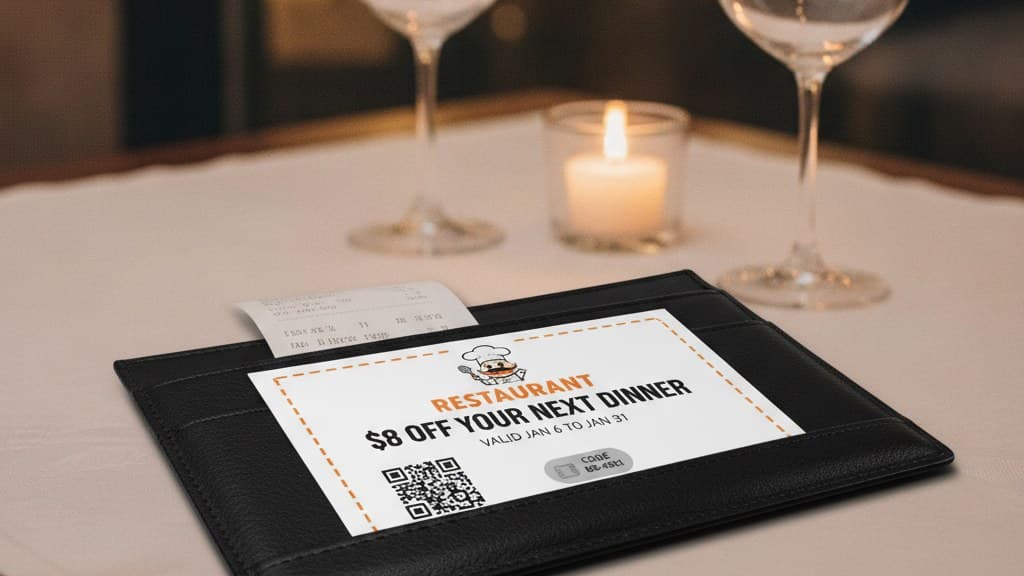
Every customer on your busiest days leaves with a card: a fixed amount off a visit inside the window, with both dates printed on it in plain words. "Valid 6 to 31 January." Not "valid for 30 days", which every customer counts from a different day.
Make it single-use. Each card carries its own QR code. When staff scan it and mark it redeemed, a second scan of the same code shows "already redeemed". Busy nights are when cards get photographed and passed around a table, and a single-use code makes that worthless, so you can hand them out without counting.
Offer shape: Fixed amount off, roughly 15 percent of your average ticket, starting 7 to 21 days after hand-out and valid 3 to 4 weeks, one redemption per code. Best handed to: Everyone on the busy days. This is the one play where regulars get it too, because you are shifting the visit, not buying it. Why it works: It turns a vague "we should come back" into a dated plan, and it dates the plan for the week you need it.
Play 2: The Bring-a-Friend Bounce
Job: Turn one returning customer into two seats.
Same card, one change: the amount only applies when the customer brings someone who has not been in before. "$10 off your table of two or more, 6 to 31 January." The customer is not asked to give anyone's name or number. They just have to arrive with company.
This suits anything sold by the table, the bay or the chair: restaurants, bars, bowling, escape rooms, nail studios with two stations free on a Wednesday. It doubles the reach of each card without doubling the discount.
Offer shape: Slightly larger fixed amount than Play 1, tied to a party of two or more, same window. Best handed to: Customers who came alone or as a pair on the busy day. Why it works: A dinner in a quiet month needs a reason and a person to go with. The card supplies both.
Play 3: The Win-Back Campaign
Job: Catch the customers whose bounce never came.
Some customers will not come back inside the window. Others have not been in for months for reasons that have nothing to do with the season. If you have their phone number or email and they agreed to hear from you (salons, groomers, garages and anyone who takes bookings usually do), you can run a small win-back campaign.
For a small business, "campaign" means one message with one coupon. Send it to customers who have gone past about twice their normal gap between visits. Make the offer larger than Play 1, give it a two-week deadline, say what it is and when it ends, and stop. No "we miss you" paragraph, no three-part sequence.
Win-back coupons redeem at lower rates than cards handed over in person. That is expected: the customer has drifted, and a message is easier to ignore than a card in the hand. Each redemption is a customer you had already lost, which is why it is worth running anyway.
Offer shape: About double the Play 1 amount, valid 14 days from sending, one redemption, sent to the phone. Best sent to: Lapsed customers who gave you their details for this kind of contact. Why it works: It arrives while the customer still remembers you and before someone else has become their usual.
Do This
- ✓Print both dates on the card: the first day it works and the last
- ✓Use a fixed amount, never a percentage
- ✓Start the window where your own quiet weeks start
- ✓Hand the cards out on the busiest days, to everyone
- ✓Count cards handed out against cards scanned when the window closes
Avoid This
- ✕Don't let the coupon work the next day (that is a discount, not a bounce-back)
- ✕Don't make the window longer than about five weeks
- ✕Don't send a win-back message to people who never agreed to hear from you
- ✕Don't follow a win-back message with reminders
- ✕Don't tie any discount to leaving a review
Where the bounce-back card changes hands
A bounce-back card has a longer trip than most coupons. It has to survive two to six weeks in a pocket, a wallet or a kitchen drawer, and still be found on the right day. Where it is handed over decides whether it makes that trip.
- 1
With the bill folder
For restaurants and bars. Put the card inside the folder on top of the receipt, face up, after the card machine has finished. A card left on the table during the meal gets used as a coaster. A card in the folder gets read while the guest is waiting to sign.
- 2
Taped to the box or bag
For takeaway, bakeries and retail on a busy weekend. Stick the card to the outside of the box with a small piece of tape, or lay it on top inside the bag. On a rush day staff do not have time to say anything, so the card must be visible the moment the bag is opened at home.
- 3
On the windscreen or the dashboard
For car washes and detailers. Hand it through the window with the keys, or tuck it under the wiper as the car leaves the bay. Cars are full of things people keep for weeks, and the card is seen every time the driver gets in.
- 4
Stapled to the gift card sleeve
For anyone selling gift cards in December. The buyer gets a bounce-back card for themselves, starting in January, stapled to the sleeve of the gift card they bought for someone else. The gift goes to a friend. The bounce-back stays with the person who already knows your shop.
- 5
To the phone, the same evening
For booked appointments. Send the coupon in the confirmation thread a few hours after the visit, with both dates in the message. It sits in the thread where the next reminder will also arrive, so it gets seen again without you sending it twice.
One December weekend, bounced into January
The same restaurant: $54 average check for a table of two, a packed weekend before Christmas, $8 off, valid 6 to 31 January. Staff put a card in every bill folder across three nights: 300 cards. These are planning numbers. Bounce-backs redeem a little lower than a plain next-visit coupon because of the gap before they start, so this uses 22 percent.
The month's cost is $528 of discount plus $25 for the Growth plan, which covers up to 500 coupons. Against it sit 66 tables on nights that averaged four. Spread over the 25 nights of the window, that is two or three extra tables a night: not a full room, but the difference between closing early and keeping a second server on.
Take off food cost at about 30 percent of the check and the 66 tables leave about $2,500 before the discount, around $1,970 after it. And the restaurant now knows something it did not: 22 percent of its December guests would come back for $8. Next December it can test $6, or start the window a week later, and see whether the number moves.
Not every one of those 66 tables is new money. Some guests would have come in January anyway and you gave them $8. The honest claim is narrower: the card moved their visit into a window you chose and gave you a count of who came. If redemption climbs well above 35 percent, the offer is probably bigger than it needs to be.
What to say when you hand it over
On a busy night nobody has time for a speech, and a long one sounds like a sales pitch anyway.
Bad version (long, and it hides the date): "We've got this little promotion thing going, it's like a voucher, I think it's for after the holidays, you just scan the code, there's some money off."
Good version (eight words, while the folder goes down): "This one starts in January. Bring the table."
This one starts in January explains the delayed start out loud, so the guest does not try to use it tonight and is not disappointed. Bring the table says who it is for: the people sitting there, together, on a quieter night.
The sentence asks for nothing. No email, no sign-up, no "would you like". It is handed over like the receipt, and it is taken like the receipt.
Change "January" to fit your window. Every person on the floor says the sentence out loud once before the first busy shift, so nobody improvises it at ten o'clock with three tables waiting.
Set up your first bounce-back offer in 6 minutes
- 1
Start the 14-day free trial
Create a ReviewQR account with your email (card required, cancel any time). After the trial, Essentials is $10/month for 100 single-use QR coupons and Growth is $25/month for 500. Every plan includes a Google review QR code. A busy weekend with more than 100 customers needs Growth.
- 2
Pick the bridge
Write down your next busy stretch and the quiet weeks after it. Hand-out days are the busy ones. The window starts where the quiet begins and runs three to four weeks. Use the table above if you are unsure.
- 3
Set the amount and the dates
A fixed amount, about 15 percent of your average ticket. Put the end of the window in as the expiry date, and write the start date into the offer line on the coupon itself, for example '$8 off, valid 6 to 31 January'. Staff check the start date when they scan.
- 4
Print the batch
Download the print-ready PDF and take it to the print shop you already use, or print on card stock yourself. Print enough for the busy days you picked and a few extra, not a year's supply. You will want to change something after the first window.
- 5
Teach the eight words
'This one starts in January. Bring the table.' Swap in your month. Every person who handles bills, bags or keys says it once out loud before the first busy shift.
- 6
Scan in the window, then count
When the coupon comes back, staff scan it with any phone and mark it redeemed. A copied or reused code shows 'already redeemed'. When the window closes, divide scans by cards handed out. That is your bounce-back rate, and next season's starting point.
Common bounce-back mistakes
Mistake 1: No start date. A coupon that works tomorrow is a discount on a visit that was going to happen anyway. The delayed start is the whole point: it is what sends the customer into the weeks you need filled.
Mistake 2: A window as long as a season. "Valid January to March" feels generous and gets forgotten. Three to four weeks keeps the date in the customer's head. If you want to fill all of Q1, run two short windows with two batches.
Mistake 3: Counting the days from the hand-out. "Valid for 30 days" means a different deadline for every customer and a muddle at the counter. Print calendar dates. Everyone gets the same start and the same end.
Mistake 4: Handing it out on the quiet days instead of the busy ones. The quiet day is when you want it spent, not when you want it given. A card handed out on a slow Tuesday reaches a handful of people. The same stack on a packed Saturday reaches hundreds.
Mistake 5: Running a win-back campaign before the bounce-back. Messages to lapsed customers redeem lower and need bigger discounts and contact details you may not have. A card in the bill folder on the busy night is cheaper than any message two months later. Treat the win-back as the safety net.
Mistake 6: Asking for a review in exchange. It is tempting to put "leave us a review and get $8 off" on the card. Offering a discount for a review breaks Google's rules and can get reviews removed. Give the bounce-back to every customer, and ask for the review separately. How to get more Google reviews covers when to ask.
Related reading
New to single-use QR coupons? QR coupons for small business explains the mechanic from the start, and single-use coupons covers why each code working once matters on busy nights. For more offers to put on the card, see the coupon ideas list and small business promotion ideas. If you are comparing tools, best QR coupon app for small business lays out the options. A bounce-back fills a quiet month. Turning those January guests into regulars is the subject of how to get repeat customers, and restaurant owners will want the restaurant version.
Frequently asked questions
What is a bounce-back offer?
A bounce-back offer is a coupon a customer receives with today's purchase that is only good on a later visit, inside a set window. The part that separates it from an ordinary "next time" discount is the start date: a true bounce-back cannot be used today or tomorrow. It begins after a gap, usually when your trade goes quiet, and ends a few weeks later. Restaurants hand them out in December for use in January, garden centres in May for use in July, car washes on a sunny Saturday for use midweek. The busy day pays for the quiet one.
What is a bounce-back coupon?
A bounce-back coupon is the physical or digital object that carries a bounce-back offer: a card, a sticker in the bag, or a code sent to a phone, with the amount, the first day it works and the last day it works. It is usually a fixed amount off rather than a percentage. A single-use QR coupon is the safest format because each code can be redeemed once and then shows as already used, so the coupon can be handed out freely without being copied, shared in a group chat or reused by the same person.
How long should a bounce-back offer last?
Two numbers decide it. The start date goes where your quiet period begins, often seven to twenty one days after the busy day the coupon was handed out on. The end date goes three to four weeks after the start. Shorter than three weeks and many customers will not get round to it. Longer than about five and the offer stops feeling like a deadline and drifts into the drawer. For a restaurant handing cards out in the second half of December, a window from the first full week of January to the end of the month is the classic shape.
What is a win-back campaign?
A win-back campaign is an offer sent to customers who have stopped coming, to bring them in once more before they are gone for good. For a small business it does not need to be a campaign in the email-software sense. It is one message with one coupon, sent to customers who have gone past roughly twice their normal gap between visits and who gave you their number or email for this kind of contact. The offer should be larger than your everyday one and should expire in about two weeks. Expect fewer redemptions than a coupon handed over in person: these customers have already drifted.
Is a bounce-back offer worth it for a small business?
Usually yes, because of where the cost falls. A bounce-back coupon that is never used costs the paper it was printed on. One that is used costs the discount, on a day when your tables, chairs or bays would otherwise have sat empty and your staff were being paid either way. On planning numbers for a restaurant, 300 cards at eight dollars off produce roughly 66 January visits at about fifty four dollars a check: about $3,560 of quiet-month sales for about $528 of discount. Your own numbers will differ, so run a small batch first and count the scans.
How much does it cost to run bounce-back coupons with QR codes?
Three costs. The software: ReviewQR Essentials is ten dollars a month for one hundred single-use QR coupons and Growth is twenty five dollars a month for five hundred. Every plan includes a Google review QR code and starts with a fourteen day free trial, card required. The printing: business card stock from any print shop, or nothing if you send the coupons to phones. The discount: a fixed amount you only pay when the customer is back and buying.
Keep reading
Punch Card for Business: Why It Fails and What Replaces It
A punch card back-loads the whole reward onto a visit most customers never reach. The math on why paper and app punch cards fail, and the single-use QR coupon that replaces them, with three plays, placement geometry, and a counter script.
guidesGoogle Review Cards: What They Are, How to Make One, and What to Print
What a Google review card is, what one costs (printed QR vs NFC tap card), how to make your own in minutes, what to write on it, and how many reviews 300 cards produce.
guides23 Coupon Ideas for Small Business: Win Customers, Boost Sales, Build Loyalty
23 proven coupon ideas for small business — grouped by goal: attract new customers, raise the average sale, and turn first-timers into regulars. Plus how to keep them margin-safe.