20 Small Business Promotion Ideas, Grouped by the Problem They Solve
20 small business promotion ideas for a slow day, a first visit, a second visit and a bigger ticket. Each one comes with the offer, who gets it, how you count it, and the math on whether it paid.
It is a Tuesday at 2:40 in the afternoon. Marco has two customers in a shop that seats thirty, a full display case he will mark down at closing, and a phone open on a list called "promotion ideas" he found the night before. Number one says "run a flash sale". Number two says "host an event". Number seven says "create a loyalty program". None of them say what to do about Tuesday.
On Saturday the same shop had a queue out the door. Marco did not need a single promotion that day. He needed Saturday's people to come back on a Tuesday.
That is the gap in most promotion lists. They are lists of activities. An owner needs the opposite: a list of problems, and for each problem the one offer that fixes it, who gets it, and how you will know it worked. This guide is that list. Twenty promotions, grouped by the four problems a small business actually has: a slow day, too few first visits, first visits that never become second ones, and a ticket that is too small.
The Busy-Anyway Test
Before any promotion goes out, ask one question about the person who will use it: would they have come anyway?
If yes, the promotion is a price cut. You paid a regular for doing what they were already going to do. If no, the promotion bought a visit that would not have existed. Only the second kind pays. We call this the Busy-Anyway Test, and every idea below is built to pass it.
Three habits make a promotion pass the test:
- Hand it to the right person. New faces, Saturday customers who never come midweek, the neighbour's customers. Not the regular who comes every morning.
- Make it redeemable where you need the visit. Handed out on the busy day, valid on the quiet one. Handed out today, valid for a second visit within a few weeks.
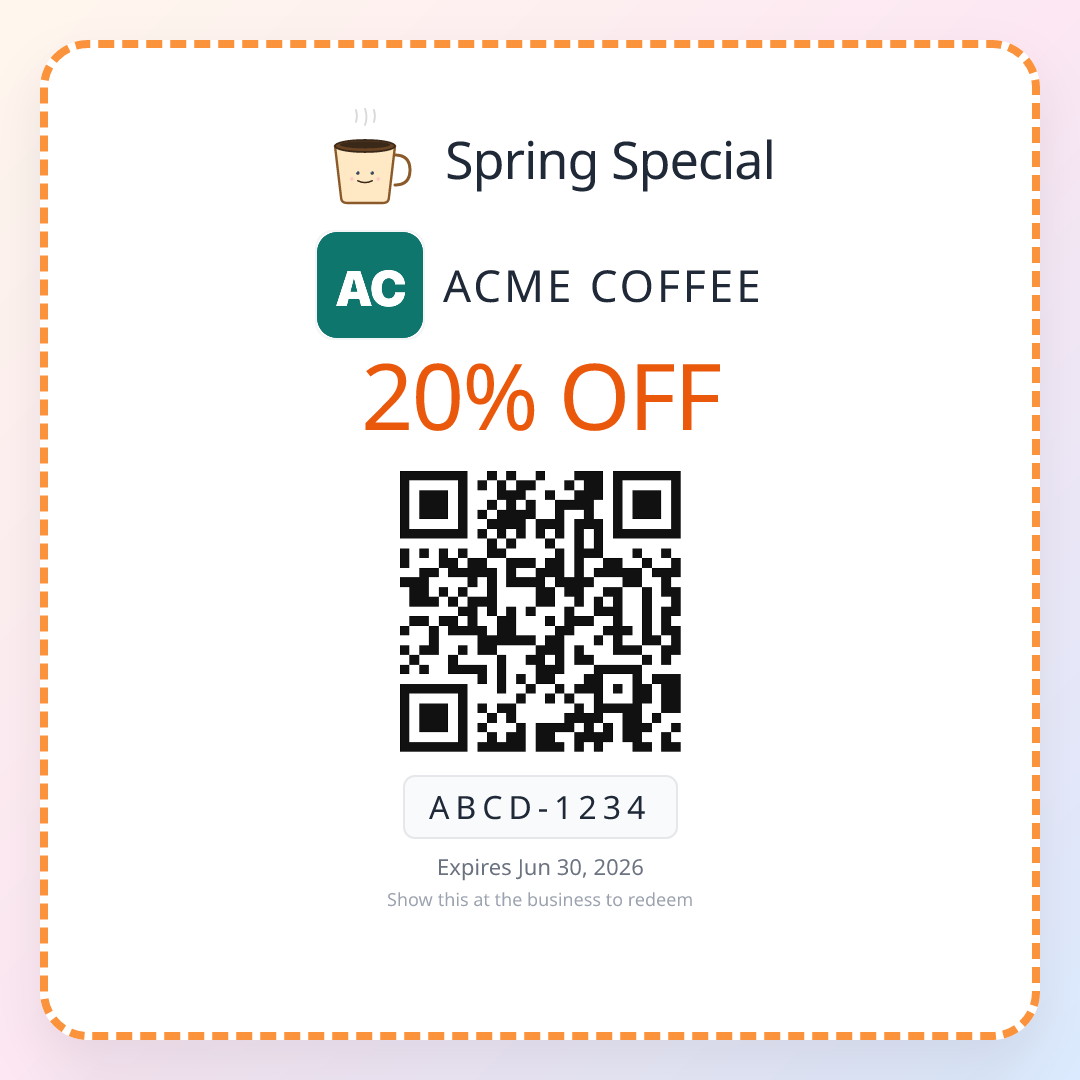
- Give every customer their own code that works once. A shared code like SAVE10 travels to people you never chose. A single-use coupon can only be used by the person holding it, so the total discount can never exceed what you planned, and you can count exactly how many came back.
What a promotion has to earn
Take a counter business with an $18 average ticket and an empty Tuesday. The usual fix is a sign: 20% off everything, Tuesdays only.
Say Tuesday already brings in $900. The sign gives $180 back to the people who were coming anyway, every Tuesday, before a single new customer walks in. Over a year that is $9,360 of discount spent on the Busy-Anyway crowd. If the sign brings in 15 extra customers a week, it may pay for itself. If it brings in 5, it is a loss you will not see, because the till only shows that Tuesday got a bit busier.
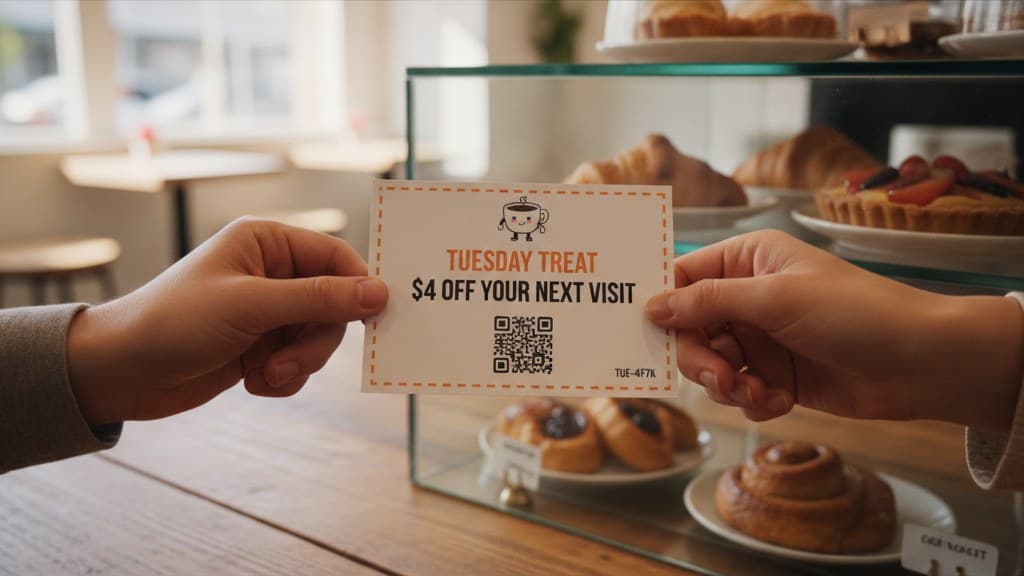
Now the other way. On Saturday, staff hand 200 cards to customers they do not see during the week: $4 off, Tuesday or Wednesday, next three weeks. Every card has its own code that works once.
On planning numbers, a card handed over in person comes back somewhere between 15 and 30 percent of the time. Call it 20 percent: 40 midweek visits, $160 of discount, and $10 for a month of Essentials. Every dollar went to someone who was not going to be in on a Tuesday.
What is one of those 40 worth? A customer who picks up a midweek habit, one $18 visit a month, is worth $216 a year. If 1 in 5 of the 40 does, that is 8 people and $1,728 a year.
The asymmetry
The Tuesday sign spends an uncapped amount (about $180 a week) on everyone who walks in, regulars first, and tells you nothing about who it brought. The Saturday card spends at most $4 × 200 = $800, and on these planning numbers really about $170 (discount plus plan) for 40 counted visits and roughly $1,728 a year from the 8 who stay. That is about 10 to 1. Halve the return rate and halve the share who stay, and it is still about 5 to 1. The sign's ratio is a guess.
The point is not that discounts are bad. It is that a discount aimed at a person, capped in number and tied to a missing visit is a completely different tool from a discount aimed at a day.
Three rules for the offer itself
Whatever the problem, the offer on the card follows the same three rules.
- Make it worth remembering. Five percent off is a rounding error, and nobody crosses town for a rounding error. A free drink, $5 off, a free add-on: something the customer can say out loud a week later.
- Make it cheap enough to give to everyone you aim it at. If handing out 200 worries you, pick a smaller offer, not fewer cards. A promotion that sits in a drawer is free and useless.
- Make it need a visit. Nothing they can use online, nothing that can be stacked onto today's order. The whole point is a second trip through the door.
Fixed amounts usually beat percentages for a first run. "$5 off" is clear in one read and caps your cost on large orders. If you want to know which works better for your customers, run both, one month each, and count.
Promotion ideas for a slow day
The problem: one or two days a week are half empty while others are full. The fix is almost never a discount on the slow day itself. It is moving people from the full day to the empty one.
| # | Promotion | What it looks like | Who gets it | How you count it |
|---|---|---|---|---|
| 1 | The Saturday-to-Tuesday card | $4 off, valid Tuesday and Wednesday only, next 3 weeks | Busy-day customers staff do not see midweek | Codes redeemed on Tue/Wed ÷ cards handed out |
| 2 | The quiet-hour card | Free add-on (pastry, topping, upgrade) between 2pm and 4pm | Lunch-rush customers | Redemptions stamped inside the window |
| 3 | Bring-a-friend midweek | Two cards, one to keep and one to give, both valid Mon to Wed | Customers who came with a friend at the weekend | Pairs where both codes come back |
| 4 | The rain-day text | A phone voucher sent the morning bad weather is forecast, valid 48 hours | Customers who opted in to texts | Vouchers redeemed in the 48 hours |
| 5 | The neighbour swap | A business with the opposite rush (gym, school, office) hands out your midweek cards | Their customers, on your quiet day | Codes from that batch, counted separately |
Idea 1 is the one to start with. It costs nothing on the busy day (the card is free until it is used), it aims at exactly the visit you are missing, and it uses customers who already know they like you. Restaurants can run the same play with weeknight cards for Friday and Saturday tables; salons and barbers with a "Tuesday or Wednesday appointment" card handed out at the Saturday chair.
Promotion ideas to win a first visit
The problem: not enough new people walk in. Paid ads are expensive for a counter business, and a shared "first visit" code ends up on a deals site within a week. These five reach new people through someone they already trust, with a code that works once.
| # | Promotion | What it looks like | Who gets it | How you count it |
|---|---|---|---|---|
| 6 | The new-neighbour card | $5 off a first order, valid 30 days, one per household | New residents nearby (new buildings, moving season) | Codes redeemed from that batch |
| 7 | The partner welcome pack | A free item for a first visit, in a hotel, realtor or landlord welcome pack | Guests and new tenants | Redemptions per partner |
| 8 | The raffle and goody-bag voucher | A $10 voucher donated to a school raffle, a charity night, an event bag | Event guests | Vouchers used, and when |
| 9 | The sample-at-the-door card | A free taste today, plus a card for $3 off a full item this week | People walking past | Cards redeemed within the week |
| 10 | The open-day come-back card | Everyone at your launch, anniversary or open day leaves with a card for a second visit | Event visitors | Codes back within 30 days |
Notice that ideas 6 to 10 do two jobs at once. The event or the partner brings the first visit, and the card in the hand is what turns it into a second. A free sample with nothing to take home is a nice afternoon. A free sample with a dated card is a promotion you can measure.
For seasonal first visits (Small Business Saturday, holiday shopping), the Black Friday plan for small business walks through the same card, built in October and redeemed in November.
Promotion ideas to bring customers back
The problem: the first visit happens and the second one does not. For most counter businesses this is where the money is, because a returning customer costs a fraction of a new one to bring in.
| # | Promotion | What it looks like | Who gets it | How you count it |
|---|---|---|---|---|
| 11 | The bounce-back card | A fixed amount off the next visit, valid about 1.5 times your normal gap (10 days for coffee, 6 weeks for a haircut) | Every customer staff do not recognise | Codes back before the expiry |
| 12 | The overdue nudge | A phone voucher sent when a regular's usual gap has passed | Customers who booked or ordered before and agreed to hear from you | Vouchers redeemed within 14 days |
| 13 | The birthday month voucher | A free item, valid the whole birthday month | Customers who gave a birthday month | Vouchers used per month |
| 14 | The third-visit card | Handed out on a second visit, for a third within a month | Customers on their second visit | Third visits recorded |
| 15 | The pass-it-on pair | Two codes, one for them and one to give a friend, 30 days | Customers who just said something nice | Friend codes redeemed |
Idea 11 is the backbone of this group and the single most reliable promotion on the list. The timing per trade is in how to get repeat customers. Idea 14 replaces a punch card without the card: a small nudge at the visit where most customers drop off. If you have been weighing a points app instead, small business loyalty program explains where each one fits.
Promotion ideas for a bigger ticket
The problem: plenty of people come in, but each one spends a little. Here the promotion is aimed at the size of the next order, not the number of visits.
| # | Promotion | What it looks like | Who gets it | How you count it |
|---|---|---|---|---|
| 16 | The threshold card | $5 off a next order of $30 or more (set the threshold about 1.5 times your average ticket) | Customers whose ticket is below average | Redeemed tickets and their size |
| 17 | The free add-on | A free side, topping or treatment add-on with a next-tier item | Customers who bought the basic item | Next-tier items sold with a code |
| 18 | The bundle card | "Lunch for two" or "cut and beard" at a set price, next visit | Solo customers who came at lunch or for one service | Bundles redeemed |
| 19 | The gift card bonus | Buy a $50 gift card in December, get a $10 voucher for yourself, valid in January | Holiday gift card buyers | January vouchers redeemed |
| 20 | The pre-order card | A card for 10% off a holiday pre-order placed by a set date | Customers who bought the same item last season | Pre-orders with a code |
Idea 19 does something unusual: it moves a December sale into a January visit, the slowest month for many shops. Idea 16 is the safest to start with, because the threshold makes sure the discount can only be used on an order that is already bigger than usual.
Where the offer changes hands
A promotion that needs a visit has to reach a person, not a wall. Five places do that well.
- 1
Across the counter, after the goods
The card goes into the customer's hand a second after the cup, the bag or the receipt, not during payment. Handed over with the product it feels like a gift. Handed over with the card reader it feels like small print.
- 2
On top of the order, inside the bag
For takeaway, bakeries and retail. Face up on top, so it is the first thing seen at home. At the bottom of the bag it goes in the bin with the receipt.
- 3
At a partner's counter
For the neighbour swap and the welcome pack. Give the partner a numbered batch of cards so you can count their customers separately, and offer to hand out theirs in return.
- 4
In the message thread
For the overdue nudge, the birthday voucher and the rain-day text: send the coupon as a link to customers who asked to hear from you. It opens on their phone and staff scan it from the screen.
- 5
In the envelope
Raffle prizes, event bags, gift card bonuses. Each envelope carries its own code, so you know exactly how many were used and none of them can be copied.
The window poster and the Instagram post still have a job: they can announce that a promotion exists ("ask for your Tuesday card"). The code itself goes from one hand to another.
One month, four promotions, every visit counted
Here is the same $18-ticket counter business running one promotion from each group for a month on the Growth plan. Planning numbers, not a promise: your rates will depend on your trade and on how well staff hand the cards over.
- Saturday-to-Tuesday card: 150 cards, $4 off, 25 percent redeemed = 38 midweek visits, $152 discount.
- Partner welcome pack: 100 cards through two neighbouring businesses, $5 off, 12 percent redeemed = 12 first visits, $60.
- Bounce-back card: 80 cards to new faces, $3 off, 30 percent redeemed = 24 second visits, $72.
- Threshold card: 50 cards, $5 off $30, 20 percent redeemed = 10 orders at about $34 instead of $18, $50.
The month cost $334 in discounts plus $25 for the plan. The bigger result is what the owner now knows: the Tuesday card returns 25 percent, partners bring roughly one new customer for every eight cards, and the bounce-back card is the strongest of the four. Next month, the weakest promotion gets changed or dropped and the strongest gets more cards.
Not every one of those 84 visits was created by a coupon. Some bounce-back customers would have come back anyway, and you paid them for it. The honest claim is narrower: every discount went to someone you chose, the total could never pass what you planned, and you can compare promotions against each other instead of guessing. If one promotion comes back above 40 percent, you are probably handing it to people who needed no reason. Make the offer a dollar smaller.
The sentence that goes with the card
A promotion card is only as good as the sentence said when it is handed over. Left alone, staff apologise for it or read it out like terms and conditions.
Bad version (long, unsure, sounds like a chore): "Oh, we've got this promotion thing going on, there's a QR code, I think it's for some weekdays, you can scan it or whatever, the date's on the back."
Good version (eight words, said as the card goes across): "Bring this back Tuesday. Five dollars, on us."
Bring this back is an instruction, and a simple one. Tuesday names the day you need, out loud, so it is heard even if the card is never read. Five dollars, on us makes it a gift rather than a deal. Swap the day and the amount for your own promotion; keep the shape. There is no question in it, nothing to decline, no email to give.
Set up your first promotion in 6 minutes
- 1
Pick one problem
Slow day, first visit, second visit or ticket size. One. Pick the one that costs you the most this month, and the matching promotion from the lists above.
- 2
Start the 14-day free trial
Create a ReviewQR account with your email (card required, cancel any time). After the trial, Essentials is $10/month for 100 single-use QR coupons and Growth is $25/month for 500. Every plan includes a Google review QR code.
- 3
Write the offer in one line
'$4 off, Tuesday or Wednesday.' Fixed amount, plain words, one condition at most. The offer is free text, so it can be a dollar amount, a percentage or a free item.
- 4
Set the expiry and the count
Choose the last valid day (three weeks for a slow-day card, about 1.5 times your visit gap for a bounce-back) and how many codes to make. Start with 100. Every code is unique and works once.
- 5
Print or send
Download the print-ready PDF sheet for your printer or print shop, or share single coupons as links by text, WhatsApp or email. Each printed coupon and each link carries its own code.
- 6
Hand over, scan, count
Teach the eight-word sentence. When a customer comes back, staff scan the QR code with any phone signed in to your account and tap redeem. After the expiry, divide codes redeemed by codes handed out. That is the promotion's score.
Common promotion mistakes
Mistake 1: Discounting the day instead of the person. A "20% off Tuesdays" sign pays every regular who already comes on Tuesday. Hand the Tuesday offer to people who come on Saturday instead.
Mistake 2: Running four promotions at once. If the slow-day card, the bounce-back card and a sign in the window all start the same week, you will never know which one worked. One promotion per problem, one full expiry window, then the next.
Mistake 3: An offer too small to remember. Five or ten percent off a small ticket is pennies. Pick something a customer could describe to a friend: a free drink, $5 off, a free add-on. Single-use codes keep the total cost capped, so you can afford it.
Mistake 4: A shared code on a public post. A code everyone can read is a code everyone can use, as many times as they like. Post that the promotion exists; keep the codes for the hand-to-hand moment.
Mistake 5: Leaving the cards in a stack by the till. A pile of cards is just a slower shared code. Regulars take them, nobody hears the sentence. Cards live under the counter and come out one at a time.
Mistake 6: Measuring "it felt busy". Busier is not a number. Codes handed out and codes redeemed, per promotion, every two weeks, is. And never swap a coupon for a Google review: rewarding reviews breaks Google's rules. Ask for reviews separately, and hand out coupons whether people review or not.
Related reading
For the product side, QR coupons for small business shows seven ways to use them. If you want more offers to put on the card, the coupon ideas list groups twenty three of them by goal. For why every code should work once, read single-use coupons. For the timing of a come-back offer in each trade, see how to get repeat customers, and for restaurants specifically, restaurant repeat customers with QR coupons. Salons have their own playbook in QR code coupons for salons and spas. If you are comparing tools, best QR coupon app for small business lays out five of them with prices.
Frequently asked questions
What are the best promotion ideas for a small business?
The best promotion is the one aimed at your actual problem. If one day of the week is empty, hand out a card on your busy day that only works on the quiet one. If too few new people find you, give a neighbouring business single-use welcome cards to hand to their customers. If new customers come once and vanish, give every first-timer a fixed amount off a second visit with a short expiry. If the average ticket is low, use a threshold offer such as $5 off $30. Start with one, run it for a full expiry window, count how many came back, then add the next.
How do I promote my business on a slow day?
Do not discount the slow day itself with a sign, because the customers who already come on that day get the discount too. Instead, hand a card to customers on your busiest day that is only valid on the slow one, for example $4 off, Tuesday and Wednesday only, for the next three weeks. You are moving people who already like you from a full day to an empty one, which costs you far less than a sign in the window. Use single-use codes so you can count how many of those cards came back.
Do promotions hurt a small business's profit margins?
A promotion hurts margin when it pays people for doing what they were going to do anyway. A 20% off sign on a Tuesday discounts every regular who walks in on Tuesday, every week. A promotion protects margin when it is aimed at a specific person, capped in number and tied to a visit that would not otherwise happen. Use fixed amounts instead of percentages so big orders do not cost you more, give each customer their own single-use code so the total discount can never exceed what you planned, and set a short expiry.
How do I know if a promotion worked?
Count two numbers: how many offers you handed out and how many came back. If every coupon has its own code that works once, codes redeemed divided by codes handed out is your response rate, per promotion. "The shop felt busier" is not a measurement, because you cannot tell new visits from regulars. Check every two weeks, compare promotions against each other, and keep the one that brings back the most people per dollar of discount.
What are good restaurant promotion ideas?
Restaurants usually have two problems: quiet weeknights and first-time diners who never return. For the first, hand a weeknight card to Friday and Saturday tables (a free dessert or $5 off, Monday to Wednesday only). For the second, give every new table a fixed amount off a second visit within 30 days. A threshold offer like $10 off a $50 bill lifts the ticket, and a "lunch for two" bundle fills the midday gap. Keep every offer single-use, so a photo of it in a group chat cannot be used fifty times.
How much does it cost to run promotions with single-use QR coupons?
Two costs: the software and the discount. ReviewQR Essentials is ten dollars a month for one hundred single-use QR coupons and Growth is twenty five dollars a month for five hundred. Every plan includes a Google review QR code and starts with a fourteen day free trial, card required. The discount you only pay when a customer comes back and a member of staff redeems the code at the counter, so a coupon that is never used costs only its share of the monthly fee.
Keep reading
How to Delete a Google Review (and What to Do When Google Says No)
Business owners cannot delete Google reviews, but they can report the ones that break policy, appeal a rejection, ask the reviewer, or file a legal request. Here is each route step by step, how to delete a review you wrote yourself, and the math for burying one bad review under good ones.
guidesHow to Leave a Google Review (Phone, Computer, and No Google Account)
Step-by-step instructions for leaving a Google review on an iPhone, an Android phone, or a computer, plus what to do without a Google account, how to edit or delete a review, and why a review sometimes does not show up. Written so a business can send this page to its customers.
guidesSmall Business Loyalty Program: No App, No Points, Just a Coupon
Every loyalty program charges the customer an enrollment tax before it can reward anything, and only your regulars ever pay it. The math on what that costs, and the three-play coupon system that replaces it, with placement geometry and a counter script.