Repeat Customers: What Counts, What They Are Worth, How to Get More
A repeat customer is one who comes back before their return clock runs out. How to work out that clock for your trade, what one repeat customer is worth in a year, how to calculate repeat customer rate, and three offers that bring first-timers back.
Repeat Customers: What Counts, What They Are Worth, How to Get More
It is Sunday night and the owner of a small shop is looking at the month on the card terminal's app. Four hundred and twelve transactions. More than last month. It felt busy, the staff were stretched on Saturdays, and the number agrees with the feeling.
Then a simple question arrives and will not leave. How many of those four hundred and twelve were people coming in for the second time?
The terminal cannot say. It knows amounts and times. It does not know faces. The owner can name maybe thirty regulars from memory, the ones who get a nod and whose order is started before they reach the counter. Thirty people cannot have made four hundred and twelve purchases. So most of the month was strangers, and most of those strangers walked out with a bag and a receipt and no particular reason to choose this shop again over the one nearer their office.
Busy months hide this. A business can grow for a year on new faces alone and still be running on a bucket with a hole in it. The fix starts with a definition, because "repeat customers" means very little until you put a clock on it.
The Return Clock: what counts as a repeat customer
The textbook says a repeat customer is anyone who has bought from you at least twice. By that rule, a person who came in twice in 2023 and never since is a repeat customer, and so is the woman who was in last Tuesday. One of them is part of your business. The other is a line in an old export.
A definition you can act on needs time in it. Every trade has a return clock: the normal gap between one visit and the next for a customer who likes you. Nobody gets a haircut every four days and nobody buys coffee every six weeks. The clock is set by the product, not by your marketing.
Once you know your clock, three things follow from it:
- A repeat customer is someone who came back inside roughly twice the clock.
- A lapsed customer is someone who has gone past twice the clock. They are not "due". They have left, quietly, and nobody told you.
- The right expiry for a come-back offer is about one and a half times the clock: long enough to reach on a normal schedule, short enough that waiting has a cost.
Here are planning figures for common trades. Treat them as starting points and adjust to what you see at your own counter.
| Trade | Typical return clock | Offer expiry (1.5x) | Lapsed after (2x) |
|---|---|---|---|
| Coffee shop, bakery | 1 week | 10 days | 2 weeks |
| Lunch spot, takeaway | 2 weeks | 21 days | 4 weeks |
| Nail salon, car wash | 3 weeks | 30 days | 6 weeks |
| Barber shop | 4 weeks | 6 weeks | 8 weeks |
| Hair salon, pet groomer | 7 weeks | 10 weeks | 14 weeks |
| Auto service, oil change | 5 months | 7 months | 10 months |
How to calculate repeat customer rate
Repeat customer rate is one division:
Repeat customer rate = customers who bought more than once in the period ÷ all customers who bought in the period
If 600 different people bought from you last quarter and 150 of them bought two or more times, your rate is 25 percent.
Two things make that number mean something. First, the period has to be at least three return clocks long. Measure a hair salon over one month and almost nobody has had time to come back, so the rate reads close to zero and tells you nothing. Second, you need some way to recognise a returning person. An online shop has an account for that. A counter that takes cash and tapped cards does not, which is why most owners have never seen their own number.
There is a way to get it without collecting a single name, and it is the same object that brings the customer back. It comes up in the plays below.
What one repeat customer is worth in a year
Take a counter business with an $18 average ticket and a two-week return clock. A lunch spot, say. The numbers here are planning figures, so swap in your own ticket and your own clock.
A customer who visits once is worth $18. That is the whole relationship.
A customer who settles into coming once a month, which is only half as often as the clock allows, is worth 12 visits at $18: $216 a year. A full regular on the two-week clock is worth 26 visits: $468 a year.
So the gap between a one-time customer and a light, once-a-month repeat customer is $198 a year. Same person, same order, same seat. The only thing that changed is whether a second visit happened and turned into a habit.
Now the cost side. Say the reason you give them to return is $4 off the next visit, printed as a single-use coupon. Hand out 100. On planning numbers, coupons handed over in person by a member of staff redeem somewhere around a quarter to a third of the time, so call it 28. Your discount bill is 28 times $4, which is $112, and you only paid it on visits that billed $504 between them.
Not all 28 will become regulars. Suppose one in four does and settles into the once-a-month pattern. That is 7 customers at $216 a year: $1,512 of revenue next year that did not exist before, bought with $112 of discount.
The asymmetry that makes this work
A new customer costs you rent, signage, ads and luck before they ever walk in. A second visit from someone who already walked in costs $4, and only if they show up. On these planning numbers, $112 of discount across 100 coupons produces 28 paid return visits now and about $1,512 a year from the 7 who make it a habit: roughly 13 to 1. Halve the redemption rate and halve the share who stay, and it is still better than 3 to 1.
That is why the question from Sunday night matters more than the transaction count. Four hundred and twelve sales is what the month was. The number of people who came back is what next year will be.
Three offers that restart the clock
Getting repeat customers is three separate jobs: getting the second visit, catching the people whose clock ran out, and keeping the ones who did return. Each job has its own offer. Start with the first one and run it alone for one full expiry window before adding another.
Play 1: The Next-Visit Card
Job: Turn a first visit into a second one.
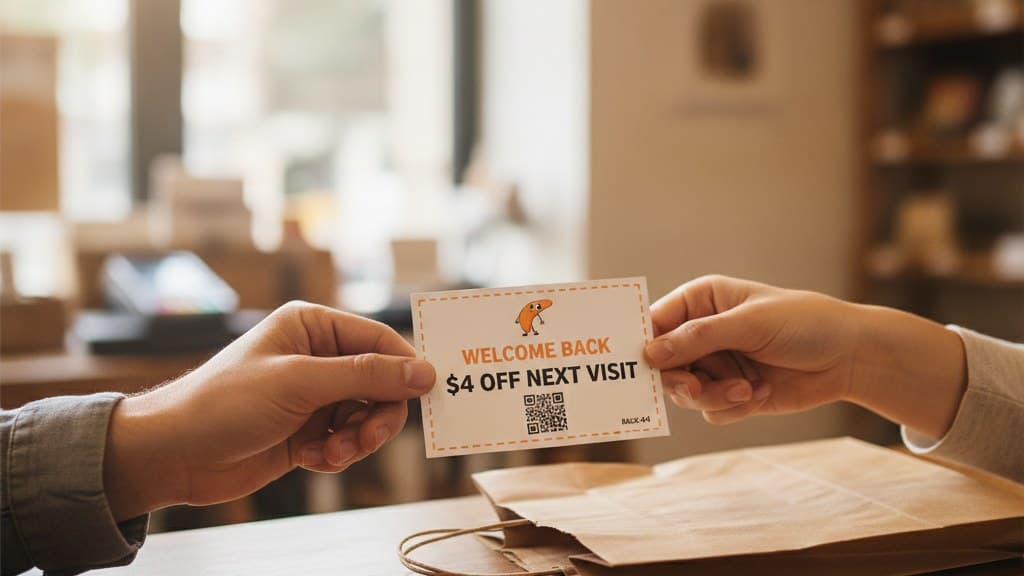
Every customer your staff do not recognise leaves with a small card: a fixed amount off their next visit, with a date on it. Not a percentage, which makes people do arithmetic and makes large orders expensive for you. A fixed amount, set at roughly a fifth of your average ticket, valid for one and a half return clocks.
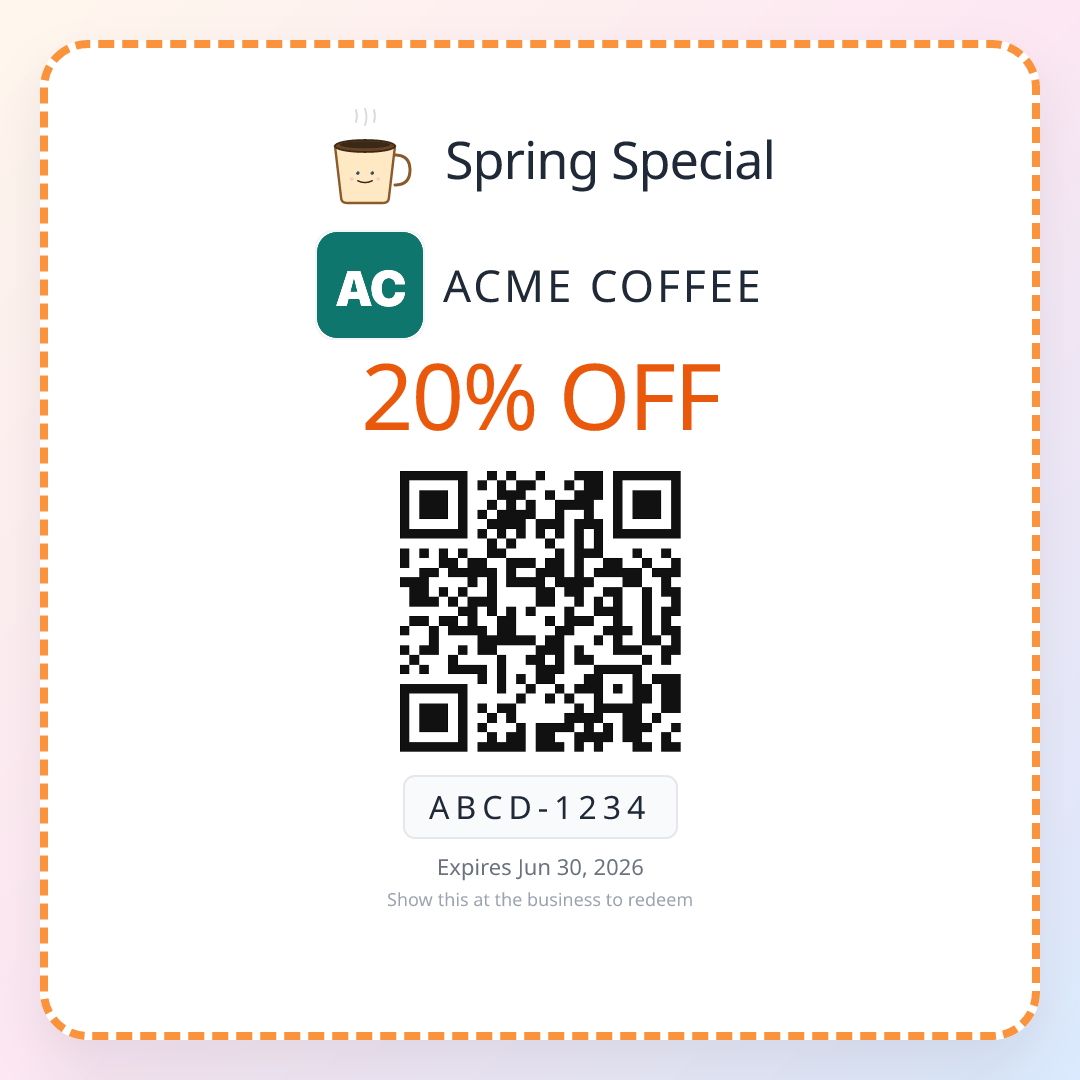
The card is single-use. Each one carries its own QR code, and once your staff scan it and mark it redeemed, a second scan of the same code shows "already redeemed". A photo of it in a group chat is worth nothing, so you can hand them out freely.
This is also how you finally get your repeat customer rate. Cards handed out is first visits. Cards scanned is second visits. Divide one by the other and you have a number no card terminal will ever give you, with no names collected and nothing for the customer to join.
Offer shape: Fixed amount off (about 20 percent of your average ticket), valid 1.5 return clocks, one redemption per code. Best handed to: Faces your staff do not recognise. Regulars are covered by Play 3. Why it works: It puts a deadline on a decision the customer would otherwise leave open, and it puts the deadline inside the window when they would naturally need you again.
Play 2: The Clock-Ran-Out Message
Job: Catch customers who have gone past twice the clock.
Some trades know who their customers are: salons, groomers, garages, anyone who takes bookings or writes a name on a ticket. If you have a phone number and permission to use it, you can see who has gone quiet. A barber client at five weeks is late. At nine weeks they have found another barber, or are about to.
Send that person one coupon, straight to their phone, larger than your everyday offer and with a short deadline of about two weeks. One message. Say what it is and when it ends.
Expect a lower redemption rate than Play 1. These customers have already drifted, and a message is easier to ignore than a card placed in a hand. That is fine. Every redemption here is a customer you had already lost.
Offer shape: About double your Play 1 amount, valid 14 days, one redemption, sent by text or messaging app. Best sent to: Customers past twice the return clock who gave you their number for exactly this kind of contact. Why it works: It arrives at the moment the customer is deciding, without noticing, that they are no longer your customer.
Play 3: The Welcome-Back Reward
Job: Make the second visit lead to a third.
When a customer redeems a Next-Visit Card, they have just done the hardest thing in retail: come back. Most businesses mark the coupon as used and say nothing. Instead, hand them a fresh card on the spot, same amount or slightly better, same window.
This turns a single return into a chain. Each redemption issues the next reason, and after three or four rounds the customer is on your clock out of habit and you can stop. It does the job of a stamp card without asking anyone to carry one for ten visits. (If you are weighing this against stamps, the punch card comparison goes through the difference in detail.)
Offer shape: Same fixed amount as Play 1, handed over at the moment of redemption, valid 1.5 return clocks. Best handed to: Anyone redeeming a previous card. Why it works: The customer is rewarded for returning at the exact moment they return, which is the behaviour you want repeated.
Do This
- ✓Run Play 1 alone for one full expiry window before adding another
- ✓Use a fixed amount off, never a percentage
- ✓Set the expiry from your return clock, not from a round number
- ✓Print the end date on the card in plain words
- ✓Count cards handed out against cards scanned every two weeks
Avoid This
- ✕Don't hand the Next-Visit Card to daily regulars (they were coming anyway)
- ✕Don't send win-back messages to people who never agreed to hear from you
- ✕Don't send a second and third reminder after a win-back message
- ✕Don't make the offer conditional on a minimum spend the first time you run it
- ✕Don't tie any discount to leaving a review
Where the offer meets the customer
A come-back offer has one short journey to survive: from your hand to the customer's pocket, and from there to the day they next need what you sell. Where it starts that journey decides whether it finishes it.
- 1
In the hand, with the goods
The strongest placement in any counter business. The card goes across with the bag, the cup or the keys, a few seconds after the payment is finished. Anything handed over during payment is filed as part of the bill. The same card handed over with the product is filed as a gift.
- 2
Inside the bag or box
For takeaway, retail and anything packed at the counter. Place the card on top of the contents, face up, so it is the first thing seen when the bag is opened at home. A card dropped to the bottom of a bag is found three weeks later with the receipt, usually after the date on it.
- 3
Clipped to the paperwork
For garages, groomers, cleaners and clinics, the customer leaves with an invoice, an aftercare sheet or a claim ticket. Staple the card to it. Paperwork gets kept, stuck on a fridge or left in a glovebox, and the offer travels with it until the next service is due.
- 4
On the phone, same day
For appointment businesses that already text confirmations. Send the coupon that afternoon while the visit is fresh. It lives in the message thread where the next booking reminder will also arrive, so the customer sees it again without you sending anything twice.
- 5
With the delivery
For anything that leaves by courier or driver. The card rides on top of the order, and the unpacking is the handover. There is no member of staff there to say the sentence, so the card has to say it: what it is, how much, and the last day it works.
Notice what is not on the list: a poster on the wall, a sign at the till, a post on social media. Those reach everyone and are addressed to no one. A come-back offer works because one specific person was given one specific object.
Four hundred first-timers, by the numbers
Same business as before: $18 average ticket, two-week return clock, $4 off, valid 21 days. Over a month, staff hand a Next-Visit Card to 400 customers they do not recognise. These are planning numbers, and yours will differ.
The month's cost is $448 of discount plus $25 for the Growth plan, which covers 500 coupons. Against that sit 112 paid visits worth $2,016.
The larger number comes later. If one in four of those 112 settles into a once-a-month habit, that is 28 new light regulars at $216 a year each: about $6,000 of next year's revenue, set up in one month by a stack of cards and a sentence.
And you now hold a figure you did not have on Sunday night. 112 out of 400 is a 28 percent second-visit rate, measured, in three weeks. Next month you can change one thing (the amount, the sentence, the moment of handover) and watch whether it moves.
Do not count all 112 visits as revenue the coupon created. Some of those customers would have come back anyway, and you gave them $4 for it. The honest claim is narrower: the card pulled the second visit into a window you can measure, and made it happen at your counter instead of a competitor's. If your redemption rate climbs above 40 percent, you are probably discounting people who needed no reason, and the offer can shrink by a dollar.
The eight words at the handover
The card does very little by itself. What moves the redemption rate is the sentence that travels with it, and most staff, left alone, will either say nothing or say far too much.
Bad version (long, apologetic, and it sounds like an advert): "Oh, and we're doing this promotion at the moment, if you scan this code you get some money off next time, it's just a thing we're trying."
Good version (eight words, said while the card changes hands): "This is for next time. Good three weeks."
This is for next time tells the customer the card is theirs and that it is about a future visit, which plants the idea that there will be one. Good three weeks is the deadline, said out loud, so it is heard even if the card is never read.
Nothing in the sentence asks for anything. No email, no sign-up, no "would you like". A question can be declined. A gift is simply taken.
Teach the sentence, word for word, to every person who works the counter, and have each of them say it out loud once before a shift. If two people say it and a third skips it, your numbers will look like the offer is weak when the offer was never made.
Set up your first come-back offer in 6 minutes
- 1
Start the 14-day free trial
Create a ReviewQR account with your email (card required, cancel any time). Fourteen days is enough to hand out a first batch and see real redemptions. After the trial, Essentials is $10/month for 100 single-use QR coupons and Growth is $25/month for 500. Every plan includes a Google review QR code.
- 2
Work out your return clock
Ask yourself how often a customer who likes you comes in. Use the table above if you are unsure. Multiply by 1.5 and you have your expiry. A two-week clock gives 21 days, a four-week clock gives six weeks.
- 3
Set a fixed amount
About a fifth of your average ticket: $4 on an $18 ticket, $8 on a $40 service. Enter it as a fixed amount off, one redemption per code, with the expiry from step two.
- 4
Print 100 cards
Download the print-ready PDF and take it to the print shop you already use, or print on card stock yourself. Start with 100. You will want to adjust the amount or the wording after the first window, and a small batch makes that painless.
- 5
Teach the eight words
'This is for next time. Good three weeks.' Change the last part to match your expiry. Every member of staff says it out loud once before their first shift with the cards.
- 6
Scan on return, then count
When a customer comes back, staff scan the code with any phone and mark it redeemed. At the end of the window, divide cards scanned by cards handed out. That is your second-visit rate, and the first real repeat-customer number most small businesses ever see.
Common repeat-customer mistakes
Mistake 1: Counting transactions and calling it loyalty. A rising sales count says more people bought. It does not say anyone came back. A business can lose every first-timer it wins and still post a record month. Measure second visits separately or you will not see the leak until the new faces slow down.
Mistake 2: Rewarding the tenth visit when the leak is at the second. Stamp cards and points save their prize for people who have already proved they are staying. The customer you are losing has visited once. Put the incentive where the loss happens. The loyalty program article covers why sign-up programs mostly enrol the people who needed them least.
Mistake 3: Picking the expiry from a round number. Thirty days is too long for a coffee shop and far too short for a hair salon. An offer that expires before the customer needs you again is worthless to them, and one that lasts three clocks carries no urgency. Set it from the clock.
Mistake 4: Giving the offer to everyone, regulars included. Your daily customer was coming tomorrow regardless. Handing them $4 off costs you $4 and changes nothing. The Next-Visit Card is for faces staff do not know. Regulars get recognition, and the Welcome-Back chain if they came in through it.
Mistake 5: Waiting until customers are gone to act. Win-back messages are the expensive end of this work: lower redemption, bigger discounts, and you need contact details. A card in the hand on day one is cheaper than any message on day sixty. Run Play 1 first and treat Play 2 as the safety net.
Mistake 6: Trading the discount for a review. It is tempting to combine the two asks. Do not. Offering a discount in exchange for a review breaks Google's rules and can get reviews removed. Ask for the review as its own thing, and give the come-back offer to every customer whether they review or not. How to get more Google reviews covers the right moments to ask.
Related reading
If single-use QR coupons are new to you, QR coupons for small business explains the mechanic from the start. For what to put on the card, the coupon ideas list groups twenty three offers by goal. If you are comparing tools, best QR coupon app for small business lays out the options. Restaurant owners will want the trade-specific version of this article, how to get repeat customers for a restaurant. And for the two programs owners usually try first, see small business loyalty program and punch card for business.
Frequently asked questions
What is a repeat customer?
A repeat customer is someone who has bought from you at least twice. That is the textbook definition, and it is too loose to run a business on, because it counts a person who came twice in 2023 the same as one who was in last Tuesday. The working definition is narrower: a repeat customer is someone who came back before their return clock ran out. The return clock is the normal gap between visits in your trade (about a week for a coffee shop, about four weeks for a barber, about six months for an oil change). Someone who returns inside roughly twice that gap is repeating. Someone who has gone past it has lapsed, even if your records still call them a customer.
How do you calculate repeat customer rate?
Pick a period, count the unique customers who bought in it, count how many of those bought more than once, and divide the second number by the first. If 600 different people bought from you last quarter and 150 of them bought two or more times, your repeat customer rate is 25 percent. Two details keep the number honest. The period has to be at least three return clocks long, otherwise customers have not had time to come back and the rate reads low for no reason. And you need a way to recognise a returning person at all, which a cash counter does not have. A single-use coupon handed on the first visit and scanned on the second is the simplest way to count returns without collecting names.
What is a good repeat customer rate?
There is no single good number, because the rate depends on the return clock of the trade and on the period you measured. A coffee shop measured over a quarter will show a far higher rate than a tyre shop measured over the same quarter, and neither is doing better than the other. The useful comparison is your own rate against your own rate from the previous period, measured the same way. If it rises after you start handing out a next-visit offer, the offer is working. Be wary of benchmark figures quoted without a trade and a time window attached, since they tell you very little about a business like yours.
How do you get more repeat customers?
Give first-time customers a small, fixed, dated reason to return, and put it in their hand before they leave. The second visit is where most customers are lost, so that is where the effort goes: a few dollars off the next visit, valid for about one and a half times your return clock, handed over with one sentence. Then catch the ones whose clock has run out with a second offer sent to their phone, and thank the ones who did come back. Service quality decides whether a customer wants to return. The offer decides whether they remember to, and whether they do it with you or with whoever they pass first.
How do you win back customers who stopped coming?
First decide who has actually stopped. A customer is lapsed when they have gone past twice their normal return clock, so a barber client at nine weeks is lapsed and one at five weeks is merely late. Then send that person a single offer, larger than your everyday one, with a short deadline of about two weeks. One message, not a sequence. Say what it is and when it ends, and skip the "we miss you" paragraph. Win-back offers redeem at lower rates than offers handed over in person, which is normal: the customer has already drifted. That is the reason the cheaper play is always the earlier one, a card in the hand on the first visit.
What does it cost to run a repeat-customer offer with QR coupons?
Three costs. The software: ReviewQR Essentials is ten dollars a month for one hundred single-use QR coupons and Growth is twenty five dollars a month for five hundred. Every plan includes a Google review QR code and starts with a fourteen day free trial, card required. The printing: business card stock from the print shop you already use, or nothing at all if you send coupons to phones. The discount: a fixed amount per redeemed coupon, which you only pay when the customer is standing at your counter buying again. An unredeemed coupon costs you the paper it was printed on.
Keep reading
Google Review Tap Card vs QR Code: Cost, Setup, and What Customers Actually Do
An NFC tap card converts better than a QR code at the counter and worse everywhere else. The honest numbers on cost per review, phone compatibility, and which one earns the return visit.
guidesHow to Get a QR Code for Google Reviews (and the Link That Makes It Work)
Getting the QR code takes two minutes. Getting the right Google link takes longer, and it is the part that decides whether scans turn into reviews. Three methods, the four URLs people confuse, and the math on what a broken link costs.
guidesPunch Card for Business: Why It Fails and What Replaces It
A punch card back-loads the whole reward onto a visit most customers never reach. The math on why paper and app punch cards fail, and the single-use QR coupon that replaces them, with three plays, placement geometry, and a counter script.