Single-Use Coupons: Why One Code Per Customer Beats a Code Everyone Shares
A single-use coupon works once and then stops. What that means, how one-time QR coupon codes and QR code vouchers work at the counter, what a shared code really costs, and three ways a small business can use them to bring customers back.
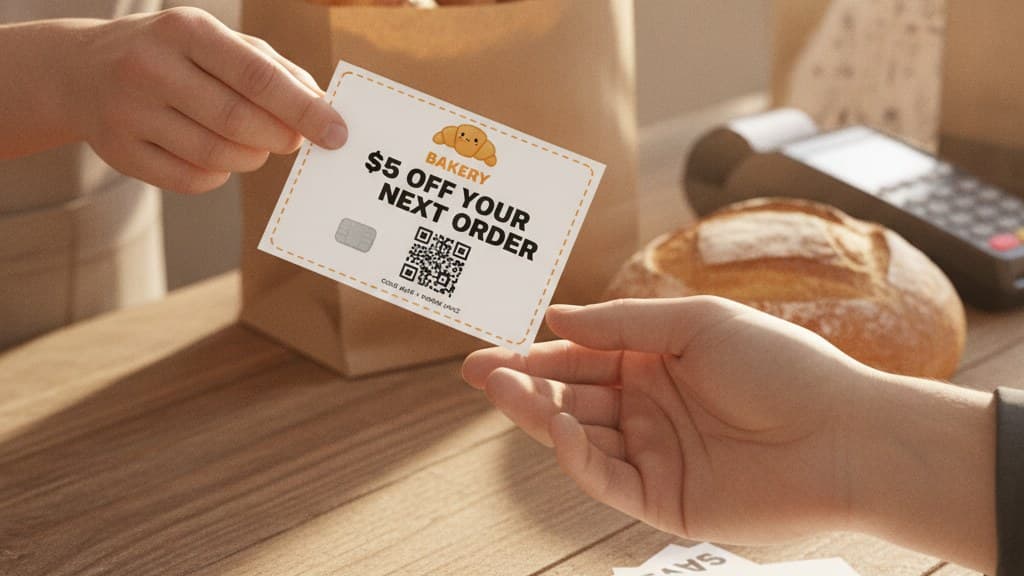
Sofia runs a bakery on a street with two new apartment buildings. In March she printed 200 flyers that said SAVE5: $5 off any order over $15 and her nephew pushed them under doors on a Saturday morning. By the end of the month the till had rung up 340 SAVE5 discounts. From 200 flyers.
She asked around. The code had gone into the building's group chat by Sunday afternoon. Someone posted it on a local deals page. Her own regulars, who heard about it from each other, started saying "SAVE5" at the counter, and her staff, not wanting an argument, gave it to them. The woman who has bought the same sourdough every Friday for four years used it eleven times.
Sofia's question was not "did the flyer work". It was "how many of those 340 were new people, and did any of them come back". She had no way to answer either. The code had been the same for everyone, so it could not tell her who anyone was.
That is the problem a single-use coupon solves. Not discounts, not marketing. Counting.
The Group-Chat Leak: why a shared code can't be counted
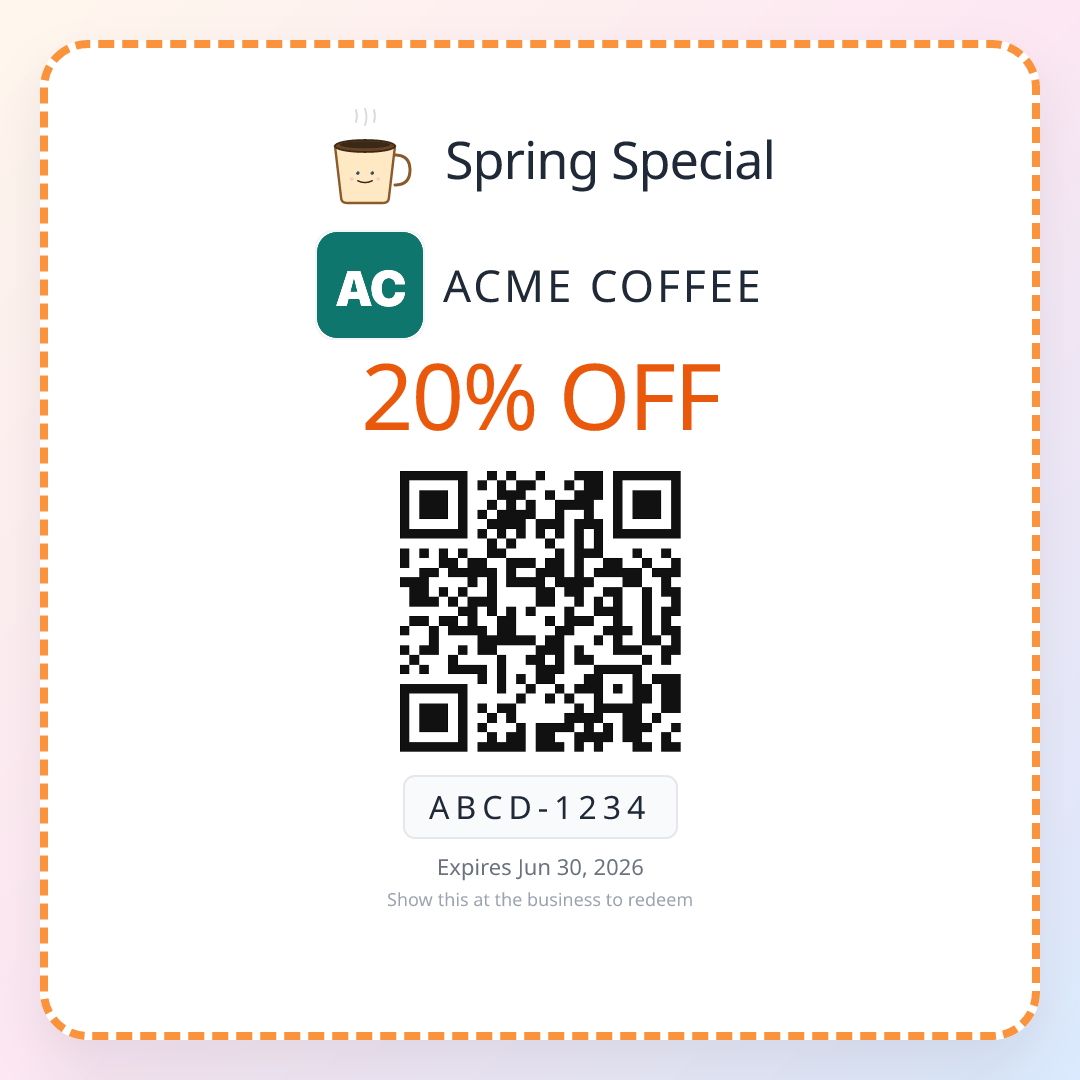
A single-use coupon is a coupon that can be redeemed once. Every customer gets their own code. When staff redeem it, that code stops working, and anyone who tries it again sees "already redeemed".
A shared promo code works the other way. It is one word, printed on everything, and it keeps working for anyone who learns it until you switch it off. That makes it leak. Not because customers are dishonest, but because a code is information, and information travels: into a group chat, onto a deals page, across the counter from one regular to the next. We call this the Group-Chat Leak: the moment a shared code reaches people you never chose, and you lose the ability to say who used it and why.
Here is what changes when every code works once:
| Shared promo code (SAVE5) | Single-use coupon | |
|---|---|---|
| Codes printed | 1, on every flyer | 1 per customer |
| Can a photo of it be used? | Yes, by anyone, any number of times | Once, by whoever gets there first |
| Maximum discounts given | Unknown until the month ends | Exactly the number of codes you made |
| Who ends up using it | Whoever hears about it, regulars included | The person you handed it to (or the friend they gave it to) |
| Response rate | Cannot be measured | Codes redeemed ÷ codes handed out |
| Safe for a generous offer? | No | Yes |
The last row matters more than it looks. Owners keep offers small because they are afraid of the leak. A free coffee on a shared code is a liability. A free coffee on a code that works once, for one person, is a gift with a known price.
Coupon, voucher, one-time code: the same thing
People search for this under several names: single-use coupon, one-time use coupon, unique coupon code, QR code voucher. They describe one mechanism. "Voucher" usually means a fixed value or a gift (a $10 voucher, a free class), "coupon" usually means money off a next purchase, but in both cases the value sits behind a code that works once. When the code is a QR code, staff check it by scanning instead of typing, which is why QR vouchers have become the default for counter businesses: nothing to type, nothing to misread.
What a leaked code costs, and what a single-use one costs
Back to Sofia's bakery, with planning numbers: a $22 average order, $5 off, and the 340 SAVE5 redemptions from her month.
Suppose 150 of those 340 were people who would have bought that week anyway: her regulars, plus neighbours who already knew her. Each of them got $5 for doing what they were going to do. That is $750 of discount that bought nothing. The other 190 may have been new, but she cannot tell which ones, cannot reach them again, and cannot tell whether a single one returned. The full bill was $1,700 in discounts for a result she cannot see.
Now the same 200 flyers, each carrying its own code that works once.
At most 200 discounts can happen. On planning numbers, a coupon pushed under a door redeems somewhere around 15 to 25 percent of the time, so call it 40. That is $200 of discount, every dollar of it spent on a person who received a flyer. And she knows the number is 40, because 40 codes were scanned.
What is one of those 40 worth? A neighbour who becomes a light regular, one $22 order a month, is worth $264 a year. If one in four of the 40 settles into that habit, that is 10 people and $2,640 a year, bought with $200 of discount and $10 for the month's coupons.
The asymmetry
A shared code spends money you cannot cap on people you did not choose, and gives you nothing to count. A single-use code spends at most $5 × the codes you made, only on the people holding one, and tells you exactly how many came. On these planning numbers: $210 in (discount plus the month's plan), 40 measured visits now and about $2,640 a year from the 10 who stay. Roughly 12 to 1. Halve the redemption rate and halve the share who stay, and it is still about 6 to 1. The shared code's ratio is unknowable, which in practice means it is worse.
There is a second, quieter saving. Once a code cannot leak, staff stop having to police it. Nobody has to say "sorry, that offer was only for the flyer" to a regular. The code either scans as valid or it does not, and the screen says so, not the person behind the counter.
Three ways to use single-use coupons
A single-use coupon is a mechanism, not an offer. What you put on it depends on the job. These three cover most counter businesses. Run one at a time for a full expiry window before adding the next, or you will not know which one moved the number.
Play 1: The Handed Card
Job: Turn a first visit into a second one.
Every customer staff do not recognise leaves with a small card carrying a fixed amount off their next visit and a date. The code on it is theirs alone, so it can go to anyone without risk: if they lose it, nothing leaks; if they give it to a friend, you gain a customer.
Offer shape: A fixed amount off, about a fifth of your average ticket. Valid roughly one and a half times your normal gap between visits (about 10 days for a coffee shop, 6 weeks for a barber). Handed to: Unfamiliar faces only. Regulars get recognition, not discounts. Why it works: It is the cheapest moment to keep a customer: they are standing in front of you, and the card costs nothing until they return. How to get repeat customers works out the timing for each trade.
Play 2: The Phone Voucher
Job: Reach someone who is not at the counter.
Each single-use coupon also exists as a link. Send it by text, WhatsApp or email to a customer who asked to hear from you: someone who booked and did not come, a client whose usual visit is overdue, a prize winner, an event guest. The QR code opens on their phone and staff scan it from the screen. A forwarded link is still one code, so it still works once.
Offer shape: A fixed amount or a named item ("one free cookie with any coffee"), valid 14 days, one per person. Sent to: People who gave you their number or email for exactly this. Never a bought list. Why it works: It turns a voucher into something you can send in four seconds and still count, which a paper gift certificate never could.
Play 3: The Pass-It-On Pair
Job: Turn a happy customer into a new one.
Hand a customer two codes instead of one: one for them, one to give away. Both work once. The friend arrives holding a code that came from someone they trust, and when it is scanned you can see that a referral happened, which a shared "tell your friends" code cannot show you.
Offer shape: Same amount on both, so neither feels like the lesser card. Valid 30 days, because passing a card on takes longer than using it. Handed to: Customers who just said something nice: thanked staff, left smiling, asked for your card. Why it works: The referral is concrete. "Give this to someone" is easier to act on than "tell your friends about us", and you can count every one that comes back.
Do This
- ✓Give every customer their own code, never one code for everyone
- ✓Use a fixed amount off, so large orders do not cost you more
- ✓Print the last valid day in plain words on the coupon
- ✓Count codes handed out against codes redeemed every two weeks
- ✓Make a small first batch (100) so you can change the offer after one window
Avoid This
- ✕Don't post a single-use coupon publicly and expect it to work for everyone
- ✕Don't hand coupons to daily regulars who were coming anyway
- ✕Don't send phone vouchers to people who never agreed to hear from you
- ✕Don't stack two offers on one code
- ✕Don't tie any coupon to leaving a review
Where a one-time code should travel
A shared code can go on a wall because it does not matter who reads it. A single-use code is the opposite: it works best when one specific person is given one specific object. Five places do that well.
- 1
Across the counter, with the goods
The card goes into the customer's hand a second after the bag, the cup or the keys, not during payment. Something handed over during payment feels like part of the bill. The same card handed over with the product feels like a gift, and gets kept.
- 2
On top of the order, inside the bag
For takeaway, bakeries and retail. Lay the card face up on top of the contents so it is the first thing seen when the bag is opened at home. At the bottom of the bag it gets thrown away with the receipt.
- 3
Stapled to the paperwork
Garages, groomers, dry cleaners and clinics send people home with an invoice, a ticket or an aftercare sheet. Staple the card to it. Paperwork gets kept in a glovebox or on a fridge, and the code travels with it until the next visit is due.
- 4
In the message thread
For appointment businesses that already text confirmations. Send the coupon link the same afternoon. It sits in the thread where the next reminder will land, so the customer sees it again without a second message.
- 5
In the envelope, for events and gifts
Raffle prizes, event goody bags, a thank-you to a supplier, a voucher for a local school auction. Each envelope gets its own code, so you know exactly how many were used and when, and none of them can be copied onto a hundred more.
What is missing on purpose: the window poster, the Instagram post, the sign by the till. Those are the right places for a shared offer you are happy for anyone to use. They are the wrong place for a code meant for one person.
Three hundred codes, one month
Take a counter business with a $22 average ticket running all three plays for a month on the Growth plan. These are planning numbers; your own rates will differ by trade and by how well the handover goes.
- Handed Card: 200 codes to first-time customers, $5 off, 25 percent redeemed = 50 return visits.
- Phone Voucher: 60 codes texted to overdue customers, $8 off, 15 percent redeemed = 9 visits.
- Pass-It-On Pair: 20 pairs (40 codes), $5 off each, 30 percent redeemed = 12 visits, of which about 5 are friends who had never been in.
The month cost $382 in discounts plus $25 for the plan. Against that sit 71 visits worth $1,562, and if 1 in 4 of those customers settles into a monthly habit, about 18 light regulars worth roughly $4,700 over the next year.
More useful than any of those totals: the business now knows that the Handed Card returns 25 percent, phone vouchers 15 percent, and referrals bring in about one new face for every four pairs. Next month, it can change one thing and see whether the number moves. With SAVE5, it would know only that the till got busier.
Single-use does not make every redemption new revenue. Some of the 71 would have come back anyway, and you paid them for it. The honest claim is narrower: every discount went to someone you chose, the total could never exceed what you planned, and you can measure the response instead of guessing it. If redemption on the Handed Card climbs above 40 percent, you are probably handing it to people who needed no reason. Shrink the offer by a dollar.
What staff say when the code changes hands
A single-use card is only as good as the sentence that goes with it. Left alone, staff tend to mumble an apology or read out terms and conditions.
Bad version (long, unsure, and it invites suspicion): "Oh, and here's a coupon thing, it's a QR code, you scan it next time, I think it only works once though, and there's a date on it somewhere."
Good version (eight words, said as the card goes across): "This code is yours. Works once. Three weeks."
This code is yours makes it personal, which is the whole point of a single-use code: it was made for this customer, not printed for the street. Works once sounds like value, not a restriction, because something that can only be used once is worth keeping. Three weeks is the deadline said out loud, so it is heard even if the card is never read. Change it to match your expiry.
There is no question in the sentence. No "would you like", no email, no sign-up. A question can be declined. A gift simply gets taken.
Make your first single-use coupons in 6 minutes
- 1
Start the 14-day free trial
Create a ReviewQR account with your email (card required, cancel any time). After the trial, Essentials is $10/month for 100 single-use QR coupons and Growth is $25/month for 500. Every plan includes a Google review QR code.
- 2
Write the offer
One line, fixed amount: '$5 off your next order'. Add a condition only if you need one ('over $15'). Avoid percentages on a first run: they make the customer do arithmetic and make big orders expensive.
- 3
Set the expiry and the count
Pick the last valid day (about one and a half times your normal gap between visits) and how many codes to make. Start with 100. Every code is unique and works once.
- 4
Print or send
Download the print-ready PDF sticker sheet for your printer or print shop, or share individual coupons as links by text, WhatsApp or email. Each printed sticker and each link carries its own code.
- 5
Teach the eight words
'This code is yours. Works once. Three weeks.' Every person who works the counter says it out loud once before their first shift with the cards.
- 6
Scan, redeem, count
When a customer comes back, staff scan the QR code with any phone signed in to your account and tap redeem. The code is locked; a second scan shows 'already redeemed'. At the end of the window, divide codes redeemed by codes handed out. That is your response rate.
Common single-use coupon mistakes
Mistake 1: Using one code and calling it single-use. A QR code that opens the same discount page for everyone is a shared code with a picture on it. If a photo of it still works after the first person redeems it, it is not single-use. Test it before you print: scan, redeem, scan again. The second scan must say the code is used.
Mistake 2: Keeping the offer tiny out of habit. Owners who have been burned by a leaked promo code keep every offer at 5 or 10 percent. With single-use codes the maximum cost is known in advance (amount × codes made), so you can afford an offer people actually notice: a free item, a real dollar amount.
Mistake 3: Leaving the cards in a stack by the till. A pile of coupons next to the card reader is a shared offer again, just slower. Regulars take them, kids take them, nobody is handed one with a sentence. Cards live under the counter and come out one at a time.
Mistake 4: Forgetting to redeem at the till. If staff accept the coupon and give the discount but never scan it, the code stays valid and your count is wrong. Make scanning part of applying the discount: no scan, no discount. It takes about five seconds.
Mistake 5: Measuring the wrong number. "We gave away 300 coupons" says nothing. "71 of 300 came back, and the Handed Card did best" says what to do next month. Look at redeemed against handed out, per play, every two weeks.
Mistake 6: Swapping a coupon for a review. It is tempting to say "leave us a review and get $5 off". Do not. Offering a reward in exchange for a review breaks Google's rules and can get reviews removed. Ask for reviews separately, and give coupons whether people review or not. How to get more Google reviews covers the right moments to ask.
Related reading
If you are new to the product side, QR coupons for small business walks through seven ways to use them. For what to print on the card, the coupon ideas list groups twenty three offers by goal. If you are comparing tools that genuinely issue one code per customer, best QR coupon app for small business lays out five of them, with prices. For the timing of a come-back offer in each trade, see how to get repeat customers. And if you have been weighing stamps or points instead, the digital punch card comparison and small business loyalty program explain where those fit.
Frequently asked questions
What is a single-use coupon?
A single-use coupon is a coupon that can be redeemed exactly once. Each customer gets their own code, and the moment staff redeem it, that code stops working. If someone scans it again, or tries a photo of it, the screen says it has already been used. That is the difference from an ordinary promo code like SAVE10, which is the same for everyone and works as many times as people type it. A single-use coupon is tied to one person and one visit, so the business decides exactly how many discounts it gives away.
What is the difference between a single-use coupon and a promo code?
A promo code is one shared word or number printed on everything, and anyone who learns it can use it, as often as they like, until you switch it off. A single-use coupon is one code per customer, and each code works once. In practice that changes three things. You can count: codes handed out against codes redeemed gives you a real response rate. You can cap: 100 codes means at most 100 discounts, no matter where a photo of one ends up. And you can aim: the code goes to the person you chose, such as a first-time customer, instead of to the regulars who were coming anyway.
What is a QR code voucher?
A QR code voucher is a voucher whose value lives behind a QR code rather than in printed text. The customer carries the voucher on paper or on a phone, and staff scan the QR code to check it and mark it used. Done properly, every voucher has its own code and each one works once, which is exactly a single-use coupon under another name. "Voucher" tends to be used for fixed amounts and gifts (a $10 voucher, a free class), "coupon" for discounts on a next purchase, but the mechanism is the same.
Can customers share a single-use coupon?
They can hand the card to a friend, and that is fine: the friend becomes a new customer and the code still works once. What they cannot do is multiply it. A photo in a group chat, a post on a deals site or a screenshot sent to ten people all point at the same code, so the first person to redeem it uses it up and everyone after sees "already redeemed". If you want sharing, give each customer two codes, one for them and one to give away, and you can count the friends who came in.
How do you redeem a single-use QR coupon at the counter?
With ReviewQR, the customer shows the coupon (printed card, sticker or a link on their phone) and a member of staff scans its QR code with an ordinary phone camera while signed in to the business account. The page that opens shows the offer, the expiry date and whether the code is still valid. Staff tap redeem, apply the discount at the till as they normally would, and the code is locked. The customer needs no app, no account and no download. There is nothing to install on the till either.
How much do single-use coupons cost a small business?
Two costs: the software and the discount. ReviewQR Essentials is ten dollars a month for one hundred single-use QR coupons, and Growth is twenty five dollars a month for five hundred. Every plan includes a Google review QR code and starts with a fourteen day free trial, card required. Printing is whatever your local print shop charges for business cards, or nothing if you send coupons to phones. The discount you only pay when a customer redeems a code in person, so an unused coupon costs you only its share of the monthly fee, about ten cents on Essentials.
Keep reading
Google Review QR Code Stand, Sign, Sticker or Poster: Which One, and Where
A Google review QR code gets scanned where customers wait, not where they walk. How to choose between a stand, sign, sticker, poster or plaque, what size to print each one, what to write on it, and the numbers on moving one code three meters.
guidesHow to Delete a Google Review (and What to Do When Google Says No)
Business owners cannot delete Google reviews, but they can report the ones that break policy, appeal a rejection, ask the reviewer, or file a legal request. Here is each route step by step, how to delete a review you wrote yourself, and the math for burying one bad review under good ones.
guidesHow to Leave a Google Review (Phone, Computer, and No Google Account)
Step-by-step instructions for leaving a Google review on an iPhone, an Android phone, or a computer, plus what to do without a Google account, how to edit or delete a review, and why a review sometimes does not show up. Written so a business can send this page to its customers.