18 Customer Appreciation Ideas for a Small Business, Grouped by What They Cost
18 customer appreciation ideas for a small business, from free to a full Customer Appreciation Day, grouped by cost per customer. Which thank-yous bring people back, the math on a thank-you coupon against a gift, and how to tell whether your thank-you was heard.
18 Customer Appreciation Ideas for a Small Business, Grouped by What They Cost
Last December the owner of a small neighbourhood café ordered 200 branded mugs at four dollars each. Every regular who came in during the two weeks before Christmas got one, with a smile and a "thank you for this year". People liked them. A few posted a photo.
In January the owner tried to work out whether the mugs had done anything. Were the regulars coming in more often? About the same? Had anyone come back because of a mug? There was no way to tell. The $800 had gone out, and the only thing it left behind was a box of 14 mugs nobody collected.
That is the problem with most customer appreciation ideas. The thank-you is real and the customers deserve it. But once it is handed over, you never hear about it again. You cannot tell which thank-you landed, which one was forgotten in a cupboard, and which one you should do again next year.
The Counted Thank-You
Every customer appreciation idea does one of two things. Most of them are said and gone: a smile, a gift, a note. They matter, and several of the best ideas below are exactly that. A few of them are said and counted: the thank-you includes a reason to come back, and when the customer comes back you can see it.
That is the Counted Thank-You. You still say thank you the way you always would. You just make sure that at least one of your thank-yous leaves a trace: a single-use coupon, handed over in person, that is either redeemed or not. When the season is over you know how many of your regulars heard you, and what it cost per person who did.
A good customer appreciation idea for a small business has three properties:
- It is personal. It comes from a person at the counter, not from a mailing list.
- It is cheap enough to give everyone. A thank-you you can only afford for your top ten customers misses the other ninety.
- At least one part of it is countable. Not every gesture, just one, so you can tell next year what to repeat.
A gift against a thank-you that comes back
Take a shop with a $25 average ticket and regulars who come in about twice a month. These are planning numbers, so swap in your own. One regular is worth about $600 a year in sales.
A $4 gift, handed to every regular: costs $4 each, the moment it is handed over, whether that person ever comes back or not. Across 200 regulars, $800. You will not know what it did.
A $5 thank-you coupon for the next visit, handed to every regular: costs a few cents each to hand out (the coupon itself, about 5 to 10 cents on a paid plan, plus the card it is printed on). It costs $5 only when the regular comes back inside the window and spends $25. Across 200 regulars, if 30 percent come back with it, that is 60 visits, $300 of discount and $1,500 of sales, and you know the number was 60.
The coupon is not a replacement for the warm part. A mug says "we like you" in a way a discount does not. The point is the order: say thank you with something personal and free, and attach one countable thank-you to it, instead of spending the whole budget on a gift you cannot follow.
The asymmetry
An unused thank-you coupon costs a few cents. A used one costs $5 and arrives with a $25 visit: 5 to 1 on the visit alone. Set against what the regular is worth over a year (about $600), the $5 is 120 to 1. A $4 gift costs the full $4 for every customer, including the ones you never see again.
18 customer appreciation ideas, by cost
Grouped by what each one costs you per customer. Start at the top. The free ones are not the consolation prize: they are what makes the paid ones feel like a thank-you instead of a promotion.
Free (costs nothing but attention)
- Learn names and usual orders. "The usual, Maria?" is the strongest customer appreciation idea on this list and it costs nothing. Write regulars' names and orders on a card behind the counter so new staff learn them too.
- A handwritten line on the receipt, cup or bag. "Thanks for coming in every Friday." Six words in pen beat any printed message.
- Reply personally to every Google review. Use the reviewer's name and mention something specific from their review. It thanks the person who wrote it and shows the next customer that someone reads them. How to respond to Google reviews has templates.
- First look for regulars. New menu item, new stock, new service: tell the regulars at the counter a week before the sign goes up. Being told first is a form of status, and it costs nothing.
- Ask their opinion, then act on it. "We are thinking of adding oat milk. Would you order it?" When you do add it, tell them they were the reason.
- A thank-you post, with permission. A photo of a long-time regular (only if they say yes) with a line about how long they have been coming. Their friends see it, and they feel seen.
Under $1 per customer
- A thank-you coupon at the counter. A single-use card for a fixed amount off the next visit, valid three to four weeks, handed over in person with a sentence. The only idea on this list that tells you afterwards who it reached. Plays below.
- A small treat with the order. A cookie on the saucer, a sample of the new product in the bag, a mint with the bill. Unannounced, which is what makes it feel like a gift.
- A printed thank-you card in the bag. One sentence, signed by a person, dropped into every bag for one week. Pair it with idea 7 by printing the coupon on the back.
- A birthday coupon. For customers who already gave you their birthday (booking businesses usually have it): a coupon sent to the phone in their birthday week. Never ask for the date just to send a coupon.
- A "thank you" chalkboard. A board by the door that thanks customers by first name for milestones they share ("Congrats to Sam on the new job"). Costs a stick of chalk and builds the feeling of a local place.
$1 to $5 per customer
- A surprise upgrade. Size up the drink, add the extra topping, give the longer massage. Do it without being asked and say why: "On us, for being here every week."
- A small branded gift for top regulars. A mug, a tote, a keychain. Keep it to the regulars you know by name, so it stays personal and the budget stays small.
- A give-one-to-a-friend card. Give each regular a single-use card to pass on, good for the friend's first visit. The regular gets to be generous, which is a thank-you in itself. Play 2 below.
- A holiday thank-you round. In the last weeks of the year, every regular gets a short "thank you for this year" and a coupon valid in the new year. Worked numbers below.
Events (one day, everyone invited)
- Customer Appreciation Day. In the US it is the third Friday of April: April 16, 2027. Pick one thing that only happens that day (a free tasting, a raffle, live music, a small gift) and give everyone who comes a coupon for the next three weeks. Play 3 below.
- A regulars' evening. One hour after closing, regulars only, with a drink and a first look at what is coming next season. Invite them in person at the counter two weeks ahead.
- A customer anniversary. For businesses with records (salons, garages, groomers): a note and a small thank-you on the anniversary of a customer's first visit. "Three years ago today you first came in."
Do This
- ✓Start with the free ideas and keep doing them all year
- ✓Give the thank-you in person whenever you can
- ✓Keep every coupon to a fixed amount and a clear end date
- ✓Count thank-you coupons handed out against redeemed
- ✓Thank customers who spend little as warmly as those who spend a lot
Avoid This
- ✕Don't turn the thank-you into a sales pitch
- ✕Don't ask for an email or phone number in exchange for a thank-you
- ✕Don't spend the whole budget on a gift you cannot follow up
- ✕Don't make the thank-you conditional on spending more
- ✕Don't offer anything in exchange for a Google review
Three thank-you coupon plays
Idea 7 is the one that makes the rest countable. It works in three shapes. Run one through a full window, look at the number, then add the next.
Play 1: The Counter Thank-You
Job: Say thank you to everyone who comes in during one week, and see how many come back.
Pick a week, usually the busiest one of the season. Every customer gets a card over the counter: "Thank you for coming in. $5 off your next visit, until 31 January." A fixed amount, both the reason and the date in plain words.
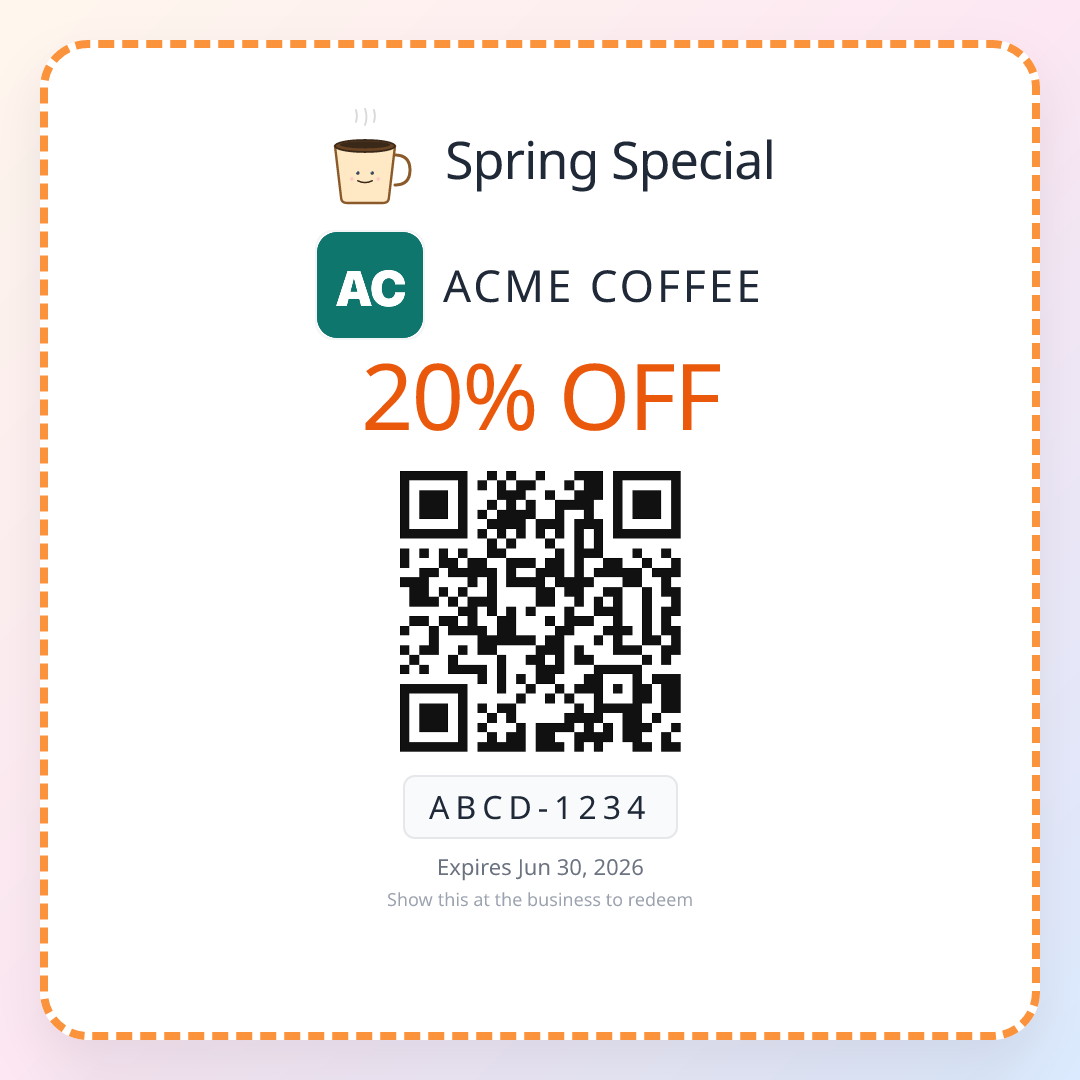
Make each card single-use. Each one carries its own QR code, and once staff scan it and mark it redeemed, a second scan shows "already redeemed". That keeps it personal: a photo in a group chat is worth nothing, so the thank-you stays with the person you handed it to.
Offer shape: Fixed amount, about 20 percent of your average ticket, valid three to four weeks, one redemption per code. Best handed to: Everyone that week, first-timers included. A first-timer who is thanked in their first week is the one most likely to become a regular. Why it works: The words make it a thank-you, the date makes it a plan, and the scan makes it a number.
Play 2: The Pass-It-On Card
Job: Let your regulars do the thanking.
Instead of a coupon for themselves, regulars get a card to give away: "$5 off your first visit, from a friend." The regular writes their own first name on the card in pen, so the friend receives it from someone they know. The regular gets to be generous, the friend gets a reason to try you, and you pay nothing unless the friend walks in.
This is not a referral program. Nobody is tracked, there is no reward for the regular, nobody fills in a form. It is a thank-you that travels one step further.
Offer shape: Fixed amount, first visit only, valid four weeks, single-use. Best handed to: Regulars you know by name. Two cards each, not a stack. Why it works: People like giving things to friends. You give them something to give.
Play 3: The Appreciation Day Card
Job: Turn one busy day into visits over the following three weeks.
Customer Appreciation Day brings people in for a free tasting or a small gift, and most of them leave and do not think about you again for months. On the day, every customer also gets a card: "Thanks for celebrating with us. $5 off any visit, 19 April to 9 May."
The day is the reason to come. The card is the reason to come back. And the redemption count three weeks later is the honest answer to "was that day worth it?", which is otherwise impossible to know.
Offer shape: Fixed amount, valid from the Monday after the day for three weeks, single-use. Best handed to: Everyone who comes in on the day. Why it works: It converts a crowd into return visits, on dates you choose.
Where the thank-you is handed over
A thank-you that is left in a stack by the till is not a thank-you, it is a flyer. Where it is handed over decides whether it is read as one.
- 1
Across the counter, with the change
For cafés, bakeries and shops. Hand the card over with the receipt, face up, and say the sentence while it is in their hand. Not in the bag where it is found later without the words that made it a thank-you.
- 2
On the saucer, next to the treat
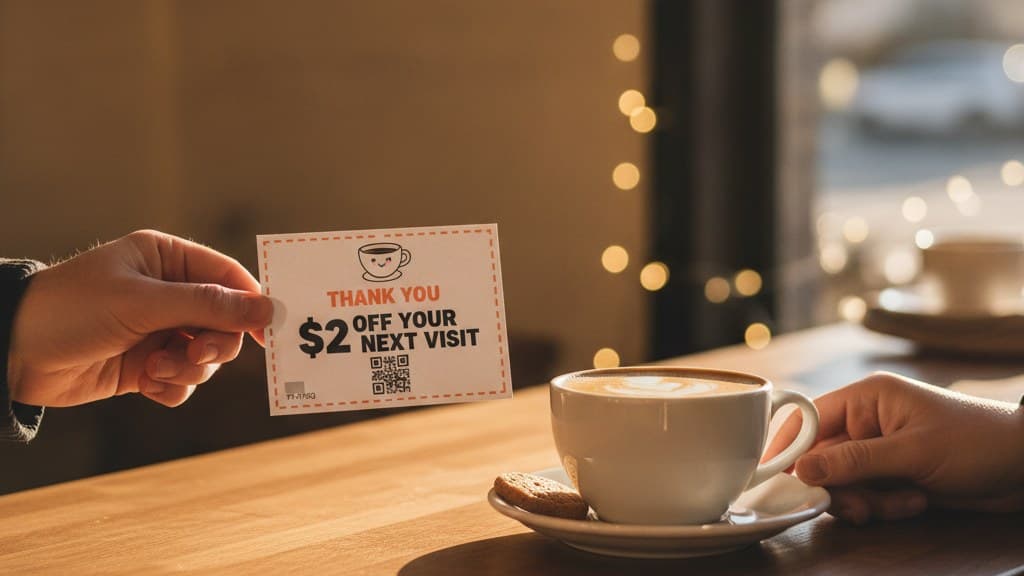
For cafés and restaurants doing idea 8. The card goes on the saucer beside the cookie or on the plate with the bill. The treat makes them look down. The card is the second thing they see.
- 3
Inside the holiday card in the bag
For retail in the last weeks of the year. A small folded card, a handwritten line on the front, the coupon inside. Dropped into the bag on top of the purchase so it is the first thing out when they unpack.
- 4
From the chair, at the end of the appointment
For salons, barbers, groomers and studios. The person who did the work hands it over, not the front desk. A thank-you from the person who spent an hour with the customer weighs more than one from the till.
- 5
At the door, on Customer Appreciation Day
For Play 3. One person at the door hands every customer the card on the way out, with the sentence. On a busy day the counter staff will not have time, so give the job to someone who has nothing else to do.
Two weeks of holiday thank-yous, counted
A café with a $9 average ticket and a regular crowd that comes in two or three times a week. The two weeks before Christmas, every customer who is a regular (staff know them by face) gets a card over the counter: "Thank you for this year. $2 off any order, 4 to 31 January." 250 cards. Planning numbers again. Regulars redeem higher than strangers, so this uses 35 percent.
The cost of the round is $176 of discount plus $25 for the Growth plan (250 coupons is more than Essentials' 100). The mugs from the opening cost $800 for 200 people. And the café now knows something the mug never told it: 88 of its regulars came in with the card in January, a week when many people promise themselves to stop buying coffee out.
Many of those 88 regulars would have come in anyway, so the $792 is not all new money, and it is not meant to be. This is a thank-you first. What the count adds is the information: how many regulars took the thank-you up, and what it cost per person who did. Next year you can test $3, or a treat instead of a discount, and compare.
What to say with it
The sentence matters more than the card. Without it the card is an advert. With it, it is a thank-you.
Bad version (sounds like marketing): "We're doing a customer appreciation thing this month, so here's a coupon, there's a QR code on it, you scan it next time and you get money off."
Good version (eight words, while it is in their hand): "Thank you for this year. This one's yours."
Thank you for this year is the whole message, said by a person. This one's yours makes the card personal without explaining it: the dates and the amount are printed on it, so you do not have to say them.
Swap "this year" for whatever fits: "for coming in every week", "for celebrating with us". Every person on the counter says it out loud once before the first shift, so it sounds the same from everyone.
Set up a thank-you coupon in 6 minutes
- 1
Start the 14-day free trial
Create a ReviewQR account with your email (card required, cancel any time). After the trial, Essentials is $10/month for 100 single-use QR coupons and Growth is $25/month for 500. Every plan includes a Google review QR code. More than 100 customers in your thank-you week needs Growth.
- 2
Write the thank-you line
The offer text is the thank-you: 'Thank you for this year. $2 off any order.' Short, no conditions beyond the date. A fixed amount, about 20 percent of your average ticket.
- 3
Set the end date
Three to four weeks after the last day you hand cards out. For a holiday round, the end of January. For Customer Appreciation Day, three weeks after the Monday that follows it.
- 4
Print the batch
Download the print-ready PDF and print on card stock, or at the print shop you already use. Print for the week you picked, not the whole year: you will want to change the wording next time.
- 5
Teach the eight words
'Thank you for this year. This one's yours.' Everyone who hands cards over says it once out loud before the first shift.
- 6
Scan, then count
When a card comes back, staff scan it with any phone and mark it redeemed. A reused code shows 'already redeemed'. When the window closes, divide redeemed by handed out. That number is your thank-you, counted.
Common customer appreciation mistakes
Mistake 1: Spending everything on the gift. A branded gift for everyone eats the whole budget and tells you nothing afterwards. Keep the gift for the regulars you know by name and put a countable thank-you in everyone else's hand.
Mistake 2: A thank-you with a condition. "Thank you! 10% off when you spend $50" is not a thank-you, it is a sales target. If the customer has to do something to earn it, it is a promotion. Keep conditions to a date.
Mistake 3: Asking for something back. An email address, a sign-up, a follow on Instagram. The moment a thank-you asks for something, the customer stops hearing the thank-you. Collect contact details another time, for another reason.
Mistake 4: Leaving the cards by the till. A stack of thank-you cards next to the card machine is a stack of flyers. Hand each one over, with the sentence, or do not print them.
Mistake 5: Only thanking the big spenders. The customer who buys one coffee every morning for five years has spent more than the one who bought a gift basket in December. Thank by frequency and time, not by the size of one receipt.
Mistake 6: Swapping a thank-you for a review. "Leave us a review and get $5 off" breaks Google's rules and can get reviews removed. Give the thank-you to everyone and ask for reviews separately, at a different moment. How to get more Google reviews covers when to ask.
Related reading
New to single-use QR coupons? QR coupons for small business explains the mechanic, and single-use coupons covers why each code working once keeps a thank-you personal. For more offers to put on the card, see the coupon ideas list and small business promotion ideas. A thank-you round in December pairs well with a bounce-back offer for the quiet weeks after. Turning thanked customers into regulars is the subject of how to get repeat customers and the small business loyalty program guide. Comparing tools? Best QR coupon app for small business lays out the options.
Frequently asked questions
What are good customer appreciation ideas for a small business?
The best ones are personal, cheap and repeatable. Free: learn regulars' names and usual orders, write a short note on the receipt or bag, reply personally to every Google review, give regulars first look at something new. Under a dollar per customer: a thank-you coupon handed over at the counter, a small treat with the order, a birthday coupon for customers who shared the date. Bigger: a surprise upgrade, an after-hours evening for regulars, a Customer Appreciation Day in April. The thank-you coupon is the only one on the list that tells you afterwards who it reached, because each single-use code is either redeemed or not.
When is Customer Appreciation Day?
In the United States, Customer Appreciation Day falls on the third Friday of April. In 2027 that is Friday, April 16. It is not an official holiday, so there are no rules: some businesses run it for one day, some for the whole week. Plan it from March. Many businesses also run a second, informal round of thank-yous in November and December, when the year's regulars are in most often.
What are cheap ways to show customer appreciation?
Most of the strongest gestures cost nothing: using someone's name, remembering their usual, a handwritten line on a receipt, a personal reply to their review, telling them first when something new arrives. When you want to spend a little, a printed thank-you coupon for their next visit costs a few cents to hand out and only costs the discount if they come back, which makes it cheaper per customer than almost any gift.
Is a coupon a good customer appreciation gift?
It can be, if it reads as a thank-you and not as a sales flyer. Keep it short ("Thank you for this year. $5 off your next visit"), give it a clear end date three to four weeks away, hand it over in person, and make each one single-use so it stays personal. Pair it with something that costs nothing, like the customer's name or a short note. A coupon alone feels like marketing. A coupon with a sentence from a person feels like a thank-you.
How do you plan a customer appreciation day?
Pick the date (the third Friday of April, or any day that fits your trade), decide on one thing that happens only that day, such as a free tasting, a small gift or a surprise upgrade, and tell regulars a week ahead with a sign at the counter. On the day, give every customer a thank-you coupon for a visit in the following three weeks. The day itself brings people in. The coupon is what brings them back afterwards, and the redemption count tells you whether the day worked.
How much does a thank-you coupon with a QR code cost?
Three costs. The software: ReviewQR Essentials is ten dollars a month for one hundred single-use QR coupons and Growth is twenty five dollars a month for five hundred. Every plan includes a Google review QR code and starts with a fourteen day free trial, card required. The printing: card stock from any print shop, or nothing if you send the coupons to customers' phones. The discount: paid only when the customer comes back and uses it.
Keep reading
20 Small Business Promotion Ideas, Grouped by the Problem They Solve
20 small business promotion ideas for a slow day, a first visit, a second visit and a bigger ticket. Each one comes with the offer, who gets it, how you count it, and the math on whether it paid.
guidesSingle-Use Coupons: Why One Code Per Customer Beats a Code Everyone Shares
A single-use coupon works once and then stops. What that means, how one-time QR coupon codes and QR code vouchers work at the counter, what a shared code really costs, and three ways a small business can use them to bring customers back.
guidesRepeat Customers: What Counts, What They Are Worth, How to Get More
A repeat customer is one who comes back before their return clock runs out. How to work out that clock for your trade, what one repeat customer is worth in a year, how to calculate repeat customer rate, and three offers that bring first-timers back.