Coffee Shop Marketing: 18 Ideas You Can Count (With Costs)
Coffee shop marketing that a small café can count: 18 ideas sorted by the job they do (new faces, the second visit, the slow afternoon, a bigger ticket, reviews), each with its cost, plus a 4-week plan.
Coffee Shop Marketing: 18 Ideas You Can Count (With Costs)
At 8:15 on a Tuesday the line goes to the door. Two baristas, one grinder running nonstop, oat milk on its third carton. By 2:40 the same café has one student with a laptop, a cold brew that has lasted an hour, and a pastry case that will be half full at closing.
The owner has tried marketing. A loyalty stamp card that regulars fill and newcomers lose. An Instagram post of the new seasonal latte (48 likes). A "half-price Wednesday" that brought in a crowd on a day the morning was already busy, and a lot of people who never came back at full price.
None of it was wrong, exactly. The problem is that nobody can say which of it put a single extra cup on the counter at 3 pm, or which first-time customer came back because of it. This guide sorts coffee shop marketing the other way round: by the gap each idea fills and how you count it.
The short answer
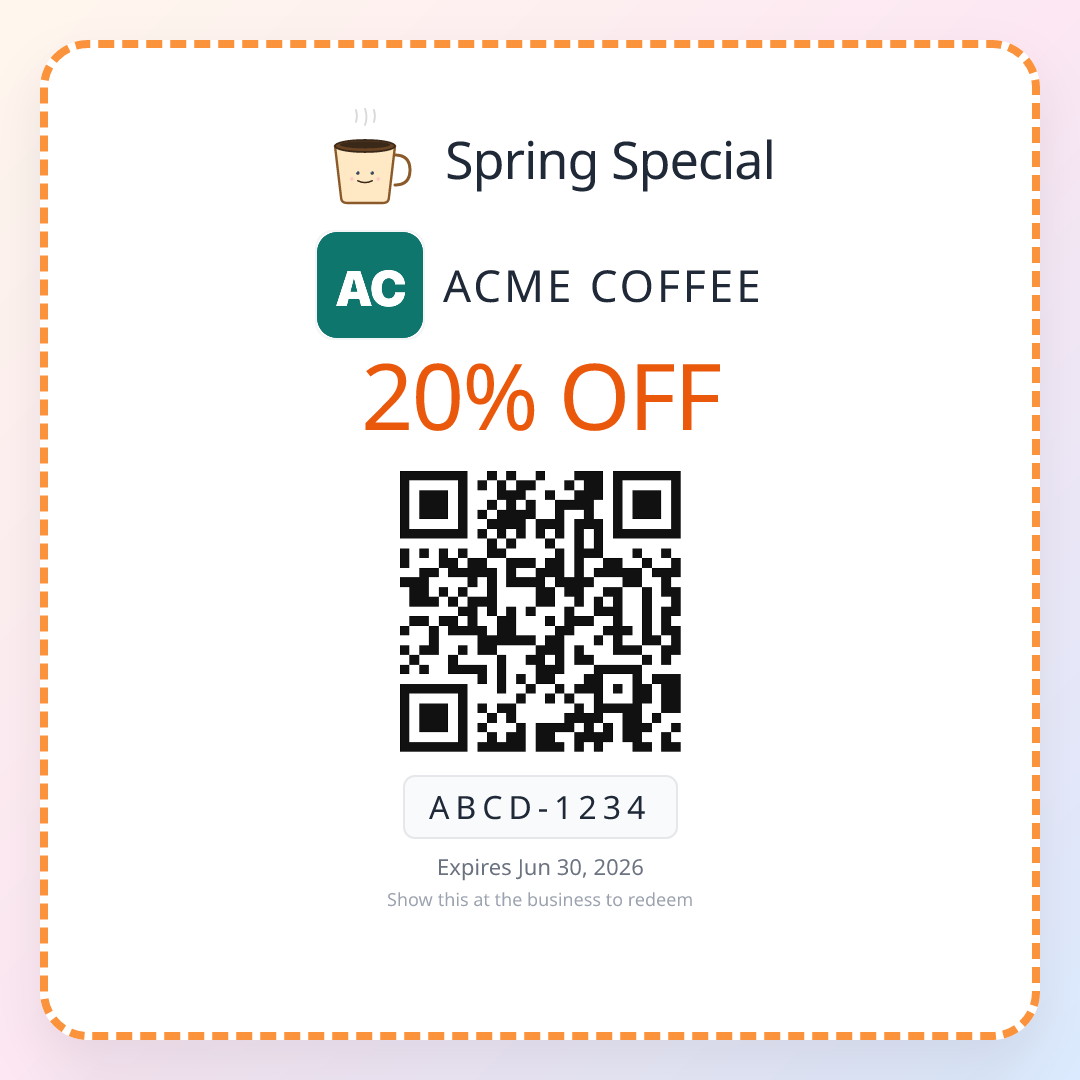
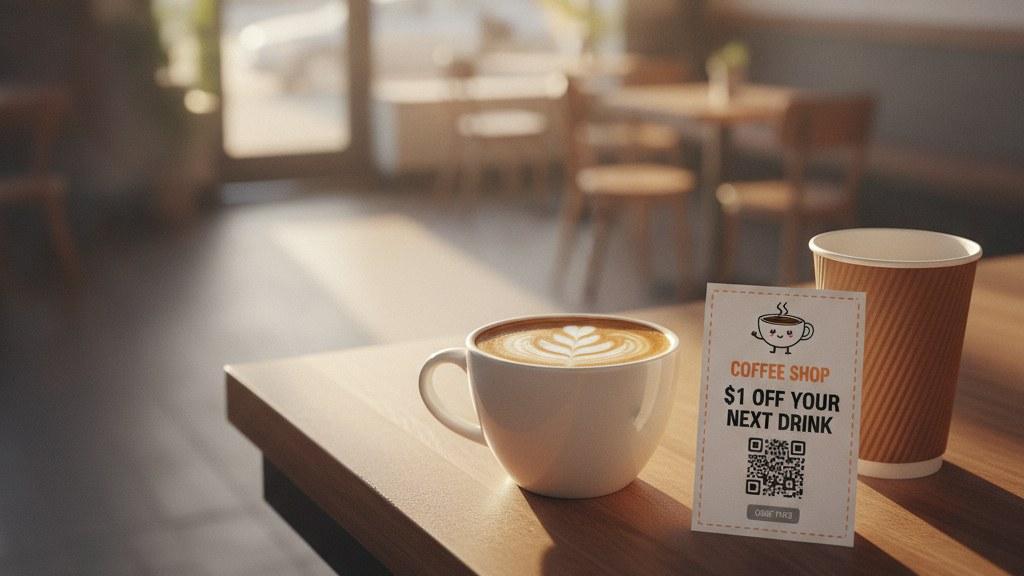
Good coffee shop marketing for a small café does two jobs before anything else: it brings first-time customers back for a second visit, and it moves some of the morning crowd into the empty afternoon. The cheapest tool for both is a small card handed over with the drink: $1 off the next one, valid one or two weeks, with its own QR code, so you can count exactly how many came back.
We make a tool for that, ReviewQR, so weigh that. Here is what it does and what it costs:
| What you need | How ReviewQR does it |
|---|---|
| A coupon only one customer can use | Every card has its own QR code that works once, then shows "already redeemed" |
| An end date | You set the expiry; the code stops working after it |
| Redeeming at a busy counter | Staff scan it with any phone. No POS integration, customers install nothing |
| A count of who came back | The dashboard shows cards created against cards redeemed |
| A price that fits a café | First 10 free, then 12¢ a coupon paid once (from $3 for 25), or $10/month for 100, $25/month for 500 |
What it does not do: stamps or points that add up over visits, a card in Apple or Google Wallet, or blocking a coupon by time of day. If an offer only works in the afternoon ("after 2 pm"), write the hours on the card and staff check them when they scan.
The 3 PM Handoff
Most cafés do not have a customer problem. They have a shape problem. The morning is full and the afternoon is empty, and both are paid for: the rent, the espresso machine warming up, the barista on shift until 5.
The 3 PM Handoff is one rule for coffee shop marketing: the morning crowd is the cheapest marketing channel you own. Every person in the 8 am line already chose you, already likes the coffee, and is standing in front of you with a hand free. Anything you hand them at 8 can pay off at 3, or next Tuesday, or in a quiet week in January.
That rule sorts the ideas below into five jobs:
| The job | Who it should bring in | How you count it |
|---|---|---|
| New faces | People who have never had your coffee | Cards from a partner shop, scanned at the counter |
| Second visit | First-time customers, back within two weeks | Next-visit cards redeemed |
| Slow afternoon | Morning regulars, after 2 pm | Afternoon redemptions of cards handed out in the rush |
| Bigger ticket | The same customer, adding food or a second drink | Pairing offers redeemed, ticket size on those orders |
| Reviews and social | People choosing a café on their phone | Google review count, claims from a link |
Most coffee shop marketing goes to the first row: ads, listings, flyers for strangers. The second and third rows are cheaper, because the person already walked in once.
What one regular is worth to a café
Planning numbers, so swap in your own: an average ticket of $6 (a drink, sometimes a pastry). A real regular comes in three times a week, about 45 weeks a year. That is around 135 visits and $810 a year from one person, before they bring a colleague or buy beans for the holidays.
Compare what it costs to get one more visit out of someone who has already been in:
- A paid ad or a boosted post: you pay for every view and click, most of them from people who will never come in, and you cannot tell which ones did.
- A half-price day: everyone gets the discount, including the regulars who were coming anyway, on a day you are already busy.
- A next-visit card: 12¢ for the code and a little card stock if it is never used. $1 off a $6 ticket if it is, and only on the visit the customer actually makes.
The asymmetry
An unused next-visit card costs about 15 cents with printing. A used one costs $1 and brings a $6 ticket: 6 to 1 on that single visit. If one in ten of those returning customers turns into a three-times-a-week regular, each one is worth about $810 a year, more than 800 times the dollar that started it.
That is why most of this list leans on people who already walked in once. New faces matter, but a café that loses most of its first-time customers is paying to fill a cup with a crack in it.
Ideas for new faces (1 to 4)
These bring in people who have never had your coffee. They cost the most per visit, so each one should leave something to count.
1. The neighbour swap. Agree with a shop next door (a gym, a salon, a bookshop, a coworking space) to hand each other's customers a welcome card: "$1 off your first drink at [you], from your friends at [them]." Cost: the discount, only when used. Count it: cards scanned, sorted by which partner's batch they came from.
2. The office welcome stack. Drop a box of pastries and a stack of welcome cards at the reception of the two or three biggest offices within five minutes' walk. Office workers choose a coffee routine in their first weeks and then rarely change it. Cost: a dozen pastries. Count it: redemptions from that batch.
3. The Google Business Profile, kept current. Correct hours (holidays included), photos of this season's drinks, and the menu readable on a phone. "Coffee near me" is decided on the map. Cost: an hour a month. Count it: calls, direction requests and website taps in the profile's own stats.
4. The new-resident card. When a new apartment building opens nearby, ask the manager to put welcome cards in the move-in packs. New neighbours have no "usual place" yet. Cost: the discount. Count it: redemptions from that batch.
Ideas for the second visit (5 to 8)
These turn a first-time customer into a second visit: the cheapest customers you will ever buy.
5. The next-visit card. Ask "first time here?" while you take the order. Every first-timer gets a card with the drink: $1 off the next one within 14 days, one code per card. Cost: 12¢ a card plus the discount when used. Count it: redemptions against cards handed out. QR code coupons for coffee shops covers this one in detail.
6. The cup-sleeve card. On takeaway orders, slip the card into the sleeve or tape it to the lid of the bag. The cup goes to the desk, where the card gets seen again at 11. Cost: same as 5. Count it: redemptions from takeaway cards.
7. The bring-a-friend card. A card for a regular to give away: "$2 off your first drink here, from [regular's name]." It works once, for one new person. Cost: the discount, only when a new face walks in. Count it: redemptions, and how many of those friends come back a third time.
8. The one-link claim at the counter. One QR code on a counter sign: customers scan it, enter their email, and each gets their own single-use coupon in their inbox. Useful in the morning rush when nobody has time to sort first-timers from regulars. Cost: the discount. Count it: claims, then redemptions.
Ideas for the slow afternoon (9 to 12)
These move visits from the hours you are full to the hours you are not. The morning pays for the afternoon.
9. The morning-to-afternoon card. During the rush, every drink comes with a card: "$1 off any drink after 2 pm, this week." Regulars get it too: you are not buying their visit, you are adding one at an hour you need it. Cost: the discount, in hours when the barista is paid anyway. Count it: afternoon redemptions.
10. The afternoon pastry pairing. "Free pastry with any drink after 2 pm, until Friday." It moves the stock that would be thrown away at closing. Cost: food cost of a pastry you would bin anyway. Count it: afternoon redemptions, and how much is left in the case at 6.
11. The study and laptop hours. Students and remote workers fill afternoons if they know they are welcome. A card for "2 to 5 pm, $1 off any drink, outlets at every table" handed to the laptop crowd who come in the morning. Cost: the discount. Count it: redemptions in those hours. Set a simple rule, like one drink per two hours, so a table does not sit on one cup all day.
12. The quiet-week bounce-back. In your busiest stretch (December for most cafés), hand out a card that starts when the quiet weeks start: "$1 off any drink, January 5 to 25." Bounce-back offers have their own guide. Cost: the discount, in January. Count it: January redemptions.
Ideas for a bigger ticket (13 and 14)
These raise what each customer spends instead of how many come in.
13. The drink-plus-food card. "$1.50 off a drink and a pastry together." It turns a $4.50 coffee into a $9 order. Cost: the discount on a bigger ticket. Count it: redemptions, and the ticket size on those orders.
14. The beans-to-go card. When a regular buys a bag of beans, hand them a card for $2 off the next bag within a month. Beans are a high-margin, once-a-month purchase that keeps your name in their kitchen every morning. Cost: the discount on a product with good margin. Count it: bag redemptions.
Social media and Google reviews (15 to 18)
These bring the first visits of people choosing a café on their phone, and most of them check your rating before your menu.
15. A post with a counter in it. "coffee shop social media marketing" usually means posting more. Make each post carry one thing to count: "Show this post at the counter this week and ask for the card" or a claim link where every follower who taps gets their own code. Cost: the discount. Count it: claims and redemptions, not likes.
16. The behind-the-bar post. A 15-second clip of the new roast being dialled in, or the pastry delivery at 6 am, with the week's card mentioned at the end. People follow cafés for the place, not for discounts. Cost: a few minutes. Count it: cards asked for at the counter that week.
17. The review card at the pickup counter. A small card with a QR code that opens your Google review box directly, next to the pickup point, where customers wait with nothing to do for 40 seconds. Cost: printing. Count it: your review count, month on month.
18. Answer every review. Reply to every Google review within a week, the good and the bad. People choosing between two cafés read the replies, and a calm answer to a one-star is better advertising than another five-star. Cost: ten minutes a week. How to respond to Google reviews has templates.
One rule for 17 and 18: never tie a discount to leaving a review. Google forbids rewards for reviews and can remove them. Ask for the review and hand out coupons separately.
Three coffee shop promotions to run first
Eighteen ideas is too many to start with. These three cover the biggest gaps for most independent cafés. Run the first one for a full window before adding the next.
Play 1: The Second-Cup Card
Job: Bring first-time customers back before the habit forms somewhere else.
Every first-timer gets a card with their drink: $1 off their next drink, valid 14 days, one code per card. Fourteen days is long enough to fit a second visit into a normal week and short enough that the card is still in the wallet.
Offer shape: About 15 to 20 percent of your average drink price, as a dollar amount. Valid 14 days. One redemption per code. Handed to: First-time customers only. Ask while taking the order. Why it works: They are holding it at the moment they decided the coffee was good, and the date turns "I should come back" into a plan.
Play 2: The 3 PM Card
Job: Fill the afternoon with morning regulars.
From opening to 10 am, every drink comes with a card that only works after 2 pm, this week. The morning rush is when you have the most people and the least time, so the card does the talking.
Offer shape: $1 off any drink, or a free pastry with a drink, after 2 pm (written on the card), expiry in 7 days. Handed to: Everyone in the morning rush, for one week. Why it works: Morning regulars already trust you. A second visit the same day or week is a small step with a reason and a deadline attached.
Play 3: The Neighbour Swap
Job: Win new faces without paying for ads.
Pick one business next door whose customers look like yours: a gym at 7 am, a salon at 11, a coworking space all day. Print 100 welcome cards with their name on them and give them the stack. Offer to hand out theirs too.
Offer shape: $1 off a first drink, valid 30 days, one per code. Handed to: The partner's customers, by the partner's staff. Why it works: A tip from a place they already trust lands better than an ad, and the cards that come back tell you which partner is worth keeping.
Do This
- ✓Use a fixed dollar amount, not a percentage
- ✓Print the end date and any hours on the card
- ✓Hand each card to one customer, with the drink
- ✓Run one promotion for a full window before starting the next
- ✓Count cards handed out against cards redeemed
Avoid This
- ✕Don't put the offer on a public chalkboard
- ✕Don't discount the morning rush
- ✕Don't make cards valid for months
- ✕Don't message customers who never agreed to hear from you
- ✕Don't tie any discount to leaving a review
A one-page coffee shop marketing plan
A coffee shop marketing plan does not need a template or a slide deck. It needs one gap per week, one idea for it, and a number at the end. Here is a four-week version for a single café:
| Week | Gap | Idea | Cost to start | What you count |
|---|---|---|---|---|
| 1 | Second visit | Second-Cup Card for every first-timer | 100 coupons: $12 paid once, or Essentials $10/month | Cards handed out, cards redeemed |
| 2 | Slow afternoon | 3 PM Card during the morning rush | Another batch of cards | Redemptions after 2 pm |
| 3 | Reviews | Review card at the pickup counter | Printing | Google review count |
| 4 | New faces | Neighbour swap with one shop | 100 welcome cards | Redemptions from the partner's batch |
At the end of the month you have four numbers instead of four feelings. Keep what worked, drop what did not, and change one thing (the amount, the expiry, where the card is handed over) before the next month.
Where the card goes in a café
A card's job is to survive the walk back to the office and be found again. Where it is handed over decides most of that.
- 1
In the hand, with the cup
Not on the counter next to the tip jar, where it gets left behind. Handed over with the drink, at the moment the customer takes their first sip and decides whether the coffee is good.
- 2
Inside the cup sleeve or on the bag
For takeaway: slipped between the sleeve and the cup, or taped to the pastry bag. It goes back to the desk and gets seen again when the cup is thrown away.
- 3
At the pickup counter, as one QR sign
For the claim link or the review card: one small sign where customers wait for their drink. It is the only 40 seconds in a café visit when people look around with nothing to do.
- 4
In the partner's hands, not your window
Welcome cards for new faces belong at the gym desk, the salon counter, the coworking reception. A stack in your own window only reaches people already outside your door.
- 5
In the bag of beans
The beans-to-go card goes inside the bag, on top. It is opened at home, the next morning, by the person you most want back next month.
One month of next-visit cards, counted
The café from the opening: a $6 average ticket and about 300 first-time customers a month. Every one gets a Second-Cup Card, $1 off, valid 14 days. These are planning numbers; your redemption rate will depend on your offer and your customers.
The month's cost is $90 of discount plus the coupons: 300 cards at 12¢ is $36 paid once, or $25 on the Growth plan, which covers 500 a month (cheaper once you hand out more than about 210). With ingredients and cups at roughly a quarter of the price, the 90 visits leave about $405 before the discount and about $315 after it, before the coupons.
That is not the whole story, and not every visit is new money: some of those customers would have come back anyway, and you gave them a dollar. The honest claim is smaller. The card dated their return, and it told you something you did not know: what share of first-timers will come back for $1. If even 10 of the 90 become regulars, they are worth about $8,100 a year at the numbers above. Next month you can try 7 days instead of 14, or a free size upgrade instead of $1, and see whether the number moves.
If redemption climbs well above 40 percent, the offer is probably bigger than it needs to be. If it stays under 10 percent, the card is probably not reaching the customer: check where it is handed over before you raise the discount.
What the barista says with the cup
At 8:15 a barista has about two seconds per customer. A long explanation slows the line and sounds like a pitch.
Bad version (long, and the deadline is lost): "Oh, and we have this little promo, it's a coupon, you scan it, it's for next time I think, some money off, there's a date on it somewhere."
Good version (eight words, with the cup): "That's a dollar off next time. Two weeks."
That's a dollar off says what it is. Next time says it is not for today. Two weeks is the deadline. Nothing is asked of the customer: no app, no phone number, no sign-up.
For the afternoon card: "Come back after two, dollar off. This week." Every barista says it once at the start of the shift, so nobody improvises it with ten people in line.
Set up your first café promotion in 6 minutes
- 1
Design the card, no account needed to start
Open the coupon builder, add your café name and the offer line: '$1 off your next drink'. Print your first 10 free to test it, then pay 12¢ a coupon once (from $3 for 25), or start a plan with a 14-day free trial (card required): Essentials $10/month for 100 coupons, Growth $25/month for 500.
- 2
Pick one gap
Second visit, slow afternoon or new faces. One promotion, one window. The Second-Cup Card is the usual first choice.
- 3
Set the expiry and the hours
14 days for a next-visit card, 7 days for an afternoon card. If the card only works at certain hours, write them into the offer line ('after 2 pm'); staff check them when they scan.
- 4
Print the batch
Download the print-ready PDF and print it on card stock at a print shop or in the back office. Print one window's worth, not a year's supply.
- 5
Teach the eight words
'That's a dollar off next time. Two weeks.' Every barista says it once before opening.
- 6
Scan, then count
When a card comes back, the barista scans it with any phone and takes the dollar off at the till. A copy or a second use shows 'already redeemed'. When the window closes, divide redemptions by cards handed out. That is your starting number for the next one.
Common coffee shop marketing mistakes
Mistake 1: Marketing you cannot count. A post, a flyer or a chalkboard with no code leaves you with a feeling, not a number. Give every idea one thing to count, even if it is only a code on the flyer.
Mistake 2: Discounting the morning rush. Half-price drinks at 8 am pay the people who were in line anyway, at the hour your baristas are already stretched. Hand the offer out in the morning and make it work in the afternoon.
Mistake 3: Only marketing to strangers. Ads and listings chase people who have never been in. If most first-timers never come back, more first-timers just means more people who try you once. Fix the second visit first.
Mistake 4: A stamp card as the only loyalty tool. A stamp card rewards the regular who comes three times a week anyway, and most first-timers lose theirs before the second stamp. Keep it if your regulars like it, and add a next-visit card for the people who have not decided yet. Coffee shop loyalty program options are priced side by side in their own guide.
Mistake 5: Cards that never expire. "Valid any time" goes in a drawer. Two weeks keeps the date in the customer's head; one week suits afternoon cards.
Mistake 6: A free drink for a review. "Leave us five stars, get a free latte" breaks Google's rules and can get your reviews removed. Ask for reviews with a review card, and keep coupons separate.
Related reading
New to single-use QR coupons? QR coupons for small business explains how they work, and the coupon ideas list has more offers to put on the card. For cafés: QR code coupons for coffee shops goes deeper on the second visit, and the coffee shop loyalty program comparison prices Square Loyalty, Loopy, Stamp Me and the rest. Comparing coupon tools? Best QR coupon app for small business lays out the options. Running a restaurant too? 21 restaurant marketing ideas is the dinner version of this list, and small business promotion ideas works for any shop.
Frequently asked questions
What is the best marketing strategy for a small coffee shop?
Fix the second visit before you buy more first visits. Most cafés get plenty of people who try them once and never come back, so the cheapest marketing is a card handed to every first-time customer: a small amount off their next drink, valid for one or two weeks, one code per card. Then move some of your morning crowd into the empty afternoon with a card handed out before 10 that only works after 2. Add a Google review card and one partner shop next door. Run one idea at a time for a full window and count how many cards came back.
How do I get more customers into my coffee shop in the afternoon?
Hand the afternoon offer to the people who already come in the morning. A card given with every drink during the rush that says "$1 off any drink after 2 pm, this week" moves some of your regulars into the quiet hours. They already like your coffee, so they are the cheapest customers to bring in at 3 pm. Write the hours on the card: staff check them when they scan.
What are good coffee shop promotion ideas that do not cut into margin?
Offers that cost little in ingredients and only apply when the customer comes back: $1 off the next drink, a free size upgrade, a free pastry with a drink after 2 pm, or a free drink for a friend on their first visit. A drink costs a café roughly a quarter of its price in coffee, milk and cup, so a $1 discount on a $6 ticket is cheap if it brings a visit that would not have happened. Avoid permanent public discounts and half-price days on your busiest mornings.
Does social media marketing work for a coffee shop?
It helps people find you and remember you, but on its own it is hard to measure. Make each post leave something to count: a claim link where each person who taps gets their own single-use coupon by email, or a post that tells followers to ask for the week's card at the counter. Then you know how many followers walked in, not only how many liked the photo.
How do I write a simple coffee shop marketing plan?
Pick one gap per month and one idea for it. Week 1: print a next-visit card and hand one to every first-time customer. Week 2: add an afternoon card handed out during the morning rush. Week 3: put a Google review card at the pickup counter. Week 4: count cards handed out against cards redeemed and decide what to keep. Write down the cost of each idea and the number it produced. A plan that fits on one page and is counted beats a long plan nobody checks.
How much do QR coupons cost for a coffee shop?
With ReviewQR you can print your first 10 coupons free, then pay 12 cents a coupon once, with no subscription (from $3 for 25), and the balance never expires. Or pick a plan: Essentials is $10 a month for 100 single-use QR coupons and Growth is $25 a month for 500. Plans include a Google review QR code and start with a 14 day free trial, card required. Printing is business card stock from any print shop, and the discount is only paid when a customer comes back.
Keep reading
Single-Use Coupons: How One-Time Codes Work at the Counter
A single-use coupon works once, for one customer, then shows 'already redeemed'. How one-time coupon codes work, what a shared code really costs, and three ways to use them to bring customers back.
guidesRepeat Customers: What Counts, What They Are Worth, How to Get More
A repeat customer is one who comes back before their return clock runs out. How to work out that clock for your trade, what one repeat customer is worth in a year, how to calculate repeat customer rate, and three offers that bring first-timers back.
guidesHow to Get More Google Reviews: The 7 Moments That Work
How to get more Google reviews for your business without being pushy or breaking the rules: the seven moments when happy customers actually leave one, the direct review link, an eight-word script, the math of a QR code on the counter, and the mistakes that get reviews removed.