21 Restaurant Marketing Ideas, Sorted by What They Bring Back
21 restaurant marketing ideas grouped by the job they do: a first visit, a second visit, a slow night, a bigger check, or a review. Each one with what it costs and how you count whether it worked.
21 Restaurant Marketing Ideas, Sorted by What They Bring Back
It is a Thursday in November and the owner of a forty-seat bistro is looking at last month's marketing. There was a post about the new braise (31 likes). There was a flyer drop on the three streets around the restaurant (400 flyers, $90 at the print shop). There was a "two-for-one Tuesday" on a delivery app that brought in orders and took 30 percent of every one.
Ask the owner which of the three put a single extra table in the room, and the honest answer is: no idea. The likes were real. The flyers went somewhere. Tuesday was a bit busier, maybe, or maybe it was the rain.
Most restaurant marketing ideas lists have the same problem. They list activities: post on Instagram, run a happy hour, sponsor the Little League team. They rarely say what each idea is supposed to bring back, what it costs, or how you would know. This list is sorted the other way round.
The short answer
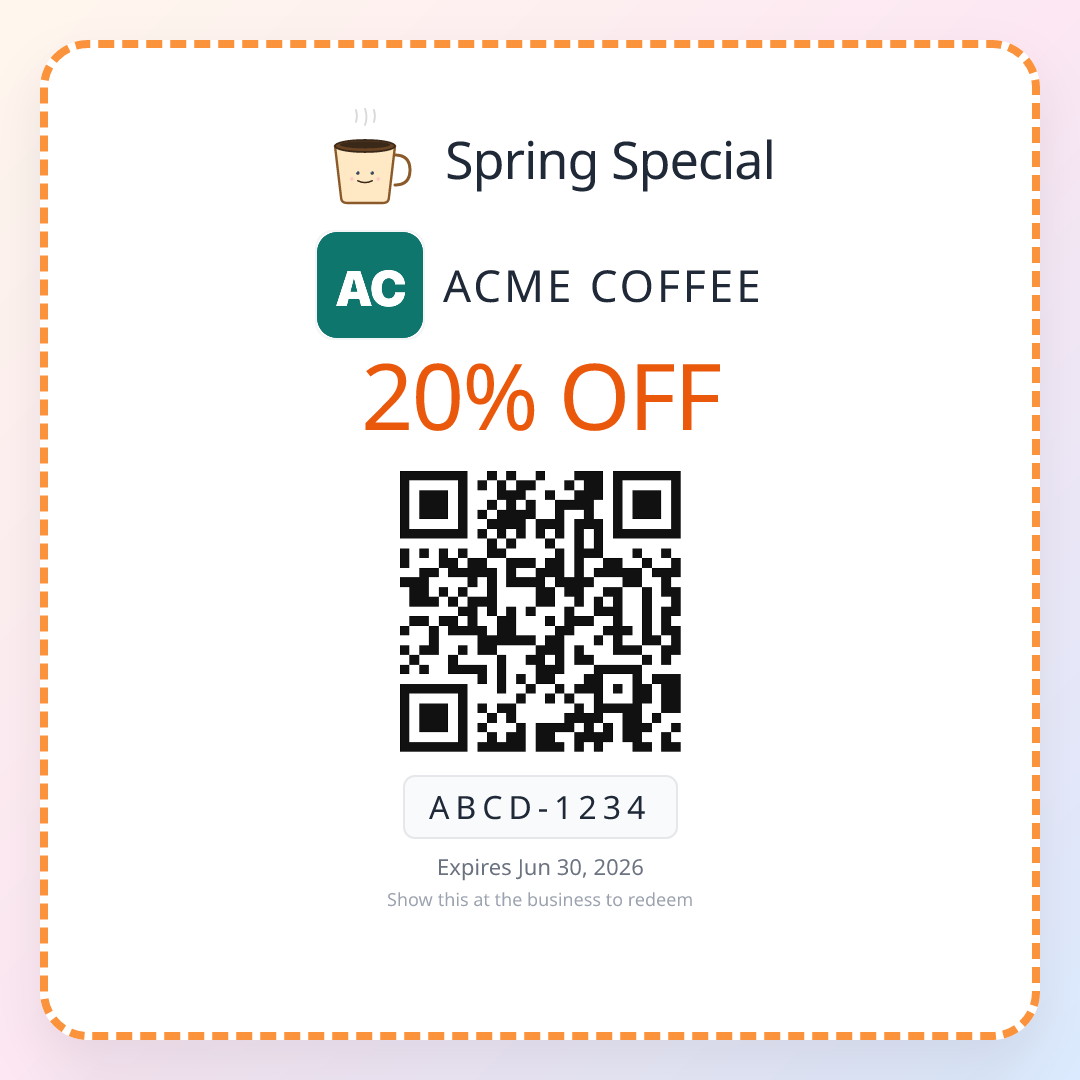
The restaurant marketing ideas that work best for a small restaurant are the ones aimed at one gap (a first visit, a second visit, a slow night, a bigger check, more reviews) that leave you something to count. The cheapest and most reliable of them is a card in the bill folder: a fixed amount off a visit in the next few weeks, one QR code per card, so you see exactly how many guests came back.
We make a tool for that, ReviewQR, so weigh that. Here is what it does and what it costs:
| What you need | How ReviewQR does it |
|---|---|
| A coupon only one guest can use | Every card has its own QR code that works once, then shows "already redeemed" |
| An end date | You set the expiry; the code stops working after it |
| A way to redeem at the host stand or the till | Staff scan it with any phone. No POS integration, guests install nothing |
| A count of who came back | The dashboard shows cards created against cards redeemed |
| A price that fits a restaurant | First 10 free, then 12¢ a coupon paid once (from $3 for 25), or $10/month for 100, $25/month for 500 |
What it does not do: post to your social accounts, list you on delivery apps, or block a coupon before a start date. If an offer starts later ("good Monday to Wednesday"), write the days on the card and staff check them when they scan.
The Counted Cover
In a restaurant a cover is one diner. Covers are what you staff for, what you prep for, and what the night's sales are divided by.
The Counted Cover is one rule for every idea on this list: before you spend on a marketing idea, decide which covers it should bring in, and how you will count them. A flyer with no code brings in covers you cannot count. A post brings in covers you cannot count. A card with its own QR code, handed to one guest with a date on it, brings in covers you can count, because staff scan every one that comes back.
That rule sorts restaurant marketing into five jobs:
| The job | The covers it should bring | How you count them |
|---|---|---|
| First visit | People who have never eaten with you | Cards from a partner shop, scanned at the till |
| Second visit | First-time guests, back within three weeks | Bill-folder cards redeemed |
| Slow night | Weekend regulars, on a Tuesday | Weekday redemptions of cards handed out on the weekend |
| Bigger check | The same table, ordering more | Threshold offers redeemed, average check on those tables |
| Reviews | Guests who had a good night, on Google | Your Google review count, month on month |
The second visit is the one most restaurants leave alone. It is also the cheapest: the guest already chose you once, tasted the food and sat in the room. You are not persuading a stranger, you are reminding someone who liked you.
What one returning table is worth
Planning numbers, so swap in your own: a table of two spends $54. A couple who make your place their monthly dinner come in 12 times a year. That is $648 a year from one table, before they bring friends or birthdays.
Now compare what it costs to get that table to come back once more:
- A paid ad or a sponsored listing: you pay for every click, most of them from people who will never come in, and you cannot tell which ones did.
- A delivery app promotion: the app takes a commission on every order, discounted or not, and the guest belongs to the app, not to you.
- A card in the bill folder: a few cents if it is never used. $6 off a $54 check if it is, and only on the visit the guest actually makes.
The asymmetry
An unused bill-folder card costs a few cents. A used one costs $6 and brings a $54 check: about 9 to 1 on that single visit. If one of every ten returning tables turns into a monthly regular, each of those regulars is worth $648 a year, more than 100 times the discount that started it.
That is why the list below leans on ideas that bring back guests you already had. New diners matter, but a restaurant that loses most of its first-time guests is filling a bucket with a hole in it.
Ideas for a first visit (1 to 5)
These bring in people who have never eaten with you. They cost more per cover than anything else on the list, so each one should leave something you can count.
1. The neighbour swap. Agree with a business next door (a cinema, a gym, a salon, a bookshop) to hand each other's customers a welcome card: "$5 off your first dinner at [you], from your friends at [them]." Cost: the discount, only when used. Count it: cards scanned, sorted by which partner's batch they came from.
2. The hotel and concierge card. Give the front desks of nearby hotels and short-let hosts a stack of welcome cards to hand guests who ask where to eat. Cost: printing and a drop-off every few weeks. Count it: redemptions from that batch.
3. The office lunch drop. Walk a tray of something small from your menu into the two or three biggest offices within ten minutes' walk, with a welcome card for each person. Cost: food for 20 to 30 people. Count it: lunch redemptions in the next three weeks.
4. The Google Business Profile, kept fresh. Current hours (including holidays), menu photos taken this season, and the menu link working on a phone. Cost: an hour a month. Count it: calls and direction requests in the profile's own stats.
5. A welcome card for the new building. When a new apartment block opens nearby, ask the building manager if you can leave welcome cards in the lobby or the move-in packs. New residents have no "usual place" yet. Cost: the discount. Count it: redemptions from that batch.
Ideas for a second visit (6 to 10)
These turn a first-time guest into a second visit, the cheapest covers you will ever buy.
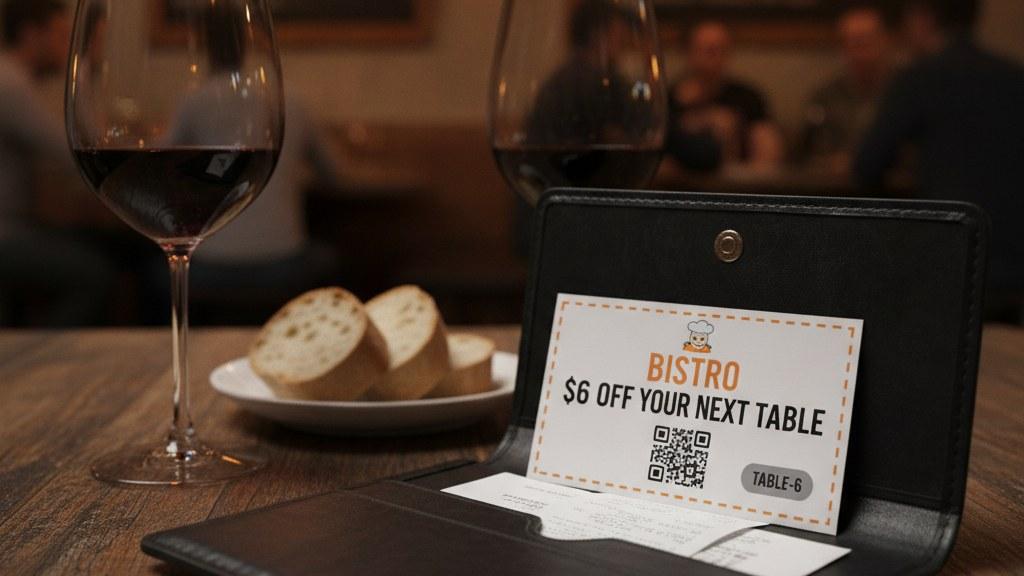
6. The bill-folder card. Every first-time table leaves with a card: a fixed amount off their next visit within three weeks. Ask "first time with us?" when they sit down so the server knows which folders get one. Cost: a few cents a card, the discount when used. Count it: redemptions against cards handed out.
7. The takeout bag card. Tape a card to the outside of every takeout bag on its first order (or on every order on your busiest nights). The guest opens the bag at home, where they decide where to eat next week. Cost: same as 6. Count it: dine-in redemptions from takeout cards.
8. The new menu invite. When the menu changes, hand regulars and recent first-timers a card that only works on the new dishes, valid two weeks. Cost: the discount on dishes you want tried anyway. Count it: redemptions, and which new dishes they ordered.
9. The birthday card at the table. When a table is celebrating, hand the birthday guest a card for their next visit, not a free dessert tonight. Tonight they were coming anyway. Cost: the discount, weeks later. Count it: redemptions from birthday cards.
10. The one-link claim at the host stand. Put one QR code on the host stand or the menu: guests scan it, enter their email, and each gets their own single-use coupon. You get a count of how many claimed, and they have the coupon in their inbox. Cost: the discount. Count it: claims, then redemptions.
Ideas for a slow night (11 to 15)
These move covers from the nights you are full to the nights you are not. The busy night pays for the quiet one.
11. The weekend-to-weekday card. On Friday and Saturday, every bill folder gets a card that only works Monday to Wednesday until the end of the month. Cost: the discount, on nights the staff are paid either way. Count it: weekday redemptions.
12. The bounce-back. In your busiest stretch (December for most restaurants), hand out a card that starts when the quiet weeks start and runs three to four weeks. Bounce-back offers have their own article. Cost: the discount, in January. Count it: January redemptions.
13. The table-of-four night. "$10 off tables of four or more, Tuesdays this month." One card fills four seats on the night with the most empty ones. Cost: the discount, spread across four covers. Count it: Tuesday redemptions, and party size.
14. The industry night. A card handed to staff from the shops, salons and bars on your street, good on your quietest night, when they are off work and you are empty. Cost: the discount. Count it: redemptions from that batch.
15. The rainy-day text. If guests gave you their number or email for offers, send one message with one coupon on a wet afternoon: "Rain all evening. $6 off your table tonight." Cost: the discount. Count it: same-night redemptions. Only message people who agreed to hear from you.
Ideas for a bigger check (16 to 18)
These raise what each table spends instead of how many tables come in.
16. The threshold card. "$8 off when your table spends $60 or more." It pulls a two-course table into a three-course one. Cost: the discount, on a larger check. Count it: redemptions, and the check size on those tables.
17. The free starter with two mains. A dish that costs you little in food and makes the table feel looked after. Cost: the food cost of one starter. Count it: redemptions, and whether those tables order dessert.
18. The private dining card. Tables of six or more get a card for a set-menu booking for their next group dinner: a work party, a family birthday. Cost: the discount on a large, booked, fixed-menu check. Count it: bookings that mention the card.
Ideas for more Google reviews (19 to 21)
Reviews bring the first visits of people you have never met: most of them read your rating before they read your menu.
19. The review card at the end of a good meal. A small card with a QR code that opens your Google review box directly, handed over with the check when the table has clearly had a good night. Cost: printing. Count it: your review count, month on month.
20. The table tent, with one line. A review QR on every table, with one sentence on it ("Liked dinner? Ten seconds on Google helps us a lot.") and nothing else. Cost: printing. Count it: scans and the review count.
21. Answer every review. Reply to every review, the good and the bad, within a week. People choosing a restaurant read the replies, and a calm answer to a one-star is a better advert than a five-star. Cost: ten minutes a week. Count it: rating over time. How to respond to Google reviews has templates.
One rule for 19 to 21: never tie a discount to leaving a review. Google forbids rewards for reviews and can remove them. Ask for the review and hand out coupons separately.
Three restaurant promotions to run first
Twenty-one ideas is too many to start with. These three cover the biggest gaps for most independent restaurants. Run the first for one full window before adding the second.
Play 1: The Second-Visit Card
Job: Bring first-time guests back before they forget you.
Every first-time table gets a card in the bill folder: a fixed amount off their next visit, valid 21 days, one code per card. Fixed amounts beat percentages because "$6 off your table" is clear at a glance and does not grow with a big order.
Offer shape: About 10 to 15 percent of your average table check, as a dollar amount. Valid 21 days. One redemption per code. Handed to: First-time guests only. Ask when they sit down. Why it works: They are holding it at the moment they decided the food was good, and the expiry turns "we should come back" into a date.
Play 2: The Weekday Bridge
Job: Fill the Monday to Wednesday tables with weekend guests.
On your two busiest nights, every table gets a card that works only on your three quietest, until the end of the month. Regulars get it too: you are not buying their visit, you are moving it to a night you need it.
Offer shape: Fixed amount off the table, Monday to Wednesday only (written on the card), expiry at month end. Handed to: Every table on Friday and Saturday. Why it works: Weekend guests already like you. A Tuesday is easier to say yes to when there is a reason and a deadline.
Play 3: The Neighbour Swap
Job: Win first visits without paying for ads.
Pick one business next door whose customers look like yours. Print 100 welcome cards with their name on them ("from your friends at [them]") and give them the stack. Offer to do the same for them.
Offer shape: $5 off a first dinner, valid 30 days, one per code. Handed to: The partner's customers, by the partner's staff. Why it works: A recommendation from a shop they trust lands better than an ad from a restaurant they do not know yet, and every card that comes back shows you which partner is worth keeping.
Do This
- ✓Use a fixed dollar amount, not a percentage
- ✓Print the end date (and any days of the week) on the card
- ✓Hand each card to one guest, in person
- ✓Run one promotion for a full window before starting the next
- ✓Count cards handed out against cards redeemed
Avoid This
- ✕Don't put the offer on a public sign or a menu board
- ✕Don't discount your busiest nights
- ✕Don't make cards valid for months
- ✕Don't message guests who never agreed to hear from you
- ✕Don't tie any discount to leaving a review
Where the card goes in a restaurant
A card's job is to survive the trip home and be found again. Where it is handed over decides most of that.
- 1
Inside the bill folder, on top of the receipt
After the card machine is done, face up. A card left on the table during the meal becomes a coaster or gets cleared with the plates. A card in the folder gets read while the guest waits to sign or tip.
- 2
Taped to the takeout bag
Outside the bag, with a small piece of tape, or on top of the food inside. The bag is opened at home, at the kitchen table, where next week's plans get made.
- 3
At the host stand, as one QR code
For the claim link: one code on the stand or the menu that gives every guest their own coupon by email. It suits busy nights when servers have no time to sort first-timers from regulars.
- 4
In the partner's hands, not your window
Welcome cards for first visits belong at the hotel desk, the salon counter, the cinema box office. A stack in your own window only reaches people who are already outside your door.
- 5
To the phone, after a booking
If the guest booked with a number or email and agreed to offers, send the coupon a few hours after the meal, in the same thread as the booking. It sits where the next reminder will land.
One month of bill-folder cards, counted
The bistro from the opening: $54 for a table of two, about 400 first-time tables a month. Every one gets a Second-Visit Card, $6 off, valid 21 days. These are planning numbers; your redemption rate will depend on your offer and your guests.
The month's cost is $600 of discount plus the coupons: $25 on the Growth plan, which covers 500 a month. Take food cost at about 30 percent and the 100 tables leave about $3,780 before the discount, about $3,180 after it.
Not every one of those tables is new money: some guests would have come back anyway, and you gave them $6. The honest claim is narrower. The card dated their return, and it told you something you did not know before: one in four first-time tables will come back for $6. Next month you can try $5, or 14 days instead of 21, and see whether the number moves.
If redemption climbs well above 35 percent, the offer is probably bigger than it needs to be. If it sits under 10 percent, the card is probably not reaching the guest: check where it is handed over before you raise the discount.
What to say when the check goes down
Servers have about two seconds at the end of a meal. A long explanation sounds like a sales pitch.
Bad version (long, and it buries the deadline): "So we have this little promo thing, it's a coupon, you can scan it, I think it's for the next time you come in, there's some money off."
Good version (eight words, as the folder goes down): "That's for next time. Three weeks, the table."
That's for next time tells the guest it is not for tonight. Three weeks is the deadline. The table says it covers everyone sitting there. Nothing is asked of the guest: no email, no sign-up, no "would you like".
Every server says it once out loud at the pre-shift meeting, so nobody improvises it at nine o'clock with four tables waiting.
Set up your first restaurant promotion in 6 minutes
- 1
Design the card, no account needed to start
Open the coupon builder, add your restaurant name and the offer line: '$6 off your table, next visit'. You can print your first 10 free to test it, then pay 12¢ a coupon once (from $3 for 25), or start a plan with a 14-day free trial (card required): Essentials $10/month for 100 coupons, Growth $25/month for 500.
- 2
Pick one gap
Second visit, slow night, or first visit. One promotion, one window. The Second-Visit Card is the usual first choice.
- 3
Set the expiry and the days
21 days for a second-visit card, end of the month for a weekday card. If the card only works on some nights, write them into the offer line ('Monday to Wednesday'); staff check them when they scan.
- 4
Print the batch
Download the print-ready PDF and take it to your usual print shop, or print on card stock in the office. Print one window's worth, not a year's supply.
- 5
Teach the eight words
'That's for next time. Three weeks, the table.' Every server and whoever packs takeout says it once at pre-shift.
- 6
Scan, then count
When a card comes back, staff scan it with any phone and mark it redeemed. A copy or a second use shows 'already redeemed'. When the window closes, divide redemptions by cards handed out. That number is your starting point for the next one.
Common restaurant marketing mistakes
Mistake 1: Marketing you cannot count. A post, a flyer or a radio spot with no code leaves you with a feeling, not a number. Give every idea one thing to count, even if it is only a code on the flyer.
Mistake 2: Spending everything on first visits. Ads, listings and app promotions all chase strangers. If most first-time guests never come back, more strangers just means more people who try you once. Fix the second visit first.
Mistake 3: Discounting the nights you are full. A Saturday discount pays guests who were coming anyway, at the hour your kitchen is already stretched. Hand the offer out on Saturday and make it work on Tuesday.
Mistake 4: Percentage off the whole bill. Twenty percent off a big group's check costs far more than you planned, and it reads like a sale. A fixed amount off the table is clear and capped.
Mistake 5: Cards that last forever. "Valid any time" goes in a drawer and never comes out. Three weeks keeps the date in the guest's head; a month suits weekday cards.
Mistake 6: A discount for a review. "Leave us five stars, get a free dessert" breaks Google's rules and can get your reviews removed. Ask for reviews with a review card, and keep coupons separate.
Related reading
New to single-use QR coupons? QR coupons for small business explains how they work, and the coupon ideas list has more offers to put on the card. For the restaurant versions: QR code coupons for restaurants covers slow shifts and menu launches, and repeat restaurant customers goes deeper on the second visit. For the review side, see Google reviews for restaurants. Comparing tools? Best QR coupon app for small business lays out the options, and small business promotion ideas is the version of this list for any shop.
Frequently asked questions
What are the best marketing ideas for a small restaurant?
The best ones are aimed at a specific gap and can be counted. For most independent restaurants the biggest gap is the second visit: plenty of first-time diners never return. So start with a card in every bill folder for first-time guests, a fixed amount off a visit in the next three weeks, one code per card. After that, add a slow-night card handed out on your busy nights, a Google review card handed over at the end of good meals, and a neighbour swap with a business next door. Run one at a time for a full expiry window and count how many came back before adding the next.
How do I get more customers into my restaurant on slow nights?
Hand out the offer on the busy nights and make it work only on the quiet ones. A card in the bill folder on Friday and Saturday that says "$6 off your table, Monday to Wednesday, until the 30th" moves some of your weekend crowd into the week. Weekend guests already like you, so they are the cheapest people to bring in on a Tuesday. A sign in the window or a social post reaches people who have never been in and converts far less.
What is a good restaurant promotion that does not kill margin?
A fixed amount off a whole table, or a free side or drink with an entree, used on a night when the room would otherwise be half empty. On a $54 check for two, $6 off costs about 11 percent of that one check, and only when the table actually shows up. Percentage discounts on peak nights, and deals on delivery apps that take a commission on every order, are the promotions that eat margin.
Do restaurant coupons cheapen the brand?
Public, permanent discounts can: a sign that says 20 percent off every Tuesday teaches people the menu price is negotiable. A single-use card handed to one guest, in person, with a date on it, reads as a thank-you rather than a sale. Nobody walking past sees it, your full-price regulars are not trained to wait for it, and each code works once, so it cannot spread around a group chat.
How do I know if my restaurant marketing is working?
Give every idea something you can count. A card with a unique QR code is counted when staff scan it. A review card is counted in your Google review total. A neighbour swap is counted by the cards coming back with the other shop's name on them. If an idea leaves nothing to count, such as a post or a flyer with no code, you will only ever have a feeling about it. Compare cards handed out with cards redeemed at the end of each window.
How much does it cost to run restaurant coupons with QR codes?
With ReviewQR you can print your first 10 coupons free, then pay 12 cents a coupon once with no subscription (from $3 for 25), or pick a plan: Essentials is $10 a month for 100 single-use QR coupons and Growth is $25 a month for 500. Plans include a Google review QR code and start with a 14 day free trial, card required. Add the printing, which is business card stock from any print shop, and the discount, which you only pay when a guest comes back and orders.
Keep reading
Restaurant Google Reviews: 40-60 New in 90 Days (QR)
How restaurants collect 40-60 Google reviews in 90 days with table-tent QR codes. Real placement data, server scripts, conversion rates by placement, and what to avoid.
Restaurants & FoodQR Code Coupons for Food Trucks: The Tomorrow's-Spot Tease
Food trucks lose customers to geography, not food. How single-use QR coupons that double as a location reveal turn one-off encounters into route regulars. Unit economics, three plays, truck-surface placement, scripts, and a 6-minute setup.
Restaurants & FoodQR Code Coupons for Bakeries: The Morning-Pastry Habit Loop
How bakeries use single-use QR coupons stickered to the pastry bag to turn occasional buyers into standing weekly regulars. With the habit-loop mechanic, the math, counter scripts, and a 6-minute setup.